

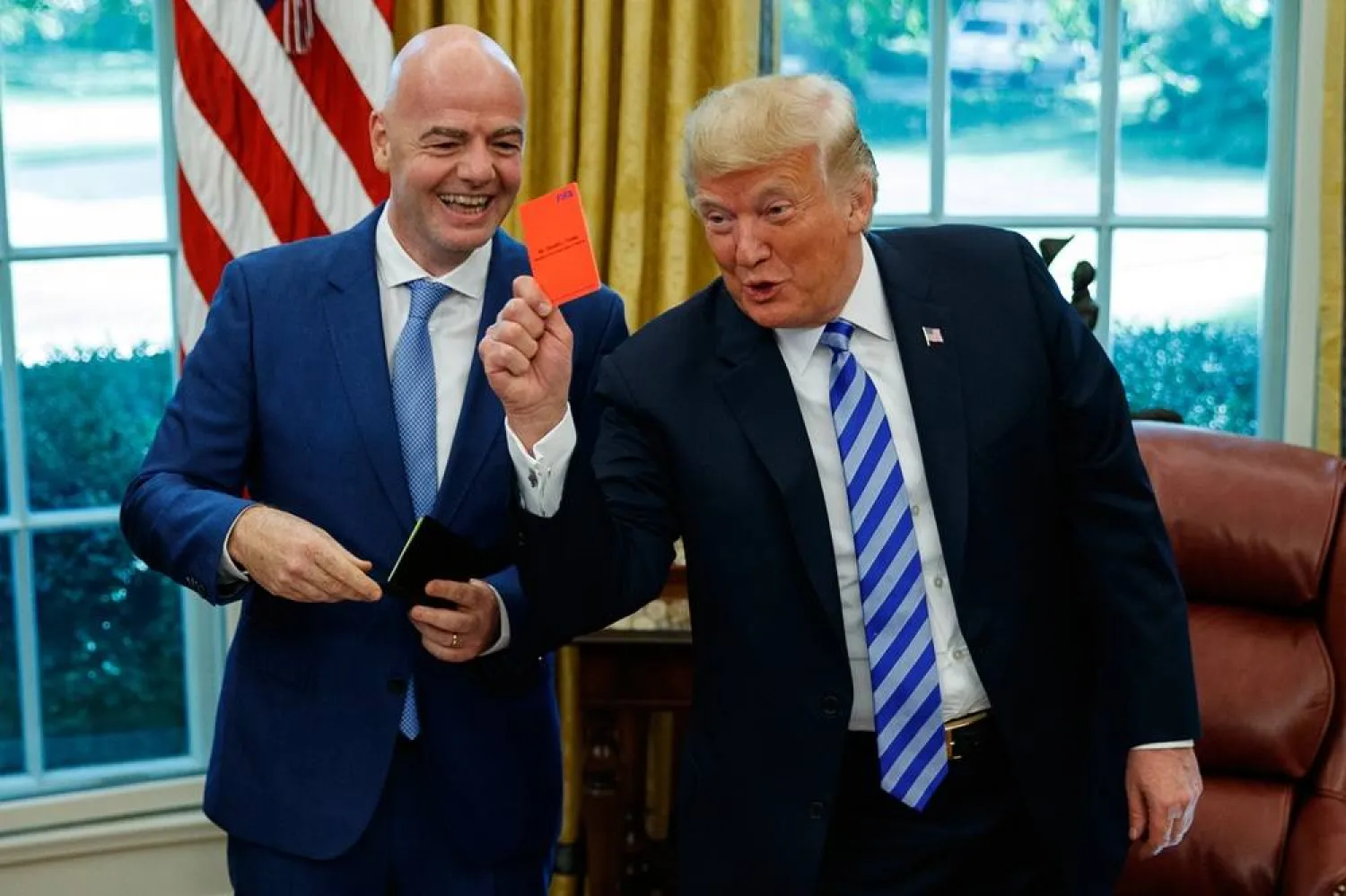

Trump Says He Asked FIFA Chief to Review Red Card Foul

President Donald Trump holds up a red card during a meeting with FIFA president Gianni Infantino in the Oval Office of the White House, Tuesday, Aug. 28, 2018, in Washington. (AP)
TT

Trump Says He Asked FIFA Chief to Review Red Card Foul

President Donald Trump holds up a red card during a meeting with FIFA president Gianni Infantino in the Oval Office of the White House, Tuesday, Aug. 28, 2018, in Washington. (AP)

President Donald Trump said on Monday he asked FIFA chief Gianni Infantino to review a red-card foul against USA striker Folarin Balogun and that he did not think the foul called by the "horrible" referee was fair.

"All I did, I asked for ‌a review, ‌because I didn't think it ‌was ⁠a foul," Trump ⁠told reporters in the Oval Office.

The unprecedented move has thrust FIFA's disciplinary process into the global spotlight and prompted an angry response from Belgium, who play the US on Monday for a place ⁠in the quarter-finals.

Trump said the incident ‌that got Balogun ‌the red card was simply a case ‌of two athletes colliding and he raised ‌questions about the fairness of the referee who called the foul.

"I saw the play," Trump said. "That wasn't a foul. That wasn't even ‌an infraction. That was two guys running full speed that happened ⁠to ⁠crash into each other."

He said FIFA made a "really brilliant decision" to suspend the red card. "I think the referee's call was horrible," he said.

Trump said all he did was ask for a review. "I didn't tell them what to do. I can't tell them what to do," he said.

He said it was important for team USA to have its best players on the field.


England’s Adaptability Shines in Mexico, Now Haaland Threat Looms

 (From L) England's forward #18 Anthony Gordon, midfielder #08 Elliot Anderson, defender #24 Reece James, midfielder #10 Jude Bellingham and forward #09 Harry Kane celebrate after winning the 2026 World Cup round of 16 football match between Mexico and England at the Mexico City Stadium in Mexico City on July 5, 2026. (AFP)
(From L) England's forward #18 Anthony Gordon, midfielder #08 Elliot Anderson, defender #24 Reece James, midfielder #10 Jude Bellingham and forward #09 Harry Kane celebrate after winning the 2026 World Cup round of 16 football match between Mexico and England at the Mexico City Stadium in Mexico City on July 5, 2026. (AFP)
TT

England’s Adaptability Shines in Mexico, Now Haaland Threat Looms

 (From L) England's forward #18 Anthony Gordon, midfielder #08 Elliot Anderson, defender #24 Reece James, midfielder #10 Jude Bellingham and forward #09 Harry Kane celebrate after winning the 2026 World Cup round of 16 football match between Mexico and England at the Mexico City Stadium in Mexico City on July 5, 2026. (AFP)
(From L) England's forward #18 Anthony Gordon, midfielder #08 Elliot Anderson, defender #24 Reece James, midfielder #10 Jude Bellingham and forward #09 Harry Kane celebrate after winning the 2026 World Cup round of 16 football match between Mexico and England at the Mexico City Stadium in Mexico City on July 5, 2026. (AFP)

England left the Estadio Azteca with aching legs, frayed nerves and a place in the World Cup quarter-finals.

They also left with something potentially more valuable: proof they can survive when matches stop following the script.

For all the talk before the tournament of talent, depth and Thomas Tuchel's tactical nous, England had not faced a truly defining moment. Mexico provided that on Sunday night.

In one of football's most intimidating arenas, at altitude and against co-hosts roared on by around 80,000 supporters, England were forced to play more than half an hour with 10 men after Jarell Quansah's red card. Yet they emerged with a 3-2 victory built on Jude Bellingham's brilliance, Harry Kane's leadership and a collective refusal to yield.

England's performance was not flawless. Mexico dominated for spells, twice cut the deficit to a single goal and bombarded the penalty area during a frantic finish. Goalkeeper Jordan Pickford had a standout game, and every England player spent the closing stages throwing themselves at crosses and ‌shots.

But World Cups ‌are rarely won through perfection. More often they are won by teams capable of surviving difficult ‌nights.

What ⁠should encourage Tuchel ⁠most is that the result was built on adaptability rather than dominance.

Recognizing the challenges posed by the conditions in Mexico City, England dialed back their usual aggressive pressing game and adopted a more measured approach.

"We are fully committed to our press. But it's not economical. We need to be smart and pick the right moments," Tuchel said.

For long periods they defended in a compact mid-block, content to protect space and conserve energy rather than chase the ball relentlessly. That tactical adjustment reflected a willingness to sacrifice style for substance.

The breakthrough came through the type of transition football that Tuchel had planned for. Declan Rice drove forward from midfield before finding Bukayo Saka, whose cross was met by the arriving Bellingham.

Barely 100 ⁠seconds later, Elliot Anderson won possession from the restart and England struck again.

Those moments illustrated England ‌at their most dangerous: compact without the ball, then direct and ruthless once possession ‌was recovered.

Bellingham once again underlined why he is emerging as one of the players of the tournament. His quickfire double transformed the atmosphere inside the ‌stadium and shifted the momentum decisively towards England.

Kane extended his scoring streak, while Anthony Gordon's pace and energy provided a crucial ‌outlet whenever Mexico threatened to overwhelm them. Yet if the victory answered questions about England's mentality, it also exposed issues Norway will have noted carefully.

Hit by injuries at the back, England have looked vulnerable throughout the tournament, and Mexico repeatedly found opportunities in the spaces around the full-backs.

Quansah red-card tackle came after England had been caught out with players committed forward

Norway possess different qualities to Mexico but potentially greater firepower. Having stunned Brazil to reach the ‌quarter-finals, the Scandinavians arrive in Miami for Saturday's quarter-final full of confidence and carrying perhaps the tournament's most dangerous striker.

Any defensive frailties England displayed against Mexico could be ruthlessly exposed by ⁠Erling Haaland, while Martin Odegaard's passing ⁠range gives Norway the creativity to find him.

At the same time, England may take confidence from the way they adapted after Quansah's dismissal.

Rather than retreat entirely, they continued to look for opportunities on the counterattack. Gordon stretched Mexico repeatedly and won the penalty that allowed Kane to restore England's two-goal cushion.

Later, Tuchel altered the shape again, introducing 6-foot-7 (1.98-meter) defender Dan Burn and switching to a back five as England repelled Mexico's aerial assault.

That tactical flexibility may prove one of England's greatest strengths as the tournament enters its decisive stage.

The challenge now is ensuring Sunday's victory does not come at too high a cost. Bellingham dropped to his knees at the final whistle, lungs heaving after battling the altitude, the conditions and relentless Mexican pressure.

Kane had lost his voice by the time the interviews began. The celebrations reflected the scale of the achievement, but veteran midfielder Jordan Henderson paid a price. He was taken to hospital with a wrist injury after falling over advertising boarding, and the injury may rule the 36-year-old out for the tournament, even if his influence has been more on the sidelines as one of the squad's senior voices.

The victory over Mexico will nevertheless rank among England's most memorable World Cup knockout performances of the modern era — the sort of result that can transform belief inside a squad.

Now England must show it was more than one extraordinary night. Mexico tested their resilience. Norway will test their ambitions.


Belgian Federation to Challenge FIFA Decision to Let Balogun Play in World Cup Match

Football - FIFA World Cup 2026 - Round of 32 - United States v Bosnia and Herzegovina - San Francisco Bay Area Stadium, Santa Clara, California, US - July 1, 2026 Folarin Balogun of the US is shown a red card by referee Raphael Claus. (Reuters)
TT

Belgian Federation to Challenge FIFA Decision to Let Balogun Play in World Cup Match

Football - FIFA World Cup 2026 - Round of 32 - United States v Bosnia and Herzegovina - San Francisco Bay Area Stadium, Santa Clara, California, US - July 1, 2026 Folarin Balogun of the US is shown a red card by referee Raphael Claus. (Reuters)

The Belgian soccer federation wants an explanation from FIFA about a decision to let US forward Folarin Balogun play at the World Cup despite getting a red card in his previous game.

Belgium takes on the United States later Monday for a spot in the quarterfinals.

The Belgian federation (RBFA) said it has still not received either “FIFA’s decision or any explanation regarding this matter. In these circumstances, it has no choice but to challenge the player’s eligibility for the upcoming match.”

It did not specify where it intends to appeal FIFA’s decision.

US President Donald Trump intervened on behalf of Balogun, whose red-card suspension was lifted in a decision that allowed him to play against Belgium.

The Belgian federation said it learned through media reports about the FIFA's move and sent a letter to the governing body requesting a copy of the decision as well as an explanation of the process.

“As its only response, FIFA sent a letter to the RBFA stating that it considered this correspondence to constitute an appeal, that a judge had been appointed, and that the RBFA had only a few hours to complete that appeal,” it said. “No information whatsoever was provided by FIFA.

The RBFA insisted that FIFA’s regulations state that the reasoned decision must first have been communicated to the appellant.

“While the RBFA was merely seeking legitimate explanations, FIFA itself created an appeal and immediately ensured that it would be declared inadmissible,” it said. “All of this occurred while FIFA simultaneously refused to respond to the RBFA’s legitimate requests.”

Balogun, the star forward for the US with three goals in the tournament, received a red card for stepping awkwardly on the right ankle of Tarik Muharemović of Bosnia-Herzegovina in a 2-0 round of 32 win on Wednesday, triggering an automatic one-game suspension.

FIFA announced Sunday that the suspension had been lifted for the round of 16 match, an extraordinary move that triggered praise from Trump and outrage from Belgium’s team. It appeared to be the first time since 1962 that a red card during a World Cup didn’t result in a suspension.

“Regardless of the sporting outcome of this match, the RBFA is deeply concerned by the course of events and will continue to fight in the coming hours, days and months in defense of the fundamental principles of ethics, fair competition, and the interests of football as a whole,” the Belgian federation added.

The FIFA decision drew criticism from the European Commission, the powerful executive arm of the European Union, which is based in Brussels.

Glenn Micallef, the European Union’s commissioner for sport, said that decisions “on sporting rules and sporting matters belong to sporting bodies, not politicians.”

“Influencing sporting decisions would undermine the autonomy of sport,” he wrote in a message on X. “Our focus should instead be on the real governance challenges facing sport, including the weaponization of sport for political purposes.”


EU Says Sport Decisions 'Belong to Sporting Bodies, Not Politicians' after Balogun Red-card U-turn

Balogun during a recent US training session (AFP)
TT

EU Says Sport Decisions 'Belong to Sporting Bodies, Not Politicians' after Balogun Red-card U-turn

Balogun during a recent US training session (AFP)

Decisions on sport "belong to sporting bodies, not politicians", EU sports chief Glenn Micallef said on Monday after FIFA overturned US striker Folarin Balogun's suspension following a reported intervention by President Donald Trump.

"Influencing sporting decisions would undermine the autonomy of sport. Our focus should instead be on the real governance challenges facing sport, including the weaponization of sport for political purposes," Micallef said.
