Apple Aims to Tell an AI Story Without AI Bills

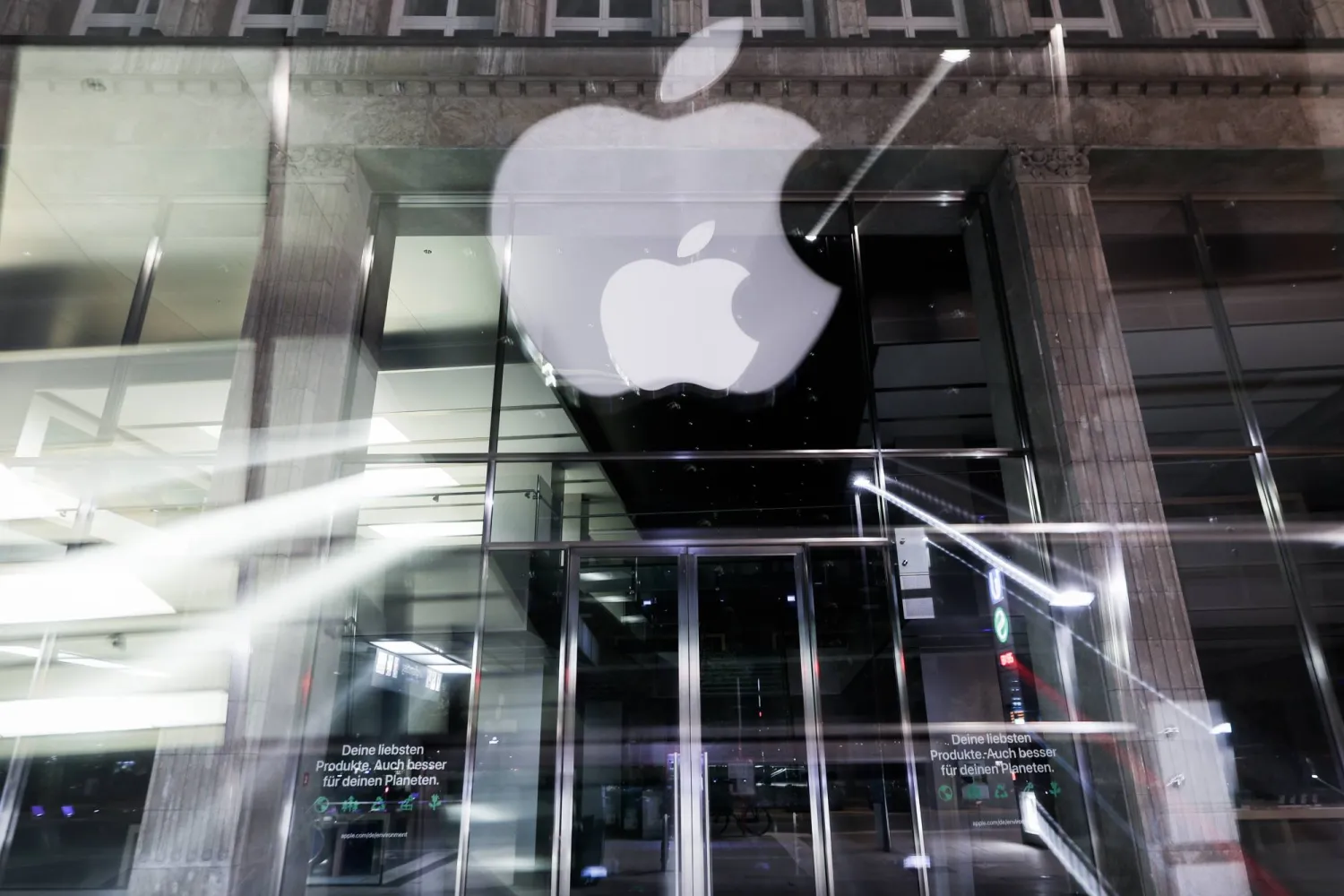
FILED - 01 May 2023, Hamburg: The logo of the US technology company Apple can be seen at night at the Apple Store Jungfernstieg in the city center. Photo: Christian Charisius/dpa
TT

Apple Aims to Tell an AI Story Without AI Bills

FILED - 01 May 2023, Hamburg: The logo of the US technology company Apple can be seen at night at the Apple Store Jungfernstieg in the city center. Photo: Christian Charisius/dpa

For most of the past year and a half, Apple Chief Executive Tim Cook has fielded questions from Wall Street analysts about his plans for artificial intelligence amid grumbling that the iPhone maker has no AI story to tell.
After the company reported quarterly earnings on Thursday, Cook insisted that Apple will have concrete details about its plans for AI to talk about very soon.
"We continue to feel very bullish about our opportunity in generative AI and we're making significant investments," Cook told Reuters in an interview, noting the company has spent $100 billion over the past five years on research and development.
Apple's Big Tech rivals have spent comparable or even greater amounts on R&D over the same period, but they have also been spending heavily to build data centers to host AI services.
Microsoft shelled out $14 billion in the most recent quarter on capex, with Alphabet's Google not far behind, at $12 billion. Meta Platforms told investors last week to expect as much as $40 billion in capital expenditures this year.
Apple thinks different. Its capital expenditure for all of 2023 was just over $10 billion.
Apple, which makes most of its money selling consumer devices, has paid a price for that stance most of this year, with its shares falling 10% as investors worried the company was falling behind in the AI race. Shares of Meta, Google and Microsoft -- all of which make money selling software or advertising services -- have all soared to record highs as the companies grapple to dominate the emerging AI landscape, though investors have also flinched at skyrocketing price tags for data centers and specialized processors required to train AI models.
Apple hinted Thursday it won't take the same tack. While Apple is expected to unveil new AI features at its annual software conference next month and overhaul its product lines with AI-ready chips, Chief Financial Officer Luca Maestri said Apple investors should not expect a huge change in how the company handles capital expenditures.
Responding to an analyst's question, Maestri noted the company's longstanding practice of splitting the cost of manufacturing tools with its suppliers, which has kept Apple's costs down and its cash generation up for more than a decade.
"We do something similar on the data center side," Maestri said. "We have our own data center capacity, and then we use capacity from third parties. It's a model that has worked well for us historically, and we plan to continue along the same lines going forward."
That could be just as well for Apple, because it remains unclear whether AI features such as chatbots that run directly on a device will spur users to buy new phones, tablets or laptops, which remain Apple's biggest source of revenue and profits.
Ben Bajarin of Creative Strategies said that while better processors could serve as a "line in the sand" for some users who need AI tools for professional use, those features may not ignite a sales boom.
"It'll be something that helps lift sales, but I don't expect it to be super cycle," Bajarin said. "You have to be careful to temper expectations."


Samsung Electronics Downplays Concerns About Neocloud Firms and AI Bubble

 A Samsung Electronics logo and a computer motherboard appear in this illustration taken August 25, 2025. (Reuters)
A Samsung Electronics logo and a computer motherboard appear in this illustration taken August 25, 2025. (Reuters)
TT

Samsung Electronics Downplays Concerns About Neocloud Firms and AI Bubble

 A Samsung Electronics logo and a computer motherboard appear in this illustration taken August 25, 2025. (Reuters)
A Samsung Electronics logo and a computer motherboard appear in this illustration taken August 25, 2025. (Reuters)

Samsung Electronics , the world's top maker of memory chips, on Wednesday downplayed concerns that highly leveraged neocloud providers could fuel a broader AI bubble, saying they account for only a small share of the overall market.

"Neoclouds represent a relatively smaller and limited portion of the overall market, approximately 8%," said Kim Yong-kwan, president and head of corporate management, strategy and operation at Samsung's component business ‌division, at ‌a Morgan Stanley conference in Singapore.

"We ‌do ⁠not expect these ⁠concerns to pose a significant threat to the broader AI growth trajectory."

Shares of neocloud firms including CoreWeave, which rents out computing capacity to tech firms, have been hit by concerns that their debt-fueled data center expansions could backfire if AI demand ⁠slows.

The departure of Jensen Huang as ‌CEO of Nvidia this month ‌could also tighten funding for smaller, highly leveraged neocloud ‌companies that have helped fuel the industry's ‌rapid expansion, analysts and investors have said.

Kim said the current AI investment boom was structural rather than cyclical, with long-term contracts between chipmakers and customers providing greater visibility ‌over demand and supply.

He said the current boom differed from previous cycles in which ⁠speculative investment ⁠ultimately led to overcapacity.

"In short, today's investment is not a result of speculation, but actual tangible demand," he said.

Kim also reiterated Samsung's previous statement that it would carry out its remaining shareholder returns through a mix of cash dividends and a "substantial" share repurchase and cancellation program.

He said the company had a number of factors to consider, including capital expenditures, before announcing details on its shareholder return package in January.


Chinese Robots Learn from Humans in Tech Hub Shenzhen

This picture taken on November 10, 2026 shows people watching a robot (back) making coffee and serving ice-cream in a booth at a park in Shenzhen, China's Guangdong province. (AFP)
TT

Chinese Robots Learn from Humans in Tech Hub Shenzhen

This picture taken on November 10, 2026 shows people watching a robot (back) making coffee and serving ice-cream in a booth at a park in Shenzhen, China's Guangdong province. (AFP)

At a park refreshment stand in China's tech capital Shenzhen, a humanoid robot grabs a cup and pulls a lever to form an ice-cream spiral, then hands the customer their order.

It's the kind of futuristic scene the country is keen to showcase as world leaders including Donald Trump and Vladimir Putin head to Shenzhen, a manufacturing hub north of Hong Kong, for this week's Asia-Pacific Economic Cooperation (APEC) summit.

Chinese robots are famous for their slick dance moves, but artificial intelligence engineers are trying to train them up to join the workforce, using reams of data captured by humans in headcams to help hone the machines' skills.

Although they still struggle with complex tasks like cleaning or ironing on their own, robots are already taking on more simple roles across the country.

"Mum, look!" a girl exclaimed when she spotted the ice-cream humanoid and its colleague that makes coffee -- treats on sale for around $4 each -- as passersby film the spectacle on their phones.

A human must regularly refill beans and empty coffee grounds for the robo-barista, but the pair's movements are driven by an AI model, according to maker AI² Robotics.

The startup said 200 of its humanoid servers are deployed in China, and up to 300 coffees are sold each day in the Shenzhen park.

"We're getting data feedback from many real scenarios," said CEO Guo Yandong, such as different light conditions that could help robots adapt to unpredictable environments.

- 'Workshop of the world' -

In China, 83 percent of people surveyed by Ipsos this year said they were excited by products and services that use AI, the highest of 32 countries including the United States, where just a third of people agreed with the statement.

Industrial spending in China on robots using so-called "embodied AI", which allows them to perceive their surroundings and act accordingly, leaped 230 percent year-on-year in January-May 2026, tax authorities said.

China is "the workshop of the world", said Dermot McGrath of strategy and innovation advisory firm ZenGen Labs.

So robot makers "can draw on decades of manufacturing experience" in the world's second-largest economy, which has many skilled workers and supply chains for everything from motors and sensors to batteries.

Suppliers are often grouped in industrial hubs like Shenzhen, home to 18 million people -- meaning developers can produce and test a part, then put it into action "faster than almost anywhere", McGrath told AFP.

In a Shenzhen logistics center, two robotic arms made by X Square Robot, another of the city's AI startups, handle parcels of different shapes on a moving belt, flipping them over if needed so the label faces up.

"If it's a soft bag, the robot grabs it with its grippers. If it's a cardboard box, it coordinates its two arms to move it," Arnold Pei, vice-president of X Square, explained.

An AI robot can ideally "decide by itself what it needs to do", Pei said, although it's more challenging for them to operate in a less controlled settings like different homes, where lighting, floors and objects vary.

- 'Like babies' -

In a supermarket in Dongguan, near Shenzhen, 23-year-old Wang Lin stocked shelves wearing sensor gloves and a helmet fitted with a camera.

Her movements were recorded and processed by Strange Attractor, one of many Chinese startups that resell the data to companies developing AI models that act as a robot's brain.

"Robots can replace humans in doing relatively dangerous and repetitive work, for example in factories or at heights," with human workers free to pursue "more creative work," she told AFP.

Elsewhere in China, cobblers, hairdressers, florists, factory workers, and cleaners are recording their skills using similar equipment, in exchange for payment.

Strange Attractor said it collects data in around 1,600 places in China and 1,000 abroad.

For company founder Kang Yu, today's robots are "like babies" at an early stage of development.

China's AI robots are so far mostly "confined to well-defined and repetitive" tasks, noted Pavlo Zvenyhorodskyi, a Chinese AI specialist at the Carnegie Endowment for International Peace.

Once their technical abilities improve, "we will likely see wide deployment of AI-powered robots across the Chinese economy", he said.

Robotics and other tech ventures benefit from government support in China, and examples of planned uses range from meal-delivery droids to others that tidy away airport luggage carts.

At battery giant CATL, humanoids made by China's Spirit AI already take the dangerous job of plugging in high-voltage connectors.

Strange Attractor's Kang foresees a "massive deployment" of AI-powered robots in China next year.

Some could pick strawberries, or help with housework -- "but for sure, it's not going be that intelligent, it's just the start."


‘Business as Usual’: Nvidia’s Kress Passes First Test as Board Slams Door on Huang

The Nvidia logo is seen in this illustration taken on January 27, 2025. (Reuters)
TT

‘Business as Usual’: Nvidia’s Kress Passes First Test as Board Slams Door on Huang

The Nvidia logo is seen in this illustration taken on January 27, 2025. (Reuters)

Nvidia's interim CEO Colette Kress expressed confidence in the chipmaker's business, leadership and staff and pledged to be "disciplined in how we commit capital," seeking to reassure investors on the first earnings call since its co-founder Jensen Huang quit.

She took the helm last week following news that Huang had an affair with a Chinese businesswoman whom US intelligence agencies are investigating over her ties to the Chinese government, revelations that have knocked more than $700 billion off Nvidia's market value.

Kress initially stumbled as she read out prepared remarks but gained resolve as the call progressed on Tuesday.

"Our leadership has stood up so strongly over the last week," she said, responding to an analyst's question about what could change during the leadership transition. "From a business perspective, it's business as usual."

Management had engaged with Nvidia's suppliers and partners, who were backing the company to the hilt, she said, with key contractor TSMC visiting ‌Nvidia's offices this ‌week.

Nvidia shares rose more than 4% in extended trading, after it forecast fourth-quarter revenue ‌above ⁠Wall Street estimates and ⁠fiscal 2028 sales to grow about 75% year over year.

"Nvidia showed the AI story can be bigger than Jensen Huang," said Jake Behan, head of capital markets at Direxion, New York. "The strength of the business and underlying demand gave traders reason to believe the story can keep moving forward without him at the helm."

Loyal employees and big tech allies, including Elon Musk, have called for Huang's reinstatement. US President Donald Trump has also backed him.

Huang, who was the face of the company that has underpinned the AI boom with its cutting-edge chips, said on Tuesday he would be "honored" to be Nvidia's CEO again.

But new board Chairman Harvey Jones rejected the ⁠idea, saying on the post-earnings call: "The Nvidia board unanimously accepted (Huang's) resignation and does not intend ‌to reinstate Jensen as CEO."

SUCCESSION IN FOCUS

Nvidia kept the post-earnings call shorter than ‌usual — around 50 minutes, versus roughly an hour in the past two quarters, when Huang led the call and answered questions more expansively.

"Kress faced ‌an unusually unforgiving debut, with every pause and phrase being scrutinized. It should not define her ability to lead," said ‌PP Foresight analyst Paolo Pescatore.

"The more meaningful test is her command of the business, how she handles difficult questions and the confidence she builds around the decisions ahead."

Kress is known to have stood up to Huang's risky, multibillion-dollar financing deals that have fueled concerns of a circular AI economy.

She was joined on the call by Ian Buck, the vice president of hyperscale and high-performance computing, whom some analysts view as ‌a top CEO candidate. However, he did not speak on the call.

“Buck’s appearance will inevitably be viewed as an informal audition ... but his participation alone should not be read ⁠as a signal that the board ⁠has chosen its next CEO," Pescatore said.

NEOCLOUD POLICY SPELLED OUT

Investors have been concerned that without Huang, Nvidia could pull back investments in debt-laden neoclouds, which rely partly on Nvidia's backing to fund their data center buildouts, an issue the company sought to address in its CFO commentary on its website.

Neocloud investments as of the end of the third quarter fell to $32 billion from $36 billion in the prior quarter.

The company said its neocloud commitments would kick in only once partners secured financing and their capacity was operational, and could be cut or scrapped if that did not happen in time.

Asked on the call whether the disclosure language on neocloud investments reflected a change in how Nvidia deals with them, Kress said: "Is it new? No. Did we change anything? No.

"What this is only saying is that we wanted to make sure ... it was very clear as we had been receiving some questions on how that exactly worked."

This week was "a referendum on AI," Direxion's Behan said, with Nvidia's results testing spending on AI infrastructure and Anthropic's upcoming market debut testing how much investors are willing to pay for companies trying to profit from it.

"We've got this," Kress said, as she ended the call.