


Apple Sidelines AI News Summaries Due to Errors

New Apple iPhone 16 models released late in 2024 boast generative artificial intelligence features. Frederic J. BROWN / AFP
TT

Apple Sidelines AI News Summaries Due to Errors

New Apple iPhone 16 models released late in 2024 boast generative artificial intelligence features. Frederic J. BROWN / AFP

Apple pushed out a software update on Thursday which disabled news headlines and summaries generated using artificial intelligence that were lambasted for getting facts wrong.
The move by the tech titan comes as it enhances its latest lineup of devices with "Apple Intelligence" in a market keen for assurance that the iPhone maker is a contender in the AI race, AFP said.
Apple's decision to temporarily disable the recently launched AI feature comes after the BBC and other news organizations complained that users were getting mistake-riddled or outright wrong headlines or news summary alerts.
Apple deployed the update to developers working with a beta version of its software, sidelining the AI feature for news headlines.
The tech giant plans to restore the feature when it is working properly and eventually roll it out to all users.
Apple in June of last year unveiled new iPhones built with generative AI as it seeks to boost sales and show it is keeping up in the technological arms race.
The company has a lot riding on the new iPhone 16 and hopes that customers are attracted to buy the latest models by its new AI powers.
"We are thrilled to introduce the first iPhones designed from the ground up for Apple Intelligence and its breakthrough capabilities," Apple chief executive Tim Cook said at an event at the iPhone-maker's Silicon Valley headquarters.
"Apple Intelligence" is a new suite of software features for all devices that was announced at the company's annual developers conference, where it also announced a partnership with ChatGPT-maker OpenAI.
In the short-term, the new powers include AI-infused image editing, translation, and small, creative touches in messaging, but not more ambitious breakthroughs promised by other AI players, such as OpenAI or Google.
The features are similar to tools recently released by Meta, Microsoft and Google, which can produce well-crafted content simply by querying in everyday language.
Google last year released AI-infused Pixel 9 smartphones, its challenge to the iPhone.

Pixel phomes account for a tiny sliver of the global smartphone market dominated by Samsung and Apple, but Google argued its new line is a chance to answer what -- after all the hype -- AI can actually do for customers.
Samsung has also showcased AI across its line, and is expected to unveil a new flagship Galaxy smartphone at an event next week in Silicon Valley.



South Korea to Invest $166 Million in AI Chip Startup Rebellions

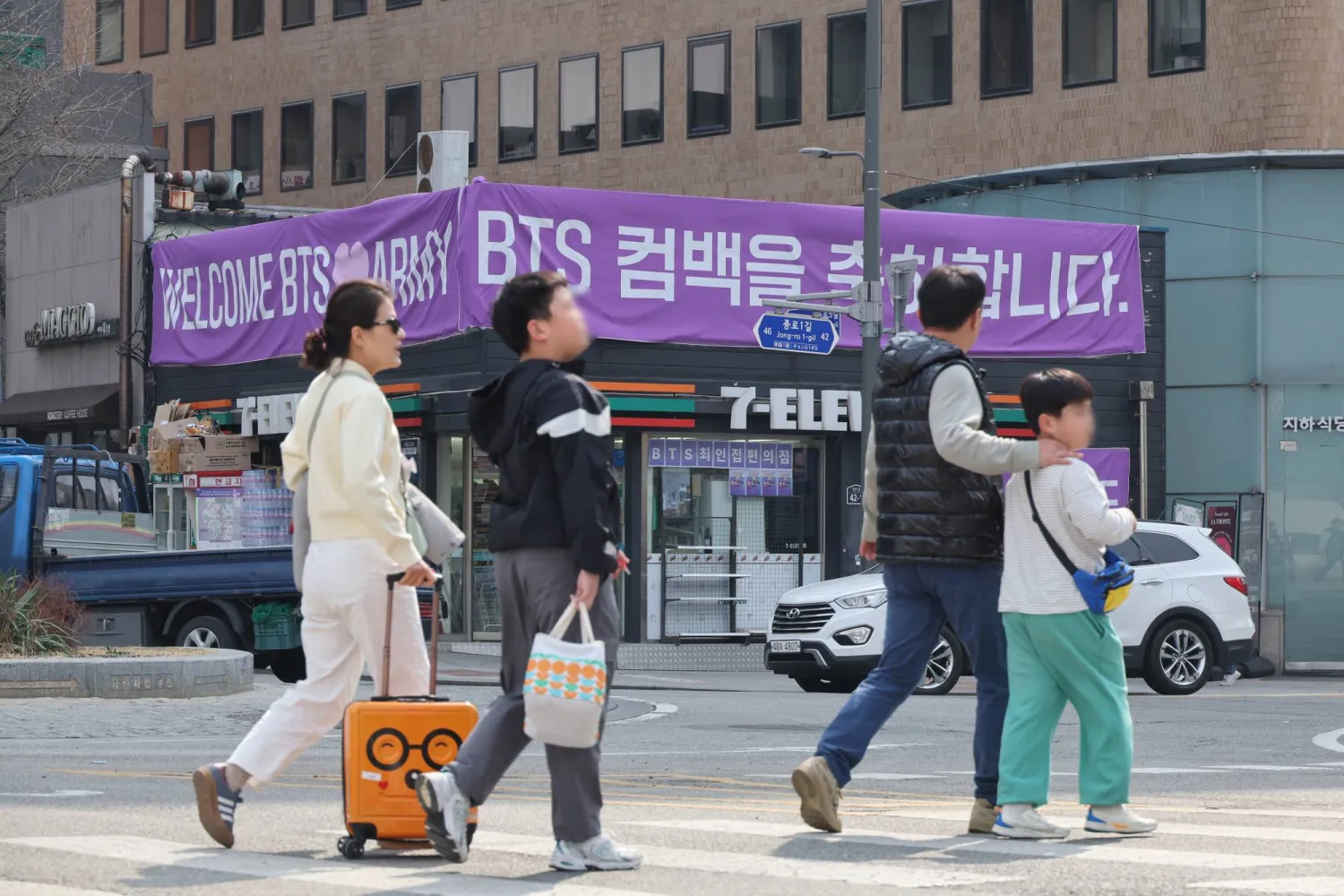
People walk near Gwanghwamun Square in Seoul, South Korea, 22 March 2026. The band performed their comeback concert on 21 March.  EPA/YONHAP
People walk near Gwanghwamun Square in Seoul, South Korea, 22 March 2026. The band performed their comeback concert on 21 March. EPA/YONHAP
TT

South Korea to Invest $166 Million in AI Chip Startup Rebellions

People walk near Gwanghwamun Square in Seoul, South Korea, 22 March 2026. The band performed their comeback concert on 21 March.  EPA/YONHAP
People walk near Gwanghwamun Square in Seoul, South Korea, 22 March 2026. The band performed their comeback concert on 21 March. EPA/YONHAP

South Korea's industry ministry on Tuesday said the Financial Services Commission's advisory board approved a 250 billion won ($166 million) investment in a local artificial intelligence chip startup called Rebellions, part of a government-backed push to nurture a homegrown advanced semiconductor firm.

Here are some details:

South Korea's Financial Services Commission advisory board, which evaluates investments in advanced strategic industries, ⁠approved a 250 ⁠billion won direct investment into Rebellions, an AI chip startup.

Rebellions, founded in 2020, designs neural processing units (NPUs) that handle AI computations.

The decision was made at a ⁠fund management committee meeting for the state-led "National Growth Fund," marking the first direct investment under the country's "K-Nvidia" initiative.

The funding will support Rebellions' mass production of NPU chips and the development of next-generation AI semiconductors, the industry ministry said in a statement.

The "K-Nvidia" project, jointly led by the Financial Services Commission and the ⁠Ministry ⁠of Science and ICT, seeks to nurture a globally competitive AI chip company amid intensifying competition in the sector, which is dominated by US firms like Nvidia.

The move underscores Seoul's efforts to strengthen its position in the AI supply chain and reduce reliance on foreign technology, as demand for high-performance computing chips surges.


Uber, Autonomous Mobility Firms to Launch Europe's 1st Commercial Robotaxis

Aerial photo shows light installation during the Festival of Lights in Zagreb, Croatia, March 18, 2026. REUTERS/Antonio Bronic
TT

Uber, Autonomous Mobility Firms to Launch Europe's 1st Commercial Robotaxis

Aerial photo shows light installation during the Festival of Lights in Zagreb, Croatia, March 18, 2026. REUTERS/Antonio Bronic

Uber Technologies and autonomous mobility companies Verne and Pony.ai have partnered up to launch Europe's first commercial robotaxi service in the Croatian capital Zagreb, with plans to expand to other cities, they said on Thursday.

Robotaxis are rapidly expanding into US cities as companies race to commercialize ⁠autonomous ride-hailing worldwide.

Alphabet's ⁠Waymo remains the early leader, while Tesla hopes its vast manufacturing scale and financial resources could reshape the competitive landscape.

The first ⁠commercial robotaxi service in Zagreb will be launched "soon,” the companies said.

Initial deployment work is underway, including public-road validation.

Pony.ai will provide autonomous driving solutions, while Verne will act as the fleet owner and service operator.

The three companies plan ⁠to ⁠expand the fleet to thousands of robotaxis in European cities over the next few years.

Uber and Nvidia said earlier this month they planned to expand their robotaxi service in 28 cities across North America, Europe, Australia and Asia.


Samsung, SK Urge Employees to Cut Car Use Amid Rising Energy Risks

FILE - The logo of the Samsung is seen at the Samsung Electronics' Seocho building in Seoul, South Korea, Friday, July 5, 2024.  (AP Photo/Lee Jin-man, File)
FILE - The logo of the Samsung is seen at the Samsung Electronics' Seocho building in Seoul, South Korea, Friday, July 5, 2024. (AP Photo/Lee Jin-man, File)
TT

Samsung, SK Urge Employees to Cut Car Use Amid Rising Energy Risks

FILE - The logo of the Samsung is seen at the Samsung Electronics' Seocho building in Seoul, South Korea, Friday, July 5, 2024.  (AP Photo/Lee Jin-man, File)
FILE - The logo of the Samsung is seen at the Samsung Electronics' Seocho building in Seoul, South Korea, Friday, July 5, 2024. (AP Photo/Lee Jin-man, File)

South Korean tech giants Samsung Electronics and SK Group said they were asking employees to curb private car use and follow fuel-saving measures after South Korea rolled ⁠out emergency energy-conservation steps ⁠amid instability in Middle Eastern energy supplies.

Internal notices showed the companies encouraging car-use restrictions ⁠such as a five and 10-day vehicle rotation system, reduced parking availability and other energy-saving practices at offices from Thursday for Samsung and from March 30 ⁠for ⁠SK.

The moves follow government guidance aimed at cutting fuel consumption as concerns grow over prolonged disruptions linked to the Iran-related energy crisis.