


Rich in Cash, Japan Automaker Toyota Builds a City to Test Futuristic Mobility

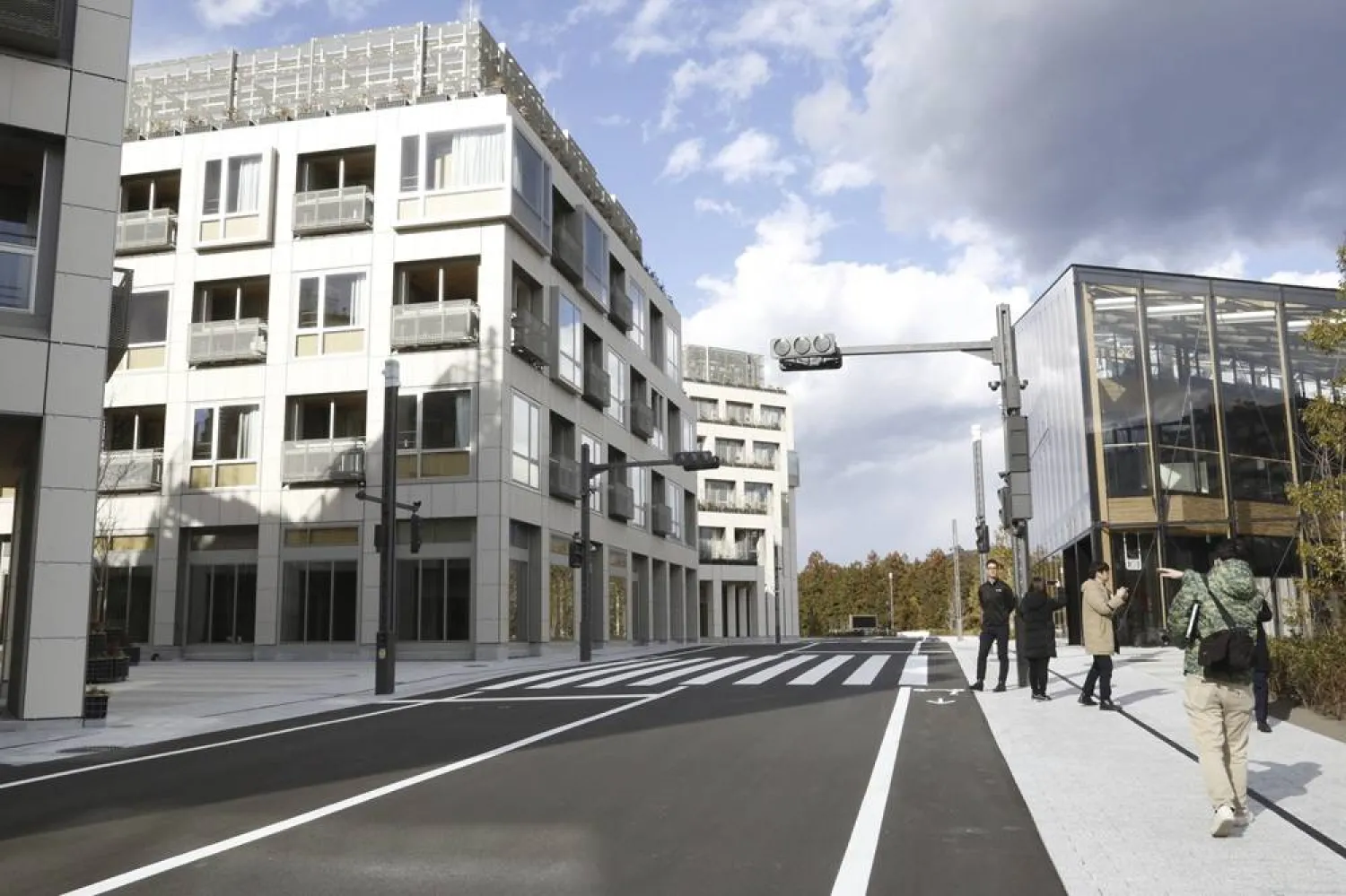
 Reporters look at the first phase of construction of Toyota’s Woven City in Susono, Shizuoka Prefecture, Saturday, Feb. 22, 2025. (AP)
Reporters look at the first phase of construction of Toyota’s Woven City in Susono, Shizuoka Prefecture, Saturday, Feb. 22, 2025. (AP)
TT

Rich in Cash, Japan Automaker Toyota Builds a City to Test Futuristic Mobility

 Reporters look at the first phase of construction of Toyota’s Woven City in Susono, Shizuoka Prefecture, Saturday, Feb. 22, 2025. (AP)
Reporters look at the first phase of construction of Toyota’s Woven City in Susono, Shizuoka Prefecture, Saturday, Feb. 22, 2025. (AP)

Woven City near Mount Fuji is where Japanese automaker Toyota plans to test everyday living with robotics, artificial intelligence and autonomous zero-emissions transportation.

Daisuke Toyoda, an executive in charge of the project from the automaker's founding family, stressed it’s not “a smart city.”

“We’re making a test course for mobility so that’s a little bit different. We’re not a real estate developer,” he said Saturday during a tour of the facility, where the first phase of construction was completed.

The Associated Press was the first foreign media to get a preview of the $10 billion Woven City.

The first phase spans 47,000 square meters (506,000 square feet), roughly the size of about five baseball fields. When completed, it will be 294,000 square meters (3.1 million square feet).

Built on the grounds of a shuttered Toyota Motor Corp. auto plant, it’s meant to be a place where researchers and startups come together to share ideas, according to Toyoda.

Woven City’s construction began in 2021. All the buildings are connected by underground passageways, where autonomous vehicles will scuttle around collecting garbage and making deliveries.

No one is living there yet. The first residents will total just 100 people.

Called “weavers,” they’re workers at Toyota and partner companies, including instant noodle maker Nissin and Daikin, which manufactures air-conditioners. Coffee maker UCC was serving hot drinks from an autonomous-drive bus, parked in a square surrounded by still-empty apartment complexes.

The city’s name honors Toyota’s beginnings as a maker of automatic textile looms. Sakichi Toyoda, Daisuke Toyoda’s great-great-grandfather, just wanted to make life easier for his mother, who toiled on a manual loom.

There was little talk of using electric vehicles, an area where Toyota has lagged. While Tesla and BYD emerged as big EV players, Toyota has been pushing hydrogen, the energy of choice in Woven City.

Toyota officials acknowledged it doesn’t expect to make money from Woven City, at least not for years.

Keisuke Konishi, auto analyst at Quick Corporate Valuation Research Center, believes Toyota wants to work on robotic rides to rival Google’s Waymo — even if it means building an entire complex.

“Toyota has the money to do all that,” he said.


Italy Watchdog Orders Meta to Halt WhatsApp Terms Barring Rival AI Chatbots

The logo of Meta is seen at Porte de Versailles exhibition center in Paris, France, June 11, 2025. (Reuters)
TT

Italy Watchdog Orders Meta to Halt WhatsApp Terms Barring Rival AI Chatbots

The logo of Meta is seen at Porte de Versailles exhibition center in Paris, France, June 11, 2025. (Reuters)

Italy's antitrust authority (AGCM) on Wednesday ordered Meta Platforms to suspend contractual terms ​that could shut rival AI chatbots out of WhatsApp, as it investigates the US tech group for suspected abuse of a dominant position.

A spokesperson for Meta called the decision "fundamentally flawed," and said the emergence of AI chatbots "put a strain on our systems that ‌they were ‌not designed to support".

"We ‌will ⁠appeal," ​the ‌spokesperson added.

The move is the latest in a string by European regulators against Big Tech firms, as the EU seeks to balance support for the sector with efforts to curb its expanding influence.

Meta's conduct appeared capable of restricting "output, market ⁠access or technical development in the AI chatbot services market", ‌potentially harming consumers, AGCM ‍said.

In July, the ‍Italian regulator opened the investigation into Meta over ‍the suspected abuse of a dominant position related to WhatsApp. It widened the probe in November to cover updated terms for the messaging app's business ​platform.

"These contractual conditions completely exclude Meta AI's competitors in the AI chatbot services ⁠market from the WhatsApp platform," the watchdog said.

EU antitrust regulators launched a parallel investigation into Meta last month over the same allegations.

Europe's tough stance - a marked contrast to more lenient US regulation - has sparked industry pushback, particularly by US tech titans, and led to criticism from the administration of US President Donald Trump.

The Italian watchdog said it was coordinating with the European ‌Commission to ensure Meta's conduct was addressed "in the most effective manner".


Amazon Says Blocked 1,800 North Koreans from Applying for Jobs

Amazon logo (Reuters)
TT

Amazon Says Blocked 1,800 North Koreans from Applying for Jobs

Amazon logo (Reuters)

US tech giant Amazon said it has blocked over 1,800 North Koreans from joining the company, as Pyongyang sends large numbers of IT workers overseas to earn and launder funds.

In a post on LinkedIn, Amazon's Chief Security Officer Stephen Schmidt said last week that North Korean workers had been "attempting to secure remote IT jobs with companies worldwide, particularly in the US".

He said the firm had seen nearly a one-third rise in applications by North Koreans in the past year, reported AFP.

The North Koreans typically use "laptop farms" -- a computer in the United States operated remotely from outside the country, he said.

He warned the problem wasn't specific to Amazon and "is likely happening at scale across the industry".

Tell-tale signs of North Korean workers, Schmidt said, included wrongly formatted phone numbers and dodgy academic credentials.

In July, a woman in Arizona was sentenced to more than eight years in prison for running a laptop farm helping North Korean IT workers secure remote jobs at more than 300 US companies.

The scheme generated more than $17 million in revenue for her and North Korea, officials said.

Last year, Seoul's intelligence agency warned that North Korean operatives had used LinkedIn to pose as recruiters and approach South Koreans working at defense firms to obtain information on their technologies.

"North Korea is actively training cyber personnel and infiltrating key locations worldwide," Hong Min, an analyst at the Korea Institute for National Unification, told AFP.

"Given Amazon's business nature, the motive seems largely economic, with a high likelihood that the operation was planned to steal financial assets," he added.

North Korea's cyber-warfare program dates back to at least the mid-1990s.

It has since grown into a 6,000-strong cyber unit known as Bureau 121, which operates from several countries, according to a 2020 US military report.

In November, Washington announced sanctions on eight individuals accused of being "state-sponsored hackers", whose illicit operations were conducted "to fund the regime's nuclear weapons program" by stealing and laundering money.

The US Department of the Treasury has accused North Korea-affiliated cybercriminals of stealing over $3 billion over the past three years, primarily in cryptocurrency.


KAUST Scientists Develop AI-Generated Data to Improve Environmental Disaster Tracking

King Abdullah University of Science and Technology (KAUST) logo
TT

KAUST Scientists Develop AI-Generated Data to Improve Environmental Disaster Tracking

King Abdullah University of Science and Technology (KAUST) logo

King Abdullah University of Science and Technology (KAUST) and SARsatX, a Saudi company specializing in Earth observation technologies, have developed computer-generated data to train deep learning models to predict oil spills.

According to KAUST, validating the use of synthetic data is crucial for monitoring environmental disasters, as early detection and rapid response can significantly reduce the risks of environmental damage.

Dean of the Biological and Environmental Science and Engineering Division at KAUST Dr. Matthew McCabe noted that one of the biggest challenges in environmental applications of artificial intelligence is the shortage of high-quality training data.

He explained that this challenge can be addressed by using deep learning to generate synthetic data from a very small sample of real data and then training predictive AI models on it.

This approach can significantly enhance efforts to protect the marine environment by enabling faster and more reliable monitoring of oil spills while reducing the logistical and environmental challenges associated with data collection.
