


China’s BYD Launches EV Charging System It Says Works Nearly as Fast as a Fill Up 

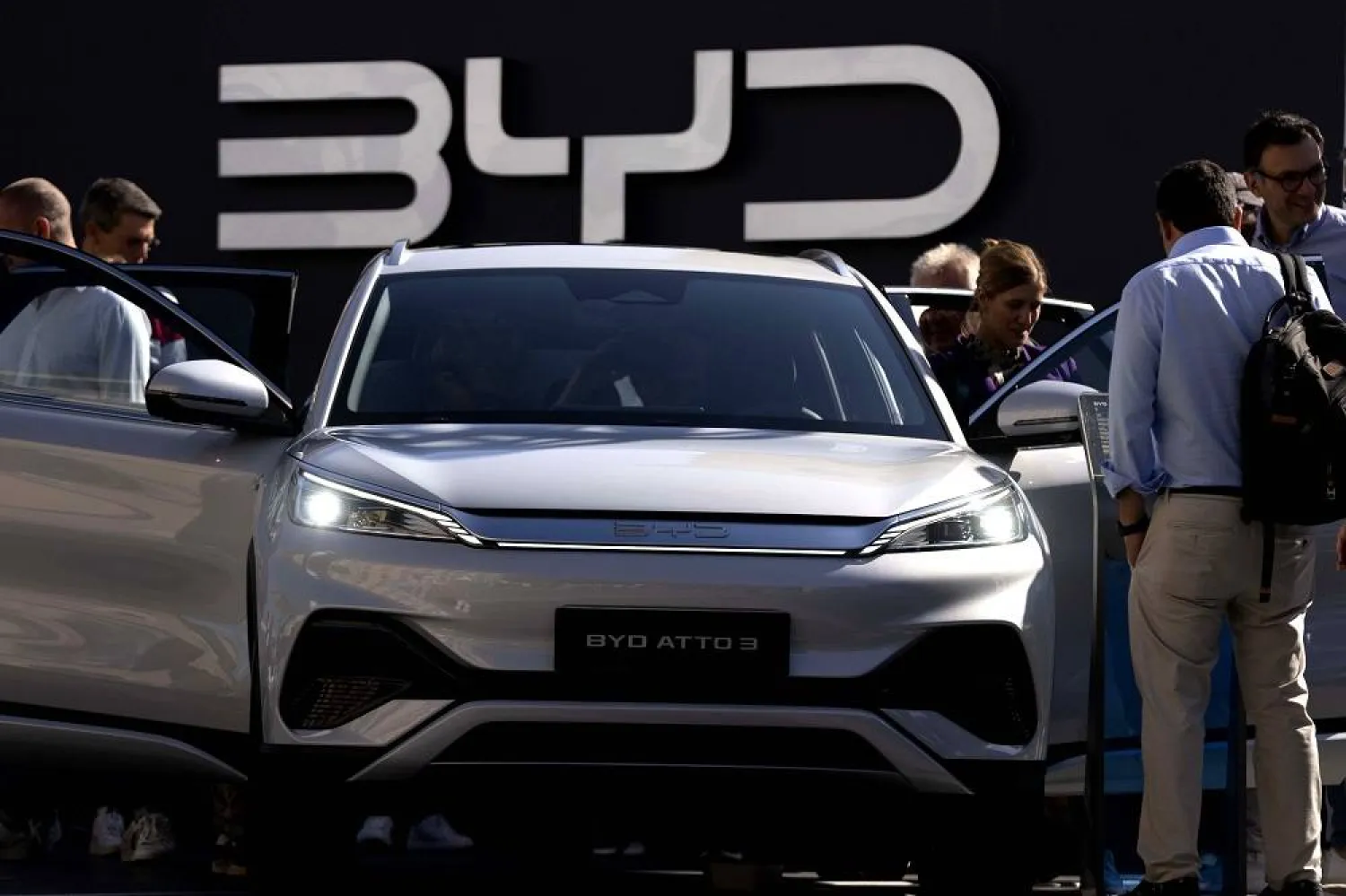
Visitors check the China made BYD ATTO 3 at the IAA motor show in Munich, Germany, on Sept. 8, 2023. (AP)
TT

China’s BYD Launches EV Charging System It Says Works Nearly as Fast as a Fill Up 

Visitors check the China made BYD ATTO 3 at the IAA motor show in Munich, Germany, on Sept. 8, 2023. (AP)

China’s energy and auto giant BYD has announced an ultra fast EV charging system that it says is nearly as quick as a fill up at the pumps.

BYD, China's largest EV maker, said Monday that its flash-chargers can provide a full charge for its latest EVs within five to eight minutes, similar to the amount of time needed to fill a fuel tank. It plans to build more than 4,000 of the new charging stations across China.

Charging times and limited ranges have been a major factor constraining the switch from gas and diesel vehicles to EVs, though Chinese drivers have embraced that change, with sales of battery powered and hybrid vehicles jumping 40% last year.

BYD's news appeared to give Tesla a jolt on Monday, as the US EV maker's share price sank 4.8%. BYD, which stands for build your dreams, began pre-sales of its Han L and Tang L models, which are upgraded versions of earlier models.

The Chinese company started out making batteries and has been refining its battery and energy storage technology while building an auto empire that is expanding outside China. It says its 1 megawatt flash chargers can provide power for 400 kilometers (nearly 250 miles) in five minutes.

Ultra-high voltage and a large current are required to maximize charging speeds, BYD's founder Wang Chuanfu said in a statement.

“To completely solve users' anxiety over charging, our pursuit is to make the charging time for EVs as short as the refueling time for fuel vehicles,” Wang said.

The company also said that its flash-charging system relies on silicon carbide power chips with voltage levels of up to 1,500V that it developed on its own. Its Blade lithium-ion phosphate battery is perhaps the world's safest and most efficient EV battery, with Tesla opting to use it in some of its EVs, industry analyst Michael Dunne said in a recent report.

BYD reported it made just over 4.3 million “new energy vehicles” last year, up 41% from a year earlier, including 1.8 million battery electric vehicles and 2.5 million plug in hybrids. The price of its shares traded on China's smaller market in Shenzhen has surged nearly 50% in the past six months.

While BYD's fanciest, latest premium models are expected to sell for up to about $40,000, it also makes much less expensive EVs including the Seagull, which sells for around $12,000 in China.

BYD barely nudged ahead of Tesla in production of battery-powered EVs in 2024, making 1,777,965 compared with Tesla's 1,773,443.

In early January, Tesla said its sales dropped in 2024, a first in more than a dozen years, as rivals such as BMW, Volkswagen and BYD gained market shares with competitive EVs.

But BYD has weaknesses as well, Dunne said, noting that JD Power's 2024 China New Energy Vehicle Initial Quality Study ranked the BYD Seal and BYD Song Plus battery electrics at the bottom of its rankings.



Google Says to Build New Subsea Cables from India in AI Push

A logo of Google is on display at Bharat Mandapam, one of the venues for AI Impact Summit, in New Delhi, India, February 17, 2026. REUTERS/Bhawika Chhabra
TT

Google Says to Build New Subsea Cables from India in AI Push

A logo of Google is on display at Bharat Mandapam, one of the venues for AI Impact Summit, in New Delhi, India, February 17, 2026. REUTERS/Bhawika Chhabra

Google announced Wednesday it would build new subsea cables from India and other locations as part of its existing $15 billion investment in the South Asian nation, which is hosting a major artificial intelligence summit this week.

The US tech giant said it would build "three subsea paths connecting India to Singapore, South Africa, and Australia; and four strategic fiber-optic routes that bolster network resilience and capacity between the United States, India, and multiple locations across the Southern Hemisphere".


Mark Zuckerberg Set to Testify in Watershed Social Media Trial 

Meta's CEO Mark Zuckerberg testifies during the Senate Judiciary Committee hearing on online child sexual exploitation at the US Capitol in Washington, US, January 31, 2024. (Reuters)
TT

Mark Zuckerberg Set to Testify in Watershed Social Media Trial 

Meta's CEO Mark Zuckerberg testifies during the Senate Judiciary Committee hearing on online child sexual exploitation at the US Capitol in Washington, US, January 31, 2024. (Reuters)

Mark Zuckerberg will testify in an unprecedented social media trial that questions whether Meta's platforms deliberately addict and harm children.

Meta's CEO is expected to answer tough questions on Wednesday from attorneys representing a now 20-year-old woman identified by the initials KGM, who claims her early use of social media addicted her to the technology and exacerbated depression and suicidal thoughts. Meta Platforms and Google’s YouTube are the two remaining defendants in the case, which TikTok and Snap have settled.

Zuckerberg has testified in other trials and answered questions from Congress about youth safety on Meta's platforms, and he apologized to families at that hearing whose lives had been upended by tragedies they believed were because of social media.

This trial, though, marks the first time Zuckerberg will answer similar questions in front of a jury. and, again, bereaved parents are expected to be in the limited courtroom seats available to the public.

The case, along with two others, has been selected as a bellwether trial, meaning its outcome could impact how thousands of similar lawsuits against social media companies would play out.

A Meta spokesperson said the company strongly disagrees with the allegations in the lawsuit and said they are “confident the evidence will show our longstanding commitment to supporting young people.”

One of Meta's attorneys, Paul Schmidt, said in his opening statement that the company is not disputing that KGM experienced mental health struggles, but rather that Instagram played a substantial factor in those struggles.

He pointed to medical records that showed a turbulent home life, and both he and an attorney representing YouTube argue she turned to their platforms as a coping mechanism or a means of escaping her mental health struggles.

Zuckerberg's testimony comes a week after that of Adam Mosseri, the head of Meta's Instagram, who said in the courtroom that he disagrees with the idea that people can be clinically addicted to social media platforms.

Mosseri maintained that Instagram works hard to protect young people using the service, and said it's “not good for the company, over the long run, to make decisions that profit for us but are poor for people’s well-being."

Much of Mosseri's questioning from the plaintiff's lawyer, Mark Lanier, centered on cosmetic filters on Instagram that changed people’s appearance — a topic that Lanier is sure to revisit with Zuckerberg.

He is also expected to face questions about Instagram’s algorithm, the infinite nature of Meta’ feeds and other features the plaintiffs argue are designed to get users hooked.


US Tech Giant Nvidia Announces India Deals at AI Summit

FILED - 04 February 2026, Bavaria, Munich: The NVIDIA logo is seen during a press conference at the opening of Telekom and NVIDIA's AI factory "Industrial AI Cloud". Photo: Sven Hoppe/dpa
TT

US Tech Giant Nvidia Announces India Deals at AI Summit

FILED - 04 February 2026, Bavaria, Munich: The NVIDIA logo is seen during a press conference at the opening of Telekom and NVIDIA's AI factory "Industrial AI Cloud". Photo: Sven Hoppe/dpa

US artificial intelligence chip titan Nvidia unveiled tie-ups with Indian computing firms on Wednesday as tech companies rushed to announce deals and investments at a global AI conference in New Delhi.

This week's AI Impact Summit is the fourth annual gathering to discuss how to govern the fast-evolving technology -- and also an opportunity to "define India's leadership in the AI decade ahead", organizers say.

Mumbai cloud and data center provider L&T said it was teaming up with Nvidia, the world's most valuable company, to build what it touted as "India's largest gigawatt-scale AI factory".

"We are laying the foundation for world-class AI infrastructure that will power India's growth," said Nvidia boss Jensen Huang in a statement that did not put a figure on the investment.

L&T said it would use Nvidia's powerful processors, which can train and run generative AI tech, to provide data center capacity of up to 30 megawatts in Chennai and 40 megawatts in Mumbai.

Nvidia said it was also working with other Indian AI infrastructure players such as Yotta, which will deploy more than 20,000 top-end Nvidia Blackwell processors as part of a $2 billion investment.

Dozens of world leaders and ministerial delegations have come to India for the summit to discuss the opportunities and threats, from job losses to misinformation, that AI poses.

Last year India leapt to third place -- overtaking South Korea and Japan -- in an annual global ranking of AI competitiveness calculated by Stanford University researchers.

But despite plans for large-scale infrastructure and grand ambitions for innovation, experts say the country has a long way to go before it can rival the United States and China.

The conference has also brought a flurry of deals, with IT minister Ashwini Vaishnaw saying Tuesday that India expects more than $200 billion in investments over the next two years, including roughly $90 billion already committed.

Separately, India's Adani Group said Tuesday it plans to invest $100 billion by 2035 to develop "hyperscale AI-ready data centers", a boost to New Delhi's push to become a global AI hub.

Microsoft said it was investing $50 billion this decade to boost AI adoption in developing countries, while US artificial intelligence startup Anthropic and Indian IT giant Infosys said they would work together to build AI agents for the telecoms industry.

Nvidia's Huang is not attending the AI summit but other top US tech figures joining include OpenAI's Sam Altman, Google DeepMind's Demis Hassabis and Microsoft founder Bill Gates.

Indian Prime Minister Narendra Modi and other world leaders including French President Emmanuel Macron and Brazil's Luiz Inacio Lula da Silva are expected to deliver a statement at the end of the week about how they plan to address concerns raised by AI technology.

But experts say that the broad focus of the event and vague promises made at previous global AI summits in France, South Korea and Britain mean that concrete commitments are unlikely.

Nick Patience, practice lead for AI at tech research group Futurum, told AFP that nonbinding declarations could still "set the tone for what acceptable AI governance looks like".

But "the largest AI companies deploy capabilities at a pace that makes 18-month legislative cycles look glacial," Patience said.

"So it's a case of whether governments can converge fast enough to create meaningful guardrails before de facto standards are set by the companies themselves."