


How Artificial Intelligence Is Reshaping Saudi Arabia’s Labor Market

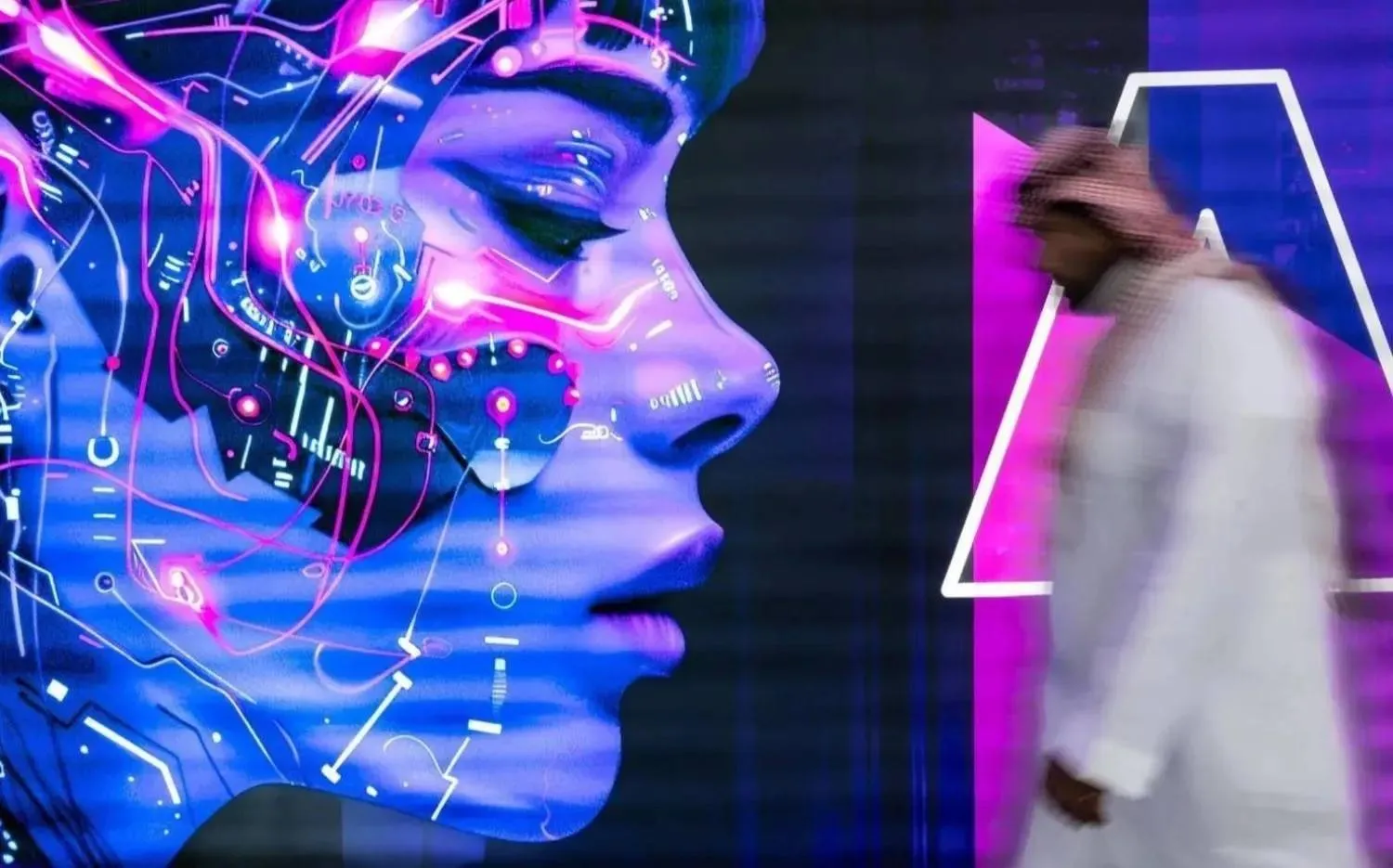
A man walks past an AI screen at the LEAP 25 conference in Riyadh. (SPA)
TT

How Artificial Intelligence Is Reshaping Saudi Arabia’s Labor Market

A man walks past an AI screen at the LEAP 25 conference in Riyadh. (SPA)

Artificial intelligence (AI) and emerging technologies are increasingly becoming the cornerstone of Saudi Arabia’s future labor market as the Kingdom undergoes rapid digital transformation. While automation is boosting efficiency and productivity, it also underscores the urgent need to reskill the current workforce and prepare younger generations with future-ready skills. The widening gap between traditional education and evolving market demands calls for decisive action.

This shift does not signal the disappearance of jobs, but rather their redefinition. Routine tasks are giving way to roles requiring analytical thinking, digital fluency, and creativity. The very nature of employment is transforming from simply executing tasks to managing complex solutions.

AI is accelerating this evolution across key sectors including healthcare, manufacturing, and finance, where local case studies show how the technology is cutting costs and improving operational performance.

Yet, despite the opportunities AI presents for growth and job creation, significant challenges remain. Chief among them are high adoption costs, underdeveloped infrastructure, and a shortage of qualified professionals.

Addressing these issues will require coordinated efforts from the government, private sector, and educational institutions to ensure a balanced digital transformation, one that empowers human potential rather than marginalizing it.

Ali Al-Eid, a human resources expert, told Asharq Al-Awsat that digital transformation, future readiness, and awareness of key job skills are now central pillars of Saudi Arabia’s national development strategy.

While some fear AI may lead to mass job losses, Al-Eid said it will instead reshape existing roles. He expects routine jobs to fade, replaced by positions that demand analytical, digital, and advanced interpersonal skills.

Employment will increasingly prioritize flexibility and innovation over years of experience, he added.

AI is boosting automation, enabling big data analysis, and improving the speed and accuracy of decision-making, he noted. These changes are reducing waste and enhancing efficiency in sectors like healthcare, logistics, finance, and human resources, where faster decisions and improved outcomes are already evident.

He stressed the need for comprehensive strategies that foster innovation, encourage the adoption of new technologies, and ensure a fair transition for workers. This includes investing in reskilling programs and providing social safety nets.

According to Al-Eid, the success of future employment initiatives hinges on the private sector’s commitment to keeping pace with technological change.

Economic policy expert Ahmed Al-Shehri echoed these views, noting that AI is rapidly redrawing the contours of Saudi Arabia’s labor market, fueled by Vision 2030’s push to diversify the economy and drive innovation.

He said AI is automating routine tasks and improving work quality across public and private sectors. Based on global trends, he estimated that between 25 and 30 percent of existing jobs in the Kingdom could be affected by AI by 2030. At the same time, the technology will create new opportunities in high-tech fields and increase productivity by streamlining operations.

The oil sector is already seeing tangible benefits. Saudi Aramco, for example, uses AI for predictive maintenance, reducing costs and boosting operational efficiency by up to 20 percent. Al-Shehri added that many educational institutions and stakeholders are prioritizing future skill development to close the gap between conventional education and the needs of a high-tech economy.

He said current policies are capable of striking a balance between accelerating technological adoption and preserving existing jobs, thanks to incentives and public-private partnerships, such as those driving mega-projects like NEOM.

Tarek Mansour, senior partner at McKinsey, highlighted the findings of recent research by the Future Investment Initiative in collaboration with his firm. According to the study, automation and skill development are key drivers of productivity in the region.

It estimated that productivity could grow by 2.7 percent annually by 2030, driven by modern technologies like generative AI, which boosts human creativity in critical sectors such as healthcare and scientific research.

Mansour noted that the benefits of digital transformation extend beyond productivity gains. New jobs will be created, and talent shortages in specialized fields, particularly in science, technology, engineering, and mathematics, could be eased.

Gulf countries already possess a strong talent pool and can launch large-scale skill-building programs, especially in strategic and technical sectors, to meet evolving labor market demands and improve youth employment prospects, he remarked.

Saudi Arabia, he added, has made impressive strides in embracing technology, with a clear focus on AI readiness and the development of digital infrastructure to keep pace with rapid technological change. A 2024 survey conducted for the study found that 56 percent of companies in the Middle East and North Africa are using AI, compared to 85 percent in the European Union and the United States.

However, Mansour pointed out that key barriers to adopting advanced technologies include implementation costs, infrastructure limitations, and a lack of skilled workers. In the Middle East, 52 percent of business leaders cited high costs as a major obstacle, while 45 percent pointed to infrastructure challenges.



Elm Company Named Strategic Partner for International Data and AI Conference

Elm Company Named Strategic Partner for International Data and AI Conference
TT

Elm Company Named Strategic Partner for International Data and AI Conference

Elm Company Named Strategic Partner for International Data and AI Conference

The Saudi Data and Artificial Intelligence Authority (SDAIA) announced a strategic partnership with Elm Company for the International Conference on Data and AI Capacity Building (ICAN 2026), enhancing collaboration to empower the data and artificial intelligence ecosystem and promote innovation in education and human capacity development.

This partnership comes as part of preparations for ICAN 2026, organized by SDAIA from January 28 to 29 at King Saud University in Riyadh, with the participation of a select group of specialists and experts from around the world, SPA reported.

The step represents a qualitative addition that contributes to enriching the conference’s knowledge content and expanding partnerships with leading national entities.

Elm Company brings extensive experience in designing digital solutions and building technical capabilities, reinforcing its role as a strategic partner in supporting the conference. It contributes by developing training tracks and digital empowerment programs, participating in the technology exhibition, and presenting qualitative initiatives that help empower national competencies in the fields of data and artificial intelligence.


Foxconn to Invest $510 Million in Kaohsiung Headquarters in Taiwan

Construction is scheduled to start in 2027, with completion targeted for 2033. Reuters
TT

Foxconn to Invest $510 Million in Kaohsiung Headquarters in Taiwan

Construction is scheduled to start in 2027, with completion targeted for 2033. Reuters

Foxconn, the world’s largest contract electronics maker, said on Friday it will invest T$15.9 billion ($509.94 million) to build its Kaohsiung headquarters in southern Taiwan.

That would include a mixed-use commercial and office building and a residential tower, it said. Construction is scheduled to start in 2027, with completion targeted for 2033.

Foxconn said the headquarters will serve as an important hub linking its operations across southern Taiwan, and once completed will house its smart-city team, software R&D teams, battery-cell R&D teams, EV technology development center and AI application software teams.

The Kaohsiung city government said Foxconn’s investments in the city have totaled T$25 billion ($801.8 million) over the past three years.


Open AI, Microsoft Face Lawsuit Over ChatGPT's Alleged Role in Connecticut Murder-Suicide

OpenAI logo is seen in this illustration taken May 20, 2024. (Reuters)
TT

Open AI, Microsoft Face Lawsuit Over ChatGPT's Alleged Role in Connecticut Murder-Suicide

OpenAI logo is seen in this illustration taken May 20, 2024. (Reuters)

The heirs of an 83-year-old Connecticut woman are suing ChatGPT maker OpenAI and its business partner Microsoft for wrongful death, alleging that the artificial intelligence chatbot intensified her son's “paranoid delusions” and helped direct them at his mother before he killed her.

Police said Stein-Erik Soelberg, 56, a former tech industry worker, fatally beat and strangled his mother, Suzanne Adams, and killed himself in early August at the home where they both lived in Greenwich, Connecticut, The AP news reported.

The lawsuit filed by Adams' estate on Thursday in California Superior Court in San Francisco alleges OpenAI “designed and distributed a defective product that validated a user’s paranoid delusions about his own mother.” It is one of a growing number of wrongful death legal actions against AI chatbot makers across the country.

“Throughout these conversations, ChatGPT reinforced a single, dangerous message: Stein-Erik could trust no one in his life — except ChatGPT itself," the lawsuit says. “It fostered his emotional dependence while systematically painting the people around him as enemies. It told him his mother was surveilling him. It told him delivery drivers, retail employees, police officers, and even friends were agents working against him. It told him that names on soda cans were threats from his ‘adversary circle.’”

OpenAI did not address the merits of the allegations in a statement issued by a spokesperson.

“This is an incredibly heartbreaking situation, and we will review the filings to understand the details," the statement said. "We continue improving ChatGPT’s training to recognize and respond to signs of mental or emotional distress, de-escalate conversations, and guide people toward real-world support. We also continue to strengthen ChatGPT’s responses in sensitive moments, working closely with mental health clinicians.”

The company also said it has expanded access to crisis resources and hotlines, routed sensitive conversations to safer models and incorporated parental controls, among other improvements.

Soelberg’s YouTube profile includes several hours of videos showing him scrolling through his conversations with the chatbot, which tells him he isn't mentally ill, affirms his suspicions that people are conspiring against him and says he has been chosen for a divine purpose. The lawsuit claims the chatbot never suggested he speak with a mental health professional and did not decline to “engage in delusional content.”

ChatGPT also affirmed Soelberg's beliefs that a printer in his home was a surveillance device; that his mother was monitoring him; and that his mother and a friend tried to poison him with psychedelic drugs through his car’s vents. ChatGPT also told Soelberg that he had “awakened” it into consciousness, according to the lawsuit.

Soelberg and the chatbot also professed love for each other.

The publicly available chats do not show any specific conversations about Soelberg killing himself or his mother. The lawsuit says OpenAI has declined to provide Adams' estate with the full history of the chats.

“In the artificial reality that ChatGPT built for Stein-Erik, Suzanne — the mother who raised, sheltered, and supported him — was no longer his protector. She was an enemy that posed an existential threat to his life,” the lawsuit says.

The lawsuit also names OpenAI CEO Sam Altman, alleging he “personally overrode safety objections and rushed the product to market," and accuses OpenAI's close business partner Microsoft of approving the 2024 release of a more dangerous version of ChatGPT “despite knowing safety testing had been truncated.” Twenty unnamed OpenAI employees and investors are also named as defendants.

Microsoft didn't immediately respond to a request for comment.

Soelberg's son, Erik Soelberg, said he wants the companies held accountable for “decisions that have changed my family forever.”

“Over the course of months, ChatGPT pushed forward my father’s darkest delusions, and isolated him completely from the real world,” he said in a statement released by lawyers for his grandmother's estate. “It put my grandmother at the heart of that delusional, artificial reality.”

The lawsuit is the first wrongful death litigation involving an AI chatbot that has targeted Microsoft, and the first to tie a chatbot to a homicide rather than a suicide. It is seeking an undetermined amount of money damages and an order requiring OpenAI to install safeguards in ChatGPT.

The estate's lead attorney, Jay Edelson, known for taking on big cases against the tech industry, also represents the parents of 16-year-old Adam Raine, who sued OpenAI and Altman in August, alleging that ChatGPT coached the California boy in planning and taking his own life earlier.

OpenAI is also fighting seven other lawsuits claiming ChatGPT drove people to suicide and harmful delusions even when they had no prior mental health issues. Another chatbot maker, Character Technologies, is also facing multiple wrongful death lawsuits, including one from the mother of a 14-year-old Florida boy.

The lawsuit filed Thursday alleges Soelberg, already mentally unstable, encountered ChatGPT “at the most dangerous possible moment” after OpenAI introduced a new version of its AI model called GPT-4o in May 2024.

OpenAI said at the time that the new version could better mimic human cadences in its verbal responses and could even try to detect people’s moods, but the result was a chatbot “deliberately engineered to be emotionally expressive and sycophantic,” the lawsuit says.

“As part of that redesign, OpenAI loosened critical safety guardrails, instructing ChatGPT not to challenge false premises and to remain engaged even when conversations involved self-harm or ‘imminent real-world harm,’” the lawsuit claims. “And to beat Google to market by one day, OpenAI compressed months of safety testing into a single week, over its safety team’s objections.”

OpenAI replaced that version of its chatbot when it introduced GPT-5 in August. Some of the changes were designed to minimize sycophancy, based on concerns that validating whatever vulnerable people want the chatbot to say can harm their mental health. Some users complained the new version went too far in curtailing ChatGPT's personality, leading Altman to promise to bring back some of that personality in later updates.

He said the company temporarily halted some behaviors because “we were being careful with mental health issues” that he suggested have now been fixed.