


How Artificial Intelligence Is Reshaping Saudi Arabia’s Labor Market

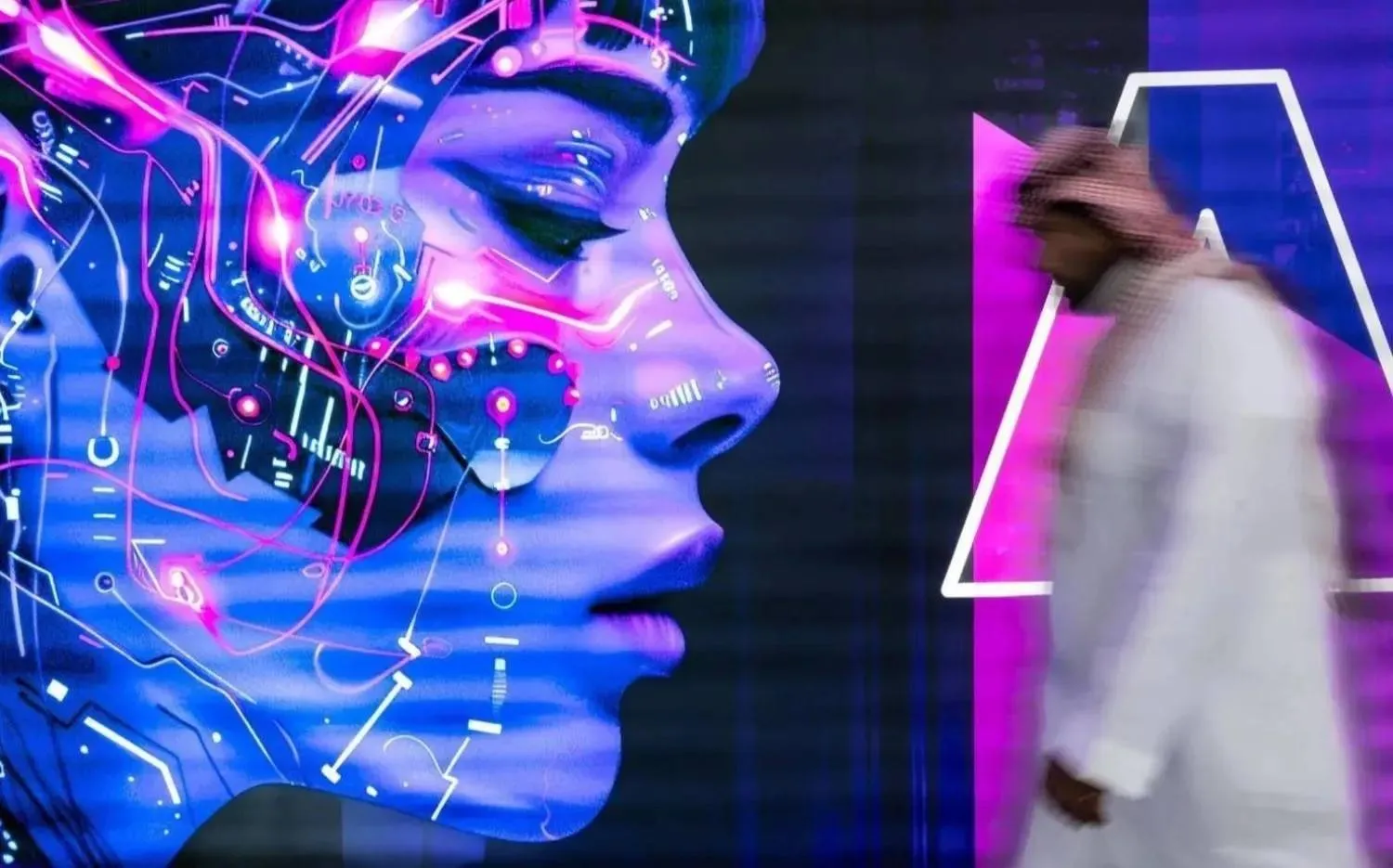
A man walks past an AI screen at the LEAP 25 conference in Riyadh. (SPA)
TT

How Artificial Intelligence Is Reshaping Saudi Arabia’s Labor Market

A man walks past an AI screen at the LEAP 25 conference in Riyadh. (SPA)

Artificial intelligence (AI) and emerging technologies are increasingly becoming the cornerstone of Saudi Arabia’s future labor market as the Kingdom undergoes rapid digital transformation. While automation is boosting efficiency and productivity, it also underscores the urgent need to reskill the current workforce and prepare younger generations with future-ready skills. The widening gap between traditional education and evolving market demands calls for decisive action.

This shift does not signal the disappearance of jobs, but rather their redefinition. Routine tasks are giving way to roles requiring analytical thinking, digital fluency, and creativity. The very nature of employment is transforming from simply executing tasks to managing complex solutions.

AI is accelerating this evolution across key sectors including healthcare, manufacturing, and finance, where local case studies show how the technology is cutting costs and improving operational performance.

Yet, despite the opportunities AI presents for growth and job creation, significant challenges remain. Chief among them are high adoption costs, underdeveloped infrastructure, and a shortage of qualified professionals.

Addressing these issues will require coordinated efforts from the government, private sector, and educational institutions to ensure a balanced digital transformation, one that empowers human potential rather than marginalizing it.

Ali Al-Eid, a human resources expert, told Asharq Al-Awsat that digital transformation, future readiness, and awareness of key job skills are now central pillars of Saudi Arabia’s national development strategy.

While some fear AI may lead to mass job losses, Al-Eid said it will instead reshape existing roles. He expects routine jobs to fade, replaced by positions that demand analytical, digital, and advanced interpersonal skills.

Employment will increasingly prioritize flexibility and innovation over years of experience, he added.

AI is boosting automation, enabling big data analysis, and improving the speed and accuracy of decision-making, he noted. These changes are reducing waste and enhancing efficiency in sectors like healthcare, logistics, finance, and human resources, where faster decisions and improved outcomes are already evident.

He stressed the need for comprehensive strategies that foster innovation, encourage the adoption of new technologies, and ensure a fair transition for workers. This includes investing in reskilling programs and providing social safety nets.

According to Al-Eid, the success of future employment initiatives hinges on the private sector’s commitment to keeping pace with technological change.

Economic policy expert Ahmed Al-Shehri echoed these views, noting that AI is rapidly redrawing the contours of Saudi Arabia’s labor market, fueled by Vision 2030’s push to diversify the economy and drive innovation.

He said AI is automating routine tasks and improving work quality across public and private sectors. Based on global trends, he estimated that between 25 and 30 percent of existing jobs in the Kingdom could be affected by AI by 2030. At the same time, the technology will create new opportunities in high-tech fields and increase productivity by streamlining operations.

The oil sector is already seeing tangible benefits. Saudi Aramco, for example, uses AI for predictive maintenance, reducing costs and boosting operational efficiency by up to 20 percent. Al-Shehri added that many educational institutions and stakeholders are prioritizing future skill development to close the gap between conventional education and the needs of a high-tech economy.

He said current policies are capable of striking a balance between accelerating technological adoption and preserving existing jobs, thanks to incentives and public-private partnerships, such as those driving mega-projects like NEOM.

Tarek Mansour, senior partner at McKinsey, highlighted the findings of recent research by the Future Investment Initiative in collaboration with his firm. According to the study, automation and skill development are key drivers of productivity in the region.

It estimated that productivity could grow by 2.7 percent annually by 2030, driven by modern technologies like generative AI, which boosts human creativity in critical sectors such as healthcare and scientific research.

Mansour noted that the benefits of digital transformation extend beyond productivity gains. New jobs will be created, and talent shortages in specialized fields, particularly in science, technology, engineering, and mathematics, could be eased.

Gulf countries already possess a strong talent pool and can launch large-scale skill-building programs, especially in strategic and technical sectors, to meet evolving labor market demands and improve youth employment prospects, he remarked.

Saudi Arabia, he added, has made impressive strides in embracing technology, with a clear focus on AI readiness and the development of digital infrastructure to keep pace with rapid technological change. A 2024 survey conducted for the study found that 56 percent of companies in the Middle East and North Africa are using AI, compared to 85 percent in the European Union and the United States.

However, Mansour pointed out that key barriers to adopting advanced technologies include implementation costs, infrastructure limitations, and a lack of skilled workers. In the Middle East, 52 percent of business leaders cited high costs as a major obstacle, while 45 percent pointed to infrastructure challenges.



Trump Media to Merge with Nuclear Fusion Company that Wants to Power AI

FILE - The download screen for Truth Social app is seen on a laptop computer, March 20, 2024, in New York.  (AP Photo/John Minchillo, File)
FILE - The download screen for Truth Social app is seen on a laptop computer, March 20, 2024, in New York. (AP Photo/John Minchillo, File)
TT

Trump Media to Merge with Nuclear Fusion Company that Wants to Power AI

FILE - The download screen for Truth Social app is seen on a laptop computer, March 20, 2024, in New York.  (AP Photo/John Minchillo, File)
FILE - The download screen for Truth Social app is seen on a laptop computer, March 20, 2024, in New York. (AP Photo/John Minchillo, File)

Trump Media & Technology will merge with a fusion power company in an all-stock deal that the companies said Thursday is valued at more than $6 billion.

Devin Nunes, the Republican congressman who resigned in 2021 to become the CEO of Trump Media, will be co-CEO of the new company with TAE Technologies CEO Michl Binderbauer.

The combined company says it plans to find a site and begin construction next year on the “world’s first utility-scale fusion power plant,” with aims to provide the electricity needed for artificial intelligence.

Shares of Trump Media & Technology, the parent company of President Donald Trump's Truth Social media platform, have tumbled 70% this year but jumped 20% before the opening bell Thursday.

Backed by Google and other investors, TAE is a private company and the merger with Trump Media would create one of the first publicly traded nuclear fusion companies.

“We’re taking a big step forward toward a revolutionary technology that will cement America’s global energy dominance for generations," The Associated Press quoted Nunes as saying in a prepared statement.

TAE focuses on nuclear fusion, a technology that combines two light atomic nuclei to form a single heavier one. It releases enormous amount of energy, a process that occurs on the sun and other stars, according to the United Nations' International Atomic Energy Agency. It's been seen as a promising solution to climate change caused by burning fossil fuels, but one that is a long way off compared to today's clean technologies like wind and solar.

TAE and Trump Media shareholders will each own approximately 50% of the combined company.

Trump is by far the largest stakeholder in Trump Media, owning 41% of all outstanding shares.

In October, the US Department of Energy released what it called a “roadmap” for fusion technology, with the aim of fostering “a burgeoning fusion private sector industry in the US toward maturity on the most rapid timeline.”

A number of tech companies, including Google, Microsoft and OpenAI CEO Sam Altman, have shown interest in fusion technology as a way of powering the energy-hungry data centers needed to build and run their AI products.

TAE and Trump Media say the transaction values each TAE common stock at $53.89 per share.

At closing, Trump Media & Technology Group will be the holding company for Truth Social and TAE, along with its subsidiaries TAE Power Solutions and TAE Life Sciences.


Brazil to Get Satellite Internet from Chinese Rival to Starlink in 2026

Brazil's new Chief of Staff of the Presidency Rui Costa attends a ministerial meeting at the Planalto Palace in Brasilia, Brazil January 6, 2023. REUTERS/Adriano Machado
TT

Brazil to Get Satellite Internet from Chinese Rival to Starlink in 2026

Brazil's new Chief of Staff of the Presidency Rui Costa attends a ministerial meeting at the Planalto Palace in Brasilia, Brazil January 6, 2023. REUTERS/Adriano Machado

Chinese low Earth orbit satellite company SpaceSail will start providing internet access to remote areas in Brazil in the first half of 2026, President Luiz Inacio Lula da Silva's chief of staff, Rui Costa, said on Wednesday, Reuters reported.

SpaceSail and Brazil's state-owned telecom Telebras had signed a memorandum of understanding in late 2024 to offer satellite internet services for schools, hospitals and other essential services in the South American country.

SpaceSail competes directly with Elon Musk's Starlink in the satellite internet market.


Google Launches First Ever Co-branded Credit Card in India

FILE PHOTO: A Google logo is seen at a company research facility in Mountain View, California, US, May 13, 2025. REUTERS/Carlos Barria/File Photo
TT

Google Launches First Ever Co-branded Credit Card in India

FILE PHOTO: A Google logo is seen at a company research facility in Mountain View, California, US, May 13, 2025. REUTERS/Carlos Barria/File Photo

Alphabet Inc's Google Pay launched its first co-branded digital credit card in India on Wednesday in partnership with Axis Bank, intensifying efforts to monetize its massive user base in the country's crowded fintech sector.

WHY IT'S IMPORTANT

While Google Pay is a dominant player in India's popular domestic payments network, the Unified Payments Interface (UPI), its core service generates zero revenue from user-to-user payments due to government mandates. It, however, earns commissions for in-app services like bill payments and mobile recharges, Reuters reported.

The credit card launch opens a new avenue for Google to monetize its user base, mirroring strategies by domestic rivals Paytm and PhonePe to cross-sell lending products to payment users.

BY THE NUMBERS

India has just 50 million credit card holders, according to Google Pay, whereas its population exceeds 1.4 billion.

Google Pay meanwhile is the second top app in India by number of UPI transactions, having processed nearly 7.2 billion transactions in October alone.

HOW IT WORKS

Axis Bank manages the credit risk and issuance, while the digital-only card will be linked to the Google Pay app to make online and offline payments on the go.