


Taiwan Cultivates Young Overseas Chip Talent with Summer Camps, University Courses

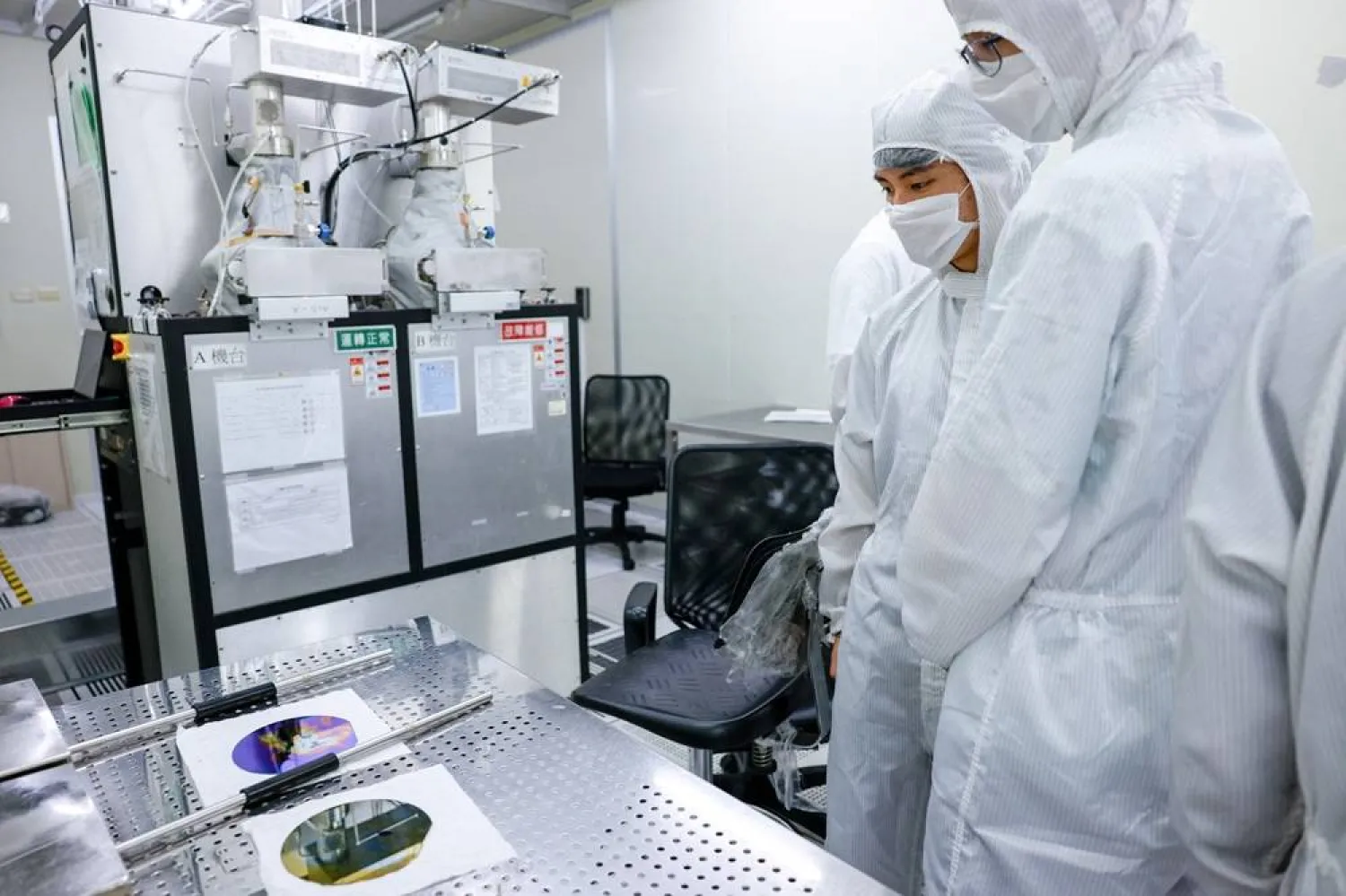
Students dressed in white protective suit and a face mask visit a clean room as part of a summer camp organized by US chip designer Synopsys with the goal to attract more youth to Taiwan's semiconductor industry, in Hsinchu, Taiwan July 18, 2025. (Reuters)
TT

Taiwan Cultivates Young Overseas Chip Talent with Summer Camps, University Courses

Students dressed in white protective suit and a face mask visit a clean room as part of a summer camp organized by US chip designer Synopsys with the goal to attract more youth to Taiwan's semiconductor industry, in Hsinchu, Taiwan July 18, 2025. (Reuters)

Dressed in a white protective suit and face mask, Nicolas Chueh listened intently as a guide introduced a series of silver machines used in manufacturing Taiwan's cutting-edge semiconductors. The 16-year-old was among students from eight countries at the summer camp staged to raise interest in Taiwan's most vital industry amid a fast-declining birth rate that could leave tens of thousands of critical jobs vacant.

"I myself really enjoy playing video games. So I'm really just always using these semiconductor products," said Chueh, whose parents enrolled him after he expressed interest.

The camp, organized by US chip design software firm Synopsys, is among several such events staged by chip companies and Taiwanese universities in recent years as demand for semiconductors, which power most electronics and AI servers, surges across the globe.

But for the first time this year, Synopsys, which has significant operations in Taiwan to be closer to the semiconductor supply chain, hosted the events both in Mandarin and English as Taiwan searches for overseas talent.

"There is an urgent need to strengthen STEM education from an early age," said Robert Li, Synopsys's Taiwan chairman, who believes the camps can increase interest in the chip industry and help prime some of its future leaders.

"That is why we are launching this initiative in Taiwan, where its strength in semiconductors meets the challenge of demographic decline. Taken together, it is clear we must act here first."

Given limitations posed by Taiwan's ageing population, Synopsys is also considering hosting camps internationally to spur interest in chip making and designing, he added. The company charges T$33,000 ($1,103) for the English versions and T$10,900 for Mandarin.

Chueh, a dual Taiwan-Belgian national who lives in Singapore, said he views semiconductors as an attractive career choice.

"I want to lean into it to some extent because I think it will be crucial in the future with AI."

SLUMPING BIRTH RATE

Taiwan, which has a population of around 23 million, holds outsized influence over the global semiconductor supply chain, thanks to its chip companies such as Taiwan Semiconductor Manufacturing Co, the world's largest contract chipmaker, MediaTek, and UMC.

Any decline in the industry poses an existential threat to Taiwan, which faces the threat of invasion from Beijing and draws much of its global significance from the chip behemoths.

But job openings in the semiconductor sector have risen from 19,401 in the second quarter of 2020 to 33,725 in the same period this year, according to 104 Corporation, a local human resources firm.

The industry is grappling with a shortage of both highly skilled professionals, such as IC design and semiconductor R&D engineers, and essential production staff, including operators and assembly technicians.

Filling those jobs locally is becoming harder each year as Taiwan's annual number of births has dropped from over 210,000 in 2014 to around 135,000 in 2024, according to government statistics. STEM graduates have also fallen by around 15% in that period, Ministry of Education statistics showed.

"Growth in Taiwan's semiconductor industry has been quite rapid, faster than what our schools can produce in terms of engineering talent each year," said Leuh Fang, chairman of Vanguard International Semiconductor, a Taiwan-based chipmaker affiliated with TSMC.

'THE FUTURE WORKFORCE'

Last year, the National Taiwan University launched a global undergraduate semiconductor program for foreign students, which included Mandarin courses to help them reach the proficiency needed to stay and work in Taiwan.

The program now enrolls over 40 students from more than 10 countries.

TSMC also began looking toward foreign talent by throwing its weight behind a program in Germany’s Saxony state, which would send German students to study for a semester at Taiwanese universities before interning at TSMC.

Other initiatives are attempting to create interest among children as young as 10.

Taiwan's National Yang Ming Chiao Tung University (NYCU) launched an outreach program in July, backed by TSMC, aimed at making chip science fun through interactive teaching tools and online games.

"The issue everyone is discussing now is where the future workforce will come from," said NYCU President Chi-Hung Lin.

"If they're curious now, they won't reject it later and some may even grow to like this kind of work."



US Allows Nvidia to Send Advanced AI Chips to China with Restrictions

An Nvidia logo and a computer motherboard appear in this illustration taken August 25, 2025. (Reuters)
TT

US Allows Nvidia to Send Advanced AI Chips to China with Restrictions

An Nvidia logo and a computer motherboard appear in this illustration taken August 25, 2025. (Reuters)

The US Commerce Department on Tuesday opened the door for Nvidia to sell advanced artificial intelligence chips in China with restrictions, following through on a policy shift announced last month by President Donald Trump.

The change would permit Nvidia to sell its powerful H200 chip to Chinese buyers if certain conditions are met -- including proof of "sufficient" US supply -- while sales of its most advanced processors would still be blocked.

However, uncertainty has grown over how much demand there will be from Chinese companies, as Beijing has reportedly been encouraging tech companies to use homegrown chips.

Chinese officials have informed some firms they would only approve buying H200 chips under special circumstances, such as development labs or university research, news website The Information reported Tuesday, citing people with knowledge of the situation.

The Information had previously reported that Chinese officials were calling on companies there to pause H200 purchases while they deliberated requiring them to buy a certain ratio of AI chips made by Nvidia rivals in China.

In its official update on Tuesday, the US Commerce Department's Bureau of Industry and Security said it had changed the licensing review policy for H200 and similar chips from a presumption of denial to handling applications case-by-case.

Trump announced in December an agreement with Chinese President Xi Jinping to allow Nvidia to export its H200 chips to China, with the US government getting a 25-percent cut of sales.

The move marked a significant shift in US export policy for advanced AI chips, which Joe Biden's administration had heavily restricted over national security concerns about Chinese military applications.

Democrats in Congress have criticized the move as a huge mistake that will help China's military and economy.

- Chinese chips -

Nvidia chief executive Jensen Huang has advocated for the company to be allowed to sell some of its more advanced chips in China, arguing the importance of AI systems around the world being built on US technology.

The chips -- graphic processing units or GPUs -- are used to train the AI models that are the bedrock of the generative AI revolution launched with the release of ChatGPT in 2022.

The GPU sector is dominated by Nvidia, now the world's most valuable company thanks to frenzied global demand and optimism for AI.

H200s are roughly 18 months behind the US company's most state-of-the-art offerings, which will still be off-limits to China.

Nvidia's Huang has repeatedly warned that China is just "nanoseconds behind" the United States as it accelerates the development of domestically produced advanced chips.

On Wednesday, leading Chinese AI startup Zhipu said it had used homegrown Huawei chips to train its new image generator.

Zhipu AI described its tool as "the first state-of-the-art multimodal model to complete the entire training process on a domestically produced chip".

The startup went public in Hong Kong last week and its shares have since soared 75 percent -- one of several dazzling recent initial public offerings by Chinese chip and generative AI companies, as high hopes for the sector outweigh concerns of a potential market crash.


Apple Rolls Out Creator Studio to Boost Services Push, Adds AI Features

A customer compares his old iPhone with the newly launched iPhone 17 pro max at an Apple retail store in Delhi, India, September 19, 2025. (Reuters)
TT

Apple Rolls Out Creator Studio to Boost Services Push, Adds AI Features

A customer compares his old iPhone with the newly launched iPhone 17 pro max at an Apple retail store in Delhi, India, September 19, 2025. (Reuters)

Apple on Tuesday unveiled Apple Creator Studio, a new subscription bundle of professional creative software priced at $12.99 a month or $129 a year, as the iPhone maker steps up its push into paid services for creators, students and professionals.

The company has used its services business, which includes its Apple ‌Music and ‌iCloud services, to drive ‌growth ⁠in recent ‌years, helping counter slower hardware growth and generate recurring revenue.

Apple Creator Studio bundles some of the company's best-known creative tools into a single subscription, including Final Cut Pro, Logic Pro ⁠and Pixelmator Pro across Mac and iPad.

The ‌package also adds premium ‍content and ‍new AI-powered features to Apple's productivity apps ‍Keynote, Pages and Numbers, while digital whiteboarding app Freeform will gain enhanced features later.

Final Cut Pro will offer new tools such as transcript-based search, visual search and beat detection to ⁠speed up video editing, while Logic Pro introduces AI-powered features like Synth Player and Chord ID to assist with music creation.

The company's Photoshop-alternative Pixelmator Pro will be available on iPad for the first time and will offer Apple Pencil support.

The subscription launches January 28 on ‌the App Store, Apple said.


Social Media Harms Teens, Watchdog Warns, as France Weighs Ban

The TikTok app logo is seen in this illustration taken January 16, 2025. (Reuters)
TT

Social Media Harms Teens, Watchdog Warns, as France Weighs Ban

The TikTok app logo is seen in this illustration taken January 16, 2025. (Reuters)

Social media harms the mental health of adolescents, particularly girls, France's health watchdog said Tuesday as the country debates banning children under 15 from accessing the immensely popular platforms.

The results of an expert scientific review on the subject were announced after Australia became the first country to prohibit big platforms including Instagram, TikTok and YouTube for under 16s last month, while other nations consider following its lead.

Using social media is not the sole cause of the declining mental health of teenagers, but its negative effects are "numerous" and well documented, the French public health watchdog ANSES wrote in its opinion, the result of five years of work by a committee of experts.

France is currently debating two bills, one backed by President Emmanuel Macron, that would ban social media for under 15s.

The ANSES opinion recommended "acting at the source" to ensure that children can only access social networks "designed and configured to protect their health".

This means that the platforms would have to change their personalized algorithms, persuasive techniques and default settings, according to the agency.

"This study provides scientific arguments for the debate about social networks in recent years: it is based on 1,000 studies," the expert panel's head Olivia Roth-Delgado told a press conference.

Social media can create an "unprecedented echo chamber" that reinforces stereotypes, promotes risky behavior and promotes cyberbullying, the ANSES opinion said.

The content also portrays an unrealistic idea of beauty via digitally altered images that can lead to low self-esteem in girls, which creates fertile ground for depression or eating disorders, it added.

Girls -- who use social media more than boys -- are subjected to more of the "social pressure linked to gender stereotypes," the opinion said.

This means girls are more affected by the dangers of social media -- as are people with pre-existing mental health conditions, it added.

On Monday, tech giant Meta urged Australia to rethink its teen social media ban, while reporting that it has blocked more than 544,000 Instagram, Facebook and Threads accounts under the new law.

Meta said parents and experts were worried about the ban isolating young people from online communities, and driving some to less regulated apps and darker corners of the internet.