


World's First Humanoid Robot Games Begin in China

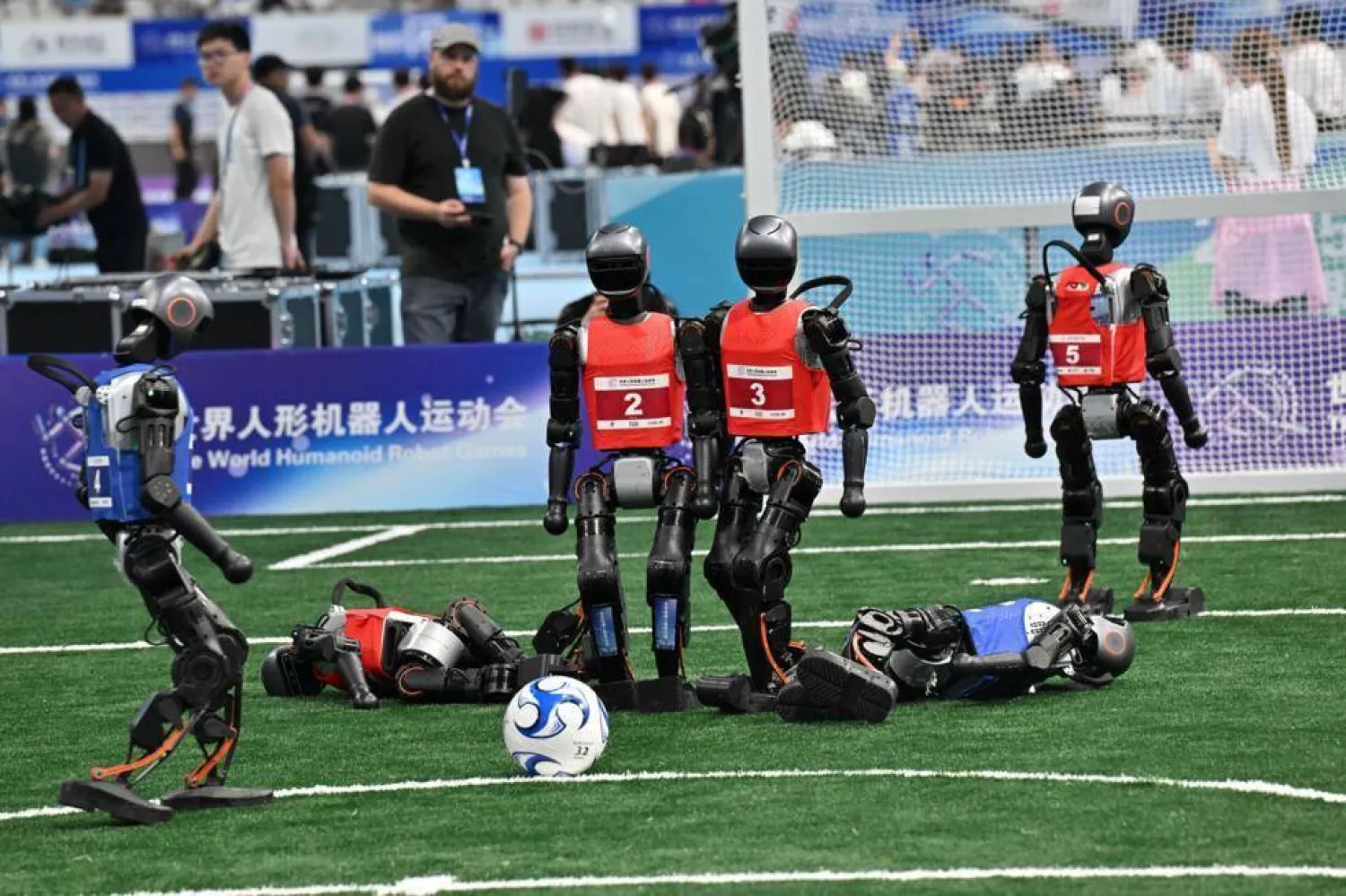
Robots compete in a 5x5 football match during the World Humanoid Robot Games. Falling over was a frequent occurrence. ADEK BERRY / AFP
TT

World's First Humanoid Robot Games Begin in China

Robots compete in a 5x5 football match during the World Humanoid Robot Games. Falling over was a frequent occurrence. ADEK BERRY / AFP

The world's first-ever humanoid robot games began Friday in Beijing, with over 500 androids alternating between jerky tumbles and glimpses of real power as they compete in events from the 100-meter hurdles to kung fu.

Hundreds of robotics teams from 16 countries are going for gold at the Chinese capital's National Speed Skating Oval, built for the 2022 Winter Olympics.

The games include traditional sports like athletics and basketball, as well as practical tasks such as medicine categorization and cleaning.

"I believe in the next 10 years or so, robots will be basically at the same level as humans," enthusiastic 18-year-old spectator Chen Ruiyuan told AFP.

Human athletes might not be quaking in their boots just yet.

At one of the first events on Friday morning, five-aside football, 10 robots the size of seven-year-olds shuffled around the pitch, often getting stuck in a scrum or falling over en masse.

However, in a 1500-meter race, domestic champion Unitree's humanoids stomped along the track at an impressive clip, easily outpacing their rivals.

The fastest robot AFP witnessed finished in 6:29:37, a far cry from the human men's world record of 3:26:00.

One mechanical racer barreled straight into a human operator. The robot remained standing, while the human was knocked flat, though did not appear to be injured.

'National strategy'

Robot competitions have been held for decades, but the 2025 World Humanoid Robot Games is the first to focus specifically on robots that resemble human bodies, organizers said.

The Chinese government has poured support into robotics hoping to lead the industry.

Beijing has put humanoids in the "center of their national strategy", the International Federation of Robotics wrote in a paper on Thursday.

"The government wants to showcase its competence and global competitiveness in this field of technology," it added.

Authorities are working to raise awareness of the sector across society.

Cui Han, accompanying her 10-year-old, told AFP that her son's school had organized and paid for the trip to the Games.

"I hope it will encourage him to learn more about these new technologies," she said.

In March, China announced plans for a one-trillion-yuan fund to support technology startups, including those in robotics and AI.

The country is already the world's largest market for industrial robots, official statistics show, and in April, Beijing held what organizers dubbed the world's first humanoid robot half-marathon.

Chen, the spectator, told AFP he was about to begin studying automation at university.

"Coming here can cultivate my passion for this field," he said. "My favorite is the boxing, because... it requires a lot of agility and I can really see how the robots have improved from before."

Meanwhile, at the kung fu competition area, a pint-sized robot resembling one from the popular Transformer series attempted to execute a move, but fell flat on its front.

It spun around on the floor as it struggled to get back up, the crowd happily cheering.


Saudi National Cybersecurity Authority Launches Service to Verify Suspicious Links

Saudi National Cybersecurity Authority Launches Service to Verify Suspicious Links
TT

Saudi National Cybersecurity Authority Launches Service to Verify Suspicious Links

Saudi National Cybersecurity Authority Launches Service to Verify Suspicious Links

The National Cybersecurity Authority has launched the “Tahqaq” service, aimed at enabling members of the public to proactively and safely deal with circulated links and instantly verify their reliability before visiting them.

This initiative comes within the authority’s strategic programs designed to empower individuals to enhance their cybersecurity, SPA reported.

The authority noted that the “Tahqaq” service allows users to scan circulated links and helps reduce the risks associated with using and visiting suspicious links that may lead to unauthorized access to data. The service also provides cybersecurity guidance to users, mitigating emerging cyber risks and boosting cybersecurity awareness across all segments of society.

The “Tahqaq” service is offered as part of the National Portal for Cybersecurity Services (Haseen) in partnership with the authority’s technical arm, the Saudi Information Technology Company (SITE). The service is available through the unified number on WhatsApp (+966118136644), as well as via the Haseen portal website at tahqaq.haseen.gov.sa.


Saudi Arabia’s Space Sector: A Strategic Pillar of a Knowledge-Based Economy

The Kingdom is developing an integrated sovereign space system encompassing infrastructure and applications, led by national expertise - SPA
TT

Saudi Arabia’s Space Sector: A Strategic Pillar of a Knowledge-Based Economy

The Kingdom is developing an integrated sovereign space system encompassing infrastructure and applications, led by national expertise - SPA

Saudi Arabia is undergoing significant transformations toward an innovation-driven knowledge economy, with the space sector emerging as a crucial pillar of Saudi Vision 2030. This sector has evolved from a scientific domain into a strategic driver for economic development, focusing on investing in talent, developing infrastructure, and strengthening international partnerships.

CEO of the Saudi Space Agency Dr. Mohammed Al-Tamimi emphasized that space is a vital tool for human development. He noted that space exploration has yielded significant benefits in telecommunications, navigation, and Earth observation, with many daily technologies stemming from space research, SPA reported.

Dr. Al-Tamimi highlighted a notable shift with the private sector's entry into the space industry, which is generating new opportunities. He stressed that Saudi Arabia aims not just to participate but to lead in creating an integrated space ecosystem encompassing legislation, investment, and innovation.

He also noted the sector's role in fostering national identity among youth, key drivers of the industry. Investing in them is crucial for the Kingdom's future, focusing on creating a space sector that empowers Saudi citizens.

In alignment with international efforts, the Saudi Space Agency signed an agreement with NASA for the first Saudi satellite dedicated to studying space weather, part of the Artemis II mission under a scientific cooperation framework established in July 2024.

According to SPA, the Kingdom is developing an integrated sovereign space system encompassing infrastructure and applications, led by national expertise. This initiative is supported by strategic investments and advanced technologies within a governance framework that meets international standards. Central to this vision is the Neo Space Group, owned by the Public Investment Fund, which aims to establish Saudi Arabia as a space leader.

Saudi Arabia views space as a strategic frontier for human development. Vision 2030 transforms space into a bridge between dreams and achievements, empowering Saudi youth to shape their futures. Space represents not just data and satellites but a national journey connecting ambition with innovation.


Nvidia, Joining Big Tech Deal Spree, to License Groq Technology, Hire Executives

The Nvidia logo is seen on a graphic card package in this illustration created on August 19, 2025. (Reuters)
TT

Nvidia, Joining Big Tech Deal Spree, to License Groq Technology, Hire Executives

The Nvidia logo is seen on a graphic card package in this illustration created on August 19, 2025. (Reuters)

Nvidia has agreed to license chip technology from startup Groq and hire away its CEO, a veteran of Alphabet's Google, Groq said in a blog post on Wednesday.

The deal follows a familiar pattern in recent years where the world's biggest technology firms pay large sums in deals with promising startups to take their technology and talent but stop short of formally acquiring the target.

Groq specializes in what is known as inference, where artificial intelligence models that have already been trained respond to requests from users. While Nvidia dominates the market for training AI models, it faces much more competition in inference, where traditional rivals such as Advanced Micro Devices have aimed ‌to challenge it ‌as well as startups such as Groq and Cerebras Systems.

Nvidia ‌has ⁠agreed to a "non-exclusive" ‌license to Groq's technology, Groq said. It said its founder Jonathan Ross, who helped Google start its AI chip program, as well as Groq President Sunny Madra and other members of its engineering team, will join Nvidia.

A person close to Nvidia confirmed the licensing agreement.

Groq did not disclose financial details of the deal. CNBC reported that Nvidia had agreed to acquire Groq for $20 billion in cash, but neither Nvidia nor Groq commented on the report. Groq said in its blog post that it will continue to ⁠operate as an independent company with Simon Edwards as CEO and that its cloud business will continue operating.

In similar recent deals, Microsoft's ‌top AI executive came through a $650 million deal with a startup ‍that was billed as a licensing fee, and ‍Meta spent $15 billion to hire Scale AI's CEO without acquiring the entire firm. Amazon hired ‍away founders from Adept AI, and Nvidia did a similar deal this year. The deals have faced scrutiny by regulators, though none has yet been unwound.

"Antitrust would seem to be the primary risk here, though structuring the deal as a non-exclusive license may keep the fiction of competition alive (even as Groq’s leadership and, we would presume, technical talent move over to Nvidia)," Bernstein analyst Stacy Rasgon wrote in a note to clients on Wednesday after Groq's announcement. And Nvidia CEO Jensen Huang's "relationship with ⁠the Trump administration appears among the strongest of the key US tech companies."

Groq more than doubled its valuation to $6.9 billion from $2.8 billion in August last year, following a $750 million funding round in September.

Groq is one of a number of upstarts that do not use external high-bandwidth memory chips, freeing them from the memory crunch affecting the global chip industry. The approach, which uses a form of on-chip memory called SRAM, helps speed up interactions with chatbots and other AI models but also limits the size of the model that can be served.

Groq's primary rival in the approach is Cerebras Systems, which Reuters this month reported plans to go public as soon as next year. Groq and Cerebras have signed large deals in the Middle East.

Nvidia's Huang spent much of his biggest keynote speech of 2025 arguing that ‌Nvidia would be able to maintain its lead as AI markets shift from training to inference.
