



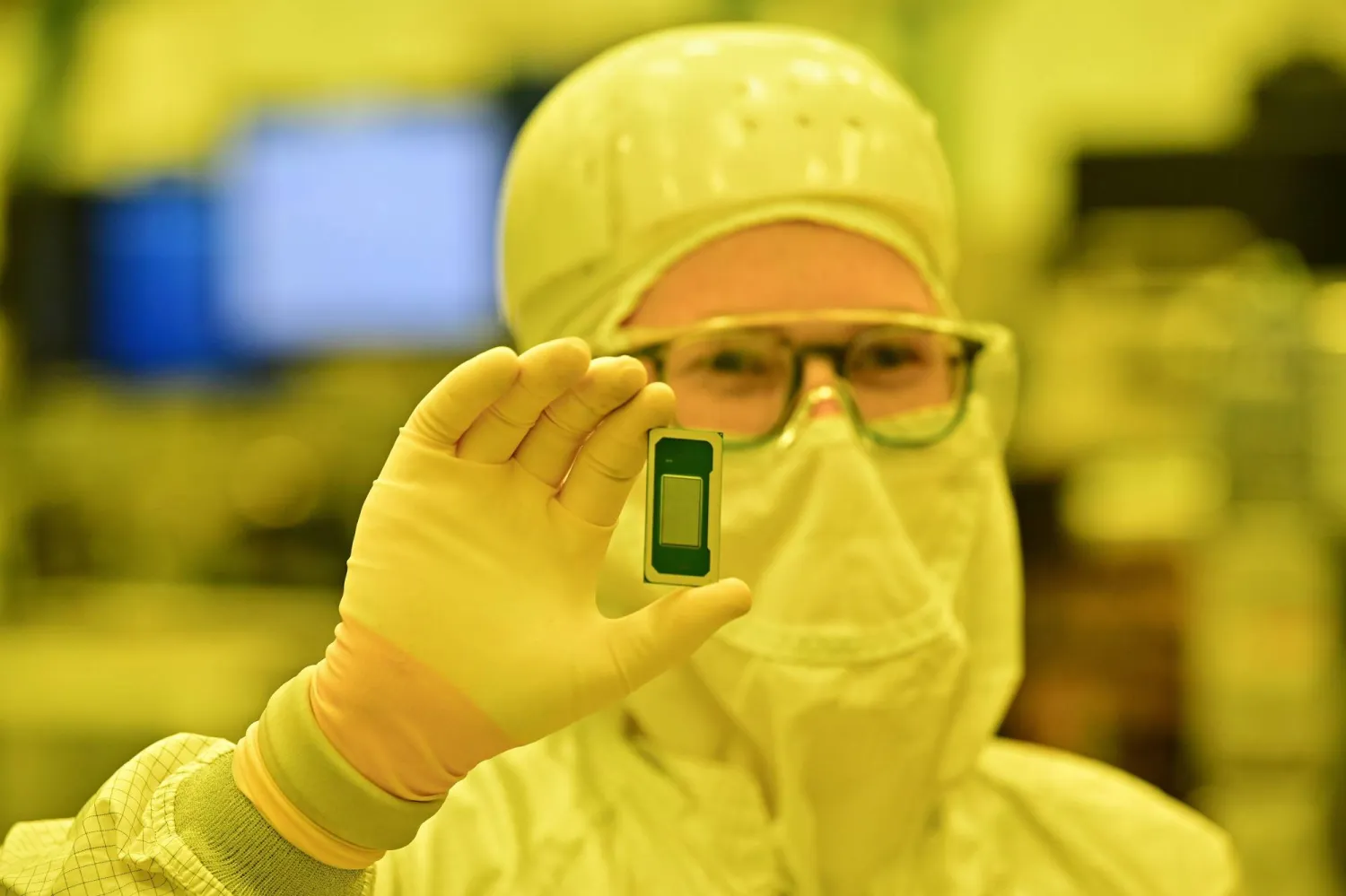

In the blistering heat of the Arizona desert, Intel staged a quiet revolution. At the Intel Technology Tour 2025 in Phoenix, the company didn’t just unveil new processors. It revealed a plan to rebuild the foundations of computing itself.
This wasn’t a spec-sheet update. It was the kind of pivot that comes along once in a generation, one that could rewrite how artificial intelligence is powered, trained, and trusted.
At this invite-only event, where Asharq Al-Awsat was the sole Arabic media presence from the Middle East, Intel showed off technologies that don’t merely shrink transistors but re-imagine how electricity and intelligence flow through silicon.
The Day Power Flipped
“For the first time in semiconductor history, we’re moving power delivery to the backside of the chip,” said James Johnson, Intel’s senior vice president and head of client computing, as he introduced PowerVia, a design shift the company calls nothing less than a revolution.
He wasn’t exaggerating. Instead of channelling energy through the maze of wires on top of a processor, PowerVia feeds it directly from behind, shorter paths, less resistance, fewer losses. The result: chips that run 30 percent more efficiently and 10 percent denser than before.
Paired with Intel’s new 2-nanometer RibbonFET transistors, the technology anchors Intel’s audacious roadmap: “Five nodes in four years.” By 2026, the company wants to reclaim the lead it ceded to TSMC and Samsung in advanced manufacturing.
“What we’re seeing,” said Stephen Robinson, one of Intel’s senior fellows, “is an unprecedented convergence between architectural innovation and manufacturing maturity.”
In other words, it’s not just about how small the chip gets, it’s about how smart it becomes.
Beyond the Shrink
For decades, the semiconductor race was about scale: who could pack more transistors into less space. But Robinson insists the game has changed.
“It’s no longer about shrinking the transistor,” he told Asharq Al-Awsat. “It’s about rethinking how every element works together to reach efficiencies no one’s seen before.”
Intel calls this philosophy System Technology Co-Optimization, or STCO. It’s engineering meets orchestration: physics, logic, and AI co-designed in a single loop. Think of it as turning the chip into a living ecosystem, not a static piece of silicon.
Robinson calls this moment a “once-in-a-lifetime opportunity” for the industry, a rare alignment of physics, data, and human ingenuity.
The AI Inside Everything
If the chip is the body, then AI is the brain now wired into it.
According to Thomas Petersen, Intel’s senior fellow for architecture and graphics, the company’s next move is about making every processor think collectively—a symphony of CPU, GPU, and NPU working as one organism.
“We’re designing processors to think together, not separately,” Petersen said.
“The days of each chip doing one job are over.”
The star of this new generation is Panther Lake, Intel’s 2026 platform for the AI PC. By weaving neural processing directly into the CPU, your laptop becomes a stand-alone AI engine, running tasks locally, instantly, and privately without the cloud on constant call.
“The goal isn’t just to get an answer from a smart model,” Petersen said. “It’s to get it instantly, privately, and with minimal energy. That’s the philosophy of the next intelligent computer.”
The shift marks a turning point from “assisted intelligence” to “active intelligence.” The PC won’t just help, it will collaborate. Users will work side-by-side with autonomous AI agents that analyze, plan, and respond in real time.
“We’re building chips that understand the meaning of data,” Petersen said, “not just calculate it.”
When AI Becomes a Colleague
At a session titled Gemini Enterprise AI, Intel described the next stage of enterprise computing: Agentic AI, systems that don’t just support humans but work alongside them.
“AI is no longer a tool,” said one speaker. “It’s a co-worker.”
Intel’s idea of Agentic Work Environments envisions teams of human employees and AI agents collaborating, making decisions, and even negotiating outcomes within secure, governed frameworks. The glue that holds it all together? Trust—not as a software patch, but as hardware architecture.
“Autonomous agents can behave unpredictably,” said an Intel security engineer. “That’s why trust must live in the silicon itself.”
To enforce that trust, Intel upgraded its Trusted Execution Environment (TEE) and hardware isolation systems, ensuring that AI models run inside encrypted, quarantined zones. In an era where synthetic content and model-to-model interaction are exploding, Intel sees this as the first line of defence in the new AI frontier.
Hyper-Connectivity: The Nervous System of AI
Fast intelligence is meaningless without fast connection.
At the “Wireless Innovations” session, Intel engineers previewed Wi-Fi 8, 5G Advanced, and early glimpses of 6G. It is a future where every connected device becomes a mini data center, processing information locally with near-zero latency.
“The edge,” said one network architect, “is the new frontier for AI. The next models won’t just live in the cloud; they’ll live in the world around us.”
That world includes the Middle East. From NEOM’s digital twins to autonomous transport grids across Saudi Arabia and the UAE, the region’s smart-city projects rely on the kind of ultra-low latency and reliability Intel is building into its chipsets and modems.
The New Metric: Sustainability
Even in a week obsessed with speed, sustainability was the quiet headline.
“Efficiency isn’t just performance per watt,” said Tim Wilson, Intel’s vice president of design engineering. “It’s responsibility per watt.”
Intel now recycles over 95 percent of its water, pursues zero-waste fabs, and designs chips that literally waste less power inside themselves. PowerVia doesn’t just make circuits cleaner, it makes computing greener.
“In the age of AI,” Wilson said, “sustainability isn’t optional. It’s a design constraint.”
That ethos mirrors the Middle East’s own goals: energy-efficient cities, renewable-powered data centers, and carbon-neutral digital growth under Saudi Vision 2030 and the UAE’s Net Zero agenda.
A New Connection with the Middle East
Though Phoenix was the stage, the conversation kept circling back to the Gulf.
Saudi Arabia is investing billions into AI, cloud infrastructure, and sovereign data centers laying the groundwork for a future semiconductor industry of its own. Intel, sensing the region’s momentum, has begun collaborating with Gulf universities and research labs on chip design and AI engineering.
A senior Intel official confirmed ongoing talks with sovereign wealth funds on potential partnerships for advanced packaging and local manufacturing projects.
The subtext: the Middle East isn’t a spectator in the AI race, it’s a stakeholder.
Making AI for Everyone
Perhaps the most radical idea at Phoenix wasn’t technical, it was social.
Intel wants to democratize AI. Through its Gaudi3 and Gaudi4 accelerators, the company is offering a low-cost alternative for training massive models up to 50 percent cheaper than rival platforms.
“AI shouldn’t be a luxury item,” an Intel executive said. “It should be like electricity, accessible, reliable, and sustainable.”
That principle could reshape emerging tech ecosystems, especially in places like Saudi Arabia, where national AI strategies hinge on local innovation. Affordable compute means universities and startups can train their own models, rather than rent power from global giants, a leap toward digital sovereignty.
The Hidden Infrastructure of Trust
As AI grows more autonomous, the question isn’t what it can do, it’s who decides what it should do.
Intel’s answer lies deep in the chip’s DNA.
“We used to protect data,” one Intel researcher told Asharq Al-Awsat. “Now we protect behavior. When models can make decisions, you need silicon that understands trust.”
The company is developing digital IDs for AI agents, encrypted model training, and physical data isolation layers, technologies increasingly vital for sectors like defence, energy, and finance.
In the Gulf, this vision echoes work by SDAIA, Saudi Arabia’s Data and AI Authority, which is crafting a national framework for AI governance and safety.
Both share the same core belief: trust isn’t a checkbox; it’s an engineering discipline.
A Legacy Reinvented
By the end of the Phoenix tour, one thing was clear: Intel isn’t just trying to win the AI race. It’s trying to redefine what leadership looks like in an era where machines think, learn, and act.
Intel sees itself as “the custodian of computing’s evolution” the thread connecting the first microprocessor to the age of autonomous intelligence.
“We stand at the intersection of physics, logic, and imagination,” Robinson said in his closing remarks. “That’s where the future of intelligence, human and artificial, truly lies.”
Petersen added a line that could have come straight from Wired’s own manifesto:
“The future of AI is too big to be locked behind closed walls. Our role is to empower everyone, from startups to governments to build on our technology.”


