


Samsung Expects Best Profit Since 2022, as AI Boom Squeezes Commodity Chip Supply 

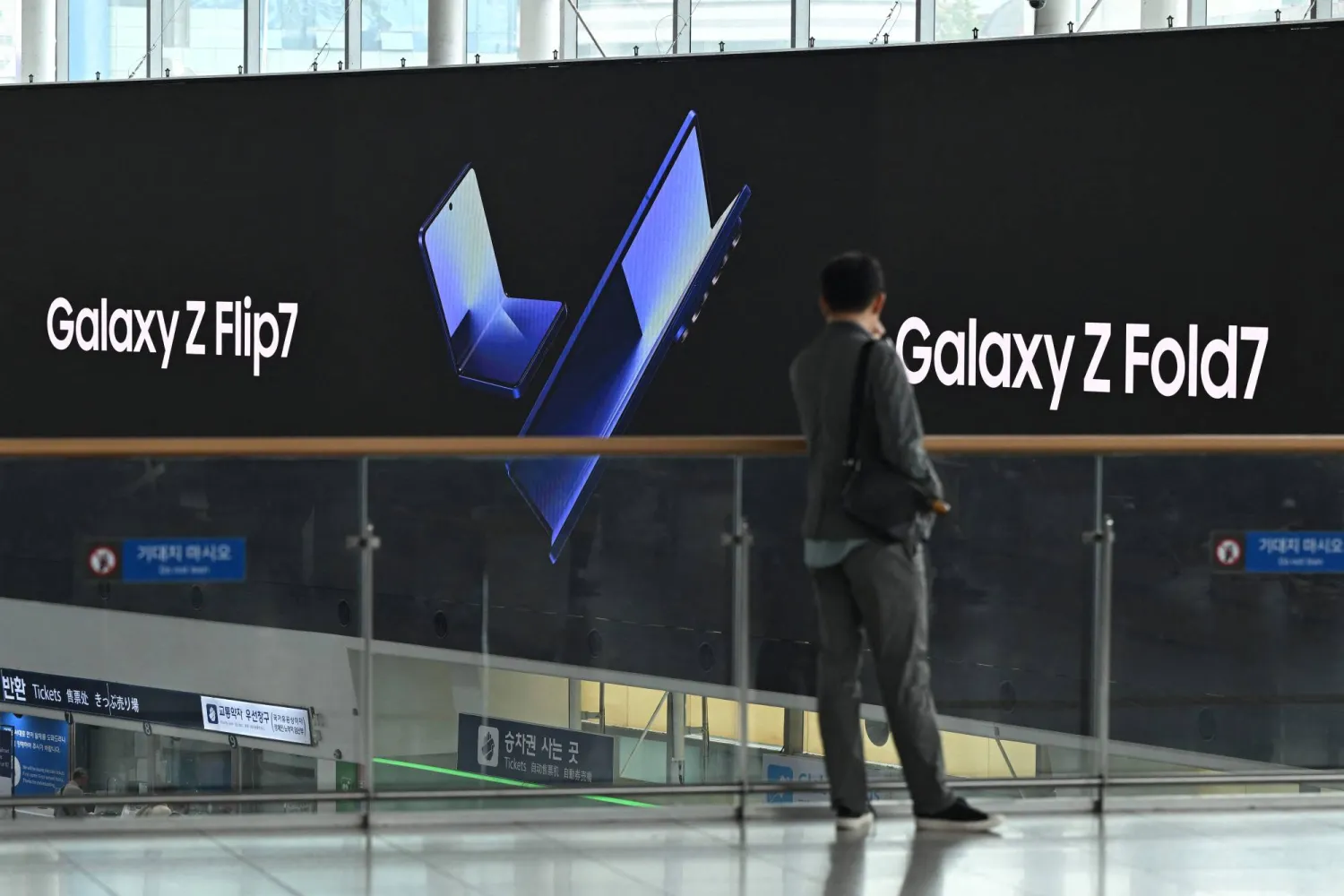
A man stands in front of a large electronic screen showing Samsung Galaxy Z Flip7 and Fold7 smartphones at Seoul train station in Seoul on October 14, 2025. (AFP)
TT

Samsung Expects Best Profit Since 2022, as AI Boom Squeezes Commodity Chip Supply 

A man stands in front of a large electronic screen showing Samsung Galaxy Z Flip7 and Fold7 smartphones at Seoul train station in Seoul on October 14, 2025. (AFP)

Samsung Electronics on Tuesday said it expects its biggest quarterly profit in over three years, as the global race to boost production of AI chips has tightened supply and driven up prices of conventional memory chips, the tech giant's mainstay.

Strong demand for conventional memory chips used in data center servers helped offset weaker sales of advanced artificial intelligence chips of Samsung, which has been lagging rivals in the race to supply to Nvidia, analysts said.

The world's leading memory chipmaker estimated an operating profit of 12.1 trillion won ($8.5 billion) for the July-September period, up 32% from a year earlier and well above a 10.1 trillion won LSEG SmartEstimate. That would mark its best quarterly profit in 13 quarters.

Samsung shares slipped 0.5% as of 0302 GMT after rising as much as 2.9% earlier to their highest level since January 2021. Analysts attributed the decline to profit-taking following the rally. The stock has risen about 75% this year.

"The third-quarter earnings surprise came from the chip business," said Ryu Young-ho, a senior analyst at NH Investment & Securities.

Strong demand for conventional memory to support general-purpose servers, combined with robust HBM demand for AI servers, have together fueled overall memory demand, he said.

Although progress in supplying advanced high bandwidth memory (HBM) chips to major clients such as Nvidia was slower than expected, gains in commodity memory, supported by tight supplies, helped cushion the impact, analysts said.

"Samsung is a big beneficiary of growing demand for commodity chips," said Sohn In-joon, an analyst at Heungkuk Securities.

Sohn attributed the earnings beat to stronger-than-expected prices of commodity DRAM and NAND chips, stemming from demand for data center servers, and lower chip inventory by chipmakers that gave them bargaining power in pricing.

Analysts said Samsung also benefited from narrower losses at its foundry unit, which makes logic chips, as utilization rates helped ease fixed-cost pressures.

The company said revenue would likely rise 8.7% to a record high of 86 trillion won from a year earlier, also helped by the weaker South Korean currency.

Samsung is expected to release detailed results including a breakdown of earnings for each of its businesses on October 30.

Expanding on its stock incentives for senior executives, the company has decided to launch a performance-linked stock compensation plan for all employees in South Korea over the next three years, according to an internal memo dated October 14, seen by Reuters. Samsung declined to comment on the plan.

SHORTAGE STOKES CONVENTIONAL CHIP PRICES

Analysts said memory makers' focus on investing in advanced chips in recent years may have limited the production of conventional chips, which extended a supply shortage and spurred price increases for conventional chips.

Prices of some DRAM chips, widely used in servers, smartphones and PCs, jumped 171.8% in the third quarter from a year earlier, according to TrendForce data.

Analysts expect the commodity memory supply shortage to continue into 2026, with big tech companies expanding their spending on AI-related investments, including data centers and servers capable of handling the growing workloads from AI services.

While recent chip supply deals with major tech companies, such as Tesla and OpenAI, eased investor concerns about Samsung, analysts cautioned that uncertainties remain that could hurt Samsung's consumer products, including potential US tariffs, an intensifying trade war between the US and China, as well as China's tightened export controls on rare earth materials used in advanced chips and manufacturing equipment.

Samsung has been the world's biggest memory chipmaker for three decades, but it is facing increasing competition in advanced AI chips after losing its No. 1 DRAM market share to SK Hynix in the first quarter of this year.

Analysts expect Samsung’s HBM sales to gradually improve after the company made meaningful progress in supplying its latest 12-layer HBM3E chips to Nvidia, though some said shipment volumes remain limited.

Samsung is betting on next-generation HBM4 products to narrow the gap with SK Hynix. Morgan Stanley said in a report that Samsung is on track with next-generation HBM4 development, working closely with major US customers. Commercial shipments and sales contributions are expected to begin in 2026.



AI Bubble to Be Short-lived, Rebound Stronger, NTT DATA Chief Says

FILE PHOTO: Figurines with computers and smartphones are seen in front of the words "Artificial Intelligence AI" in this illustration taken, February 19, 2024. REUTERS/Dado Ruvic/Illustration/File Photo
TT

AI Bubble to Be Short-lived, Rebound Stronger, NTT DATA Chief Says

FILE PHOTO: Figurines with computers and smartphones are seen in front of the words "Artificial Intelligence AI" in this illustration taken, February 19, 2024. REUTERS/Dado Ruvic/Illustration/File Photo

A potential artificial intelligence bubble will deflate faster than past tech cycles but give way to an even stronger rebound as corporate adoption catches up with infrastructure spending, the head of Japanese IT company NTT DATA Inc. said.

Despite worries around supply chains, the direction of travel is clear, CEO Abhijit Dubey said in an interview with the Reuters Global Markets Forum.

"There is absolutely no doubt that in the medium- to long-term, AI is a massive secular trend," he said.

"Over the next 12 months, I think we're going to have a bit of a normalization ... It'll be a short-lived bubble, and (AI) will come out of it stronger."

With demand for compute still running ahead of supply, "supply chains are almost spoken for" over the next two to three years, he said. Pricing power is already tilting toward chipmakers and hyperscalers, mirroring their stretched valuations in public markets, he added.

AI has triggered the biggest technological shake-up since the advent of the internet, fueling trillions of dollars of investment and eye-watering equity gains. But it has caused shortages of memory chips, drawn regulatory scrutiny, and created growing unease over the future of work.

Dubey, who is also the firm's chief AI officer, said his company has begun rethinking recruitment strategies as AI reshapes labor markets.

"There will clearly be an impact ... Over a five- to 25-year horizon, there will likely be dislocation," he said. However, he added that NTT DATA continues to hire across locations.

Speakers at the Reuters NEXT conference in New York discussed how AI may upend work and job growth.

AI startup Writer Inc.'s CEO May Habib said customers are focused on slowing headcount growth.

"You close a customer, you get on the phone with the CEO to kick off the project, and it's like, 'Great, how soon can I whack 30% of my team?'," she said.

Still, a PwC survey of the global workforce released in November suggests the reality of generative AI usage has yet to match boardroom expectations.

Daily use of GenAI remains "significantly lower" than widely touted by executives, PwC said, even as workers with AI skills commanded an average wage premium of 56% — more than double last year's figure.

PwC also flagged a widening skills gap, with about half of non-managers reporting access to training resources, compared with roughly three-quarters of senior executives.


EU Launches Antitrust Probe into Meta over Use of AI in WhatsApp

FILE - Attendees visit the Meta booth at the Game Developers Conference 2023 in San Francisco on March 22, 2023. (AP Photo/Jeff Chiu, File)
TT

EU Launches Antitrust Probe into Meta over Use of AI in WhatsApp

FILE - Attendees visit the Meta booth at the Game Developers Conference 2023 in San Francisco on March 22, 2023. (AP Photo/Jeff Chiu, File)

Brussels has opened a new antitrust investigation into Meta Platforms over its rollout of artificial intelligence features in WhatsApp, the European Commission said on Thursday, reflecting rising scrutiny of Big Tech's use of generative AI.

The move, reported earlier by Reuters and the Financial Times, marks the latest action by European regulators against large technology firms as the bloc seeks to balance support for the sector with efforts to curb its expanding influence.

The European Commission opened the investigation into "Meta's new policy regarding AI providers' access to WhatsApp" after the California-based company integrated its Meta AI system into the messaging service earlier this year.

A WhatsApp spokesperson said that "the claims are baseless", adding that the emergence of chatbots on its platforms "puts a strain on our systems that they were not designed to support".

"Even still, the AI space is highly competitive and people have access to the services of their choice in any number of ways, including app stores, search engines, email services, partnership integrations, and operating systems."

Meta AI, a chatbot and virtual assistant, has been built into WhatsApp's interface since March 2025 across European markets.

Italy's antitrust watchdog opened a parallel investigation in July into allegations that Meta leveraged its market power by integrating an AI tool into WhatsApp. The probe was expanded in November to examine whether Meta further abused its dominance by blocking rival AI chatbots from the messaging platform.

The FT, citing officials, said that the EU probe will be conducted under traditional antitrust rules rather than the EU's Digital Markets Act, the bloc's landmark legislation currently used to scrutinize Amazon and Microsoft's cloud services for potential curbs.


Nintendo Launches Long-awaited 'Metroid Prime 4' Sci-fi Blaster

The 'Metroid' series's unique look has garnered many fans since it began in 1986. Ina FASSBENDER / AFP/File
TT

Nintendo Launches Long-awaited 'Metroid Prime 4' Sci-fi Blaster

The 'Metroid' series's unique look has garnered many fans since it began in 1986. Ina FASSBENDER / AFP/File

Fans of Nintendo's "Metroid" science-fiction saga have reason to celebrate Thursday as the latest instalment in the series is released after an eight-year wait and a bumpy road through development.

Drawing loose inspiration from the "Alien" movies since its first title in 1986, the game series has followed the adventures of space bounty hunter Samus Aran in her battle with the extraterrestrial Metroid, said AFP.

Over 15 instalments, the saga evolved from 2D platforming and exploration into a first-person action-adventure format from 2002, when the first "Metroid Prime" appeared on the Gamecube console.

Now "Metroid Prime 4: Beyond" will take players on Switch 1 or 2 to a distant planet they can explore on foot or by motorbike in Samus's distinctive armored suit.

Equipped with an arm-mounted cannon and a suite of psychic powers to overcome different challenges, players must blaze a trail through jungles or deserts as they battle enemies.

In a novelty for this instalment, players can use the Switch 2's detachable controller handset like a computer mouse to look around the environment -- making the game more comfortable for people used to gaming on a PC setup.

Critics have largely welcomed the new game, with a score of 81 out of 100 based on 71 reviews aggregated by the Metacritic website.

That's a relief for Nintendo after its painful and rare decision to restart development from scratch in 2019 -- 18 months after the title's initial unveiling.

The Japanese giant's first take had "not reached the standards we seek", Nintendo development lead Shinya Takahashi said at the time in a YouTube video.

Nintendo instead handed the job to its US-based development house Retro Studios, which created the first three "Metroid Prime" titles.

The years flying under the radar for "Prime 4" meant it joined longed-for future titles like "Half-Life 3" from Valve or "Beyond Good and Evil 2" from Ubisoft among game fans' white whales.