


Samsung's Galaxy XR Headset to Take on Apple with Help from Google and Qualcomm 

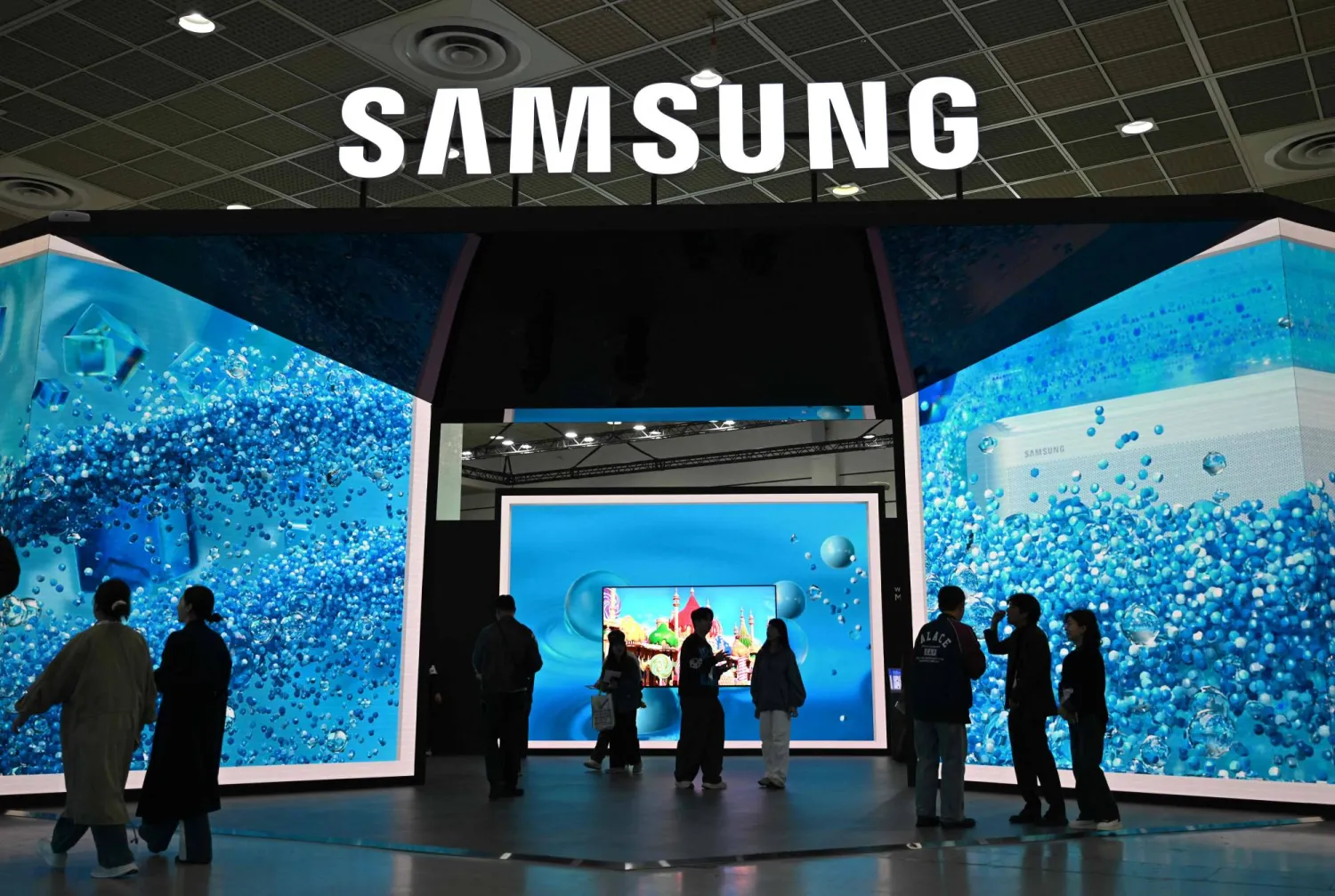
Visitors walk past the Samsung Electronics booth during the Korea Electronics Show 2025 at the COEX convention and exhibition center in Seoul on October 22, 2025. (AFP)
TT

Samsung's Galaxy XR Headset to Take on Apple with Help from Google and Qualcomm 

Visitors walk past the Samsung Electronics booth during the Korea Electronics Show 2025 at the COEX convention and exhibition center in Seoul on October 22, 2025. (AFP)

Samsung Electronics released its Galaxy XR extended reality headset on Tuesday, counting on AI features from Google to propel it into the nascent and uncertain market of computing-on-your-face that is dominated by Meta and Apple.

The headset, resembling those made by others such as Meta, will cost $1,799, or about half of what Apple charges for its Vision Pro headset.

It is the first of a family of new devices, powered by the Android XR operating system and artificial intelligence, in a long-term partnership with Alphabet's Google and Qualcomm.

"There's a whole journey ahead of us in terms of other devices and form factors," said Google's vice president of AR/XR Sharham Izadi in an interview ahead of the launch.

Up next will be the release of lighter eyeglasses, executives said, declining to elaborate. Samsung has announced partnerships with Warby Parker and South Korea's Gentle Monster luxury eyewear.

The race to find new form factors for entertainment and computing, underpinned by AI, has fueled a battle among the biggest technology companies. Instagram-owner Meta overwhelmingly dominates the VR headset industry with about an 80% market share, with Apple trailing behind.

ChatGPT-maker OpenAI is also diving into the market and spent $6.5 billion to buy iPhone designer Jony Ive's hardware startup io Products in May to figure out devices in the AI age.

Samsung has studied the extended reality segment for the past 10 years, and it was not until about four years ago that the company approached Google to jointly develop the project, codenamed "Moohan," meaning "infinite" in Korean, said Jay Kim, executive vice president at Samsung's mobile division.

"We have been agonizing over when to bring the product to the market, and considering various factors such as technology evolution and market situation, we believe that now is the best timing," he said at a briefing in Seoul on Wednesday.

USING GOOGLE AI STRENGTH

The long-awaited Samsung Galaxy XR, first demonstrated last year, combines virtual reality and mixed reality features. The goggles immerse users watching videos, such as on Alphabet's YouTube, or playing games and viewing pictures, while also allowing users to interact with their surroundings.

The latter feature takes advantage of Google's Gemini service, which can analyze what users are seeing and offer directions or information about real-world objects by looking and circling objects with their fingers.

In an interview last week, executives from Google and Samsung discussed how they believe extended reality headsets, which have yet to ignite mass consumer interest, would benefit greatly from the application of Google's powerful multimodal AI features throughout the device that can process information from different types of data such as text, photos and videos.

It's a set of software capabilities that Apple has yet to demonstrate, despite rolling out an updated Vision Pro with a more powerful chip.

"Google entering the fray again changes the dynamic in the ecosystem," said Anshel Sag, principal analyst at Moor Insights & Strategy, noting that Google's software added $1,000 in value to the device by some estimates. "Google really wants people to get the full experience of Gemini when using this headset."

Customers who buy the device this year will receive a bundle of free services including 12 months of access to Google AI Pro, YouTube Premium, Google Play Pass and other specialized XR content, the companies said.

The prototype for AI-enhanced goggles was ready by the time Apple had launched its Vision Pro headset in 2024, executives said, as they sought to enhance existing applications like YouTube and Google Photos and Google Maps, while creating new immersive experiences.

Like many first generation technologies, it attempts to do multiple things that could have consumer and enterprise applications.

Qualcomm is providing its Snapdragon XR2+ Gen 2 chip to power the headset.

DIFFICULT MARKET

Many tech CEOs have been seduced by what they say is the next big thing in personal computing, but the market remains tiny by tech standards.

Research firm Gartner estimated the global Head-Mounted Display market is expected to rise by 2.6% from this year to $7.27 billion next year. Lighter, eyeglass-type AI devices such as Meta's smartglasses made in collaboration with EssilorLuxottica Ray-Bans are expected to drive most of this growth.

Despite the expanding competitive landscape, the global virtual reality market, which includes so-called "mixed reality" headsets launching more recently, has faced three consecutive years of decline. Weakening again, shipments in 2025 are expected to fall 20% year on year, according to research firm Counterpoint.

"With a potentially more competitive price point than Apple’s Vision Pro, Samsung’s Project Moohan headset could emerge as a strong contender in the premium VR segment, particularly within the enterprise market," Counterpoint senior analyst Flora Tang.

The Galaxy XR is the first Android XR device. But Samsung has dabbled with face-mounted computing devices dating back a decade, involving slipping a smartphone into a headset, called the Gear VR, in partnership with VR headset maker Oculus. Meta acquired Oculus in 2014.



New Process for Stable, Long-Lasting Batteries

The image shows a test cell used to fabricate and test the all-solid-state battery developed at PSI. (Paul Scherrer Institute PSI/Mahir Dzambegovic) 
TT

New Process for Stable, Long-Lasting Batteries

The image shows a test cell used to fabricate and test the all-solid-state battery developed at PSI. (Paul Scherrer Institute PSI/Mahir Dzambegovic) 

Researchers at the Paul Scherrer Institute PSI have achieved a breakthrough on the path to practical application of lithium metal all-solid-state batteries.

The team expects the next generation of batteries to store more energy, are safer to operate, and charge faster than conventional lithium-ion batteries.

The team has reported these results in the journal Advanced Science.

All-solid-state batteries are considered a promising solution for electromobility, mobile electronics, and stationary energy storage – in part because they do not require flammable liquid electrolytes and therefore are inherently safer than conventional lithium-ion batteries.

Two key problems, however, stand in the way of market readiness: On the one hand, the formation of lithium dendrites at the anode remains a critical point.

On the other hand, an electrochemical instability – at the interface between the lithium metal anode and the solid electrolyte – can impair the battery’s long-term performance and reliability.

To overcome these two obstacles, the team led by Mario El Kazzi, head of the Battery Materials and Diagnostics group at the Paul Scherrer Institute PSI, developed a new production process:

“We combined two approaches that, together, both densify the electrolyte and stabilize the interface with the lithium,” the scientist explained.

Central to the PSI study is the argyrodite type LPSCl, a sulphide-based solid electrolyte made of lithium, phosphorus, and sulphur. The mineral exhibits high lithium-ion conductivity, enabling rapid ion transport within the battery – a crucial prerequisite for high performance and efficient charging processes.

To densify argyrodite into a homogeneous electrolyte, El Kazzi and his team did incorporate the temperature factor, but in a more careful way: Instead of the classic sintering process, they chose a gentler approach in which the mineral was compressed under moderate pressure and at a moderate temperature of only about 80 degrees Celsius.

The result is a compact, dense microstructure resistant to the penetration of lithium dendrites. Already, in this form, the solid electrolyte is ideally suited for rapid lithium-ion transport.

To ensure reliable operation even at high current densities, such as those encountered during rapid charging and discharging, the all-solid-state cell required further modification.

For this purpose, a coating of lithium fluoride (LiF), only 65 nanometres thick, was evaporated under vacuum and applied uniformly to the lithium surface – serving as a ultra-thin passivation layer at the interface between the anode and the solid electrolyte.

In laboratory tests with button cells, the battery demonstrated extraordinary performance under demanding conditions.

“Its cycle stability at high voltage was remarkable,” said doctoral candidate Jinsong Zhang, lead author of the study.

After 1,500 charge and discharge cycles, the cell still retained approximately 75% of its original capacity.

This means that three-quarters of the lithium ions were still migrating from the cathode to the anode. “An outstanding result. These values are among the best reported to date.”

Zhang therefore sees a good chance that all-solid-state batteries could soon surpass conventional lithium-ion batteries with liquid electrolyte in terms of energy density and durability.

Thus El Kazzi and his team have demonstrated for the first time that the combination of solid electrolyte mild sintering and a thin passivation layer on lithium anode effectively suppresses both dendrite formation and interfacial instability.

This combined solution marks an important advance for all-solid-state battery research – not least because it offers ecological and economic advantages: Due to the low temperatures, the process saves energy and therefore costs.

“Our approach is a practical solution for the industrial production of argyrodite-based all-solid-state batteries,” said El Kazzi. “A few more adjustments – and we could get started.”


Meta Urges Australia to Change Teen Social Media Ban

Meta has called for Australia's social media for under-16s to target app stores. Saeed KHAN / AFP
TT

Meta Urges Australia to Change Teen Social Media Ban

Meta has called for Australia's social media for under-16s to target app stores. Saeed KHAN / AFP

Tech giant Meta urged Australia on Monday to rethink its world-first social media ban for under-16s, while reporting that it has blocked more than 544,000 accounts under the new law.

Australia has required big platforms including Meta, TikTok and YouTube to stop underage users from holding accounts since the legislation came into force on December 10 last year.

Companies face fines of Aus $49.5 million (US$33 million) if they fail to take "reasonable steps" to comply.

Billionaire Mark Zuckerberg's Meta said it had removed 331,000 underage accounts from Instagram, 173,000 from Facebook, and 40,000 from Threads in the week to December 11.

The company said it was committed to complying with the law.

"That said, we call on the Australian government to engage with industry constructively to find a better way forward, such as incentivizing all of industry to raise the standard in providing safe, privacy-preserving, age appropriate experiences online, instead of blanket bans," it said in statement.

Meta renewed an earlier call for app stores to be required to verify people's ages and get parental approval before under-16s can download an app.

This was the only way to avoid a "whack-a-mole" race to stop teens migrating to new apps to avoid the ban, the company said.

The government said it was holding social media companies to account for the harm they cause young Australians.

"Platforms like Meta collect a huge amount of data on their users for commercial purposes. They can and must use that information to comply with Australian law and ensure people under 16 are not on their platforms," a government spokesperson said.

Meta said parents and experts were worried about the ban isolating young people from online communities, and driving some to less regulated apps and darker corners of the internet.

Initial impacts of the legislation "suggest it is not meeting its objectives of increasing the safety and well-being of young Australians", it said.

While raising concern over the lack of an industry standard for determining age online, Meta said its compliance with the Australian law would be a "multilayered process".

Since the ban, the California-based firm said it had helped found the OpenAge Initiative, a non-profit group that has launched age-verification tools called AgeKeys to be used with participating platforms.


China Is Closing in on US Technology Lead Despite Constraints, AI Researchers Say

 Visitors look at robots on display at robotics company Unitree's first retail store in Beijing in January 9, 2026. (AFP)
Visitors look at robots on display at robotics company Unitree's first retail store in Beijing in January 9, 2026. (AFP)
TT

China Is Closing in on US Technology Lead Despite Constraints, AI Researchers Say

 Visitors look at robots on display at robotics company Unitree's first retail store in Beijing in January 9, 2026. (AFP)
Visitors look at robots on display at robotics company Unitree's first retail store in Beijing in January 9, 2026. (AFP)

China can narrow its technological gap with the US driven by growing risk-taking and innovation, though the lack of advanced chipmaking tools is hobbling the sector, the country's leading artificial intelligence researchers said on Saturday.

China's so-called "AI tiger" startups MiniMax and Zhipu AI had strong debuts on the Hong Kong Stock Exchange this week, reflecting growing confidence in the sector as Beijing fast-tracks AI and chip listings to bolster domestic alternatives to advanced US technology.

Yao Shunyu, a former senior researcher at ChatGPT maker OpenAI ‌who was named ‌technology giant Tencent's chief AI scientist in December, ‌said ⁠there was a ‌high likelihood of a Chinese firm becoming the world's leading AI company in the next three to five years but said the lack of advanced chipmaking machines was the main technical hurdle.

"Currently, we have a significant advantage in electricity and infrastructure. The main bottlenecks are production capacity, including lithography machines, and the software ecosystem," Yao said at an AI conference in Beijing.

China has completed a working prototype of an extreme-ultraviolet lithography ⁠machine potentially capable of producing cutting-edge semiconductor chips that rival the West's, Reuters reported last month. However, the ‌machine has not yet produced working chips and may ‍not do so until 2030, people with ‍knowledge of the matter told Reuters.

MIND THE INVESTMENT GAP

Yao and other ‍Chinese industry leaders at the Beijing conference on Saturday also acknowledged that the US maintains an advantage in computing power due to its hefty investments in infrastructure.

"The US computer infrastructure is likely one to two orders of magnitude larger than ours. But I see that whether it's OpenAI or other platforms, they're investing heavily in next-generation research," said Lin Junyang, technical lead for Alibaba's flagship Qwen large language model.

"We, ⁠on the other hand, are relatively strapped for cash; delivery alone likely consumes the majority of our computer infrastructure," Lin said during a panel discussion at the AGI-Next Frontier Summit held by the Beijing Key Laboratory of Foundational Models at Tsinghua University.

Lin said China's limited resources have spurred its researchers to be innovative, particularly through algorithm-hardware co-design, which enables AI firms to run large models on smaller, inexpensive hardware.

Tang Jie, founder of Zhipu AI which raised HK$4.35 billion in its IPO, also highlighted the willingness of younger Chinese AI entrepreneurs to embrace high-risk ventures - a trait traditionally associated with Silicon Valley - as a positive development.

"I think if we can improve this environment, ‌allowing more time for these risk-taking, intelligent individuals to engage in innovative endeavors ... this is something our government and the country can help improve," said Tang.