


China Excludes EVs in Latest Five-year Plan as Industry Grapples with Oversupply

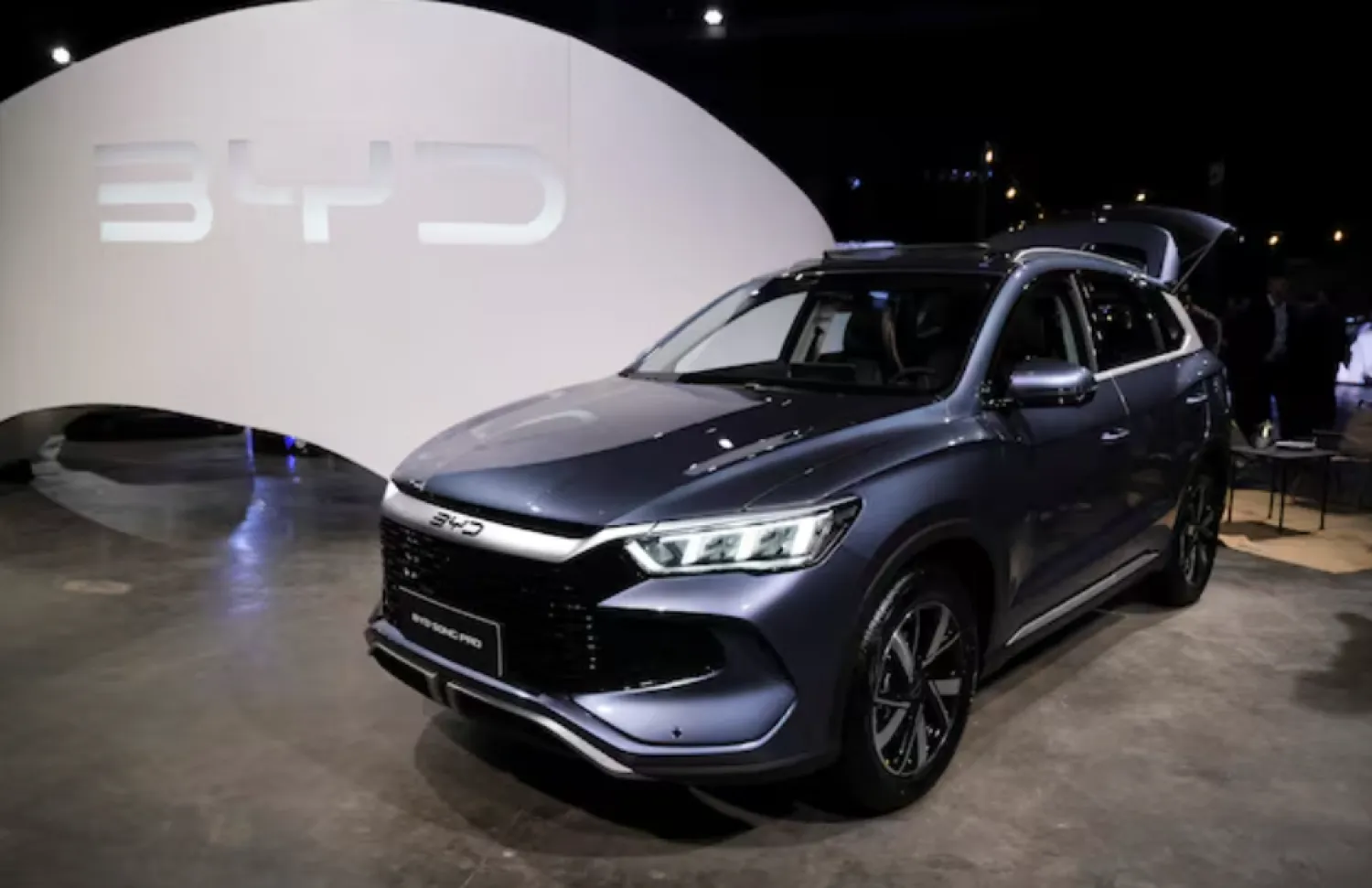
A BYD Song Pro electric vehicle is displayed during the launch event of Chinese electric vehicle (EV) maker BYD in Buenos Aires, Argentina, October 8, 2025. REUTERS/Alessia Maccioni/File Photo
TT

China Excludes EVs in Latest Five-year Plan as Industry Grapples with Oversupply

A BYD Song Pro electric vehicle is displayed during the launch event of Chinese electric vehicle (EV) maker BYD in Buenos Aires, Argentina, October 8, 2025. REUTERS/Alessia Maccioni/File Photo

China has omitted electric vehicles from its list of strategic industries in its five-year development plan for 2026-2030, marking their first exclusion in more than a decade, as the sector grapples with oversupply challenges.

New energy vehicles (NEVs)— a category comprising EVs, plug-in hybrids, and fuel cell vehicles — were included as strategic emerging industries in the previous three five-year plans, aimed at sharpening industrial competitiveness, Reuters reported.

The central and local governments had provided billions of dollars in subsidies, helping China achieve a leading position in the global EV market and industry chain.

PLAN SETS QUANTUM, BIO-MANUFACTURING, HYDROGEN AS PRIORITIES

However, the 15th five-year plan, published by the official Xinhua News Agency on Tuesday, prioritizes quantum technology, bio-manufacturing, hydrogen energy, and nuclear fusion as new drivers of economic growth, omitting NEVs from the list.

Automobiles were mentioned alongside housing, with the government urging the removal of purchase restrictions to boost consumption.

The full five-year plan will be released at a parliamentary meeting in March.

China has over the years become the world's largest auto market. But the sector has been gripped by overcapacity, a prolonged price war and excessive competition.

In remarks on the new five-year plan published by Xinhua also on Tuesday, Chinese President Xi Jinping reiterated the importance of avoiding rushing to develop and invest in the same "new productive forces".

"We aim to guide all parties concerned to adopt a sound, rational, and realistic approach in their work and refrain from rushing headlong into new initiatives," Xi said.

Earlier this year, Xi questioned whether every province needed to develop industries such as artificial intelligence, computing power, and EVs, according to the People's Daily.

CHINA STRUGGLES WITH SATURATED DOMESTIC EV MARKET

Since China kicked off an EV push in 2009, a growing number of cities not traditionally known as mobility hubs, such as Hefei and Xi'an, have turned into EV heavyweights. The advances, in tandem with China's ambition to be a leading innovator, have almost every locality jostling for a place.

A saturated domestic market with dozens of EV brands vying for consumers' spend amid entrenched deflationary pressures is compounded by clouds hanging over car exports as China navigates trade tensions with the West.

China's Communist Party has issued five-year plans since 1953 to set economic and industrial priorities for the nation's development.



South Korea to Invest $166 Million in AI Chip Startup Rebellions

People walk near Gwanghwamun Square in Seoul, South Korea, 22 March 2026. The band performed their comeback concert on 21 March.  EPA/YONHAP
People walk near Gwanghwamun Square in Seoul, South Korea, 22 March 2026. The band performed their comeback concert on 21 March. EPA/YONHAP
TT

South Korea to Invest $166 Million in AI Chip Startup Rebellions

People walk near Gwanghwamun Square in Seoul, South Korea, 22 March 2026. The band performed their comeback concert on 21 March.  EPA/YONHAP
People walk near Gwanghwamun Square in Seoul, South Korea, 22 March 2026. The band performed their comeback concert on 21 March. EPA/YONHAP

South Korea's industry ministry on Tuesday said the Financial Services Commission's advisory board approved a 250 billion won ($166 million) investment in a local artificial intelligence chip startup called Rebellions, part of a government-backed push to nurture a homegrown advanced semiconductor firm.

Here are some details:

South Korea's Financial Services Commission advisory board, which evaluates investments in advanced strategic industries, ⁠approved a 250 ⁠billion won direct investment into Rebellions, an AI chip startup.

Rebellions, founded in 2020, designs neural processing units (NPUs) that handle AI computations.

The decision was made at a ⁠fund management committee meeting for the state-led "National Growth Fund," marking the first direct investment under the country's "K-Nvidia" initiative.

The funding will support Rebellions' mass production of NPU chips and the development of next-generation AI semiconductors, the industry ministry said in a statement.

The "K-Nvidia" project, jointly led by the Financial Services Commission and the ⁠Ministry ⁠of Science and ICT, seeks to nurture a globally competitive AI chip company amid intensifying competition in the sector, which is dominated by US firms like Nvidia.

The move underscores Seoul's efforts to strengthen its position in the AI supply chain and reduce reliance on foreign technology, as demand for high-performance computing chips surges.


Uber, Autonomous Mobility Firms to Launch Europe's 1st Commercial Robotaxis

Aerial photo shows light installation during the Festival of Lights in Zagreb, Croatia, March 18, 2026. REUTERS/Antonio Bronic
TT

Uber, Autonomous Mobility Firms to Launch Europe's 1st Commercial Robotaxis

Aerial photo shows light installation during the Festival of Lights in Zagreb, Croatia, March 18, 2026. REUTERS/Antonio Bronic

Uber Technologies and autonomous mobility companies Verne and Pony.ai have partnered up to launch Europe's first commercial robotaxi service in the Croatian capital Zagreb, with plans to expand to other cities, they said on Thursday.

Robotaxis are rapidly expanding into US cities as companies race to commercialize ⁠autonomous ride-hailing worldwide.

Alphabet's ⁠Waymo remains the early leader, while Tesla hopes its vast manufacturing scale and financial resources could reshape the competitive landscape.

The first ⁠commercial robotaxi service in Zagreb will be launched "soon,” the companies said.

Initial deployment work is underway, including public-road validation.

Pony.ai will provide autonomous driving solutions, while Verne will act as the fleet owner and service operator.

The three companies plan ⁠to ⁠expand the fleet to thousands of robotaxis in European cities over the next few years.

Uber and Nvidia said earlier this month they planned to expand their robotaxi service in 28 cities across North America, Europe, Australia and Asia.


Samsung, SK Urge Employees to Cut Car Use Amid Rising Energy Risks

FILE - The logo of the Samsung is seen at the Samsung Electronics' Seocho building in Seoul, South Korea, Friday, July 5, 2024.  (AP Photo/Lee Jin-man, File)
FILE - The logo of the Samsung is seen at the Samsung Electronics' Seocho building in Seoul, South Korea, Friday, July 5, 2024. (AP Photo/Lee Jin-man, File)
TT

Samsung, SK Urge Employees to Cut Car Use Amid Rising Energy Risks

FILE - The logo of the Samsung is seen at the Samsung Electronics' Seocho building in Seoul, South Korea, Friday, July 5, 2024.  (AP Photo/Lee Jin-man, File)
FILE - The logo of the Samsung is seen at the Samsung Electronics' Seocho building in Seoul, South Korea, Friday, July 5, 2024. (AP Photo/Lee Jin-man, File)

South Korean tech giants Samsung Electronics and SK Group said they were asking employees to curb private car use and follow fuel-saving measures after South Korea rolled ⁠out emergency energy-conservation steps ⁠amid instability in Middle Eastern energy supplies.

Internal notices showed the companies encouraging car-use restrictions ⁠such as a five and 10-day vehicle rotation system, reduced parking availability and other energy-saving practices at offices from Thursday for Samsung and from March 30 ⁠for ⁠SK.

The moves follow government guidance aimed at cutting fuel consumption as concerns grow over prolonged disruptions linked to the Iran-related energy crisis.