
Rise of the Robots: The Promise of Physical AI 

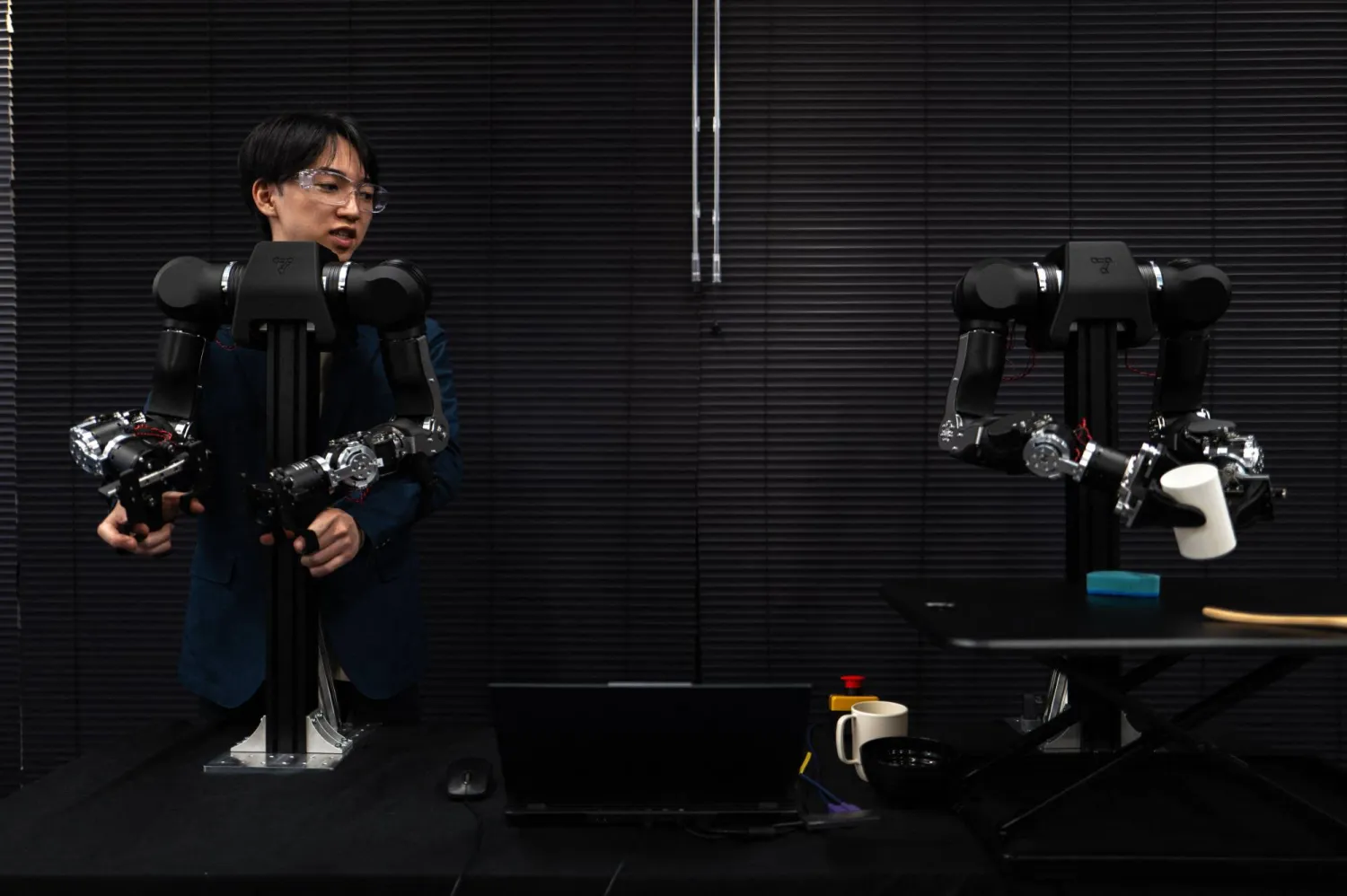
This picture taken on November 5, 2025 shows Hiro Yamamoto, CEO of company Enactic, tele-operating an OpenArm humanoid robotic arm at his office during an interview with AFP, in Tokyo. (AFP)
TT

Rise of the Robots: The Promise of Physical AI 

This picture taken on November 5, 2025 shows Hiro Yamamoto, CEO of company Enactic, tele-operating an OpenArm humanoid robotic arm at his office during an interview with AFP, in Tokyo. (AFP)

A pair of swiveling, human-like robotic arms, built for physical artificial intelligence research, mirror the motions of an operator in a VR headset twirling his hands like a magician.

With enough practice, arms like these can complete everyday tasks alone, claims Tokyo company Enactic, which is developing humanoid robots to wash dishes and do laundry in short-staffed Japanese care homes.

Welcome to the future of AI as it starts to infiltrate the material world in the form of smart robots, self-driving cars and other autonomous machines.

"The next wave of AI is physical AI," Jensen Huang, head of US chip giant Nvidia, said last year.

That's "AI that understands the laws of physics, AI that can work among us" and understands "how to perceive the world", Huang added.

Tech firms are pouring massive sums into physical AI, and Morgan Stanley predicts the world could have more than a billion humanoid robots by 2050.

The buzz is only heightened by videos showing advanced androids, often Chinese-made, dancing to Taylor Swift or pulling heavy objects with ease.

Beyond the promise of sci-fi robot butlers, the race has sparked concern over job losses, privacy and how long these innovations will take to actually be useful.

Hiro Yamamoto is the 24-year-old CEO of Enactic, whose OpenArm physical AI training devices are used by Nvidia and at top universities such as Stanford.

He plans to begin deploying new robots, currently under development, from next summer to "live alongside people in environments that are very chaotic, and where conditions are always changing" like care homes.

"So it has to be safe," with a soft exterior that won't injure anyone, Yamamoto said.

In the Chinese city of Guangzhou, a female figure with a glowing oval-shaped visor for a face, clad in white woven fabric like a fencing athlete, walked slowly across a stage last week to cheers and whispers.

It was the latest humanoid robot to be unveiled by Chinese electric vehicle maker XPeng, which is also pushing into physical AI.

Nimble machines made by US companies, such as Boston Dynamics' dog-like robots, have grabbed headlines over the years.

But government support and strong domestic supply chains are helping Chinese rivals, also including Unitree Robotics and EngineAI, race ahead.

"I haven't given much thought to how many robots we will sell annually in 10 years' time, but I think it would be more than cars," XPeng CEO He Xiaopeng told reporters.

XPeng's robots walk and even dance autonomously -- but how well they handle objects, a more complicated feat, has not been widely demonstrated.

Their dexterous fingers and flexible skin are unlikely to replace workers on China's factory floors soon, he said.

The cost of one robot hand, which needs to be replaced regularly for heavy-duty work, could pay a Chinese worker's salary for years.

But with enough data and training, AI humanoid robots could one day perform "almost any human role", from nanny to home chef or gardener, XPeng co-president Brian Gu told AFP.

Text-based AI tools like ChatGPT are trained on huge volumes of words, but physical AI models must also grapple with vision and the spatial relationship between objects.

For now, remotely operating AI robots to teach them how to do something like picking up a cup "is by far the most reliable way to collect data", Yamamoto said.

Just 30 to 50 demonstrations of each task are needed to fine-tune "vision-language-action" AI models, he added.

Enactic has approached several dozen care facilities in Japan to propose that its teleoperated robots take over menial tasks, so qualified care workers have more time to look after elderly residents.

This on-the-job experience will train physical AI models so the robots can act autonomously in future, Yamamoto said.

US-Norwegian startup 1X is taking a similar approach for its humanoid home helper NEO, which it will deliver to American homes from next year.

NEO costs $20,000 to buy, but so far, its performance is shaky, with one video in US media showing the robot struggling to close a dishwasher door, even when teleoperated.

In another embarrassing moment, a Russian humanoid robot, said to be the country's first, staggered then fell flat on its face as it made its debut on stage earlier this week.

There is currently a "big gap" between robots' AI systems and their physical abilities, which lag behind, said Sara Adela Abad Guaman, assistant professor in robotics at University College London.

"Nature has shown us that in order to adapt to the environment, you need to have the right body," Abad told AFP, giving the example of a mountain goat that stumbles on ice.

Nevertheless, big deals are being struck, even as booming investment in artificial intelligence feeds fears of a stock market bubble.

Japan's SoftBank recently called physical AI its "next frontier" as it said it was buying industrial robot maker ABB Robotics for $5.4 billion.

Automation raises questions about the future of human labor, but Abad is not too worried.

At the end of the day, "our sense of touch is incomparable", she said.


Foxconn to Invest $510 Million in Kaohsiung Headquarters in Taiwan

Construction is scheduled to start in 2027, with completion targeted for 2033. Reuters
TT

Foxconn to Invest $510 Million in Kaohsiung Headquarters in Taiwan

Construction is scheduled to start in 2027, with completion targeted for 2033. Reuters

Foxconn, the world’s largest contract electronics maker, said on Friday it will invest T$15.9 billion ($509.94 million) to build its Kaohsiung headquarters in southern Taiwan.

That would include a mixed-use commercial and office building and a residential tower, it said. Construction is scheduled to start in 2027, with completion targeted for 2033.

Foxconn said the headquarters will serve as an important hub linking its operations across southern Taiwan, and once completed will house its smart-city team, software R&D teams, battery-cell R&D teams, EV technology development center and AI application software teams.

The Kaohsiung city government said Foxconn’s investments in the city have totaled T$25 billion ($801.8 million) over the past three years.


Open AI, Microsoft Face Lawsuit Over ChatGPT's Alleged Role in Connecticut Murder-Suicide

OpenAI logo is seen in this illustration taken May 20, 2024. (Reuters)
TT

Open AI, Microsoft Face Lawsuit Over ChatGPT's Alleged Role in Connecticut Murder-Suicide

OpenAI logo is seen in this illustration taken May 20, 2024. (Reuters)

The heirs of an 83-year-old Connecticut woman are suing ChatGPT maker OpenAI and its business partner Microsoft for wrongful death, alleging that the artificial intelligence chatbot intensified her son's “paranoid delusions” and helped direct them at his mother before he killed her.

Police said Stein-Erik Soelberg, 56, a former tech industry worker, fatally beat and strangled his mother, Suzanne Adams, and killed himself in early August at the home where they both lived in Greenwich, Connecticut, The AP news reported.

The lawsuit filed by Adams' estate on Thursday in California Superior Court in San Francisco alleges OpenAI “designed and distributed a defective product that validated a user’s paranoid delusions about his own mother.” It is one of a growing number of wrongful death legal actions against AI chatbot makers across the country.

“Throughout these conversations, ChatGPT reinforced a single, dangerous message: Stein-Erik could trust no one in his life — except ChatGPT itself," the lawsuit says. “It fostered his emotional dependence while systematically painting the people around him as enemies. It told him his mother was surveilling him. It told him delivery drivers, retail employees, police officers, and even friends were agents working against him. It told him that names on soda cans were threats from his ‘adversary circle.’”

OpenAI did not address the merits of the allegations in a statement issued by a spokesperson.

“This is an incredibly heartbreaking situation, and we will review the filings to understand the details," the statement said. "We continue improving ChatGPT’s training to recognize and respond to signs of mental or emotional distress, de-escalate conversations, and guide people toward real-world support. We also continue to strengthen ChatGPT’s responses in sensitive moments, working closely with mental health clinicians.”

The company also said it has expanded access to crisis resources and hotlines, routed sensitive conversations to safer models and incorporated parental controls, among other improvements.

Soelberg’s YouTube profile includes several hours of videos showing him scrolling through his conversations with the chatbot, which tells him he isn't mentally ill, affirms his suspicions that people are conspiring against him and says he has been chosen for a divine purpose. The lawsuit claims the chatbot never suggested he speak with a mental health professional and did not decline to “engage in delusional content.”

ChatGPT also affirmed Soelberg's beliefs that a printer in his home was a surveillance device; that his mother was monitoring him; and that his mother and a friend tried to poison him with psychedelic drugs through his car’s vents. ChatGPT also told Soelberg that he had “awakened” it into consciousness, according to the lawsuit.

Soelberg and the chatbot also professed love for each other.

The publicly available chats do not show any specific conversations about Soelberg killing himself or his mother. The lawsuit says OpenAI has declined to provide Adams' estate with the full history of the chats.

“In the artificial reality that ChatGPT built for Stein-Erik, Suzanne — the mother who raised, sheltered, and supported him — was no longer his protector. She was an enemy that posed an existential threat to his life,” the lawsuit says.

The lawsuit also names OpenAI CEO Sam Altman, alleging he “personally overrode safety objections and rushed the product to market," and accuses OpenAI's close business partner Microsoft of approving the 2024 release of a more dangerous version of ChatGPT “despite knowing safety testing had been truncated.” Twenty unnamed OpenAI employees and investors are also named as defendants.

Microsoft didn't immediately respond to a request for comment.

Soelberg's son, Erik Soelberg, said he wants the companies held accountable for “decisions that have changed my family forever.”

“Over the course of months, ChatGPT pushed forward my father’s darkest delusions, and isolated him completely from the real world,” he said in a statement released by lawyers for his grandmother's estate. “It put my grandmother at the heart of that delusional, artificial reality.”

The lawsuit is the first wrongful death litigation involving an AI chatbot that has targeted Microsoft, and the first to tie a chatbot to a homicide rather than a suicide. It is seeking an undetermined amount of money damages and an order requiring OpenAI to install safeguards in ChatGPT.

The estate's lead attorney, Jay Edelson, known for taking on big cases against the tech industry, also represents the parents of 16-year-old Adam Raine, who sued OpenAI and Altman in August, alleging that ChatGPT coached the California boy in planning and taking his own life earlier.

OpenAI is also fighting seven other lawsuits claiming ChatGPT drove people to suicide and harmful delusions even when they had no prior mental health issues. Another chatbot maker, Character Technologies, is also facing multiple wrongful death lawsuits, including one from the mother of a 14-year-old Florida boy.

The lawsuit filed Thursday alleges Soelberg, already mentally unstable, encountered ChatGPT “at the most dangerous possible moment” after OpenAI introduced a new version of its AI model called GPT-4o in May 2024.

OpenAI said at the time that the new version could better mimic human cadences in its verbal responses and could even try to detect people’s moods, but the result was a chatbot “deliberately engineered to be emotionally expressive and sycophantic,” the lawsuit says.

“As part of that redesign, OpenAI loosened critical safety guardrails, instructing ChatGPT not to challenge false premises and to remain engaged even when conversations involved self-harm or ‘imminent real-world harm,’” the lawsuit claims. “And to beat Google to market by one day, OpenAI compressed months of safety testing into a single week, over its safety team’s objections.”

OpenAI replaced that version of its chatbot when it introduced GPT-5 in August. Some of the changes were designed to minimize sycophancy, based on concerns that validating whatever vulnerable people want the chatbot to say can harm their mental health. Some users complained the new version went too far in curtailing ChatGPT's personality, leading Altman to promise to bring back some of that personality in later updates.

He said the company temporarily halted some behaviors because “we were being careful with mental health issues” that he suggested have now been fixed.


Microsoft Fights $2.8 billion UK Lawsuit over Cloud Computing Licences

A view shows a Microsoft logo at Microsoft offices in Issy-les-Moulineaux near Paris, France, March 25, 2024. REUTERS/Gonzalo Fuentes/File photo
TT

Microsoft Fights $2.8 billion UK Lawsuit over Cloud Computing Licences

A view shows a Microsoft logo at Microsoft offices in Issy-les-Moulineaux near Paris, France, March 25, 2024. REUTERS/Gonzalo Fuentes/File photo

Microsoft was on Thursday accused of overcharging thousands of British businesses to use Windows Server software on cloud computing services provided by Amazon, Google and Alibaba, at a pivotal hearing in a 2.1 billion-pound ($2.81 billion) lawsuit.

Regulators in Britain, Europe and the United States have separately begun examining Microsoft and others' practices in relation to cloud computing, Reuters reported.

Competition lawyer Maria Luisa Stasi is bringing the case on behalf of nearly 60,000 businesses that use the Windows Server on rival cloud platforms, arguing Microsoft makes it more expensive than on its own cloud computing service Azure.

Stasi is asking London's Competition Appeal Tribunal to certify the case to proceed, an early step in the proceedings.

Microsoft, however, says Stasi's case does not set out a proper blueprint for how the tribunal will work out any alleged losses and should be thrown out.

MICROSOFT ACCUSED OF 'ABUSIVE STRATEGY'

Stasi's lawyer Sarah Ford told the tribunal that thousands of businesses had been overcharged because Microsoft charges higher prices to those who do not use Azure, making it a cheaper option than Amazon's AWS or the Google Cloud Platform .

She also said that "Microsoft degrades the user experience of Windows Server" on rival platforms, which Ford said was part of "a coherent abusive strategy to leverage Microsoft's dominant position" in the cloud computing market.

Microsoft argues that its vertically integrated business, where it uses Windows Server as an input for Azure while also licensing it to rivals, can benefit competition.

In July, an inquiry group from Britain's Competition and Markets Authority said Microsoft's licensing practices reduced competition for cloud services "by materially disadvantaging AWS and Google".

Microsoft said at the time that the group's report had ignored that "the cloud market has never been so dynamic and competitive".