

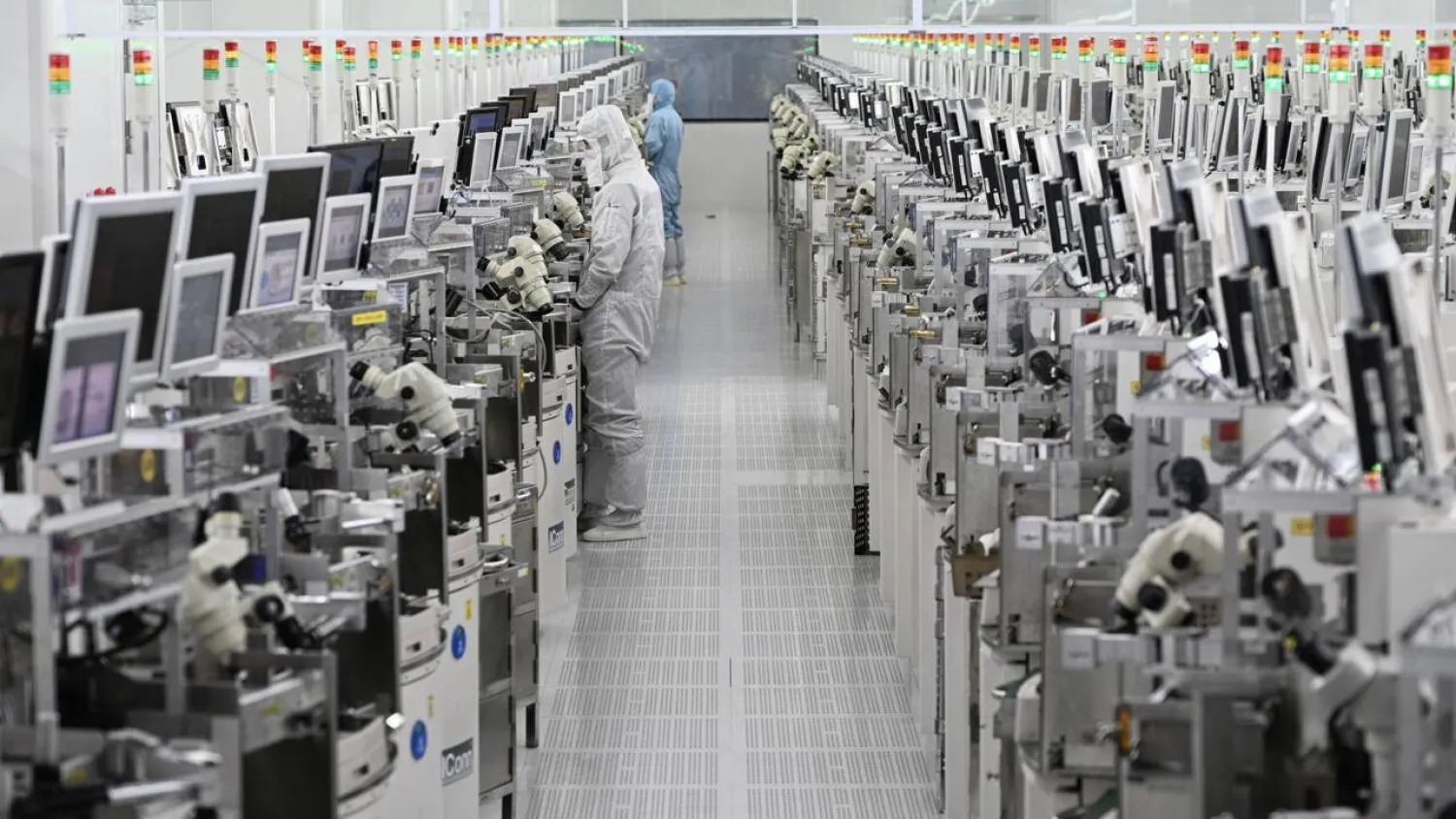

Memory Chip Crunch Set to Drive Up Smartphone Prices

While AI-led demand is surging, chip-makers are also winding back spending on capacity, which is keeping prices elevated. STR / AFP
TT

Memory Chip Crunch Set to Drive Up Smartphone Prices

While AI-led demand is surging, chip-makers are also winding back spending on capacity, which is keeping prices elevated. STR / AFP

Shoppers could face higher prices for phones, laptops and other gadgets next year, manufacturers and analysts warn, as AI data centers hoover up memory chips used in consumer electronics.

The world's biggest tech companies are ploughing head-spinningly huge sums into building the hardware that powers artificial intelligence tools like ChatGPT, AFP said.

Their insatiable demand is snarling up a supply chain kept tight on purpose by chipmakers who are keen to avoid price drops that dent profits, experts say.

In 2026, supply chain pressure for memory chips "will be far greater than this year", Lu Weibing, president of Chinese electronics giant Xiaomi, said this week.

"Everyone will likely observe that retail prices for products will see a significant increase," he told an earnings call.

William Keating, head of semiconductor and tech consulting firm Ingenuity, expects the same.

"All companies that manufacture PCs, smartphones, servers etc will be impacted by the shortage," Keating told AFP.

"End result: consumers will pay more."

In high demand are key chips known as DRAM and storage components called NAND, which are found in everyday gadgets but are also needed to help process the vast amounts of data crunched by generative AI.

That's driving up memory chip prices, which in turn is turbocharging revenue for the firms that produce them such as South Korea's Samsung and SK hynix, and Micron and SanDisk in the United States.

"AI-related server demand keeps growing, and this demand significantly exceeds industry supply," Kim Jae-june of Samsung Electronics said last month.

'Keep prices high'

Samsung said Sunday that it plans to build a new semiconductor plant in South Korea to meet the soaring demand, while SK hynix recently reported its best-ever quarterly performance, "driven by the full-scale rise in prices of DRAM and NAND".

Industry analysts TrendForce have lowered their 2026 global production forecasts for smartphones and notebook laptops.

"The memory industry has begun a robust upward pricing cycle," which "forces downstream brands to hike retail prices," TrendForce said.

Cars may also be affected, although Keating noted that a smaller portion of their tech relies on memory chips.

Last week China's largest contract chipmaker SMIC said customers were hesitant to place orders owing to uncertainty over how many phones, cars, or other products the memory chip industry can supply.

The cause of the shortage is two-fold.

AI-driven demand is greater than anticipated, but memory chip makers have also been "drastically cutting" spending on expanding capacity in recent years, Keating explained.

"Keep capacity tight, keep prices high is basically their mantra," he said.

"They've done this deliberately to ensure that there's no repeat of the most recent memory price collapse, which cost the memory makers tens of billions in losses."

Price jumps for memory chips "are huge and the trend is continuing", said Stephen Wu, founder of the Carthage Capital investment fund.

"Consumers and enterprises should expect higher memory prices, longer lead times, and more take-or-pay contracts through at least early 2026," Wu said.



Amazon Says Blocked 1,800 North Koreans from Applying for Jobs

Amazon logo (Reuters)
TT

Amazon Says Blocked 1,800 North Koreans from Applying for Jobs

Amazon logo (Reuters)

US tech giant Amazon said it has blocked over 1,800 North Koreans from joining the company, as Pyongyang sends large numbers of IT workers overseas to earn and launder funds.

In a post on LinkedIn, Amazon's Chief Security Officer Stephen Schmidt said last week that North Korean workers had been "attempting to secure remote IT jobs with companies worldwide, particularly in the US".

He said the firm had seen nearly a one-third rise in applications by North Koreans in the past year, reported AFP.

The North Koreans typically use "laptop farms" -- a computer in the United States operated remotely from outside the country, he said.

He warned the problem wasn't specific to Amazon and "is likely happening at scale across the industry".

Tell-tale signs of North Korean workers, Schmidt said, included wrongly formatted phone numbers and dodgy academic credentials.

In July, a woman in Arizona was sentenced to more than eight years in prison for running a laptop farm helping North Korean IT workers secure remote jobs at more than 300 US companies.

The scheme generated more than $17 million in revenue for her and North Korea, officials said.

Last year, Seoul's intelligence agency warned that North Korean operatives had used LinkedIn to pose as recruiters and approach South Koreans working at defense firms to obtain information on their technologies.

"North Korea is actively training cyber personnel and infiltrating key locations worldwide," Hong Min, an analyst at the Korea Institute for National Unification, told AFP.

"Given Amazon's business nature, the motive seems largely economic, with a high likelihood that the operation was planned to steal financial assets," he added.

North Korea's cyber-warfare program dates back to at least the mid-1990s.

It has since grown into a 6,000-strong cyber unit known as Bureau 121, which operates from several countries, according to a 2020 US military report.

In November, Washington announced sanctions on eight individuals accused of being "state-sponsored hackers", whose illicit operations were conducted "to fund the regime's nuclear weapons program" by stealing and laundering money.

The US Department of the Treasury has accused North Korea-affiliated cybercriminals of stealing over $3 billion over the past three years, primarily in cryptocurrency.


KAUST Scientists Develop AI-Generated Data to Improve Environmental Disaster Tracking

King Abdullah University of Science and Technology (KAUST) logo
TT

KAUST Scientists Develop AI-Generated Data to Improve Environmental Disaster Tracking

King Abdullah University of Science and Technology (KAUST) logo

King Abdullah University of Science and Technology (KAUST) and SARsatX, a Saudi company specializing in Earth observation technologies, have developed computer-generated data to train deep learning models to predict oil spills.

According to KAUST, validating the use of synthetic data is crucial for monitoring environmental disasters, as early detection and rapid response can significantly reduce the risks of environmental damage.

Dean of the Biological and Environmental Science and Engineering Division at KAUST Dr. Matthew McCabe noted that one of the biggest challenges in environmental applications of artificial intelligence is the shortage of high-quality training data.

He explained that this challenge can be addressed by using deep learning to generate synthetic data from a very small sample of real data and then training predictive AI models on it.

This approach can significantly enhance efforts to protect the marine environment by enabling faster and more reliable monitoring of oil spills while reducing the logistical and environmental challenges associated with data collection.


Uber, Lyft to Test Baidu Robotaxis in UK from Next Year 

A sign of Baidu is pictured at the company's headquarters in Beijing, China March 16, 2023. (Reuters)
TT

Uber, Lyft to Test Baidu Robotaxis in UK from Next Year 

A sign of Baidu is pictured at the company's headquarters in Beijing, China March 16, 2023. (Reuters)

Uber Technologies and Lyft are teaming up with Chinese tech giant Baidu to try out driverless taxis in the UK next year, marking a major step in the global race to commercialize robotaxis.

It highlights how ride-hailing platforms are accelerating autonomous rollout through partnerships, positioning London as an early proving ground for large-scale robotaxi services ‌in Europe.

Lyft, meanwhile, plans ‌to deploy Baidu's ‌autonomous ⁠vehicles in Germany ‌and the UK under its platform, pending regulatory approval. Both companies have abandoned in-house development of autonomous vehicles and now rely on alliances to accelerate adoption.

The partnerships underscore how global robotaxi rollouts are gaining momentum. ⁠Alphabet's Waymo said in October it would start ‌tests in London this ‍month, while Baidu ‍and WeRide have launched operations in the ‍Middle East and Switzerland.

Robotaxis promise safer, greener and more cost-efficient rides, but profitability remains uncertain. Public companies like Pony.ai and WeRide are still loss-making, and analysts warn the economics of expensive fleets could pressure margins ⁠for platforms such as Uber and Lyft.

Analysts have said hybrid networks, mixing robotaxis with human drivers, may be the most viable model to manage demand peaks and pricing.

Lyft completed its $200 million acquisition of European taxi app FreeNow from BMW and Mercedes-Benz in July, marking its first major expansion beyond North America and ‌giving the US ride-hailing firm access to nine countries across Europe.