


AI Boom Brings Fresh Risks to US Markets, and More Money to M&A

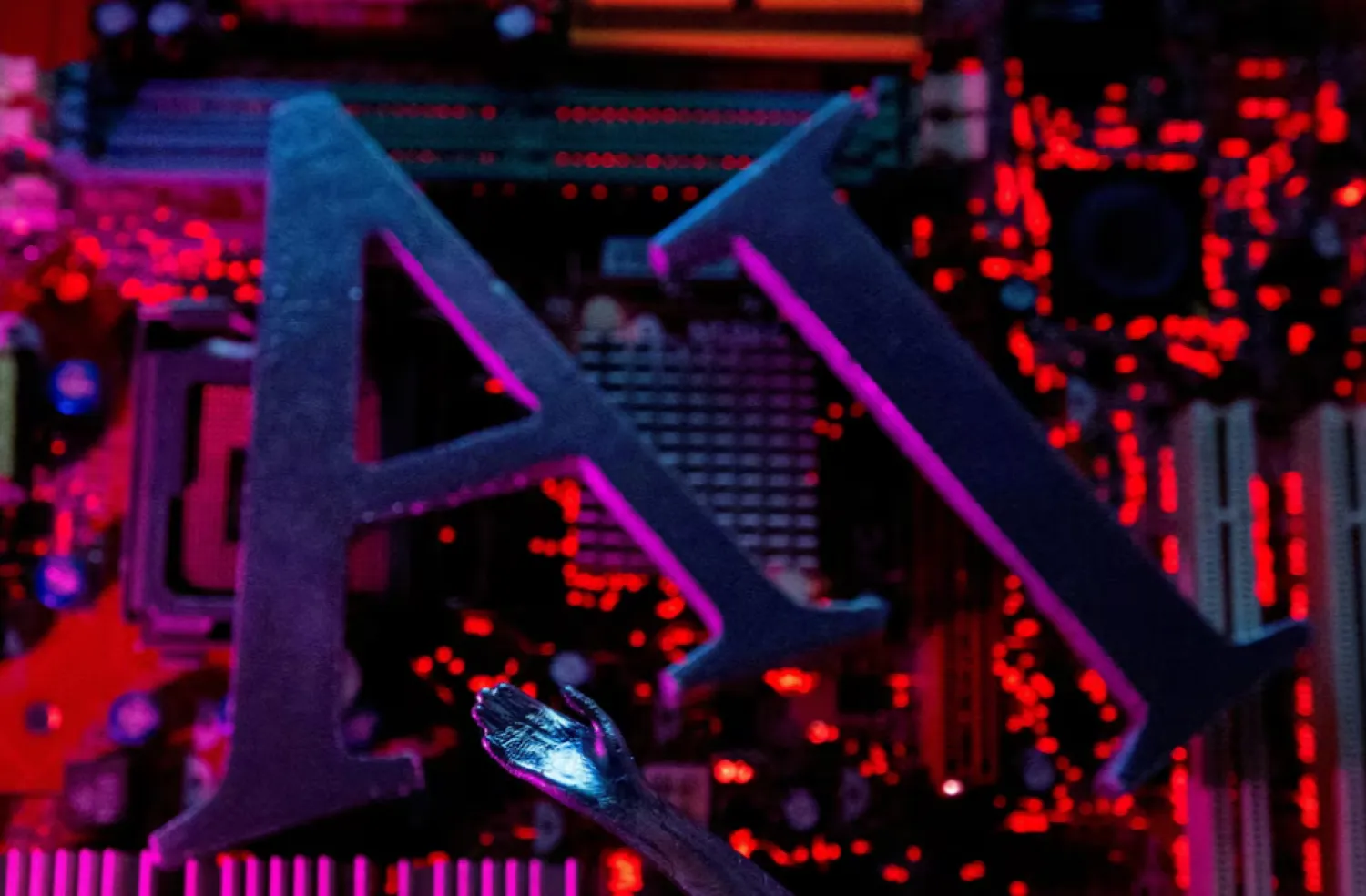
AI (Artificial Intelligence) letters and robot hand are placed on computer motherboard in this illustration created on June 23, 2023. REUTERS/Dado Ruvic/Illustration/File Photo
TT

AI Boom Brings Fresh Risks to US Markets, and More Money to M&A

AI (Artificial Intelligence) letters and robot hand are placed on computer motherboard in this illustration created on June 23, 2023. REUTERS/Dado Ruvic/Illustration/File Photo

The AI boom is bringing new risks to the financial markets as investors flock to tech stocks and executives pay steep premiums to buy AI technology they can't build in-house, warned two top finance executives.

AI has become the “number one topic of conversation” for both investors and corporate executives, Matthew Danzig, managing director at investment bank Lazard, said on a panel discussion with Citadel Chief Risk Officer Joanna Welsh at Reuters Momentum AI 2026 conference in New York this week. Companies are scrambling to articulate an AI strategy, often acquiring capabilities or proprietary datasets to stay competitive, the tech banker said, Reuters reported.

“Every company that’s a potential target is figuring out their AI angle,” he said. Valuations are being driven to historically high levels as investors bet on potential profits instead of current fundamentals, he said. "It's markets willing to pay for the future."

NVIDIA'S POST-EARNINGS SURGE

The industry will need roughly $7 trillion in capital by 2030 to fund its growth – and that's just for data centers, according to McKinsey & Co. Investors, however, have largely brushed aside concerns about the increasing amount of leverage in the system and the lack of revenue to support all the debt needed to finance that growth. Chipmaker Nvidia's shares surged by more than 5% in premarket trading Thursday after the $4.5 trillion company reported record revenue and a 65% year-over-year surge in net income for its fiscal third quarter.

Beneath the frenzy, however, structural vulnerabilities lurk and cracks are starting to show.

Welsh said Citadel, which has $71 billion in assets under management, is prepared for potential drawdowns at any given time. The hedge fund's risk models show that modern markets amplify shocks.

“Markets are just faster,” she said. "These volatility spikes and pulses, they hit harder, they fade faster, they repeat more often."

RISKS ARE 'STARTING TO CONVERGE'

Risks in credit markets are “starting to converge and stack” with the AI boom, Welsh said, pointing to a rise in high-quality corporate issuance of 30- and 40-year bonds on assets with around four-year depreciation cycles. That means companies are paying off debt for a long time after the asset has potentially become obsolete. A mismatch between the debt maturity and the depreciation cycle is also a marker of increased risk because it strains cash flow.

At the lower end of corporate credit, issuers and investors have "equal enthusiasm" for zero-coupon convertible bonds issued by less creditworthy tech firms, she said. Zero-coupon convertible bonds are considered higher risk investments that give investors stock if the company does well and priority payment with bondholders in bankruptcy, but they don't pay a coupon.

"Zero coupon converts are having a big issuance year, same as they did in 2001, the same as they did in 2021," she said, citing previous market downturns. "And if you stack that on top of the amount of capital that has gone into illiquid things like private credit," she continued, "you can see how there's some portfolios where... a brush fire could be pretty healthy."




South Korea to Invest $166 Million in AI Chip Startup Rebellions

People walk near Gwanghwamun Square in Seoul, South Korea, 22 March 2026. The band performed their comeback concert on 21 March.  EPA/YONHAP
People walk near Gwanghwamun Square in Seoul, South Korea, 22 March 2026. The band performed their comeback concert on 21 March. EPA/YONHAP
TT

South Korea to Invest $166 Million in AI Chip Startup Rebellions

People walk near Gwanghwamun Square in Seoul, South Korea, 22 March 2026. The band performed their comeback concert on 21 March.  EPA/YONHAP
People walk near Gwanghwamun Square in Seoul, South Korea, 22 March 2026. The band performed their comeback concert on 21 March. EPA/YONHAP

South Korea's industry ministry on Tuesday said the Financial Services Commission's advisory board approved a 250 billion won ($166 million) investment in a local artificial intelligence chip startup called Rebellions, part of a government-backed push to nurture a homegrown advanced semiconductor firm.

Here are some details:

South Korea's Financial Services Commission advisory board, which evaluates investments in advanced strategic industries, ⁠approved a 250 ⁠billion won direct investment into Rebellions, an AI chip startup.

Rebellions, founded in 2020, designs neural processing units (NPUs) that handle AI computations.

The decision was made at a ⁠fund management committee meeting for the state-led "National Growth Fund," marking the first direct investment under the country's "K-Nvidia" initiative.

The funding will support Rebellions' mass production of NPU chips and the development of next-generation AI semiconductors, the industry ministry said in a statement.

The "K-Nvidia" project, jointly led by the Financial Services Commission and the ⁠Ministry ⁠of Science and ICT, seeks to nurture a globally competitive AI chip company amid intensifying competition in the sector, which is dominated by US firms like Nvidia.

The move underscores Seoul's efforts to strengthen its position in the AI supply chain and reduce reliance on foreign technology, as demand for high-performance computing chips surges.


Uber, Autonomous Mobility Firms to Launch Europe's 1st Commercial Robotaxis

Aerial photo shows light installation during the Festival of Lights in Zagreb, Croatia, March 18, 2026. REUTERS/Antonio Bronic
TT

Uber, Autonomous Mobility Firms to Launch Europe's 1st Commercial Robotaxis

Aerial photo shows light installation during the Festival of Lights in Zagreb, Croatia, March 18, 2026. REUTERS/Antonio Bronic

Uber Technologies and autonomous mobility companies Verne and Pony.ai have partnered up to launch Europe's first commercial robotaxi service in the Croatian capital Zagreb, with plans to expand to other cities, they said on Thursday.

Robotaxis are rapidly expanding into US cities as companies race to commercialize ⁠autonomous ride-hailing worldwide.

Alphabet's ⁠Waymo remains the early leader, while Tesla hopes its vast manufacturing scale and financial resources could reshape the competitive landscape.

The first ⁠commercial robotaxi service in Zagreb will be launched "soon,” the companies said.

Initial deployment work is underway, including public-road validation.

Pony.ai will provide autonomous driving solutions, while Verne will act as the fleet owner and service operator.

The three companies plan ⁠to ⁠expand the fleet to thousands of robotaxis in European cities over the next few years.

Uber and Nvidia said earlier this month they planned to expand their robotaxi service in 28 cities across North America, Europe, Australia and Asia.


Samsung, SK Urge Employees to Cut Car Use Amid Rising Energy Risks

FILE - The logo of the Samsung is seen at the Samsung Electronics' Seocho building in Seoul, South Korea, Friday, July 5, 2024.  (AP Photo/Lee Jin-man, File)
FILE - The logo of the Samsung is seen at the Samsung Electronics' Seocho building in Seoul, South Korea, Friday, July 5, 2024. (AP Photo/Lee Jin-man, File)
TT

Samsung, SK Urge Employees to Cut Car Use Amid Rising Energy Risks

FILE - The logo of the Samsung is seen at the Samsung Electronics' Seocho building in Seoul, South Korea, Friday, July 5, 2024.  (AP Photo/Lee Jin-man, File)
FILE - The logo of the Samsung is seen at the Samsung Electronics' Seocho building in Seoul, South Korea, Friday, July 5, 2024. (AP Photo/Lee Jin-man, File)

South Korean tech giants Samsung Electronics and SK Group said they were asking employees to curb private car use and follow fuel-saving measures after South Korea rolled ⁠out emergency energy-conservation steps ⁠amid instability in Middle Eastern energy supplies.

Internal notices showed the companies encouraging car-use restrictions ⁠such as a five and 10-day vehicle rotation system, reduced parking availability and other energy-saving practices at offices from Thursday for Samsung and from March 30 ⁠for ⁠SK.

The moves follow government guidance aimed at cutting fuel consumption as concerns grow over prolonged disruptions linked to the Iran-related energy crisis.