

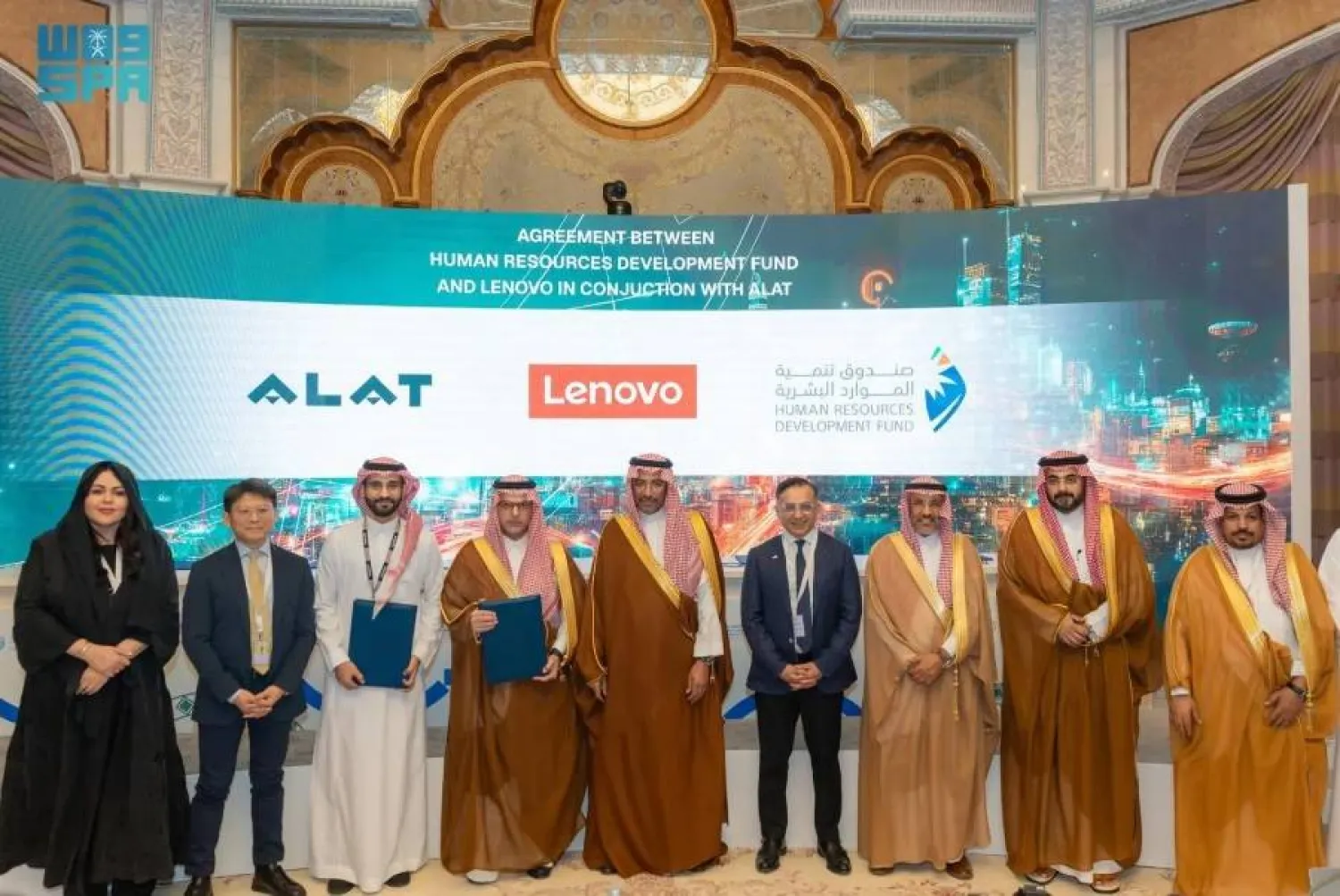

Saudi Arabia, Lenovo Sign Agreement to Train and Employ 100 National Talents in Advanced Industrial Technologies

The ‏agreement was signed during the 21st General Conference of the United Nations Industrial Development Organization (UNIDO) in Riyadh. SPA
TT

Saudi Arabia, Lenovo Sign Agreement to Train and Employ 100 National Talents in Advanced Industrial Technologies

The ‏agreement was signed during the 21st General Conference of the United Nations Industrial Development Organization (UNIDO) in Riyadh. SPA

The Human Resources Development Fund (HRDF) signed a major workforce development agreement with Lenovo Saudi Arabia to train and employ 100 Saudi men and women across high-value technical and engineering roles.

‏The signing took place during the 21st General Conference of the United Nations Industrial Development Organization (UNIDO), currently being hosted in Riyadh. Held under the patronage of the Minister of Industry and Mineral Resources, Bandar AlKhorayef, the agreement is a key pillar of the Kingdom’s national agenda to develop world-class industrial capabilities and strengthen human capital in priority sectors.

‏Under the agreement, Lenovo will launch its first specialized industrial training program in Saudi Arabia, designed to equip national talent with globally competitive skills for careers in advanced manufacturing and high-tech industrial operations.

‏The initiative will include training inside and outside the Kingdom, supported by HRDF. This agreement also aligns with Lenovo's strategic partnership with Alat. It reinforces the human capabilities initiative in advanced manufacturing, which was announced at the Future Investment Initiative (FII9) in Riyadh last month.

‏The program is designed to equip 100 Saudi nationals with specialized expertise for critical roles within the advanced manufacturing sector. Participants will be prepared for careers spanning multiple disciplines, including various engineering fields, materials management and planning, and production and industrial engineering.

‏The curriculum will also develop talent in quality management and strategic operations, ensuring a comprehensive pipeline of skilled professionals ready to support the Kingdom's industrial ambitions. All selected candidates will join Lenovo as full-time employees and simultaneously enter the ISTDAM Advanced Talent Development Program, a four-month intensive training track designed to build core competencies for high-tech industrial roles.

‏This partnership reinforces Saudi Arabia's commitment to cultivating a world-class national workforce capable of driving the Kingdom's expanding industrial and technological sectors. This high-profile signing at the UNIDO General Conference positions Saudi Arabia as a global sustainability leader and spotlights its strategic investment in human capital development.

‏Other global manufacturers, such as Lenovo, now have a clear pathway into Saudi Arabia's advanced industrial ecosystem, which combines modern infrastructure, strategic investment, and a skilled national workforce. This collaboration creates a repeatable model for future alliances. It opens the way for Saudi Arabia to become the hub of global innovation, attracting leading technologies in artificial intelligence, automation, and sustainable manufacturing.



Kia to Sell Lower-priced Electric Vehicle in US

A KIA logo on an electric vehicle is seen on display at the Canadian International AutoShow in Toronto, Ontario, Canada, February 13, 2025. REUTERS/Carlos Osorio
TT

Kia to Sell Lower-priced Electric Vehicle in US

A KIA logo on an electric vehicle is seen on display at the Canadian International AutoShow in Toronto, Ontario, Canada, February 13, 2025. REUTERS/Carlos Osorio

Kia said Wednesday it will begin selling a lower-priced electric vehicle in the United States later this year as automakers work to recharge EV sales.

The Korean automaker said at the New York Auto Show it will offer the EV3 in the US market starting later this year, Reuters reported.

Automakers are facing a tougher EV market in the United States after Congress repealed the $7,500 EV tax credit last year but higher gasoline prices in recent weeks has prompted new interest in the EVs.


Passengers Stranded in Moving Traffic after Robotaxi Outage in China

This file photo taken on August 1, 2024 shows a general view of a driverless robotaxi autonomous vehicle developed as part of tech giant Baidu's Apollo Go self-driving project, in Wuhan, in central China's Hubei province. (Photo by PEDRO PARDO / AFP)
TT

Passengers Stranded in Moving Traffic after Robotaxi Outage in China

This file photo taken on August 1, 2024 shows a general view of a driverless robotaxi autonomous vehicle developed as part of tech giant Baidu's Apollo Go self-driving project, in Wuhan, in central China's Hubei province. (Photo by PEDRO PARDO / AFP)

Some robotaxi passengers were left stranded in the middle of fast-moving traffic in a major Chinese city after their driverless vehicles stopped running, according to police and media reports on Wednesday.

A preliminary investigation indicates more than 100 robotaxis came to a halt because of a “system malfunction,” police in the city of Wuhan said in a statement, without elaborating. No injuries were reported.

One passenger told Chinese media that their robotaxi stopped after turning a corner. An instruction on a screen read: “Driving system malfunction. Staff are expected to arrive in 5 minutes.” After no one showed up, the passenger pushed an SOS button and was told that staff were on their way. The car door could be opened, so the passenger got out on their own.

It is the first time a mass shutdown of robotaxis has been reported in China, The Associated Press said. In December, many of Waymo’s self-driving cars came to a stop in San Francisco because of a power outage.

The taxis in Wuhan are operated by Baidu, a major Chinese internet and AI company that is expanding its Apollo Go robotaxi business to overseas locations in Europe and the Mideast.

Baidu did not have any immediate comment.

Police said reports that taxis were coming to a halt started coming in around 9 p.m., while media reports said multiple people were rescued.

While some passengers were able to exit their taxis on their own, others were afraid to get out because their vehicle had stopped in the middle lane of a ring road with other vehicles passing on both sides, the reports said. Ring roads are elevated roads without traffic lights designed to move traffic quickly in urban areas.

Baidu operates hundreds of robotaxis in Wuhan, which hosted an early pilot project for the company.


Microsoft Reportedly on Track to Invest $5.5 Billion in Singapore by 2029

FILE PHOTO: A Microsoft logo is seen next to a cloud in Los Angeles, California, US June 14, 2016. REUTERS/Lucy Nicholson/File Photo
TT

Microsoft Reportedly on Track to Invest $5.5 Billion in Singapore by 2029

FILE PHOTO: A Microsoft logo is seen next to a cloud in Los Angeles, California, US June 14, 2016. REUTERS/Lucy Nicholson/File Photo

Microsoft is on track to invest $5.5 billion in cloud and artificial ⁠intelligence infrastructure in Singapore ⁠through 2029, the ⁠Wall Street Journal reported on Wednesday.

Microsoft did not immediately respond to a ⁠Reuters request for ⁠comment.

The Thai government ⁠said in a statement on Tuesday that Microsoft plans to invest $1 billion in Thailand over the next two years in cloud services and AI infrastructure.

The investment includes developing digital ⁠skills of the Thai workforce, the statement said.

The announcement follows a number of data center investments to support AI, as Southeast ⁠Asia's ⁠second-largest economy looks to speed up projects involving data centers, electronics, and power generation.