


Australia Begins Enforcing World-First Teen Social Media Ban 

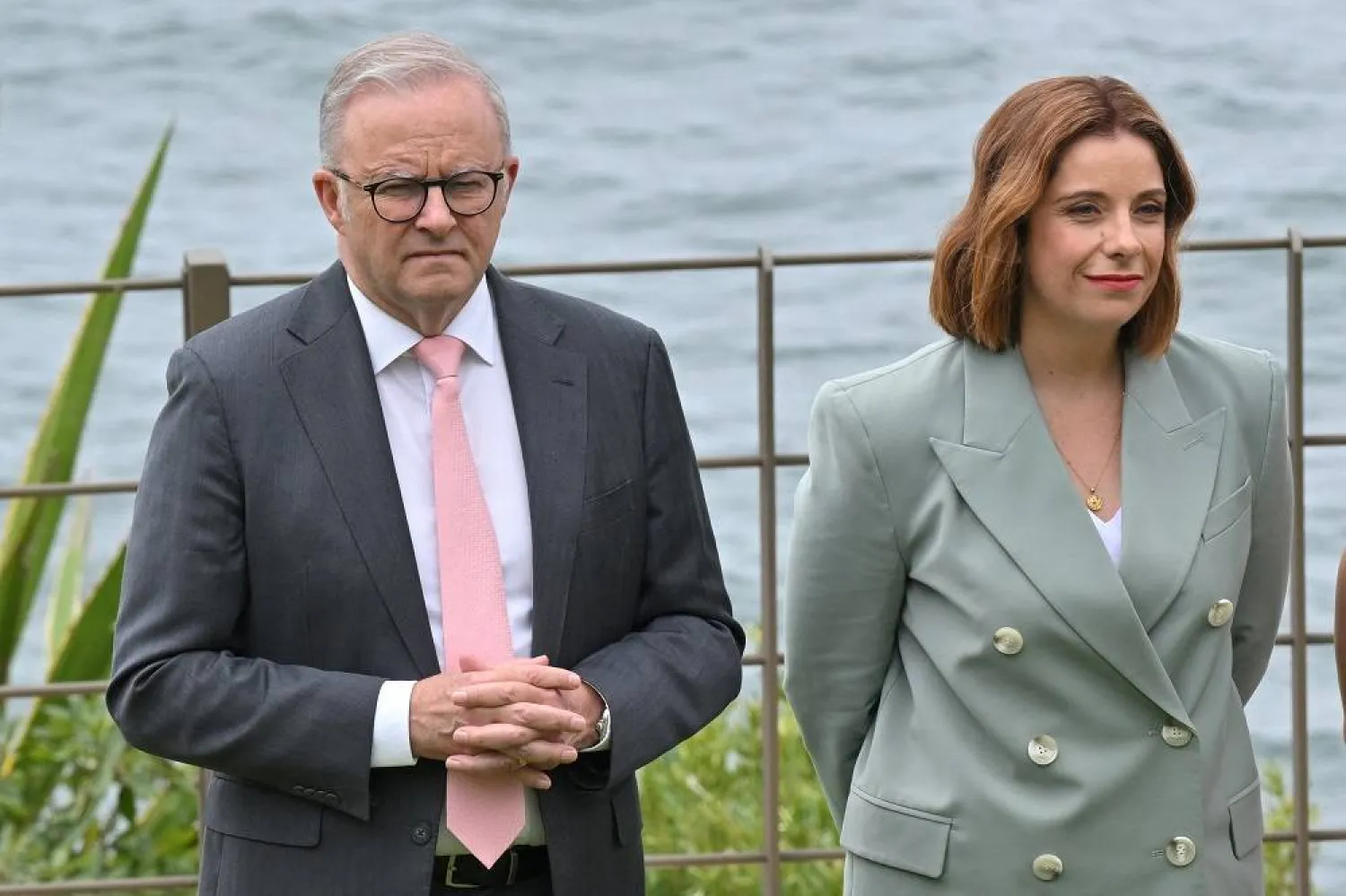
Prime Minister Anthony Albanese and Minister for Communications Anika Wells stand during an event to mark the beginning of the social media ban for children under 16 years of age, at Kirribilli House in Sydney, Australia, December 10, 2025. (AAP/Mick Tsikas/via Reuters) 
TT

Australia Begins Enforcing World-First Teen Social Media Ban 

Prime Minister Anthony Albanese and Minister for Communications Anika Wells stand during an event to mark the beginning of the social media ban for children under 16 years of age, at Kirribilli House in Sydney, Australia, December 10, 2025. (AAP/Mick Tsikas/via Reuters) 

Australia on Wednesday became the first country to ban social media for children under 16, blocking access in a move welcomed by many parents and child advocates but criticized by major technology companies and free-speech advocates.

Starting at midnight (1300 GMT on Tuesday), 10 of the largest platforms including TikTok, Alphabet's YouTube and Meta's Instagram and Facebook were ordered to block children or face fines of up to A$49.5 million ($33 million) under the new law, which is being closely watched by regulators worldwide.

Prime Minister Anthony Albanese called it "a proud day" for families and cast the law as proof that policymakers can curb online harms that have outpaced traditional safeguards.

"This will make an enormous difference. It is one of the biggest social and cultural changes that our nation has faced," Albanese told a news conference on Wednesday.

"It's a profound reform which will continue to reverberate around the world."

In a video message, Albanese urged children to "start a new sport, new instrument, or read that book that has been sitting there for some time on your shelf," ahead of Australia's summer school break starting later this month.

In the hours before the ban took effect, many of the estimated one million children impacted by the legislation began posting messages saying goodbye to their online followers.

"No more social media... no more contact with the rest of the world," wrote one teen on TikTok.

"#seeyouwhenim16," said another.

BAN HAS GOBAL IMPLICATIONS

The rollout caps a year of debate over whether any country could practically stop children from using platforms embedded in daily life and begins a live test for governments worldwide frustrated that social media firms have been slow to implement harm-reduction measures.

Albanese's center-left government proposed the landmark law citing research showing harms to mental health from the overuse of social media among young teens, including misinformation, bullying and harmful depictions of body image.

Several countries from Denmark to New Zealand to Malaysia have signaled they may study or emulate Australia's model, making the country a test case for how far governments can push age-gating without stifling speech or innovation.

Julie Inman Grant, the US-born eSafety Commissioner who is overseeing the ban, told Reuters on Wednesday a groundswell of American parents wanted similar measures.

"I hear from the parents and the activists and everyday people in America, 'we wish we had an eSafety commissioner like you in America, we wish we had a government that was going to put tween and teen safety before technology profits,'" she said in an interview at her office in Sydney.

'NOT OUR CHOICE': X SAYS WILL COMPLY

Elon Musk's X became the last of the 10 major platforms to take measures to cut off access to underage teens after publicly acknowledging on Wednesday that it would comply.

"It's not our choice - it's what the Australian law requires," X said on its website.

"X automatically offboards anyone who does not meet our age requirements."

Australia has said the initial list of covered platforms would change as new products emerge and young users migrate.

Companies have told Canberra they will deploy a mix of age inference - estimating a user's age from their behavior - and age estimation based on a selfie, alongside checks that could include uploaded identification documents or linked bank account details.

For social media businesses, the implementation marks a new era of structural stagnation as user numbers flatline and time spent on platforms shrinks, studies show.

Platforms say they earn little from advertising to under-16s, but warn the ban disrupts a pipeline of future users. Just before the ban took effect, 86% of Australians aged eight to 15 used social media, the government said.

Some youngsters have warned the social media ban could isolate people.

"It's going to be worse for people with niche interests I guess because that's the only way they can find their community," said 14-year-old Annie Wang ahead of the ban.

"Some people also use it to vent their feelings and talk to people to get help ... So I feel like it'll be fine for some people, but for some people it'll worsen their mental health."



Microsoft Unveils $23 Billion in New AI Investments With Big Focus on India

Microsoft Chief Executive Satya Nadella speaks at the company's annual developer conference in Seattle, Washington, US, May 21, 2024. REUTERS/Max Cherney
TT

Microsoft Unveils $23 Billion in New AI Investments With Big Focus on India

Microsoft Chief Executive Satya Nadella speaks at the company's annual developer conference in Seattle, Washington, US, May 21, 2024. REUTERS/Max Cherney

Microsoft on Tuesday unveiled about $23 billion in new artificial intelligence investments, with the bulk earmarked for India as it deepens its bet on one of the world's fastest-growing digital markets.

As part of the move, Microsoft will spend $17.5 billion in India in its largest Asia investment to build out artificial intelligence infrastructure in the country, CEO Satya Nadella said.

The investment builds on the $3 billion investment Microsoft announced earlier this year. It would give the company the largest cloud presence in India, with the first new data center going live mid-2026.

Microsoft has pledged hefty investments worldwide this year, as the company races to secure more cloud computing capacity to meet the surging demand for AI workloads and compete better with rivals Amazon and Google-parent Alphabet.

Microsoft earlier in the day said it was investing more than C$7.5 billion ($5.42 billion) in Canada over the next two years.

New capacity under the investment will begin to come online in the second half of 2026, Microsoft said, adding that its total estimated investment in Canada amounts to C$19 billion between 2023 and 2027.

Microsoft also said it would expand its Azure Local cloud offering in Canada. It is also partnering with Canadian AI startup Cohere to offer the firm's advanced AI models on its Azure platform.

The company is also launching a dedicated "Threat Intelligence Hub" in Canada to focus on cybersecurity protection and AI security research, and work with the Canadian government and lawmakers to track threat actors and organized crime.

Microsoft currently has more than 5,300 employees across 11 cities in Canada.

Last month, Microsoft announced plans to invest $10 billion in AI infrastructure in Portugal as well as $15 billion in the United Arab Emirates.

Big Tech is under growing investor pressure to show that its hefty investments in AI are paying off, as surging valuations of companies and a web of circular investments fuel concerns of an AI bubble.

Microsoft reported a record capital expenditure of nearly $35 billion for its fiscal first quarter in October and warned that spending would further increase this year. It has predicted it would remain constrained on supply at least until the end of its current fiscal year in June 2026.


EU Launches Antitrust Probe into Google’s Use of Online Content for AI Purposes 

01 December 2025, Hamburg: The Google logo shines above the entrance to Google's German headquarters. (dpa)
TT

EU Launches Antitrust Probe into Google’s Use of Online Content for AI Purposes 

01 December 2025, Hamburg: The Google logo shines above the entrance to Google's German headquarters. (dpa)

The European Commission has opened an antitrust probe to assess whether Google is breaching EU competition rules in its use of online content from web publishers and YouTube for artificial intelligence purposes, it said on Tuesday.

"The investigation will notably examine whether Google is distorting competition by imposing unfair terms and conditions on publishers and content creators, or by granting itself privileged access to such content, thereby placing developers of rival AI models at a disadvantage," the Commission said.

It said it was concerned Google may have used content from web publishers to generate AI-powered services on its search results pages without appropriate compensation to publishers and without offering them the possibility to refuse such use of their content.

The Commission said it is also concerned whether Google has used content uploaded to YouTube to train its own generate AI models without offering creators compensation or the possibility to refuse.


US to Allow Nvidia H200 Chip Shipments to China, Trump Says 

A Nvidia logo appears in this illustration taken August 25, 2025. (Reuters) 
TT

US to Allow Nvidia H200 Chip Shipments to China, Trump Says 

A Nvidia logo appears in this illustration taken August 25, 2025. (Reuters) 

The United States will allow Nvidia's H200 processors, its second-best artificial intelligence chips, to be exported to China and collect a 25% fee on such sales, US President Donald Trump said on Monday.

The decision appears to settle a US debate about whether Nvidia and rivals should maintain their global lead in AI chips by selling to China or withhold the exports, though Beijing has told companies not to use US technology, leaving it unclear whether Trump's decision would lead to new sales.

Nvidia shares rose 2% in after-hours trading after Trump made the announcement on Truth Social, following a 3% rise during the day on a report by Semafor.

Trump said in his post that he had informed President Xi Jinping of China, where Nvidia's chips are under government scrutiny, about the move and that he "responded positively."

He said the US Commerce Department was finalizing details of the arrangement and the same approach would apply to other AI chip firms such as Advanced Micro Devices and Intel.

Trump's post said the fee to be paid to the US government was "$25%", and a White House official confirmed he meant 25%, higher than the 15% proposed in August.

"We will protect National Security, create American Jobs, and keep America’s lead in AI," Trump wrote on Truth Social. "NVIDIA’s US Customers are already moving forward with their incredible, highly advanced Blackwell chips, and soon, Rubin, neither of which are part of this deal."

Trump did not say how many H200 chips would be authorized for shipment or what conditions might apply, only that exports would occur "under conditions that allow for continued strong National Security."

Administration officials consider the move a compromise between sending Nvidia's latest Blackwell chips to China, which Trump has declined to allow, and sending China no US chips at all, which officials believe would bolster Huawei's efforts to sell AI chips in China, a person familiar with the matter said.

"Offering H200 to approved commercial customers, vetted by the Department of Commerce, strikes a thoughtful balance that is great for America," Nvidia said in a statement.

Intel declined to comment. The US Commerce Department, which oversees export controls, and AMD did not respond to requests for comment.

A White House official said that the 25% fee would be collected as an import tax from Taiwan, where the chips are made, to the United States, where the chips will undergo a security review by US officials before being exported to China.

FEARS OF CHIPS STRENGTHENING CHINA'S MILITARY

China hawks in Washington are concerned that selling more advanced AI chips to China could help Beijing supercharge its military, fears that had first prompted limits on such exports by the Biden administration.

The Trump administration had been considering greenlighting the sale, sources told Reuters last month. Trump said last week he met with Nvidia CEO Jensen Huang and that the executive was aware of where he stood on export controls.

"It’s a terrible mistake to trade off national security for advantages in trade," said Eric Hirschhorn, who was a senior Commerce Department official during the Obama administration. "It cuts against the consistent policies of Democratic and Republican administrations alike not to assist China’s military modernization."

According to a report released on Sunday by the non-partisan think tank, the Institute for Progress (IFP), the H200 would be almost six times as powerful as the H20, the most advanced AI semiconductor that can legally be exported to China, after the Trump administration reversed its short-lived ban on such sales this year.

The Blackwell chip now in use by US AI firms is about 1.5 times faster than H200 chips for training AI systems, the IFP said, and five times faster for inferencing work where AI models are put to use. Nvidia's own research has suggested Blackwell chips are 10 times faster than H200 chips for some tasks.

Several Democratic US senators in a statement described Trump's decision as a "colossal economic and national security failure" that would be a boon to China's industry and military.

Republican Representative John Moolenaar, who chairs the House China Select Committee, said in a statement to Reuters that China would use the chips to strengthen its military capabilities and surveillance.

"Nvidia should be under no illusions - China will rip off its technology, mass-produce it themselves and seek to end Nvidia as a competitor," he said.

CHINA EYES POTENTIAL SECURITY RISKS

The approval, however, comes as China is strengthening its resolve to wean the country off its reliance on Nvidia's chips. China's cyberspace regulator in July also accused Nvidia's H20 chips of potentially carrying backdoor security risks, an allegation Nvidia has denied.

In recent months, Beijing has cautioned Chinese tech companies against buying chips that Nvidia downgraded to sell to the Chinese market, which are the H20, RTX 6000D and L20, two sources said.

"Chinese firms want H200s, but the Chinese state is driven by paranoia and pride," said Craig Singleton, a senior fellow at the Washington think tank Foundation for Defense of Democracies. "Washington may approve the chips, but Beijing still has to let them in."

The H200 change of stance comes the same day that Trump's Justice Department announced it had cracked a China-linked chip smuggling ring that in late 2024 and early 2025 exported and attempted to export at least $160 million worth of controlled Nvidia H100 and H200 chips.

Chris McGuire, an expert on technology and national security who served at the US State Department until this summer, said Chinese firms would likely still buy H200s, given that the chip "is better than every chip the Chinese can make."

China's domestic AI chip companies now include tech giant Huawei Technologies, which in September released a three-year product roadmap, as well as smaller players such as Cambricon and Moore Threads.

China's SSE STAR Chip Index and the CSI Semiconductor Industry Index both dropped more than 1% at market open on Tuesday but soon recovered most of the losses.