


What to Expect from CES 2026, the Annual Show of All Things Tech?

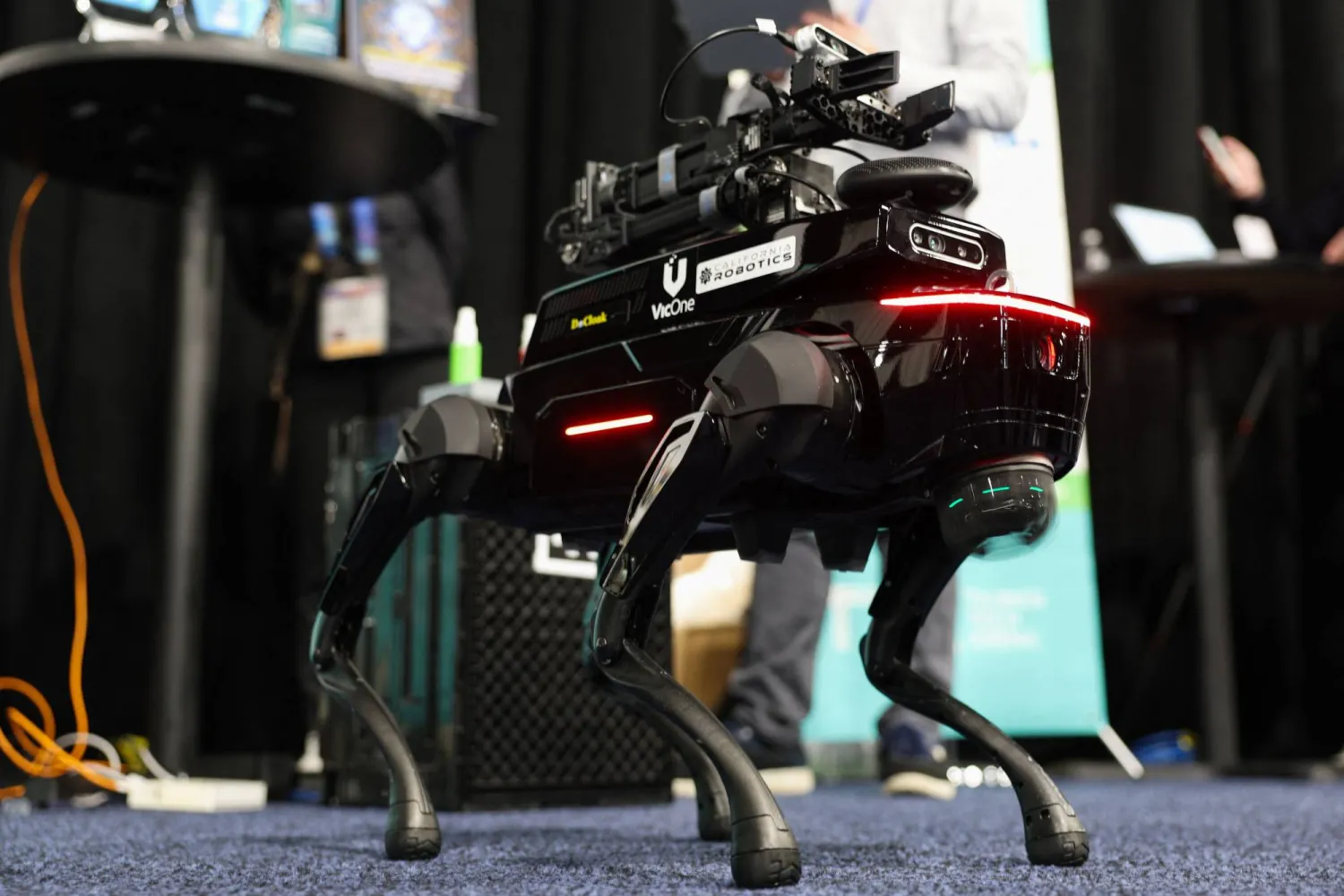
DeCloak security privacy software is demonstrated on a California Robotics robot during CES Unveiled ahead of the Consumer Electronics Show (CES) in Las Vegas, Nevada on January 4, 2026. (Photo by Patrick T. Fallon / AFP)
TT

What to Expect from CES 2026, the Annual Show of All Things Tech?

DeCloak security privacy software is demonstrated on a California Robotics robot during CES Unveiled ahead of the Consumer Electronics Show (CES) in Las Vegas, Nevada on January 4, 2026. (Photo by Patrick T. Fallon / AFP)

With the start of the New Year squarely behind us, it's once again time for the annual CES trade show to shine a spotlight on the latest tech companies plan on offering in 2026.

The multi-day event, organized by the Consumer Technology Association, kicks off this week in Las Vegas, where advances across industries like robotics, healthcare, vehicles, wearables, gaming and more are set to be on display.

Artificial intelligence will be anchored in nearly everything, again, as the tech industry explores offerings consumers will want to buy. AI industry heavyweight Jensen Huang will be taking the stage to showcase Nvidia's latest productivity solutions, and AMD CEO Lisa Su will keynote to “share her vision for delivering future AI solutions.” Expect AI to come up in other keynotes, like from Lenovo's CEO, Yuanqing Yang.

The AI industry is out in full force tackling issues in healthcare, with a particular emphasis on changing individual health habits to treat conditions — such as Beyond Medicine's prescription app focused on a particular jaw disorder — or addressing data shortages in subjects such as breast milk production.

Expect more unveils around domestic robots too. Korean tech giant LG already has announced it will show off a helper bot named “ CLOiD,” which allegedly will handle a range of household tasks. Hyundai also is announcing a major push on robotics and manufacturing advancements. Extended reality, basically a virtual training ground for robots and other physical AI, is also in the buzz around CES.

In 2025, more than 141,000 attendees from over 150 countries, regions, and territories attended the CES. Organizers expect around the same numbers for this year’s show, with more than 3,500 exhibitors across the floor space this week.

The AP spoke with CTA Executive Chair and CEO Gary Shapiro about what to expect for CES 2026. The conversation has been edited for clarity and length.

What are the main themes we can expect this week? Well, we have a lot at this year's show.

Obviously, using AI in a way that makes sense for people. We’re seeing a lot in robotics. More robots and humanoid-looking robots than we’ve ever had before.

We also see longevity in health, there’s a lot of focus on that. All sorts of wearable devices for almost every part of the body. Technology is answering healthcare’s gaps very quickly and that’s great for everyone.

Mobility is big with not only self-driving vehicles but also with boats and drones and all sorts of other ways of getting around. That’s very important.

And of course, content creation is always very big.

Is 2026 the year we finally see humanoid robots in people’s homes? You are seeing humanoid robots right now. It sometimes works, sometimes doesn’t.

But yes, there are more and more humanoid robots. And when we talk about CES 5, 10, 15, 20 years now, we’re going to see an even larger range of humanoid robots.

Obviously, last year we saw a great interest in them. The number one product of the show was a little robotic dog that seems so life-like and fun, and affectionate for people that need that type of affection.

But of course, the humanoid robots are just one aspect of that industry. There’s a lot of specialization in robot creation, depending on what you want the robot to do. And robots can do many things that humans can’t.

Will we start seeing more innovative use of AI tools in entertainment? AI is the future of creativity.

Certainly AI itself may be arguably creative, but the human mind is so unique that you definitely get new ideas that way. So I think the future is more of a hybrid approach, where content creators are working with AI to craft variations on a theme or to better monetize what they have to a broader audience.

Any interesting AI-powered devices or services that consumers will want to buy? We’re seeing all sorts of different devices that are implementing AI. But we have a special focus at this show, for the first time, on the disability community. Verizon set this whole stage up where we have all different ways of taking this technology and having it help people with disabilities and older people.

Are you concerned about a potential AI bubble? Well, there’s definitely no bubble when it comes to what AI can do. And what AI can do is perform miracles and solve fundamental human problems in food production and clean air and clean water.

Obviously in healthcare, it’s gonna be overwhelming.

But this was like the internet itself. There was a lot of talk about a bubble, and there actually was a bubble. The difference is that in late 1990s there were basically were no revenue models. Companies were raising a lot of money with no plans for revenue.

These AI companies have significant revenues today, and companies are investing in it.

What I’m more concerned about, honestly, is not Wall Street and a bubble. Others can be concerned about that. I’m concerned about getting enough energy to process all that AI. And at this show, for the first time, we have a Korean company showing the first ever small-scale nuclear-powered energy creation device. We expect more and more of these people rushing to fill this gap because we need the energy, we need it clean and we need a kind of all-of-the-above solution.



Nvidia CEO Huang Says Next Generation of Chips Is in Full Production

 Nvidia CEO Jensen Huang speaks during a Nvidia keynote address at CES 2026, an annual consumer electronics trade show, in Las Vegas, Nevada, US January 5, 2026. (Reuters)
Nvidia CEO Jensen Huang speaks during a Nvidia keynote address at CES 2026, an annual consumer electronics trade show, in Las Vegas, Nevada, US January 5, 2026. (Reuters)
TT

Nvidia CEO Huang Says Next Generation of Chips Is in Full Production

 Nvidia CEO Jensen Huang speaks during a Nvidia keynote address at CES 2026, an annual consumer electronics trade show, in Las Vegas, Nevada, US January 5, 2026. (Reuters)
Nvidia CEO Jensen Huang speaks during a Nvidia keynote address at CES 2026, an annual consumer electronics trade show, in Las Vegas, Nevada, US January 5, 2026. (Reuters)

Nvidia CEO Jensen Huang said on Monday that the company’s next generation of chips is in "full production," saying they can deliver five times the artificial-intelligence computing of the company’s previous chips when serving up chatbots and other AI apps.

In a speech at the Consumer Electronics Show in Las Vegas, the leader of the world's most valuable company revealed new details about its chips, which will arrive later this year and which Nvidia executives told Reuters are already in the company's labs being tested by AI firms, as Nvidia faces increasing competition from rivals as well as its own customers.

The Vera Rubin platform, made up of six separate Nvidia chips, is expected to debut later this year, with the flagship server containing 72 of the company’s graphics units and 36 of its new central processors.

Huang showed ‌how they can ‌be strung together into "pods" with more than 1,000 Rubin chips and said they could improve ‌the ⁠efficiency of generating ‌what are known as "tokens" - the fundamental unit of AI systems - by 10 times.

To get the new performance results, however, Huang said the Rubin chips use a proprietary kind of data that the company hopes the wider industry will adopt.

"This is how we were able to deliver such a gigantic step up in performance, even though we only have 1.6 times the number of transistors," Huang said.

While Nvidia still dominates the market for training AI models, it faces far more competition - from traditional rivals such as Advanced Micro Devices as well as customers like Alphabet's Google - in delivering the fruits of those models to hundreds of millions of users of chatbots and other technologies.

Much of ⁠Huang’s speech focused on how well the new chips would work for that task, including adding a new layer of storage technology called "context memory storage" aimed at helping chatbots ‌provide snappier responses to long questions and conversations.

Nvidia also touted a new generation ‍of networking switches with a new kind of connection called co-packaged ‍optics. The technology, which is key to linking together thousands of machines into one, competes with offerings from Broadcom and Cisco ‍Systems.

Nvidia said that CoreWeave will be among the first to have the new Vera Rubin systems and that it expects Microsoft, Oracle, Amazon and Alphabet to adopt them as well.

In other announcements, Huang highlighted new software that can help self-driving cars make decisions about which path to take - and leave a paper trail for engineers to use afterward. Nvidia showed research about software, called Alpamayo, late last year, with Huang saying on Monday it would be released more widely, along with the data used to train it so that automakers can make evaluations.

"Not only do we open-source the models, we also open-source the data that we use ⁠to train those models, because only in that way can you truly trust how the models came to be," Huang said from a stage in Las Vegas.

Last month, Nvidia scooped up talent and chip technology from startup Groq, including executives who were instrumental in helping Alphabet's Google design its own AI chips. While Google is a major Nvidia customer, its own chips have emerged as one of Nvidia's biggest threats as Google works closely with Meta Platforms and others to chip away at Nvidia's AI stronghold.

During a question-and-answer session with financial analysts after his speech, Huang said the Groq deal "won't affect our core business" but could result in new products that expand its lineup.

At the same time, Nvidia is eager to show that its latest products can outperform older chips like the H200, which US President Donald Trump has allowed to flow to China. Reuters has reported that the chip, which was the predecessor to Nvidia's current "Blackwell" chip, is in high demand in China, which has alarmed China hawks across the US political spectrum.

Huang told financial analysts after his keynote ‌that demand is strong for the H200 chips in China, and Chief Financial Officer Colette Kress said Nvidia has applied for licenses to ship the chips to China but was waiting for approvals from the US and other governments to ship them.


TV Makers Tout AI Upgrades at CES, as Smartphone Threat Looms

Attendees view the Samsung Micro RGB 130-inch TV after it was unveiled during the Samsung Electronics First Look event ahead of the Consumer Electronics Show (CES) in Las Vegas, Nevada on January 4, 2026. (AFP)
TT

TV Makers Tout AI Upgrades at CES, as Smartphone Threat Looms

Attendees view the Samsung Micro RGB 130-inch TV after it was unveiled during the Samsung Electronics First Look event ahead of the Consumer Electronics Show (CES) in Las Vegas, Nevada on January 4, 2026. (AFP)

A century after Scottish inventor John Logie Baird demonstrated the first mechanical television system, TVs face mounting competition from a much more recent invention: smartphones.

But with a suite of new models boasting massive screens, richer imagery and artificial intelligence enhancements -- on display this week at the Consumer Electronics Show in Las Vegas -- manufacturers don't plan on TVs being relegated to the dustbin of history.

The proportion of daily viewing on TV sets declined from 61 percent at the start of 2017 to 48 percent late last year, according to market tracker Ampere Analysis. Smartphone viewing, meanwhile, nearly doubled over that same period to 21 percent.

"This is the battle between big screens, which are traditionally for older people who grew up around televisions, and younger people who have either a phone, tablet, or laptop on which they're doing their consumption," said Patrick Horner, leader of TV research at Omdia.

He said that in China, seen as a trendsetter in the global market, young consumers are shunning large-screen televisions in favor of smartphones or tablets.

Around the world, television ownership is constant or declining, with average selling prices also holding steady or dropping, according to Horner.

One way for TV makers to protect or increase revenue when unit sales don't rise is to get people to buy ever larger and smarter screens, at a higher price.

- TVs get personal -

Those massive screens once again starred at CES, with producers touting AI to personalize experiences and sharpen picture quality.

Also in the spotlight was "Micro RGB" technology that dramatically ramps up picture quality using ultra-precise control of colors in LED displays.

Samsung Electronics, the top TV seller for 20 consecutive years, unveiled what it billed as the world's first 130-inch Micro RGB TV and spoke of packing AI into its products.

"We will embed AI across every area, every product, and every service," Samsung device experience division chief executive TM Roh said during a media event.

Hisense, LG, Samsung, Sony, and TCL were also at CES.

AI is being used to improve picture and sound quality, as well as help people find shows they want or ask questions about what they're seeing.

"I am really curious to see if most brands at CES can actually prove their new AI devices live up to their claims," said Forrester principal analyst Thomas Husson.

- Amazon vs Walmart -

Behind the scenes, e-commerce titans Amazon and Walmart are shaping the future of television as they vie for dominance -- not in selling TVs, but in advertising and e-commerce.

"This is really a knockdown, drag-out fight between Amazon.com and Walmart," Horner told AFP.

Walmart closed a $2.3 billion deal to buy TV maker Vizio in late 2024, as a strategic response to Amazon boosting sales through advertising on its Fire smart TVs and devices, often through its Prime Video streaming service.

"Amazon was putting advertisements on television programming for things that Amazon sold," Horner said. "So now Walmart is going to be putting advertisements on your television for things that Walmart sells."

And the profit margin on selling ads dwarfs the markup on selling TV hardware.

Walmart is expected to sell more than a million of its "Onn" brand TVs monthly and use an operating system it acquired with Vizio to pump advertising to viewers.

"Televisions are no longer about making profit from TV hardware," Horner said. "They're an ad delivery device being inserted into your living room to boost e-commerce sales."


AMD Shows off New Higher Performing AI Chip at CES Event

 Lisa Su, CEO of AMD, holds an AMD Ryzen AI Halo Developer Platform during an AMD keynote address at CES 2026, an annual consumer electronics trade show, in Las Vegas, Nevada, US, January 5, 2026. (Reuters)
Lisa Su, CEO of AMD, holds an AMD Ryzen AI Halo Developer Platform during an AMD keynote address at CES 2026, an annual consumer electronics trade show, in Las Vegas, Nevada, US, January 5, 2026. (Reuters)
TT

AMD Shows off New Higher Performing AI Chip at CES Event

 Lisa Su, CEO of AMD, holds an AMD Ryzen AI Halo Developer Platform during an AMD keynote address at CES 2026, an annual consumer electronics trade show, in Las Vegas, Nevada, US, January 5, 2026. (Reuters)
Lisa Su, CEO of AMD, holds an AMD Ryzen AI Halo Developer Platform during an AMD keynote address at CES 2026, an annual consumer electronics trade show, in Las Vegas, Nevada, US, January 5, 2026. (Reuters)

Advanced Micro Devices CEO Lisa Su showed off a number of the company's AI chips on Monday at the CES trade show in Las Vegas, including its advanced MI455 AI processors, which are components in the data center server racks that the company is selling to firms like ChatGPT maker OpenAI.

Su also unveiled the MI440X, a version of the MI400 series chip designed for on-premise use at businesses. The so-called enterprise version is designed to fit into infrastructure that is not specifically designed for AI clusters. The ‌MI440X is a version ‌of an earlier chip that the US plans ‌to ⁠use in a supercomputer.

AMD ‌is one of Nvidia's strongest rivals but has struggled to have as much success. In October, AMD signed a deal with OpenAI that, in addition to the financial upside, was a major vote of confidence in AMD's AI chips and software. But it is unlikely to dent Nvidia's dominance, as the market leader continues to sell every AI chip it can make, analysts said.

At the Monday event, OpenAI President Greg Brockman joined Su on ⁠stage and said chip advancements were critical to OpenAI's vast computing needs.

Looking to the future needs of ‌companies like OpenAI, Su previewed the MI500 and said it ‍offered 1,000 times the performance of an ‍older version of the processor. The company said the chips would launch in ‍2027.

At the event, Su hosted Daniele Pucci, CEO of Generative Bionics, an Italian AI developer, who unveiled GENE.01, a humanoid robot.

"Our first commercial humanoid robot will be manufactured in the second half of 2026," Pucci said at the event.

Earlier on Monday, Nvidia showed off its next-generation Vera Rubin platform, which is made up of six separate chips. CEO Jensen Huang said it was in full production. It is expected to debut ⁠later this year.

In October, AMD signed the deal with ChatGPT maker OpenAI that will add billions of dollars to the company’s annual revenue. The first deployment of AI chips that incorporate AMD’s MI400 series will roll out this year. Nvidia has generated tens of billions of dollars in quarterly revenue from its AI chip sales, a feat that AMD has struggled to achieve thus far.

OpenAI is a key customer of AMD and executives at the Santa Clara, California-based company expect the deal to lead to significant additional new sales.

Also on Monday, AMD launched its Ryzen AI 400 Series processors for AI PCs, alongside Ryzen AI Max+ chips for advanced local inference and gaming. Intel held a launch event ‌earlier for its Panther Lake chips that it said would be available for order on Tuesday.