
Google Unveils AI Tool Probing Mysteries of Human Genome

A Google logo is seen at a company research facility in Mountain View, California, US, May 13, 2025. (Reuters)
TT

Google Unveils AI Tool Probing Mysteries of Human Genome

A Google logo is seen at a company research facility in Mountain View, California, US, May 13, 2025. (Reuters)

Google unveiled an artificial intelligence tool Wednesday that its scientists said would help unravel the mysteries of the human genome -- and could one day lead to new treatments for diseases.

The deep learning model AlphaGenome was hailed by outside researchers as a "breakthrough" that would let scientists study and even simulate the roots of difficult-to-treat genetic diseases.

While the first complete map of the human genome in 2003 "gave us the book of life, reading it remained a challenge", Pushmeet Kohli, vice president of research at Google DeepMind, told journalists.

"We have the text," he said, which is a sequence of three billion nucleotide pairs represented by the letters A, T, C and G that make up DNA.

However, "understanding the grammar of this genome -- what is encoded in our DNA and how it governs life -- is the next critical frontier for research," said Kohli, co-author of a new study in the journal Nature.

Only around two percent of our DNA contains instructions for making proteins, which are the molecules that build and run the body.

The other 98 percent was long dismissed as "junk DNA" as scientists struggled to understand what it was for.

However, this "non-coding DNA" is now believed to act like a conductor, directing how genetic information works in each of our cells.

These sequences also contain many variants that have been associated with diseases. It is these sequences that AlphaGenome is aiming to understand.

- A million letters -

The project is just one part of Google's AI-powered scientific work, which also includes AlphaFold, the winner of 2024's chemistry Nobel.

AlphaGenome's model was trained on data from public projects that measured non-coding DNA across hundreds of different cell and tissue types in humans and mice.

The tool is able to analyze long DNA sequences then predict how each nucleotide pair will influence different biological processes within the cell.

This includes whether genes start and stop and how much RNA -- molecules which transmit genetic instructions inside cells -- is produced.

Other models already exist that have a similar aim. However, they have to compromise, either by analyzing far shorter DNA sequences or decreasing how detailed their predictions are, known as resolution.

DeepMind scientist and lead study author Ziga Avsec said that long sequences -- up to a million DNA letters long -- were "required to understand the full regulatory environment of a single gene".

And the high resolution of the model allows scientists to study the impact of genetic variants by comparing the differences between mutated and non-mutated sequences.

"AlphaGenome can accelerate our understanding of the genome by helping to map where the functional elements are and what their roles are on a molecular level," study co-author Natasha Latysheva said.

The model has already been tested by 3,000 scientists across 160 countries and is open for anyone to use for non-commercial reasons, Google said.

"We hope researchers will extend it with more data," Kohli added.

- 'Breakthrough' -

Ben Lehner, a researcher at Cambridge University who was not involved in developing AlphaGenome but did test it, said the model "does indeed perform very well".

"Identifying the precise differences in our genomes that make us more or less likely to develop thousands of diseases is a key step towards developing better therapeutics," he explained.

However, AlphaGenome "is far from perfect and there is still a lot of work to do", he added.

"AI models are only as good as the data used to train them" and the existing data is not very suitable, he said.

Robert Goldstone, head of genomics at the UK's Francis Crick Institute, cautioned that AlphaGenome was "not a magic bullet for all biological questions".

This was partly because "gene expression is influenced by complex environmental factors that the model cannot see", he said.

However, the tool still represented a "breakthrough" that would allow scientists to "study and simulate the genetic roots of complex disease", Goldstone added.


Tech Stocks Under Pressure as AI Jitters Persist

An electronic billboard displays messages supporting Nvidia CEO Jensen Huang in Taipei, Taiwan, November 25, 2026. REUTERS/Ann Wang
TT

Tech Stocks Under Pressure as AI Jitters Persist

An electronic billboard displays messages supporting Nvidia CEO Jensen Huang in Taipei, Taiwan, November 25, 2026. REUTERS/Ann Wang

Global technology stocks tumbled Wednesday as renewed concerns over the AI boom washed away the euphoria that greeted the return of Jensen Huang to the scandal-hit chip giant Nvidia.

News that Huang, one of the most prominent proponents of the artificial intelligence explosion, had returned as CEO less than two weeks after resigning over extramarital affairs -- including with an alleged Chinese spy -- had sent markets soaring after weeks of heavy selling.

But sentiment soured on renewed fears about the colossal sums pumped into the AI build-out and when investors would see returns.

The prospect of higher US interest rates amid high inflation has also sparked fears about the infrastructure investment costs.

"The sell-off in tech stocks continues, as market skepticism is driving price action," said Kathleen Brooks, research director at the trading group XTB.

Taipei, Tokyo and Seoul -- home of most of Asia's key AI-linked firms -- sank 4.8 percent, 2.8 percent and 6.2 percent, respectively.

Losses were led by Taiwan's TSMC and MediaTek, Japanese chip giants Kioxia and Advantest, and South Korean titans SK hynix and Samsung.

Hong Kong and Shanghai stock markets also fell.

"The continued slump in the AI trade in Asia and the US is helping the rotation into European indices," Brooks said.

London, Paris and Frankfurt were all higher in morning deals, with carmakers and the luxury sector leading the way.

The tech rout followed a return to selling on Wall Street on Tuesday after Monday's surge, with Nvidia shedding almost six percent.

Nvidia remains under scrutiny from investigators including the FBI and on Capitol Hill for allegedly helping Chinese firms gain access to the firm's most advanced chips.

And Anthropic, maker of the AI chatbot Claude, slumped 6.5 percent to fall below the $83 price for its massive IPO last week, the largest ever.

Investors will be keeping an eye on the release of the US Federal Reserve's preferred gauge of inflation later in the day, which could play a role in its interest rate decisions.

Due to stubbornly high inflation, Fed officials are widely expected to raise rates next month.

In company news, Chinese electronics giant Xiaomi rose in Hong Kong on optimism for the performance of the company's higher-end smartphones, even as an AI-driven memory chip supply crunch hits profits.


Fake Gifts, Real Losses as AI Ads Proliferate

(FILES) Trolleys piled high for delivery are seen as shoppers queue at the checkout of a supermarket in London on March 14, 2020. (Photo by JUSTIN TALLIS / AFP)
TT

Fake Gifts, Real Losses as AI Ads Proliferate

(FILES) Trolleys piled high for delivery are seen as shoppers queue at the checkout of a supermarket in London on March 14, 2020. (Photo by JUSTIN TALLIS / AFP)

Online shoppers endlessly scrolling through gift suggestions this holiday season risk being duped by a blizzard of AI-generated scams touting nonexistent products.

Vertical video advertisements, pulling millions of views ahead of Black Friday, are using artificial intelligence to hawk items such as themed advent calendars, heated robes and pet accessories.

Holiday gift scams are not new, but experts warn that AI has lowered the cost required to create a convincing product demonstration.

Some 43 percent of Americans told an October 2026 shopping survey they had been duped by ads generated by the technology.

"It's been surprising how susceptible all ages are to buying these products," said Dallas-based content creator Maggie McGaugh.

She fronts a popular Instagram series of unboxing videos dedicated to exposing AI-advertised items.

Packages that she receives -- purchased primarily through Chinese-owned e-commerce company Temu because it refunds customers if items are not delivered -- fail to resemble the slickly marketed items seen on social media.

"Most of the items are very poor quality," she said. "The size is much smaller, the fabric is like a cheap costume, the lights are dimmer or you have to build it yourself."

Heated, excessively decorated robes are particularly viral this holiday season. Some are styled after the gowns of popular Disney characters that often retail for over $100.

The ads suggest that the item is stocked in physical stores, including H&M.

The global fashion retailer told AFP it had received requests from customers in search of the apparel, but that its name and branding were falsely used to "promote products that are not sold by H&M."

Michelle Richard, known for her "Disney Fashionista" blog, told AFP she was quick to purchase the plush-looking item, but it has yet to be shipped.

"It wasn't until I reported it to my credit card company that I received a lengthy email and more reliable tracking," Richard said. "I am keeping my fingers crossed that the product comes soon and is of the quality it appeared in the ads."

Avid online shopper Tia Evans ordered a similar product in early October after repeatedly seeing ads for it across Facebook, Instagram and TikTok.

"I took a risk on the ad specifically because I had seen it so many times," she told AFP.

She purchased four robes, from a store that catered to African American culture, for more than $200.

Soon after, the website she shopped from went dark, with no reliable tracking information on her order and messages left unanswered by the vendor.

Her bank sent a notification asking if she recognized the purchase. She left the case open in the hopes she "can refer back to it and say: 'Hey, I never got this.'"

Other shoppers reported to AFP that their credit card information had been compromised, used for unauthorized purchases on gambling websites.

Digital media expert Christina Inge said the AI products add to "the perfect storm" of impulse buys around the holidays.
The promotions are tested through "hundreds of ad variations to find the audience for the fake," she said.

But similar to Evans, consumers on Reddit are flagging void tracking numbers and disappearing product listings.

One user told AFP about the purchase of a $280 "smart" Christmas tree gone wrong: "The website vanished after payment, and the only proof of purchase was a fake invoice."


China’s Used Phones Find New Homes from Karachi to Algiers

Used smartphones are seen at ATRenew Dongguan Automation Operations Center, which recycles and processes used smartphones in Dongguan, in southern China's Guangdong province on November 3, 2026. (AFP)
TT

China’s Used Phones Find New Homes from Karachi to Algiers

Used smartphones are seen at ATRenew Dongguan Automation Operations Center, which recycles and processes used smartphones in Dongguan, in southern China's Guangdong province on November 3, 2026. (AFP)

In the maze of Shenzhen's neon-lit Huaqiangbei electronics market, buyers from Africa to Bangladesh buy dozens of used phones at a time -- even with cracked screens -- to sell back home.

"From all China, the broken mobile phones come here," Akhtar Muhammad, 38, a Pakistani businessman, told AFP as he browsed the stacks of devices in the southern Chinese city.

"We will fix them in Pakistan."

The supply is mind-boggling. As the world's largest smartphone producer, China discards over 400 million devices annually, the China Association of Circular Economy estimates.

As chip shortages and rising prices around the world make new devices harder to afford, so the demand for pre-owned phones is also soaring.

Mama, a 24-year-old Nigerian buyer, said he had bought around 40 used phones in one day in Shenzhen, which hosted leaders including US President Donald Trump last week.

"They are more expensive in Africa because we don't have big suppliers or markets like this one," Mama told AFP. "If I buy and send them to my country, I get profit."

Nearby, another Nigerian buyer haggled with a stall owner. His haul included damaged iPhone 13 Pro and 14 Pro models bought for 1,000 to 2,000 yuan ($150 to $300) each.

He plans to repair their screens locally before shipping them home for a lucrative resale.

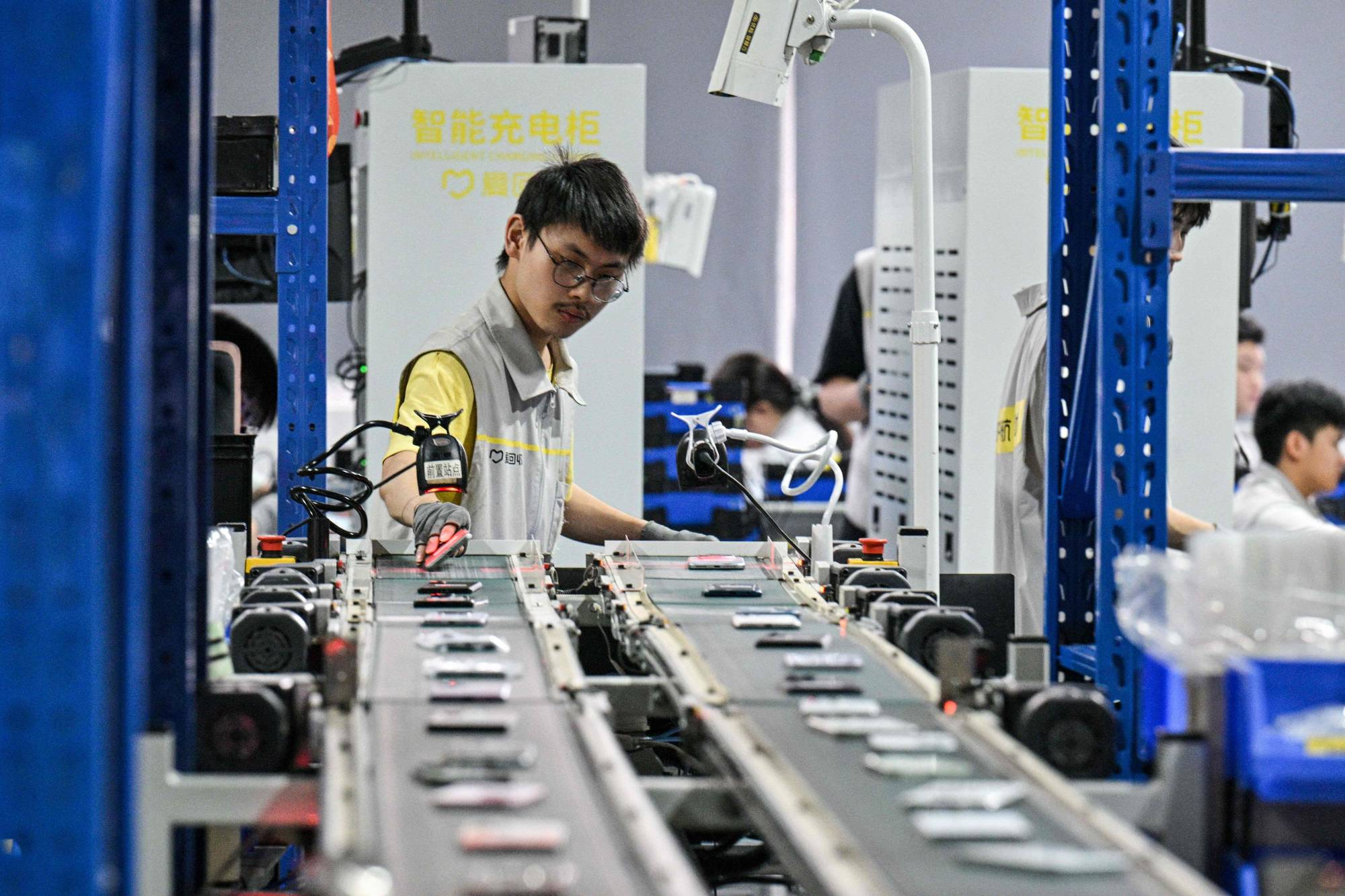
A worker is seen at ATRenew Dongguan Automation Operations Center, which recycles and processes used smartphones in Dongguan, in southern China's Guangdong province on November 3, 2026. (AFP)

- Repair not replace -

In particular, people in emerging markets such as South Asia and Africa, where there is less purchasing power, are turning to used models, Counterpoint Research analyst Ivan Lam told AFP.

The global secondary smartphone market grew 13 percent year-on-year in the first half of 2026 to 150 million units, according to Counterpoint.

In Pakistan, people often opt to repair rather than replace broken devices, said Muhammad, who has been coming to China since 2007.

"Maybe people use one mobile phone for four or five years. It's not the same like the US or Europe. They change every year or every six months," he said.

But outside Huaqiangbei's crowded stalls, a more formalized alternative is taking root: PaiJiTang Mall, a self-service second-hand marketplace run by Chinese recycling company ATRenew.

Inside, rows of over 20,000 used phones are on display. Buyers scan QR codes for instant inspection reports and pricing, test the units and purchase in bulk.

The shop draws up to 1,000 visitors daily, with international traders making up about a third, said store manager Zhang Xiaoming.

Abdul Rahim, a 20-year-old shopkeeper who flies to China up to three times a month to stock his phone and accessory store in Algeria, capitalizes on a price gap of 100 to 120 euros ($110 to $132) per device.

"It's very easy for Algerians to get the visa to China. You put in your papers and in two or three days you have the visa in your passport," he told AFP.

"For Europe, there just aren't visas... So we come here."

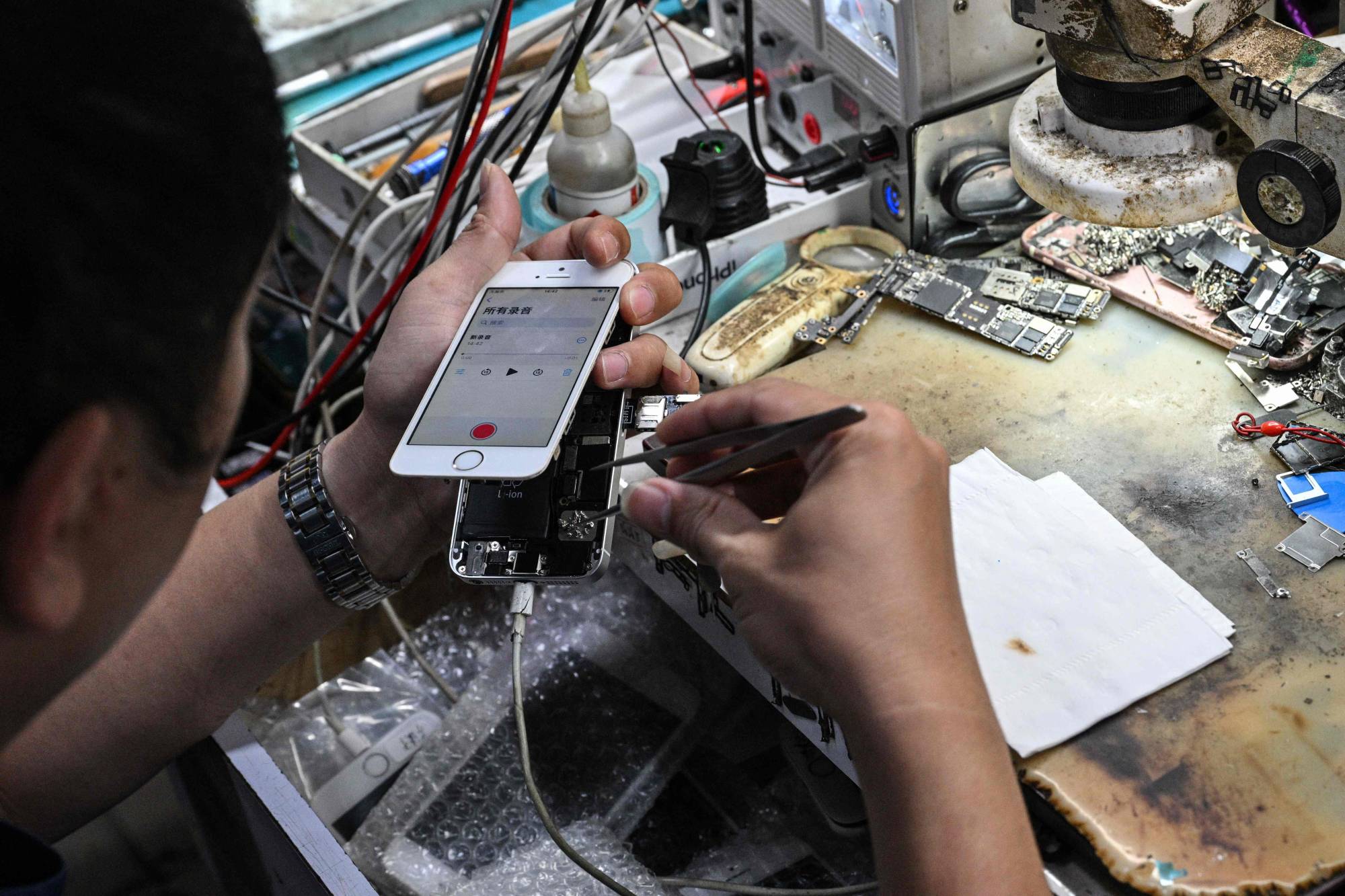
A technician repairs a smarthphone in a shopping mall dedicated to the sale of smartphones in Shenzhen, Guangdong Province, on November 2, 2026. (AFP)

- 'Buy, buy, buy' -

Apple devices account for 70 to 80 percent of sales, with the rest split among Chinese brands such as Huawei, Xiaomi, Oppo and Vivo, Zhang noted.

Older models like the iPhone 11, 12 and 13 -- losing ground to cheap Androids in China -- retain strong brand power overseas, where they find a second life, explained Jeremy Ji, ATRenew's head of corporate strategy and overseas business.

At ATRenew's massive processing hub in Dongguan, north of Shenzhen, roughly 30,000 second-hand gadgets arrive daily and are inspected and packed by over 300 technicians.

Rising prices are also changing buying habits in China itself with consumers opting increasingly for pre-owned models, particularly nearly new premium models, said Arthur Guo, an analyst at IDC China.

Most phones discarded in China are still sold domestically, and bulk exports via official channels have not increased significantly, Lam, of Counterpoint, told AFP.

For Mama, sourcing phones is still a hands-on process.

"If I come, I spend a month checking (phones). I buy, buy, buy," he said. "After I have finished, I go back to my country."