


Fake Gifts, Real Losses as AI Ads Proliferate

(FILES) Trolleys piled high for delivery are seen as shoppers queue at the checkout of a supermarket in London on March 14, 2020. (Photo by JUSTIN TALLIS / AFP)
TT

Fake Gifts, Real Losses as AI Ads Proliferate

(FILES) Trolleys piled high for delivery are seen as shoppers queue at the checkout of a supermarket in London on March 14, 2020. (Photo by JUSTIN TALLIS / AFP)

Online shoppers endlessly scrolling through gift suggestions this holiday season risk being duped by a blizzard of AI-generated scams touting nonexistent products.

Vertical video advertisements, pulling millions of views ahead of Black Friday, are using artificial intelligence to hawk items such as themed advent calendars, heated robes and pet accessories.

Holiday gift scams are not new, but experts warn that AI has lowered the cost required to create a convincing product demonstration.

Some 43 percent of Americans told an October 2026 shopping survey they had been duped by ads generated by the technology.

"It's been surprising how susceptible all ages are to buying these products," said Dallas-based content creator Maggie McGaugh.

She fronts a popular Instagram series of unboxing videos dedicated to exposing AI-advertised items.

Packages that she receives -- purchased primarily through Chinese-owned e-commerce company Temu because it refunds customers if items are not delivered -- fail to resemble the slickly marketed items seen on social media.

"Most of the items are very poor quality," she said. "The size is much smaller, the fabric is like a cheap costume, the lights are dimmer or you have to build it yourself."

Heated, excessively decorated robes are particularly viral this holiday season. Some are styled after the gowns of popular Disney characters that often retail for over $100.

The ads suggest that the item is stocked in physical stores, including H&M.

The global fashion retailer told AFP it had received requests from customers in search of the apparel, but that its name and branding were falsely used to "promote products that are not sold by H&M."

Michelle Richard, known for her "Disney Fashionista" blog, told AFP she was quick to purchase the plush-looking item, but it has yet to be shipped.

"It wasn't until I reported it to my credit card company that I received a lengthy email and more reliable tracking," Richard said. "I am keeping my fingers crossed that the product comes soon and is of the quality it appeared in the ads."

Avid online shopper Tia Evans ordered a similar product in early October after repeatedly seeing ads for it across Facebook, Instagram and TikTok.

"I took a risk on the ad specifically because I had seen it so many times," she told AFP.

She purchased four robes, from a store that catered to African American culture, for more than $200.

Soon after, the website she shopped from went dark, with no reliable tracking information on her order and messages left unanswered by the vendor.

Her bank sent a notification asking if she recognized the purchase. She left the case open in the hopes she "can refer back to it and say: 'Hey, I never got this.'"

Other shoppers reported to AFP that their credit card information had been compromised, used for unauthorized purchases on gambling websites.

Digital media expert Christina Inge said the AI products add to "the perfect storm" of impulse buys around the holidays.
The promotions are tested through "hundreds of ad variations to find the audience for the fake," she said.

But similar to Evans, consumers on Reddit are flagging void tracking numbers and disappearing product listings.

One user told AFP about the purchase of a $280 "smart" Christmas tree gone wrong: "The website vanished after payment, and the only proof of purchase was a fake invoice."

Fake Gifts, Real Losses as AI Ads Proliferate

(FILES) Trolleys piled high for delivery are seen as shoppers queue at the checkout of a supermarket in London on March 14, 2020. (Photo by JUSTIN TALLIS / AFP)
TT

Fake Gifts, Real Losses as AI Ads Proliferate

(FILES) Trolleys piled high for delivery are seen as shoppers queue at the checkout of a supermarket in London on March 14, 2020. (Photo by JUSTIN TALLIS / AFP)

Online shoppers endlessly scrolling through gift suggestions this holiday season risk being duped by a blizzard of AI-generated scams touting nonexistent products.

Vertical video advertisements, pulling millions of views ahead of Black Friday, are using artificial intelligence to hawk items such as themed advent calendars, heated robes and pet accessories.

Holiday gift scams are not new, but experts warn that AI has lowered the cost required to create a convincing product demonstration.

Some 43 percent of Americans told an October 2026 shopping survey they had been duped by ads generated by the technology.

"It's been surprising how susceptible all ages are to buying these products," said Dallas-based content creator Maggie McGaugh.

She fronts a popular Instagram series of unboxing videos dedicated to exposing AI-advertised items.

Packages that she receives -- purchased primarily through Chinese-owned e-commerce company Temu because it refunds customers if items are not delivered -- fail to resemble the slickly marketed items seen on social media.

"Most of the items are very poor quality," she said. "The size is much smaller, the fabric is like a cheap costume, the lights are dimmer or you have to build it yourself."

Heated, excessively decorated robes are particularly viral this holiday season. Some are styled after the gowns of popular Disney characters that often retail for over $100.

The ads suggest that the item is stocked in physical stores, including H&M.

The global fashion retailer told AFP it had received requests from customers in search of the apparel, but that its name and branding were falsely used to "promote products that are not sold by H&M."

Michelle Richard, known for her "Disney Fashionista" blog, told AFP she was quick to purchase the plush-looking item, but it has yet to be shipped.

"It wasn't until I reported it to my credit card company that I received a lengthy email and more reliable tracking," Richard said. "I am keeping my fingers crossed that the product comes soon and is of the quality it appeared in the ads."

Avid online shopper Tia Evans ordered a similar product in early October after repeatedly seeing ads for it across Facebook, Instagram and TikTok.

"I took a risk on the ad specifically because I had seen it so many times," she told AFP.

She purchased four robes, from a store that catered to African American culture, for more than $200.

Soon after, the website she shopped from went dark, with no reliable tracking information on her order and messages left unanswered by the vendor.

Her bank sent a notification asking if she recognized the purchase. She left the case open in the hopes she "can refer back to it and say: 'Hey, I never got this.'"

Other shoppers reported to AFP that their credit card information had been compromised, used for unauthorized purchases on gambling websites.

Digital media expert Christina Inge said the AI products add to "the perfect storm" of impulse buys around the holidays.
The promotions are tested through "hundreds of ad variations to find the audience for the fake," she said.

But similar to Evans, consumers on Reddit are flagging void tracking numbers and disappearing product listings.

One user told AFP about the purchase of a $280 "smart" Christmas tree gone wrong: "The website vanished after payment, and the only proof of purchase was a fake invoice."


China’s Used Phones Find New Homes from Karachi to Algiers

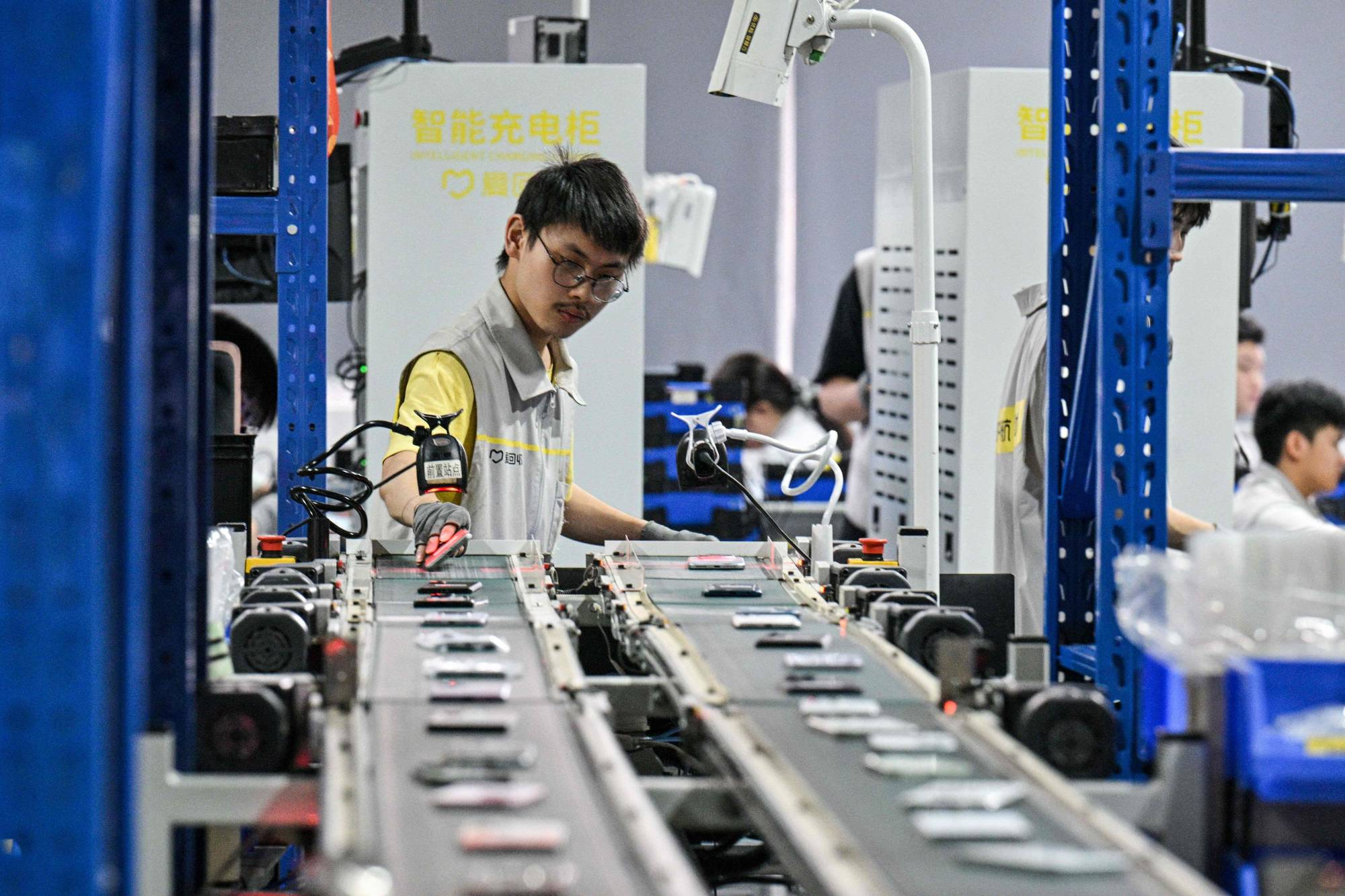
Used smartphones are seen at ATRenew Dongguan Automation Operations Center, which recycles and processes used smartphones in Dongguan, in southern China's Guangdong province on November 3, 2026. (AFP)
TT

China’s Used Phones Find New Homes from Karachi to Algiers

Used smartphones are seen at ATRenew Dongguan Automation Operations Center, which recycles and processes used smartphones in Dongguan, in southern China's Guangdong province on November 3, 2026. (AFP)

In the maze of Shenzhen's neon-lit Huaqiangbei electronics market, buyers from Africa to Bangladesh buy dozens of used phones at a time -- even with cracked screens -- to sell back home.

"From all China, the broken mobile phones come here," Akhtar Muhammad, 38, a Pakistani businessman, told AFP as he browsed the stacks of devices in the southern Chinese city.

"We will fix them in Pakistan."

The supply is mind-boggling. As the world's largest smartphone producer, China discards over 400 million devices annually, the China Association of Circular Economy estimates.

As chip shortages and rising prices around the world make new devices harder to afford, so the demand for pre-owned phones is also soaring.

Mama, a 24-year-old Nigerian buyer, said he had bought around 40 used phones in one day in Shenzhen, which hosted leaders including US President Donald Trump last week.

"They are more expensive in Africa because we don't have big suppliers or markets like this one," Mama told AFP. "If I buy and send them to my country, I get profit."

Nearby, another Nigerian buyer haggled with a stall owner. His haul included damaged iPhone 13 Pro and 14 Pro models bought for 1,000 to 2,000 yuan ($150 to $300) each.

He plans to repair their screens locally before shipping them home for a lucrative resale.

A worker is seen at ATRenew Dongguan Automation Operations Center, which recycles and processes used smartphones in Dongguan, in southern China's Guangdong province on November 3, 2026. (AFP)

- Repair not replace -

In particular, people in emerging markets such as South Asia and Africa, where there is less purchasing power, are turning to used models, Counterpoint Research analyst Ivan Lam told AFP.

The global secondary smartphone market grew 13 percent year-on-year in the first half of 2026 to 150 million units, according to Counterpoint.

In Pakistan, people often opt to repair rather than replace broken devices, said Muhammad, who has been coming to China since 2007.

"Maybe people use one mobile phone for four or five years. It's not the same like the US or Europe. They change every year or every six months," he said.

But outside Huaqiangbei's crowded stalls, a more formalized alternative is taking root: PaiJiTang Mall, a self-service second-hand marketplace run by Chinese recycling company ATRenew.

Inside, rows of over 20,000 used phones are on display. Buyers scan QR codes for instant inspection reports and pricing, test the units and purchase in bulk.

The shop draws up to 1,000 visitors daily, with international traders making up about a third, said store manager Zhang Xiaoming.

Abdul Rahim, a 20-year-old shopkeeper who flies to China up to three times a month to stock his phone and accessory store in Algeria, capitalizes on a price gap of 100 to 120 euros ($110 to $132) per device.

"It's very easy for Algerians to get the visa to China. You put in your papers and in two or three days you have the visa in your passport," he told AFP.

"For Europe, there just aren't visas... So we come here."

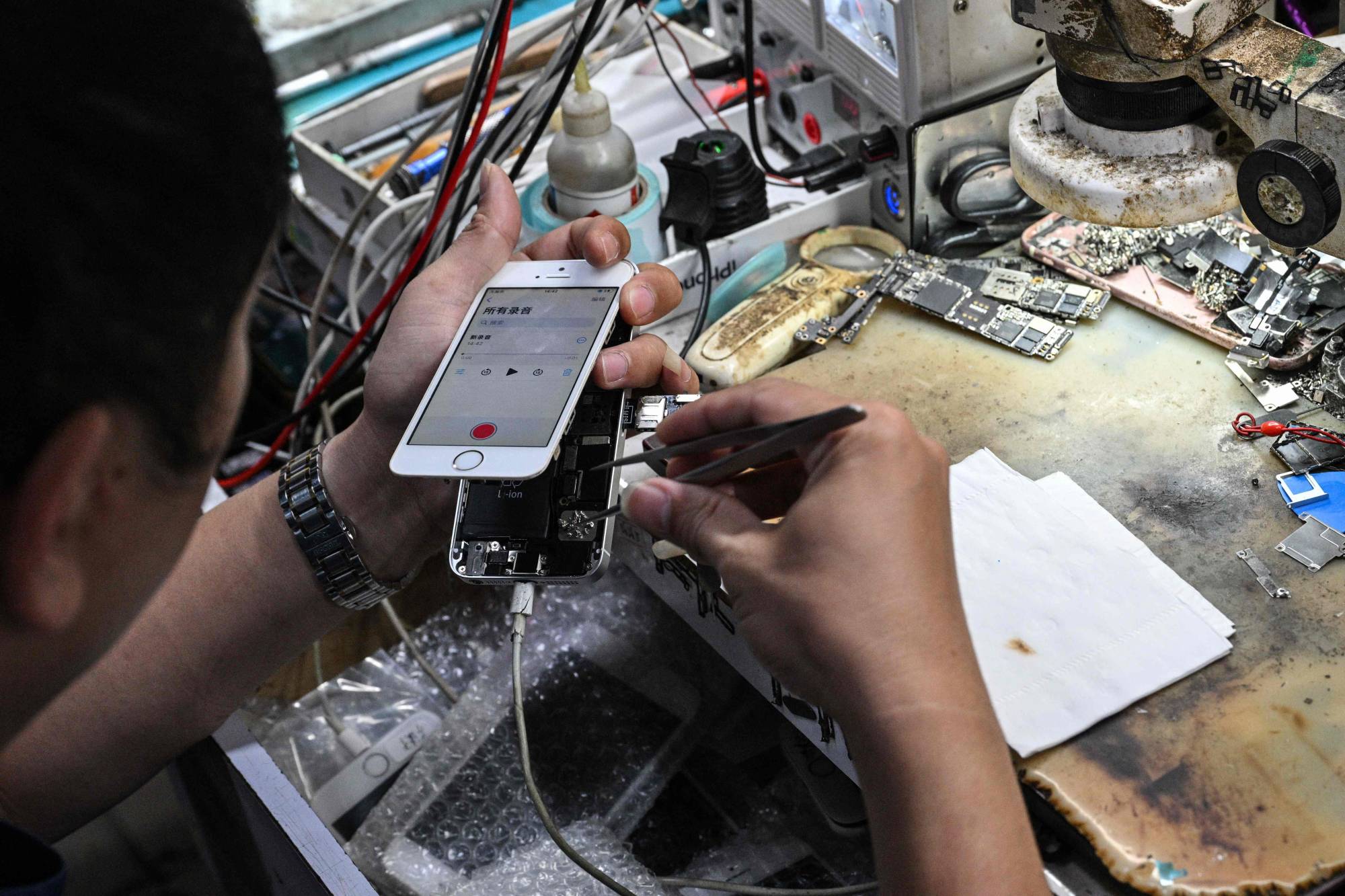
A technician repairs a smarthphone in a shopping mall dedicated to the sale of smartphones in Shenzhen, Guangdong Province, on November 2, 2026. (AFP)

- 'Buy, buy, buy' -

Apple devices account for 70 to 80 percent of sales, with the rest split among Chinese brands such as Huawei, Xiaomi, Oppo and Vivo, Zhang noted.

Older models like the iPhone 11, 12 and 13 -- losing ground to cheap Androids in China -- retain strong brand power overseas, where they find a second life, explained Jeremy Ji, ATRenew's head of corporate strategy and overseas business.

At ATRenew's massive processing hub in Dongguan, north of Shenzhen, roughly 30,000 second-hand gadgets arrive daily and are inspected and packed by over 300 technicians.

Rising prices are also changing buying habits in China itself with consumers opting increasingly for pre-owned models, particularly nearly new premium models, said Arthur Guo, an analyst at IDC China.

Most phones discarded in China are still sold domestically, and bulk exports via official channels have not increased significantly, Lam, of Counterpoint, told AFP.

For Mama, sourcing phones is still a hands-on process.

"If I come, I spend a month checking (phones). I buy, buy, buy," he said. "After I have finished, I go back to my country."


Australia to Treat AI as Key Foreign Policy Challenge

The words "AI Artificial Intelligence" and a keyboard are shown in this illustration created on October 19, 2026. (Reuters)
TT

Australia to Treat AI as Key Foreign Policy Challenge

The words "AI Artificial Intelligence" and a keyboard are shown in this illustration created on October 19, 2026. (Reuters)

Australia will treat artificial intelligence ‌as a key challenge in its foreign policy, warning the technology was reshaping society's foundations and giving overseas actors new ways to interfere in its democracy.

In a major address to parliament on Tuesday setting out Australia's changing foreign policy approach, Foreign Minister Penny Wong is expected to name AI alongside forces, such as the growing influence of middle powers and strategic competition between the US and China.

"Technology is transforming the foundations and dimensions of economic and strategic power," Wong will say.

"Artificial intelligence and emerging technologies are spreading ‌and disrupting ‌faster than any previous revolutionary technologies -- reordering our ‌lives, ⁠economies and militaries in ⁠ways we cannot fully foresee."

It comes after the Australian government earlier this month announced it would toughen its AI regulation, mandating companies report breaches and establishing a dedicated regulator for the technology, following revelations an OpenAI agent breached the database of the country's health system.

Citing recent foreign disinformation operations, Wong will also warn in ⁠her speech, entitled "Securing Australia's future in a changing world: ‌Australian foreign policy for a ‌new era", that AI tools make interference in Australia's democracy by foreign actors ‌faster, cheaper, and harder to recognize.

"We are strengthening our ‌critical technology, infrastructure and cyber resilience, and legislating mandatory safety and security protections for every frontier AI company that operates in Australia," Wong is expected to say.

While welcoming investment and innovation in frontier AI, she will ‌say it must be "on terms that work for all Australians".

Australia intends to help shape the race ⁠to develop ⁠advanced models by ensuring it "does not reward speed over prudence", Wong is expected to say, drawing comparisons to nuclear non-proliferation and online safety.

"Australia is working with partners on AI safety, making it a shared, global endeavor... Australia has helped shape the international order before, in non-proliferation and in online safety. With artificial intelligence, we intend to do it again."

Wong will also outline five other key forces reshaping the international order.

These include the changes in how the US and China define and pursue their interests, the influence of middle powers, the growing threat or use of force and coercion, and increasing difficulty in achieving collective international action.