


AI Demand Drives Chipmaker TSMC's Net Profit to Fresh Record

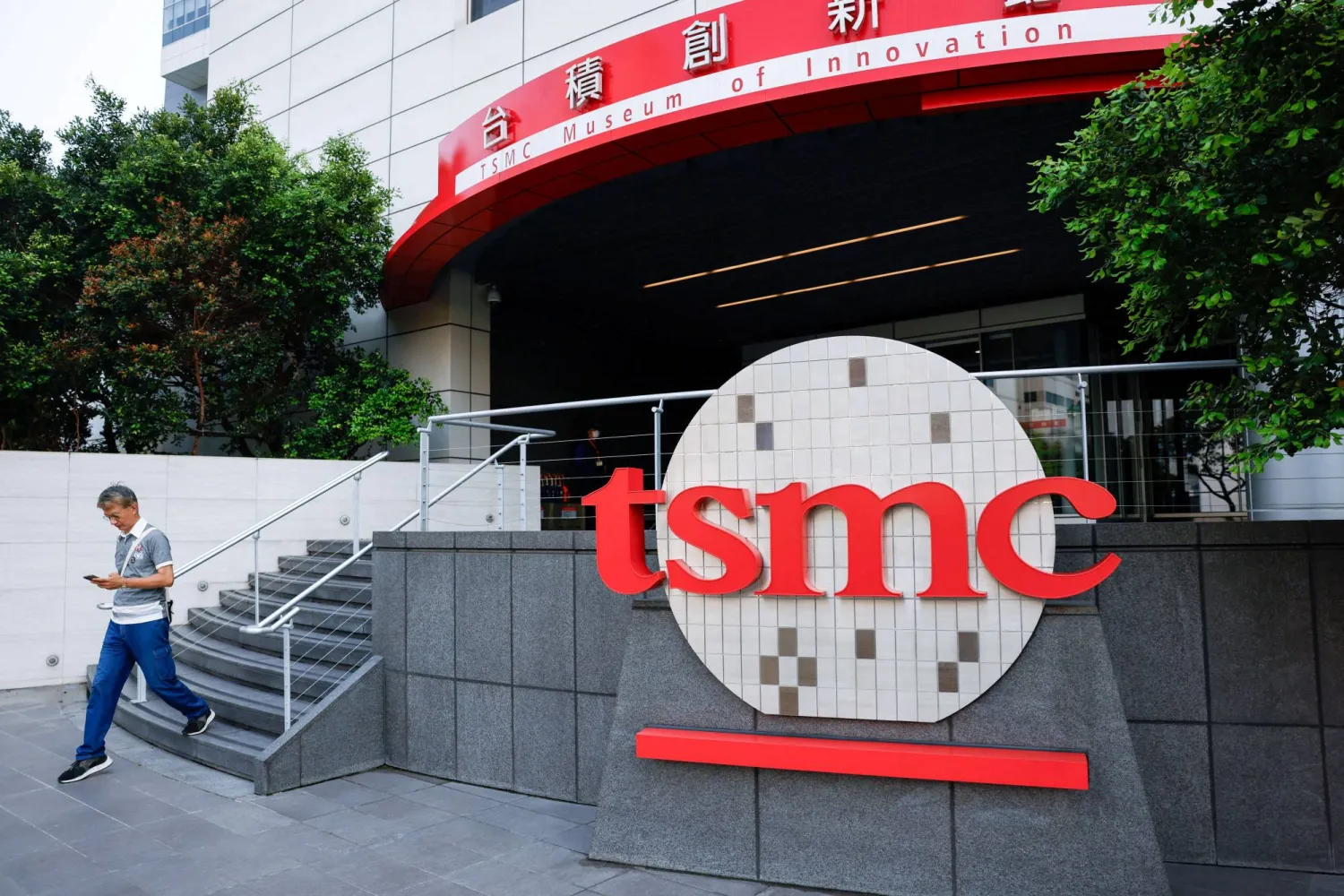
FILE PHOTO: The logo of Taiwan Semiconductor Manufacturing Company (TSMC) is displayed outside of TSMC Museum of Innovation in Hsinchu, Taiwan April 9, 2026. REUTERS/Ann Wang/File Photo
TT

AI Demand Drives Chipmaker TSMC's Net Profit to Fresh Record

FILE PHOTO: The logo of Taiwan Semiconductor Manufacturing Company (TSMC) is displayed outside of TSMC Museum of Innovation in Hsinchu, Taiwan April 9, 2026. REUTERS/Ann Wang/File Photo

Taiwanese chip manufacturer TSMC said Thursday that net profit for January-March leaped to a fresh quarterly record, boosted by the race to develop artificial intelligence technology.

Massive global demand for AI hardware means business is booming for TSMC, the world's biggest contract maker of microchips used in everything from Apple phones to Nvidia's AI processors.

TSMC said its net profit for the first quarter of 2026 rose a whopping 58.3 percent from a year ago to NT$572.5 billion ($18 billion).

The figure trounced estimates of NT$540.20 billion in a Bloomberg survey of analysts.
Governments and tech giants are pouring hundreds of billions of dollars into building new data centers that can run and train AI tools such as chatbots, image generators and agents that can execute tasks.

Last month, Jensen Huang, head of top US chip designer Nvidia, said the entire tech world feels they could develop their AI and grow revenue "if they could just get more capacity".

Ahead of the earnings announcement, Ian Lyall at Proactive Investors said it appeared TSMC is "so deeply embedded in the AI supply chain that macro headwinds are struggling to leave a mark".

"Advanced-node chip production, the bleeding-edge manufacturing that only TSMC can reliably deliver at scale, is running at capacity," he noted.

TSMC is "supplying chips for artificial intelligence accelerators, next-generation smartphones, and the data center build-out that is consuming capital at a pace that has surprised even its most bullish observers", Lyall said.

A weaker Taiwanese dollar had also boosted TSMC's revenues from overseas sales, AFP reported.

On Thursday, TSMC said net revenue for the first quarter came in at NT$1.13 trillion, up 35.1 percent year-on-year.

A note from UBS analysts had predicted strong quarterly results for TSMC but warned that consumer demand was weakening as a result of higher prices caused by a global memory chip shortage fueled by the AI boom.

"Cloud AI demand continues to strengthen, but we think supply constraints will limit meaningful upside for TSMC this year," the UBS team said.

"Middle East tensions add a layer of macro uncertainty, but AI spend should stay insulated, barring a protracted conflict."

The UBS analysts predicted "limited disruption from tight helium supply on TSMC's production".

Helium gas is a key material in the chip supply chain, and Qatar -- one of the countries affected by the war in the Middle East -- is one of its few large-scale producers.

TSMC said Thursday it does not expect the war to impact its supply of chipmaking materials such as helium and hydrogen in the near term.



Meta Enters Enterprise AI Race with New Business Agent

The logo of Meta at the Meta Lab in Los Angeles, California, US, May 20, 2026. (Reuters)
TT

Meta Enters Enterprise AI Race with New Business Agent

The logo of Meta at the Meta Lab in Los Angeles, California, US, May 20, 2026. (Reuters)

Meta Platforms on Wednesday unveiled an artificial intelligence agent aimed at helping businesses carry out day-to-day operations, positioning the social media giant as a player in the enterprise AI market.

Announced at the company's WhatsApp-focused Conversations conference in London, the new product expands on existing business messaging services by enabling "agentic" capabilities in which the assistant can take actions like booking calendar appointments and closing sales on behalf of businesses.

The company said more than 1 million businesses were already using earlier chatbot versions of such agents on WhatsApp and Messenger. The new version will be added to Instagram as well and rolled out globally to businesses of all sizes.

The move hints at Meta's ambitions to compete with rivals like OpenAI, Anthropic and Alphabet's Google in the market ‌for enterprise applications ‌of its AI tools, leveraging the reach of its WhatsApp, ‌Instagram ⁠and Facebook apps.

"This ⁠is definitely an enterprise play," Naomi Gleit, Meta's head of product, told Reuters in an interview on the sidelines of the conference.

The Business Agent can be customized to respond to queries on those apps, channeling a company's tone and handling tasks such as answering frequently asked questions, qualifying leads and escalating complex queries to human staff when needed.

Businesses will initially be able to access the tool for free, with paid subscription options planned in the coming months.

"We actually want to ⁠take actions now. We actually want it to be able to ‌complete the payment, to process the booking, to place ‌the order," going beyond "rule-based automations" for legacy bots, she said.

Alongside the new Business Agent offerings inside ‌Meta's apps, the company is also launching a broader "Business Agent Platform" aimed at giving businesses ‌the infrastructure to build custom AI agents to help them manage their operations elsewhere.

The platform is connected to hundreds of non-Meta systems like Shopify, Zendesk and Shopee, where those agents can be deployed, and provides larger businesses with enterprise-grade controls, guardrails and measurement, the company said.

Gleit is spearheading the company's efforts ‌to expand into new lines of business around AI agents, including with a new team, Enterprise Solutions, announced as part of a ⁠recent companywide restructuring around ⁠AI.

The team will send squads of forward-deployed engineers to embed with enterprise customers, a model used by AI companies such as Anthropic that is aimed at navigating internal politics around AI adoption and writing custom code to help models deliver results.

Its scope is currently focused on new business agents, but it is also working to build and sell agentic AI products that businesses can use for additional internal functions.

Gleit is also working to consolidate the different AI agents Meta has built, including internal workflow-oriented tooling, a user-facing Meta AI support bot and a separate ads-focused "business assistant" launched globally last month, she said.

"The number one thing I hear, especially from small businesses, is 'I just want to go to one place that can do all the things,'" she said.

"You want to make things modular, and you also need to be willing to evolve, because the technology is moving so quickly."


UK Allows Websites to Opt Out of Google AI Search

FILE PHOTO: The Google logo is pictured at the entrance to the Google offices in London, Britain January 18, 2019. REUTERS/Hannah McKay/File Photo
TT

UK Allows Websites to Opt Out of Google AI Search

FILE PHOTO: The Google logo is pictured at the entrance to the Google offices in London, Britain January 18, 2019. REUTERS/Hannah McKay/File Photo

Britain's competition watchdog said Wednesday that it had ordered Google to allow UK website owners to opt out of having their content used by the US technology giant's AI search.

According to AFP, the Competition and Markets Authority (CMA) called the change a "world first" after it had proposed the measure in January.

Website publishers, particularly media outlets, claim that artificial intelligence models take their content without compensation.

They also argue that the AI-generated summaries discourage clicks to publishers' original pages, reducing traffic to their sites and in turn cutting their advertising revenue.

Google said Wednesday that sites opting out would not receive traffic or impressions from its generative AI features.

In response to the opt-out ruling, Google said that "Today, we're beginning to test a new control that lets website owners manage how their links and content appear in generative AI search features," its Search Ecosystem general manager, Mrinalini Loew, said in a statement.

The CMA said the ruling "will secure a fairer deal for publishers and consumers.”

It added that Google is "required to make sure that publisher content is properly attributed, using clear links, in AI-generated search results.”

The CMA last year designated Google with "strategic market status,” subjecting it to tougher regulation alongside other technology giants.

"With features like (Google's) AI Overviews rapidly reshaping online search, it is crucial that content publishers, including news organizations, have appropriate bargaining power over how their content is used," CMA chief executive Sarah Cardell said in a statement.

AI Overviews currently have more than 2.5 billion monthly users, according to Google, which last month showed off plans to turn its traditional search bar into an AI assistant.


Intel Says Competition from Nvidia PC Chip a ‘Good Thing’

A sign is posted in front of Intel headquarters in Santa Clara, California, US, Aug. 1, 2024. (AFP)
TT

Intel Says Competition from Nvidia PC Chip a ‘Good Thing’

A sign is posted in front of Intel headquarters in Santa Clara, California, US, Aug. 1, 2024. (AFP)

Intel said Tuesday that competition in personal computer chips from hardware giant Nvidia as a "good thing" as artificial intelligence presents new business opportunities.

The comments come a day after Nvidia, the world's most valuable company, unveiled a powerful chip for Windows machines designed to run AI agents, tools that can carry out tasks for users.

The announcement from Nvidia is a challenge to legacy PC chipmakers including Intel and AMD, as well as Apple's laptop business.

"If you take a look at what they brought to market (Monday), I think it's a good thing," Alex Katouzian, general manager of Intel's client computing and physical AI group, told a news conference in Taipei.

"It shows the importance of how critical the PC is," he added.

"We welcome the competition, but I think we're going to do really well," he said, touting Intel's scale -- with "every segment covered" -- and the trust of its customer base.

"They want us to grow with them, there's new opportunities on the AI side," Katouzian said, calling the company's roadmap "super strong".

Shares in Intel took off late last year after Nvidia announced it would invest $5 billion in the firm.

And in April, the company smashed quarterly earnings expectations, in what could be a sign it is on a path to recovery.

Intel largely missed the smartphone boom and failed to develop competitive hardware for the AI era, allowing Asian manufacturers TSMC and Samsung to dominate the custom semiconductor market.

Most notably, Intel was blindsided by Nvidia's rise as the world's leading AI chip provider.

Nvidia's graphics processing units (GPUs), originally designed for gaming consoles, have become the essential building blocks of AI systems, with tech giants scrambling to secure them for their data servers and AI projects.

The heads of both companies are in Taipei this week for the major industry show Computex.

On Tuesday, Intel announced upgrades to its AI data center hardware offerings as well as new collaborations with supply chain partners such as Taiwan's Foxconn.

While several experts told AFP that Nvidia's competitors should be worried about its new PC chip for the AI era, the RTX Spark, others were more cautious.

"This move may create incremental pressure for Intel and Qualcomm; however, given the complexity and likely premium pricing, we don't expect significant competition with mainstream AI PCs," Bloomberg Intelligence analysts wrote.