


Introducing Argus, a Robot with 20 Legs and Eyes Built to Move and See in Any Direction Instantly

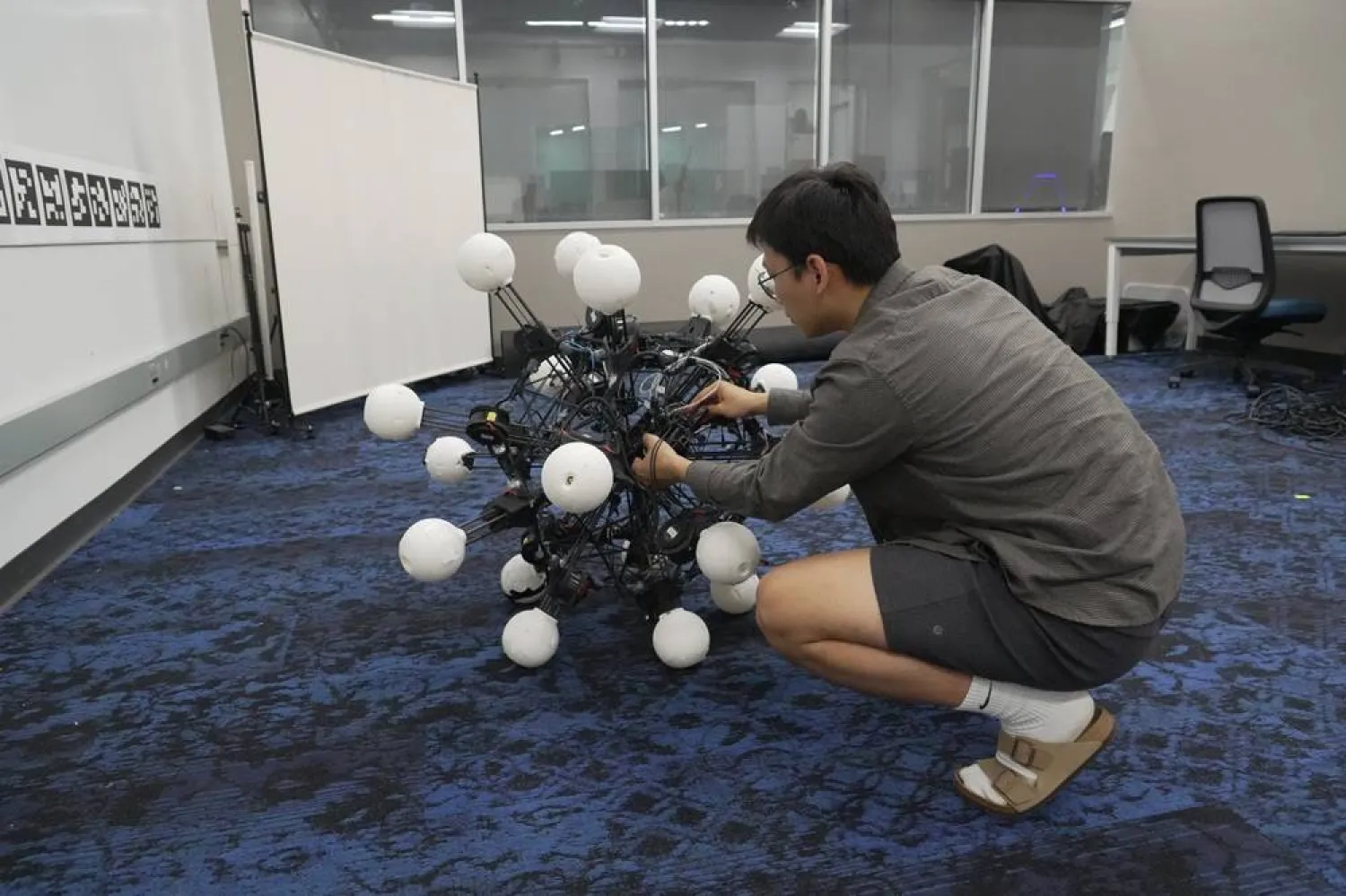
 Jiaxun Liu, a PhD student, works on a robot named Argus at Duke University's General Robotics Lab in Durham, NC, Tuesday, May 26, 2026. (AP)
Jiaxun Liu, a PhD student, works on a robot named Argus at Duke University's General Robotics Lab in Durham, NC, Tuesday, May 26, 2026. (AP)
TT

Introducing Argus, a Robot with 20 Legs and Eyes Built to Move and See in Any Direction Instantly

 Jiaxun Liu, a PhD student, works on a robot named Argus at Duke University's General Robotics Lab in Durham, NC, Tuesday, May 26, 2026. (AP)
Jiaxun Liu, a PhD student, works on a robot named Argus at Duke University's General Robotics Lab in Durham, NC, Tuesday, May 26, 2026. (AP)

A robot being developed at Duke University is almost ready to face the world, in any direction.

Instead of trying to copy symmetrical shapes from nature by building robots that look like people, dogs or insects, engineering professor Boyuan Chen and his team focused on uniformity in action, or what he calls "dynamic symmetry."

The result was Argus. The roly-poly robot named after a mythological many-eyed giant has depth-sensing cameras attached to 20 telescoping legs that radiate from a central core. With no front, back, top or bottom, it can see and move in any direction instantly.

"Instead of measuring how your legs are arranged around a different part of your body, we’re measuring how fast you can move in any direction," Chen said. "Who said, you know, if you have a robot to help us in a most effective way, it has to look like us?"

In experiments, Argus has navigated sandy beaches and forest undergrowth, rolling over obstacles and stabilizing itself after being pushed. It can climb between parallel brick walls by alternating bracing and thrusting motions with its legs. If one or more motor dies or a leg breaks, it continues to function.

"Watching Argus move is unlike watching any other robot we’ve worked with," said Jiaxun Liu, a graduate student and co-author of a study about Argus published online Wednesday in the journal Science Robotics. "The first time we saw it navigate among trees and rough terrain, even under heavy collisions, we knew this was something different."

As part of their work, researchers developed a new design principle called dynamic isotropy that rates robots on a scale of 0 to 1 based on how uniformly they can accelerate in every direction. Most robots in use today, including humanoids and drones, score below 0.6. Argus scores 0.91.

"When a robot can accelerate equally well in every direction, it stops needing to face the world in any particular way," said Chen, who hopes the same principle could guide the development of search and rescue robots, underwater or aerial vehicles or robots with the ability to grip objects.

"Instead of building a robot hand that looks like a human hand ... one idea is to think about having Argus be the hand itself, and it can manipulate objects in any direction," he said. "The knowledge we can transfer to the rest of the world is much more deeper than building an existing robot or copying an existing species."



WhatsApp Will Allow Users to Go by Usernames Instead of Phone Numbers, Closing a Privacy Blind Spot

A WhatsApp icon is displayed on an iPhone, Nov. 15, 2018, in Gelsenkirchen, Germany. (AP)
TT

WhatsApp Will Allow Users to Go by Usernames Instead of Phone Numbers, Closing a Privacy Blind Spot

A WhatsApp icon is displayed on an iPhone, Nov. 15, 2018, in Gelsenkirchen, Germany. (AP)

WhatsApp users will soon get the option of going by usernames instead of phone numbers, the company said Monday, announcing plans to address a privacy blind spot.

The app said it has started allowing users to reserve unique usernames, which can be used to contact WhatsApp users when the feature is launched later this year.

WhatsApp, which says it has more than 3 billion users globally, has until now allowed users to be contacted by anyone who has their phone number.

The app, owned by Meta Platforms, said in a blog post that over the “coming months” users will get the option to be found and contacted only by their username, and not their number. It wasn't more specific about the timeline.

“We have designed this as a core privacy feature,” Alice Newton-Rex, WhatsApp's vice president of product, told reporters.

There won't be a directory of usernames on the app, and the app won't suggest names as you type.

“People will need to know your exact username to contact you for the first time,” she said.

WhatsApp's current privacy settings are limited to blocking individual users and silencing unknown callers. The app also allows users to add a profile name, but that's only displayed in chat groups for other people who don't have the user's contact info saved.

While Americans still prefer text messaging to WhatsApp, the app is widely used in Europe, Asia and much of the rest of the world.

Catchy online handles are highly coveted and users will likely scramble to claim a desirable one.

“I think a lot of people will go and get usernames and that’s why we decided to open reservations early,” Newton-Rex said.

Companies, organizations and creators with existing accounts on Meta's social media platforms, Instagram and Facebook, will get the chance to claim their usernames on WhatsApp.

Usernames need to be between three and 35 characters. To prevent impersonation, WhatsApp will hold back usernames for high-profile people or groups such as celebrities, public figures and government entities.


BT, Verizon Join Forces to Create $4 Billion Int’l Joint Venture

The Verizon logo is seen on the 375 Pearl Street building in Manhattan, New York City, US, November 22, 2021. REUTERS/Andrew Kelly
TT

BT, Verizon Join Forces to Create $4 Billion Int’l Joint Venture

The Verizon logo is seen on the 375 Pearl Street building in Manhattan, New York City, US, November 22, 2021. REUTERS/Andrew Kelly

BT and Verizon on Monday announced a deal to combine their international enterprise operations into a 50:50 joint venture, focusing on serving multinational clients and bringing together $4 billion in combined annual revenue.

Verizon has agreed to pay BT an equalization payment of $625 million, and both companies ⁠will hold equal ⁠voting rights in the new venture, which will serve more than 3,000 customers in over 180 countries, Reuters reported.

The deal marks a milestone for BT chief executive ⁠Allison Kirkby, who has been steadily refocusing the 180-year-old British telecoms group on its home UK market while shedding international assets.

Verizon CEO Dan Schulman, who has been pushing his own turnaround at the US wireless carrier, said the venture was "the clear answer" for international customers ⁠who ⁠need secure, flexible connectivity that works across borders and cloud environments.

BT and Verizon named Martijn Blanken as chief executive officer-designate of the new company. Blanken will join BT Group from September 1, 2026, and work with both parent companies as they prepare to launch the joint venture.


South Korea Unveils Massive AI and Chip Investment Drive

South Korean President Lee Jae Myung (C), alongside Samsung Electronics Co. Chairman Lee Jae-yong (L) and SK Group Chairman Chey Tae-won, attends a meeting at the presidential office Cheong Wa Dae in Seoul, South Korea, 29 June 2026.  EPA/YONHAP
South Korean President Lee Jae Myung (C), alongside Samsung Electronics Co. Chairman Lee Jae-yong (L) and SK Group Chairman Chey Tae-won, attends a meeting at the presidential office Cheong Wa Dae in Seoul, South Korea, 29 June 2026. EPA/YONHAP
TT

South Korea Unveils Massive AI and Chip Investment Drive

South Korean President Lee Jae Myung (C), alongside Samsung Electronics Co. Chairman Lee Jae-yong (L) and SK Group Chairman Chey Tae-won, attends a meeting at the presidential office Cheong Wa Dae in Seoul, South Korea, 29 June 2026.  EPA/YONHAP
South Korean President Lee Jae Myung (C), alongside Samsung Electronics Co. Chairman Lee Jae-yong (L) and SK Group Chairman Chey Tae-won, attends a meeting at the presidential office Cheong Wa Dae in Seoul, South Korea, 29 June 2026. EPA/YONHAP

South Korea rolled out sweeping chip and AI mega-projects on Monday, as President Lee Jae Myung pledged to cement overwhelming industry ⁠leadership with investments spanning ⁠hundreds of billions of dollars over several years.

The announcement marks Lee's boldest push yet to align South Korea's AI and chip ambitions with his pledge to narrow regional disparities and revive economies beyond the Seoul metropolitan area.

Lee was joined by ⁠the leaders of Samsung Electronics and SK Hynix, the world's two largest memory chipmakers, for the televised announcement.

"We must secure the core elements of AI faster than any other country," Reuters quoted the president as saying. "Semiconductors, physical AI, and AI data centers are the triple axis for our great leap forward."

The projects are expected to attract investments including by Samsung and SK over the next several years. Lee said the country's ⁠southwestern ⁠city of Gwangju and South Jeolla province will also invest 520 trillion won ($336.70 billion) in the projects.

As part of the overall initiative, the southwest would be the home to new massive chip production clusters, Lee said, in part to utilize the rich power resources yet untapped there.

Local media have reported the planned investments could exceed 1,000 trillion won ($651.41 billion) over coming years.