


How SK Hynix’s Bet on a Niche Memory Chip Made It More Valuable Than Samsung

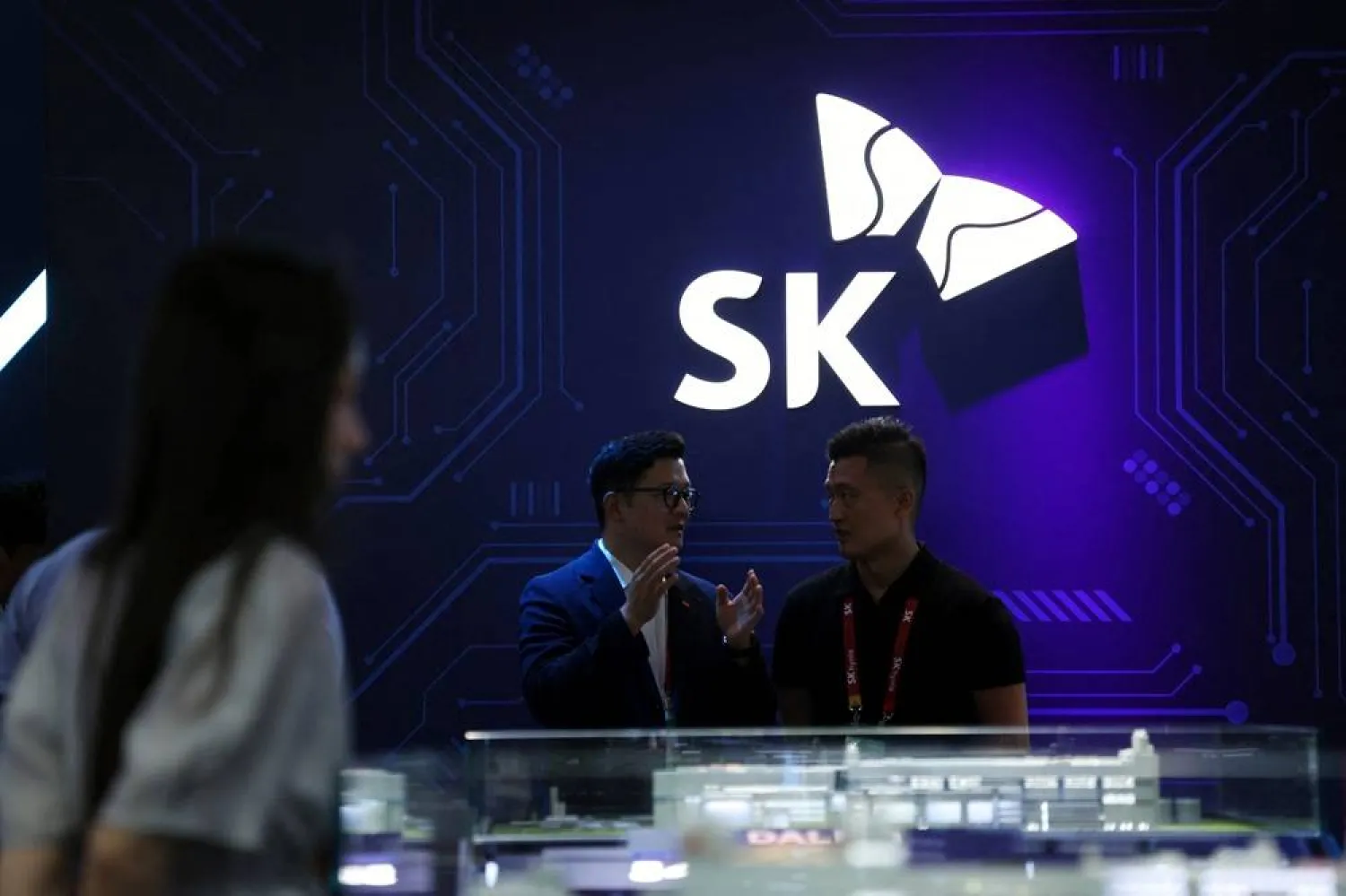
 People stand near a logo of SK Hynix at the South Korean chipmaker's booth during the China International Supply Chain Expo (CISCE) in Beijing, China June 22, 2026. (Reuters)
People stand near a logo of SK Hynix at the South Korean chipmaker's booth during the China International Supply Chain Expo (CISCE) in Beijing, China June 22, 2026. (Reuters)
TT

How SK Hynix’s Bet on a Niche Memory Chip Made It More Valuable Than Samsung

 People stand near a logo of SK Hynix at the South Korean chipmaker's booth during the China International Supply Chain Expo (CISCE) in Beijing, China June 22, 2026. (Reuters)
People stand near a logo of SK Hynix at the South Korean chipmaker's booth during the China International Supply Chain Expo (CISCE) in Beijing, China June 22, 2026. (Reuters)

SK Hynix's overtaking of Samsung Electronics to become South Korea's most valuable firm was the culmination of 14 years of bets that brought it skepticism and scorn but ultimately put it at the center of the global AI gold rush.

In 2012, conglomerate SK Group acquired Hynix Semiconductor in a deal that was considered financially irresponsible. Samsung, in contrast, was valued at more than 10 times SK Hynix and was the global leader in Dynamic Random-Access Memory (DRAM), a memory type that powers laptops and smartphones.

Eager to find an edge, SK Hynix bet on a different memory type that was considered niche: high-bandwidth memory chips (HBM), which could feed data fast but were not widely used by data center customers.

It released the world's first HBM product with Advanced Micro Devices in 2014, but stumbled with the chip's second generation, falling behind Samsung in the late 2010s. That prompted executives to debate whether to halt HBM development, two ex-executives said.

They eventually decided to double down, revamping their technology and investing heavily in new production capacity as they expected growing demand from Nvidia - back then known as a supplier of ‌3D graphic chips to ‌the computing and video game markets - said Shim Dae-yong, who led HBM development at SK Hynix at ‌the time.

That ⁠gamble, which involved ⁠an 880 billion won ($640 million) investment into a packaging facility in Icheon and other assets, initially appeared to backfire. That facility struggled with underutilization in 2019 as demand from Nvidia and cryptocurrency miners plummeted.

"It was a headache back in 2019," Shim said. "It was obsolete."

But it eventually paid off when OpenAI's ChatGPT release in 2022 ignited the artificial intelligence boom and global demand for HBM chips, which became critical to Nvidia's AI accelerators used in data centers to train and run AI models.

Today, SK Hynix is Nvidia's main HBM supplier.

"No one expected the HBM market would post such explosive growth," Shim said. "But we were ready in terms of performance and capacity."

Reuters spoke to three ex-SK Hynix executives including Shim and reviewed two books on the firm to help illustrate its early days and meteoric ⁠rise.

SK Hynix declined to comment on Reuters' questions about this story.

South Korea's stock market has been volatile of ‌late and SK Hynix's market cap fell below Samsung's on Wednesday.

CRISIS-RIDDEN

Founded in 1983 as Hyundai ‌Electronics, the firm went through crises and acquisitions before it became SK Hynix.

In 2001, it flirted with bankruptcy as chip prices plummeted before creditor banks, led by ‌state lenders, rescued it.

The creditors then tried to sell their stakes several times, including to Micron Technology in 2002, a decision that was ‌rejected by the company's board.

SK Group, then known for its telecoms and energy businesses, bought Hynix a decade later in a deal that prompted Standard & Poor's Ratings Services to assign SK Telecom a negative outlook, warning of the highly cyclical nature of the semiconductor industry and large capital expenditure requirements.

SK Group Chairman Chey Tae-won explained his thinking in a book published in January.

"What I really wanted to accomplish when we acquired Hynix was to transform it from a commodity memory producer into a mainstream ‌semiconductor company whose products are indispensable," Chey said.

Hyun Sun-yeop, a former SK Hynix HR executive, said its underdog status made it work harder.

"We believed that it would be impossible to overcome Samsung in commodity DRAM ⁠products," he said. "We were desperate to change ⁠the market dynamics. We needed a breakthrough."

Its focus on HBM later helped SK Hynix recover from the global memory industry's boom-and-bust cycle faster than Samsung. In 2023, a severe downturn battered memory prices, pushing SK Hynix to report an annual operating loss of 7.73 trillion won.

In 2024, the company posted a record operating profit and it briefly overtook Samsung as the world's top DRAM maker in 2025.

"No one would ever have imagined that SK Hynix would overtake Samsung," said Shin Jae-yong, a business administration professor at Seoul National University.

"It is almost impossible for a runner-up to catch up with the market leader in this capital-intensive industry, which requires massive investment. HBM was the powerful driver behind how they turned the tables."

Today, Samsung is playing catch-up. Its in-house foundry business supplies key components for HBM chips, while SK Hynix relies on Taiwan Semiconductor Manufacturing to produce the so-called base die using less advanced technology.

SK Hynix's fortunes helped power South Korea's economy, its stock market and made its employees attractive marriage material. It is preparing to list shares in the US as soon as August to broaden its investor base, Reuters has reported.

It has also outpaced the expectations of its top bosses, with shares rallying more than 340% this year.

In 2024, Chey, the SK Group chair, said SK Hynix should seek a market capitalization of 1 quadrillion won and eventually raise that to 2 quadrillion won, according to a book, Super Momentum.

On Monday, it became South Korea's most valuable listed company, with a market value of nearly 2.1 quadrillion won.



Race for Robotaxi Market Arrives in London

A car from British autonomous driving technology company Wayve Technologies Ltd is pictured driving around the street, on the sidelines of London Tech Week in London on June 8, 2026. (AFP)
TT

Race for Robotaxi Market Arrives in London

A car from British autonomous driving technology company Wayve Technologies Ltd is pictured driving around the street, on the sidelines of London Tech Week in London on June 8, 2026. (AFP)

Bristling with sensors and electronic eyes, robotaxis are appearing on London's streets, slipping silently between red buses and black cabs, as companies battle to lead Europe's emerging autonomous vehicle market.

British start-up Wayve, in partnership with Uber, is racing to beat US rival Waymo, owned by Google-parent Alphabet.

China's Baidu is also to launch in the British capital, where winding streets, roadworks and pedestrian traffic bring unique challenges.

"London has 20 times the amount of road construction than San Francisco and 10 times the amount of vulnerable road users," said Kaity Fischer, head of business development at Wayve.

"We've had 2,000-year-old roads, certainly no perfect grid system," she told AFP ahead of a ride in the company's Ford Mustang Mach-E.

On the road, every pedestrian and intersection presents a test. The car responded smoothly though, braking where necessary.

Passengers tend to spend the first few minutes of the ride "marveling, videoing the steering wheel moving on its own, taking selfies", Fischer said.

Then "about three minutes in, they're doing the exact same thing that they do in any other Uber or ride hail -- they're looking at their phone", she added.

Britain stands ahead of the European Union in the race to getting driverless cars on the road, thanks to government efforts to speed up regulation.

The Labour government expects the autonomous vehicle sector to generate 38,000 jobs and £42 billion ($55 billion) by 2035.

- Backlash -

Londoners will be able to take their first commercial rides with Wayve this summer, with a human operator on board in the initial stages.

Waymo, already operating in 11 US cities using pre-mapped routes, could follow shortly after.

The sector's complexity means that companies competing in one city may collaborate in another, with one providing the technology and the other managing the fleet and commercial rollout.

Baidu, in partnership with ride-sharing firm Lyft, will be testing "in the coming weeks" ahead of launching in London later this year, said Jeremy Bird, Lyft's head of global growth.

At its launch, fares are likely to be "pretty similar" to traditional taxis, he told AFP.

Companies are under pressure to get the public on side, after a series of high-profile mishaps.

This year, a string of Baidu vehicles stalled in central China leaving passengers stranded.

Waymo had to recall nearly 4,000 cars after several incidents in which its robotaxis entered closed-off highway construction areas.

"Robotaxi players know they are just one bad accident away from getting serious pushback," McKinsey transport specialist Philipp Kampshoff told AFP.

"So you have to make sure safety is your absolute priority."

- 'Tourist attraction' -

Waymo product director Saswat Panigrahi has offered assurances that its cars record 13 times fewer serious accidents than human drivers.

The system's AI technology is "powerful enough" to detect tiny movements that indicate a pedestrian is about to walk across the road, he said at the South by Southwest tech festival in London.

But for Steve McNamara, head of London's taxi association, robotaxis are just "a solution to a problem that doesn't exist".

"They are pumping millions and millions of dollars into PR, into spin, into marketing, into convincing politicians, into convincing people that this is a great thing," McNamara told AFP.

London's taxi industry is still recovering from the rise of Uber, which reduced the number of its vehicles on the road to 14,800 in 2024 from 22,300 in 2009.

McNamara said robotaxis will ultimately become "a tourist attraction", adding that autonomous vehicles tend to wait until roads are completely clear before pulling out.

"There's parts of London where it would be sitting there until Christmas Day, if you're waiting for the road to be clear."


AI Can Outpace Cybersecurity Norms 'in Months', Says Spy Alliance

FILE PHOTO: AI (Artificial Intelligence) letters and robot hand miniature in this illustration taken, June 23, 2023. REUTERS/Dado Ruvic/Illustration/File Photo
TT

AI Can Outpace Cybersecurity Norms 'in Months', Says Spy Alliance

FILE PHOTO: AI (Artificial Intelligence) letters and robot hand miniature in this illustration taken, June 23, 2023. REUTERS/Dado Ruvic/Illustration/File Photo

The most advanced artificial intelligence models are improving quickly enough to outsmart prevailing cybersecurity know-how within months, the Five Eyes spy agency alliance has warned.

The risk posed by AI-enhanced hacking is in the spotlight, after US startup Anthropic said in April that its cutting-edge Mythos models had unprecedented abilities to find software vulnerabilities, reported AFP.

The security agencies of Britain, the United States, Australia, Canada and New Zealand urged governments and businesses to act swiftly to prepare themselves as AI evolves.

"The rapid pace of frontier AI development means cyber risk assumptions can become outdated in months, not years," said a joint statement dated Monday.

AI "lowers barriers for malicious actors and increases the speed and complexity of attacks", the Five Eyes advisory said.

"Breaches will occur. Preparedness helps you contain them quickly and prevent escalation into major operational and financial crises."

To improve cyber defenses, organizations should integrate AI tools into their security operations, update old systems and limit access to critical systems among other steps, they said.

Anthropic this month suspended access to Mythos 5 and a restricted version called Fable 5 to comply with a US national security order.

Just days after publicly launching Fable 5, the company said it had received a government directive banning all foreign nationals from accessing the two models.

The intervention is striking for a White House that has otherwise pushed to loosen AI oversight -- even moving to block states from writing their own rules.


Indian Startup Head Appointed as New WhatsApp Boss

The WhatsApp logo is seen in this illustration taken, August 22, 2022. (Reuters)
TT

Indian Startup Head Appointed as New WhatsApp Boss

The WhatsApp logo is seen in this illustration taken, August 22, 2022. (Reuters)

Meta has tapped Indian fintech founder Kunal Shah as the new head of WhatsApp, as the US tech giant seeks ways to monetize the messaging app's massive user base.

The announcement, made Monday night, was accompanied by news that Meta would also lead a $900 million funding round in Shah's consumer finance firm CRED.

"Kunal built CRED into one of India's most important technology companies," Meta chief Mark Zuckerberg said in a statement.

"He brings the kind of builder mentality and global perspective that will serve him well in running the world's biggest messaging app."

Shah, a serial entrepreneur and influential figure in India's fintech world, started CRED in 2018 after selling an earlier payments startup to Indian e-commerce giant Snapdeal for roughly $400 million.

He is also one of India's most prolific angel investors, according to data tracker Tracxn, with the local financial press often reporting how Shah agrees to seed funding pitches within minutes of hearing them.

But over the last few years, Shah has focused on building CRED -- which got its start by offering rewards to customers for timely credit card payments.

Since then, the company has aggressively expanded into offering wealth management, insurance and lending services to its 17 million users.

This experience is likely to help WhatsApp as it seeks new revenue streams that go beyond the core advertising business of Meta, which also runs Facebook and Instagram.

While India is WhatsApp's largest market -- with over half a billion users, according to 2021 government figures -- analysts say it has largely missed the chance to build an equally popular payments service.

In May, the messaging app offered businesses in India the ability to use artificial intelligence for services including responding to customers at all hours or booking appointments.

Shah acknowledged the scope for future growth, saying in a statement that the gap between "WhatsApp today and its full potential is massive".

India's startup ecosystem also celebrated Shah's appointment -- the latest example of an Indian-born executive becoming the leader of a Silicon Valley company.

Sajith Pai of Blume Ventures, an early stage Indian start-up backer said Shah was getting an "even bigger canvas to paint his bold brushstrokes in".

"Great news for everyone in the Indian startup ecosystem, and for India!"