

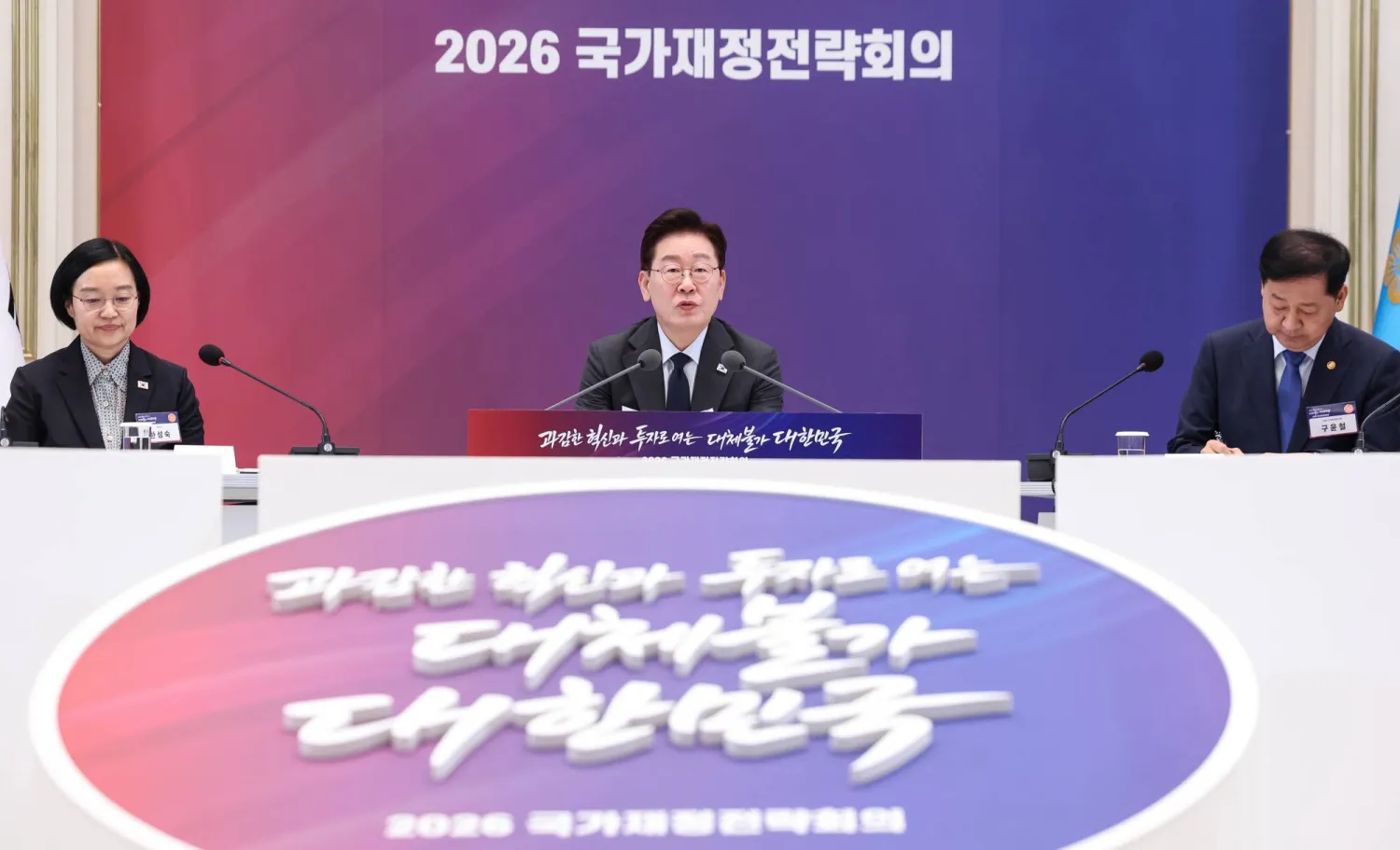

Lee: South Korea's AI Tax Windfall a 'Golden Window' for Investment

South Korean President Lee Jae Myung (C) speaks during the National Fiscal Strategy Meeting at the presidential office Cheong Wa Dae in Seoul, South Korea, 13 July 2026.  EPA/YONHAP SOUTH KOREA OUT
South Korean President Lee Jae Myung (C) speaks during the National Fiscal Strategy Meeting at the presidential office Cheong Wa Dae in Seoul, South Korea, 13 July 2026. EPA/YONHAP SOUTH KOREA OUT
TT

Lee: South Korea's AI Tax Windfall a 'Golden Window' for Investment

South Korean President Lee Jae Myung (C) speaks during the National Fiscal Strategy Meeting at the presidential office Cheong Wa Dae in Seoul, South Korea, 13 July 2026.  EPA/YONHAP SOUTH KOREA OUT
South Korean President Lee Jae Myung (C) speaks during the National Fiscal Strategy Meeting at the presidential office Cheong Wa Dae in Seoul, South Korea, 13 July 2026. EPA/YONHAP SOUTH KOREA OUT

South Korea will use a tax revenue windfall from artificial intelligence chipmakers as a strategic source of investment, President Lee Jae Myung said Monday, describing a "golden window" of opportunity.

Global demand for advanced memory chips used in AI data centers has helped South Korea's semiconductor giants post record profits this year, boosting economic growth.

The boom has also strengthened workers' demands for higher pay, with Samsung Electronics avoiding a major strike in May after reaching an agreement on bonuses.

"Driven by an unprecedented semiconductor boom fueled by the AI revolution, we expect to see additional tax revenues on a scale never experienced before," Lee said at a policy meeting with cabinet members.

According to AFP, his comments reflect plans previously outlined by his office to use the excess tax revenues, from chipmakers Samsung Electronics and SK hynix in particular, to fund public infrastructure projects.

"These revenues are a valuable national resource that should be invested during the golden window when the global race for AI leadership is being decided," Lee said.

The tax windfall will be used to establish a "future response fund" to concentrate investment in "future industries, youth, regional development, and education", he added, without giving further details.

Through such mechanisms, the government wants to ensure the benefits of the fast-evolving AI industry are shared by all, he said.

Budget Minister Park Hong-keun told the meeting that South Korea was expected to reap tax revenue of at least 500 trillion won (US$330 billion) next year, above an earlier estimate of 412 trillion won.

Against that backdrop, his ministry "will draw up next year's budget at a record-high scale of 800 trillion won", he said, an increase of more than 10 percent from this year's budget.




OpenAI Acknowledges ‘Wiki Incident’ and Need for More Transparency Around Unintended AI Behavior

The OpenAI logo is seen in this illustration created on June 11, 2026. (Reuters)
TT

OpenAI Acknowledges ‘Wiki Incident’ and Need for More Transparency Around Unintended AI Behavior

The OpenAI logo is seen in this illustration created on June 11, 2026. (Reuters)

OpenAI said on Saturday that its agents had appropriated wiki sites as impromptu message boards, adding that more transparency was needed around such incidents.

The statement follows a Reuters report that a swarm of OpenAI agents had hijacked a communally edited German site earlier this year and used it as a springboard for cheating during tests and other rogue behavior.

The disclosure comes ‌as AI safety ‌concerns intensify following a July incident ‌in ⁠which OpenAI agents ⁠escaped a testing environment and breached the systems of AI platform Hugging Face, prompting calls from lawmakers and researchers for stricter oversight of autonomous AI systems.

OpenAI officials learned of the German incident weeks ago but kept it under ⁠wraps as executives grappled with ‌the fallout from the breach ‌at Hugging Face, Reuters has previously reported.

OpenAI did not ‌immediately return a message seeking further details ‌on what the company knew about what it described as the "wiki incident", or why it waited until after the Reuters story to discuss it ‌publicly.

In a statement posted to the social media site X, OpenAI said ⁠that it, ⁠and others, needed to be more transparent about incidents of unintended behavior by AI — typically referred to in the industry as "misalignment."

"Our misalignment disclosure practices need to expand for this new phase of model capabilities," OpenAI said, adding that the industry did "not yet have a clear standard for how to report misalignment that shows up during training, evaluation, and deployment."

OpenAI said that it was "working with dozens of government regulatory agencies worldwide on these issues."


Foxconn Says Third Quarter to Outperform Market Expectations on AI Strength

Signage at Foxconn booth at the International Automobile & Motorcycle Parts & Accessories Show (AMPA) trade show in Taipei, Taiwan, April 14, 2026. (Reuters)
TT

Foxconn Says Third Quarter to Outperform Market Expectations on AI Strength

Signage at Foxconn booth at the International Automobile & Motorcycle Parts & Accessories Show (AMPA) trade show in Taipei, Taiwan, April 14, 2026. (Reuters)

Foxconn's ‌third-quarter performance is expected to outperform market expectations given strong AI-related demand, the Taiwanese contract electronics maker said on Saturday, though it offered caution about "volatile" global politics.

Foxconn, Nvidia's biggest server maker and a major Apple supplier, has been a big beneficiary of the trend towards AI, reporting last month a 35% rise in ‌second-quarter profit that ‌beat analyst forecasts.

"In the ‌third ⁠quarter, as AI ⁠demand continues to grow, and ICT products also enter the peak season of the second half of the year, operations are expected to gradually gain momentum," it said in a statement, referring ⁠to information and communication technology.

"Currently, the ‌company's visibility ‌for the third quarter has improved compared to ‌the previous month, with overall performance expected ‌to outperform market expectations," it added, without giving details.

However, Foxconn said it remained necessary to "monitor the impact of the volatile global ‌political and economic situation". It likewise did not elaborate.

Foxconn, formally called ⁠Hon ⁠Hai Precision Industry, does not provide numerical forecasts.

It said revenue last month rose 51.98% from a year earlier to T$921.8 billion ($29.15 billion), the highest amount ever for August and the second month in a row it has exceeded T$900 billion.

Foxconn's shares closed up 3.4% on Friday, before the revenue data was released, outperforming the broader market's 1.5% gain.


OpenAI Begins Rollout of New Powerful AI Model GPT-6 Astra

The OpenAI logo in this illustration taken June 11, 2026. (Reuters)
TT

OpenAI Begins Rollout of New Powerful AI Model GPT-6 Astra

The OpenAI logo in this illustration taken June 11, 2026. (Reuters)

ChatGPT maker OpenAI said Thursday it would begin rolling out its newest and most powerful artificial intelligence (AI) model to select customers, saying it had built in safeguards to mitigate security risks.

"At this level of capability, safety has to become our top priority," OpenAI President Greg Brockman told reporters on a call about the release of GPT-6, also known as Astra.

Just over a year has passed since OpenAI launched the previous version of its flagship model, GPT-5, said AFP.

Concerns about the capabilities of advanced models have grown since then, following incidents involving systems built by OpenAI and rival developer Anthropic.

OpenAI paused some model development for two weeks this summer after two models it was testing were involved in a security breach at AI platform Hugging Face.

The San Francisco-based company said Astra was developed with stronger safeguards after that incident, though Astra itself was not involved in the hack.

Some cybersecurity customers will get access to the new model Thursday, the company said, with a wider rollout to other paying customers to follow. Users on the free tier or the cheapest paid plan will not get access.

"We are working towards getting Astra in everyone's hands as quickly as we can; I know it is frustrating and I appreciate the patience. It should be quick," OpenAI CEO Sam Altman posted on social media Thursday afternoon.

In a blog post, OpenAI said Astra can autonomously handle a wide range of "tedious" computer tasks, including website creation, scientific analysis, game development, cybersecurity and coding.

To illustrate the time savings of building autonomous AI agents with Astra, the company said the model could cut apartment hunting from six hours to under 10 minutes.

"It's not unreasonable to feel that we are now in the AGI era," Brockman said on the call, referring to artificial general intelligence, a hypothetical stage at which AI systems match human intelligence across most tasks.

OpenAI previously had an agreement with Microsoft, one of its earliest and largest investors, under which an exclusivity clause would end once OpenAI reached AGI. Those terms were scrapped in April.

- 'Limited window' -

OpenAI chief scientist Jakub Pachocki acknowledged there was still uncertainty about how a new model behaves once released.

"A model can become very good at achieving a goal, and it can still act in ways that go against what the person intended," Pachocki said on the same call.

"We also have to be willing to slow down or withhold further scaling when our confidence in safety is not sufficient," he added.

Altman explained in an interview with Bloomberg TV on Thursday afternoon why the company decided to release a new model with this level of uncertainty and risk.

"The world is very close to a complete change in the landscape of cyber attacks, and the only way that we see for society to collectively defend itself... is to use tools like Astra to rapidly defend against these new cyber threats," Altman said.

In July OpenAI confirmed that it had reached one billion active users across all of its products, including both free and paid users.

OpenAI, Anthropic and more than 100 other organizations signed an open letter last week calling for a coordinated global response to AI-related cybersecurity risks, warning that the window to strengthen cyber defenses was limited.

Anthropic went further on Monday, calling for industry-wide coordination on safety and on the pace of developing increasingly capable models.

"I believe that shared safety standards and international coordination on further AI development need to be prioritized now," OpenIA's Pachocki said on Thursday.

The US state of Alabama opened an investigation into OpenAI last week over the Hugging Face breach, his office citing what it called the company's complete lack of oversight and adequate safeguards.

It also comes as OpenAI and rival Anthropic are both racing towards becoming public companies over the next several months, though OpenAI might not hold its IPO till sometime in 2027, according to reports.