


US Bans Foreign-Made Humanoid Robots, Targeting China Over National Security

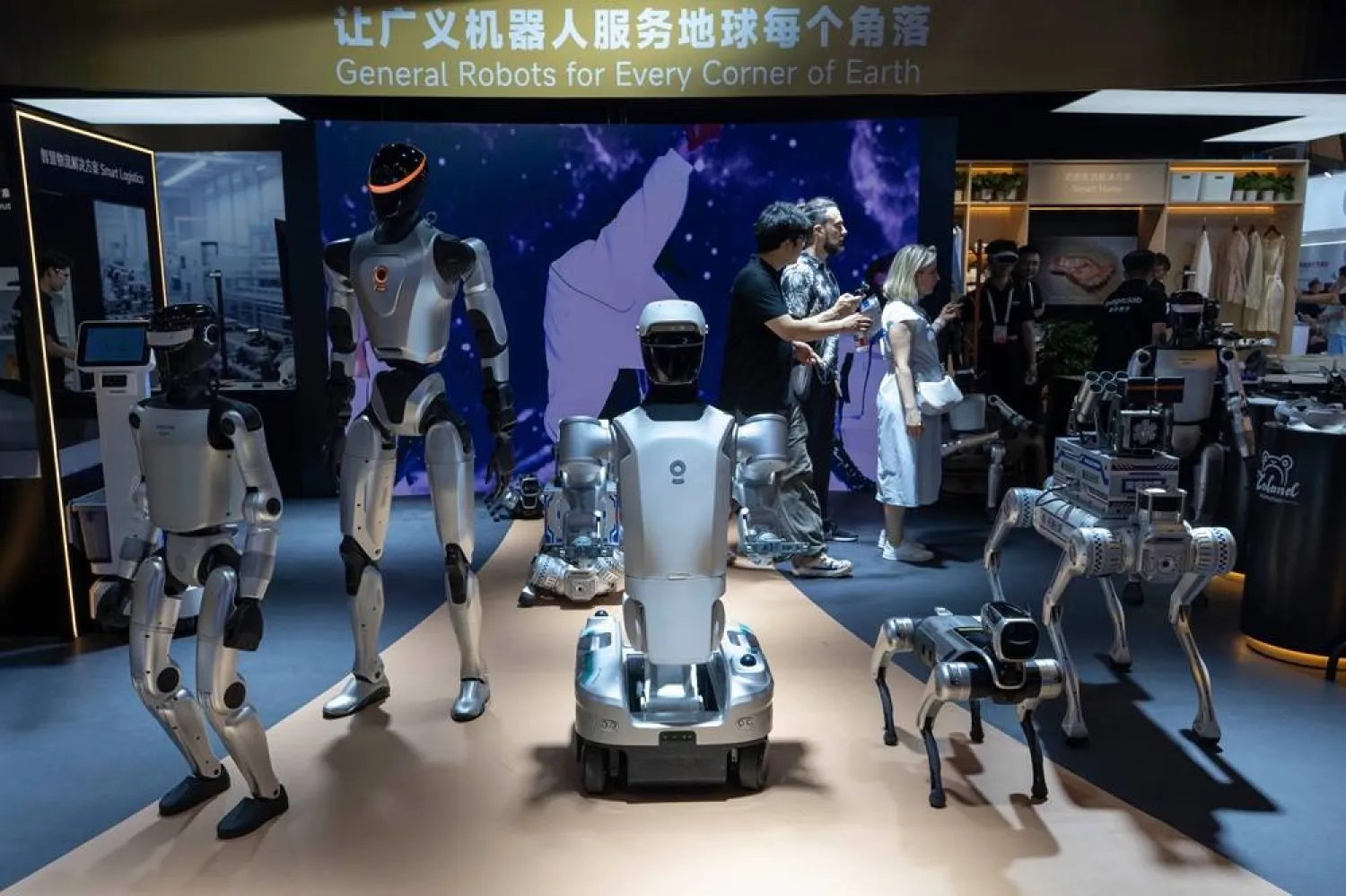
A variety of robots are displayed at the World AI Conference in Shanghai, Friday, July 17, 2026. (AP)
TT

US Bans Foreign-Made Humanoid Robots, Targeting China Over National Security

A variety of robots are displayed at the World AI Conference in Shanghai, Friday, July 17, 2026. (AP)

The Federal Communications Commission in the US said on Tuesday it would ban the import of foreign-made humanoid robots in a move that targets China, arguing they pose a national security risk.

The decision could strain bilateral relations as the technology race between the two world leaders advances. China makes substantially more humanoid robots than the US and other competitors, and analysts estimate that Chinese humanoid robots’ global market share has reached roughly 85%.

The FCC’s ban includes new imports of humanoid robots, quadrupeds – often referred to as four-legged robot dogs – as well as foreign-made power inverters.

In making the decision, the FCC said these advanced robots produced in foreign countries pose supply chain vulnerabilities to the US as well as cybersecurity and national security risks.

FCC chairperson Brendan Carr said in a statement that the move was to “secure America’s critical supply chains.”

The United States has been taking steps to keep Chinese technology out with recent bans on imports, including of Chinese-made drones. The US is also weighing restrictions on Chinese open-source artificial intelligence models, at a time when Chinese AI is rapidly gaining ground.

“It’s a steady drumbeat of potential flashpoints heading into (the) Trump-Xi summit planned for September,” said Samm Sacks, a senior fellow at the New America think tank focused on Chinese technology policies.

US President Donald Trump is expected to meet Chinese leader Xi Jinping in September following their mid-May meeting in Beijing.

Last year, China accounted for around 85% of humanoid deployments globally, according to Barclays, with its technological sector backed strongly by state support and policy. Morgan Stanley analysts forecast China’s humanoid robot market could reach $15 billion by 2030.

“Chinese manufacturers have been scaling production and reducing costs faster than most overseas competitors,” said analyst Kangyuxiao Li at Morningstar.

“Restricting their access to the US removes an important future market and protects US developers from potential price competition,” he said. “However, it will not materially slow China’s overall humanoid development, given the size of its domestic manufacturing base and opportunities in other export markets.”

Of the around 15,000 humanoid robots shipped globally in 2025, Unitree and AGIBOT, two of China’s largest advanced robotics companies, each shipped more than 5,000, while their US counterparts like Tesla and Figure AI each shipped a few hundred or less, according to the technology research and advisory group Omdia.

When it comes to global markets, China is also targeting Europe, for example, as a key market for its advanced robots including humanoids, Omdia said.

China has pushed back and defended its technological advancements as an opportunity for the world, rather than a threat, as countries including the US raise concerns over how a “China Shock 2.0” could hurt their economies.

The latest US ban could also potentially impact collaborations between US and Chinese technology companies, said Lian Jye Su, a chief analyst at Omdia.

Nvidia, for example, in June revealed a humanoid robot reference design which uses the humanoid chassis of Chinese robot maker Unitree.

The Pentagon recently placed Unitree alongside several major Chinese technology companies on its list of firms that it said have ties to or aid the Chinese military, a claim that Beijing said it “firmly opposes.”



UK Cinemas Restricting Meta AI and Other Smart Glasses over Piracy Concerns

FILED - 27 May 2025, Mecklenburg-Western Pomerania, Schwerin: The Facebook, Messenger, Instagram and WhatsApp apps are shown on a smartphone display that reflects the logo of the AI application Meta AI. Photo: Jens Büttner/dpa
TT

UK Cinemas Restricting Meta AI and Other Smart Glasses over Piracy Concerns

FILED - 27 May 2025, Mecklenburg-Western Pomerania, Schwerin: The Facebook, Messenger, Instagram and WhatsApp apps are shown on a smartphone display that reflects the logo of the AI application Meta AI. Photo: Jens Büttner/dpa

Cinema operators in Britain are introducing policies to prohibit or restrict camera-enabled smart glasses, including Meta's AI-powered eyewear, the UK Cinema Association said on Thursday, citing privacy and film piracy concerns.

The move follows growing scrutiny of smart glasses over their recording capabilities, with courts in England and Wales this month prohibiting Meta smart glasses because of restrictions on taking images and videos in courts, Reuters reported.

Policies vary by venue, with operators introducing prohibitions and/or restrictions rather than a single industry-wide rule.

The UK Cinema Association said operators recognise smart glasses can provide benefits to those with specific access requirements. The association said it would continue working with members to ensure their approach "remains relevant and proportionate."

Elsewhere, a German advocacy group earlier in August said it had filed a criminal complaint against Meta and others involved in selling the Meta devices, citing privacy laws.


UNESCO to Lead Global Efforts in Riyadh to Shape Responsible AI Policies in September

A general view of Riyadh, Saudi Arabia. (SPA)
TT

UNESCO to Lead Global Efforts in Riyadh to Shape Responsible AI Policies in September

A general view of Riyadh, Saudi Arabia. (SPA)

The United Nations Educational, Scientific and Cultural Organization (UNESCO) will spearhead intensive efforts in Riyadh in September to advance the implementation of its recommendations on artificial intelligence (AI) ethics, strengthen AI governance, and promote its responsible use, the Saudi Press Agency said on Wednesday.

The efforts come at a critical turning point for the global technology sector. AI ethics is no longer merely a regulatory option but has become a fundamental pillar and an urgent international imperative to harness advanced technologies for the benefit of humanity and safeguard human achievements worldwide.

Countries around the world recognize the potential of AI to deliver significant benefits to humanity. However, concerns remain over ensuring accountability in the use of these technologies and addressing related challenges, including biases that could lead to discrimination and inequality among communities worldwide.

These concerns are outlined in UNESCO’s Recommendation on the Ethics of Artificial Intelligence, adopted by UNESCO member states in 2021, which also underscores the need to ensure the safe use of AI technologies and safeguard human dignity and rights.

UNESCO has selected Saudi Arabia to host the fourth edition of the UNESCO Global Forum on the Ethics of Artificial Intelligence (GFEAI 2026) from September 14 to 17. Saudi Arabia will be the first Arab country to host the international event, which will bring together technology and AI ministers from UNESCO member states, policymakers, leaders of major global companies, and representatives of international organizations.

The forum will be held in partnership with the Saudi Data and AI Authority (SDAIA) and the International Center for AI Research and Ethics (ICAIRE), under the auspices of UNESCO and in coordination with the Saudi National Commission for Education, Culture and Science.

Over four days, GFEAI 2026 will address key themes including AI ethics and governance, capacity building, responsible innovation, and international policies. It will also showcase the latest global initiatives and experiences in the field through high-level sessions and specialized workshops bringing together leading experts and policymakers from around the world.


Sources: Samsung Hikes Chipmaking Prices by Up to 15% on Demand Spike

The logo of Samsung is seen at the Samsung Electronics Seocho building in Seoul on July 30, 2026. (Photo by Jung Yeon-je / AFP)
TT

Sources: Samsung Hikes Chipmaking Prices by Up to 15% on Demand Spike

The logo of Samsung is seen at the Samsung Electronics Seocho building in Seoul on July 30, 2026. (Photo by Jung Yeon-je / AFP)

Samsung Electronics has raised prices for some advanced contract chipmaking services by up to 15% for new orders, two people familiar with the matter said, as demand for AI chips tightens capacity in a business long dominated by TSMC.

Demand from Chinese customers has been particularly strong, but Samsung has been unable to meet all orders because it must serve US customers and reserve part of its capacity to support its own chip production, said the sources, who spoke on the condition of anonymity because they are discussing sensitive commercial matters.

Chinese customers are among those accepting the steepest price increase, one of the sources said, underscoring how US curbs on exports of advanced chipmaking equipment to China have increased local firms' reliance on overseas foundries.

The price hikes mark a turnaround for Samsung's foundry business, which has been a loss maker since 2022, according to industry ⁠estimates.

The division ⁠has struggled to narrow the gap with Taiwan Semiconductor Manufacturing Co, even as Samsung reported record profits, driven by soaring prices for memory chips used in AI systems.

Samsung raised prices in July for chips made using its 4-nanometre process, known as SF4, the sources said.

Prices for SF4 customers in China and the US were increased 10% to 15% from the previous month, while customers in Taiwan, home to TSMC, saw increases of 5% to 10%, according to one of the sources.

Prices for wafers produced by its 5-nanometre SF5 process rose by 10% to 15%, while those for its older 8-nanometre technology ⁠rose by nearly 10%, according to the source. Samsung declined to comment to Reuters as the company does not provide details on operational matters.

Samsung produced 7% of global foundry revenue in the first quarter of 2026, compared with more than 70% for TSMC, according to research firm Counterpoint.

However, demand for AI chips has booked up much of TSMC's leading-edge capacity.

Samsung expects advanced processes to account for more than half of foundry revenue this year, while AI and high-performance-computing applications would make up more than 30%, up from 15% to 20% in late 2025.

With TSMC's production taken up, Samsung has more leverage to raise prices.

"As TSMC faces tight capacity and raises prices, customers are shifting to rivals such as Samsung and Intel, prompting Samsung to raise its prices as well," said Lee Min-hee, a Seoul-based analyst at BNK Investment & Securities.

"If Samsung raises prices from here, its foundry business could potentially become profitable as early as next ⁠year, earlier than previously expected," ⁠Lee said.

Samsung's SF4 production line at its Pyeongtaek, South Korea, plant has been running at full capacity since late last year, said a person familiar with the company's operations.

The line produces logic chips for customers including Qualcomm as well as base dies used in Samsung's own multi-layer high-bandwidth memory (HBM) chips, the person said.

Samsung said in July it expects the foundry unit to return to profit in the near future, helped by higher factory utilization, better production yields and firmer pricing.

It also said then rising sales to major US and Chinese customers, along with demand for HBM base dies, should help lift foundry revenue by more than double-digit percentage points in the second half from a year earlier.

Improvements in production yields have also helped Samsung win customers. Tesla and Apple unveiled chip manufacturing deals with Samsung last year. Samsung also announced an AI chip production deal with Broadcom in July, while Nvidia CEO Jensen Huang said in March that Samsung would manufacture its new AI inference processor.

Google is also in talks with Samsung to manufacture chips using SF4, said one of the two sources familiar with the price increases.

Google did not respond to a request for comment.