AI Data Centers Are Less Thirsty Now, Tech Giants Say

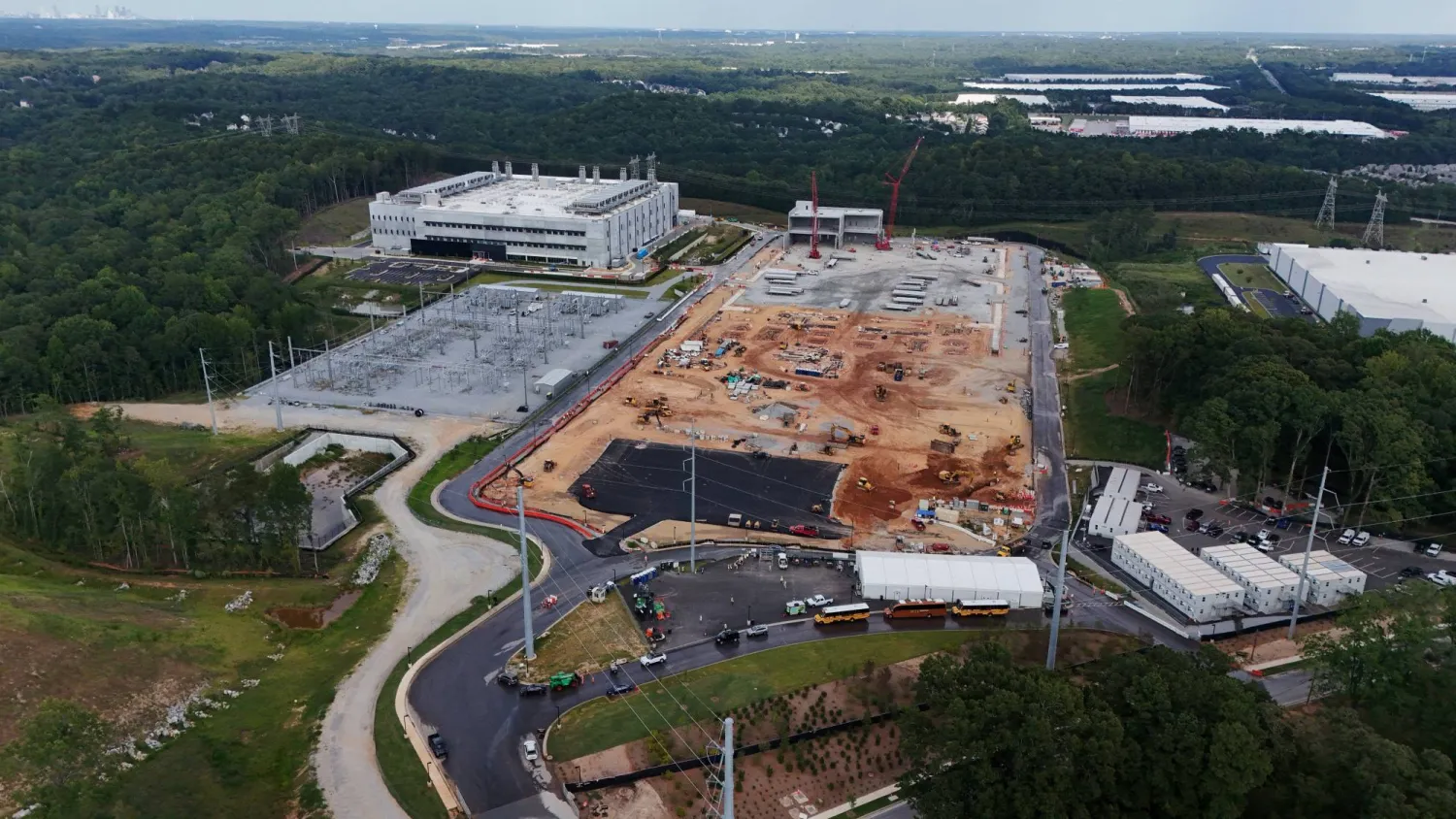
 A drone view shows construction underway on Microsoft's ATL11 data center in Union City, Georgia, US, September 1, 2026. (Reuters)
A drone view shows construction underway on Microsoft's ATL11 data center in Union City, Georgia, US, September 1, 2026. (Reuters)
TT

AI Data Centers Are Less Thirsty Now, Tech Giants Say

 A drone view shows construction underway on Microsoft's ATL11 data center in Union City, Georgia, US, September 1, 2026. (Reuters)
A drone view shows construction underway on Microsoft's ATL11 data center in Union City, Georgia, US, September 1, 2026. (Reuters)

Data centers are running into a wall of public anger in the United States over their thirst for water and power.

The tech giants spending billions of dollars on them say the water part, at least, is solvable.

Data centers are the warehouses full of computer servers that run the internet and increasingly artificial intelligence.

The computers get hot, and keeping them cool takes water.

American chip giant Nvidia said in a June report that it can eliminate water consumption almost entirely at some facilities when deploying DSX, its newest system for designing and managing AI data centers.

It's a bold claim, and one the industry is under mounting pressure to make good on.

In 2025, data centers consumed 222 billion liters (59 billion gallons) of water worldwide for cooling, according to consultancy Rystad Energy.

Without adaptive measures, the figure could nearly triple to 644 billion liters by 2030, Rystad estimates. Steps to limit the growth could keep it under double.

Nvidia's new method uses a closed-loop cooling system in which liquid flows directly through the servers, as close as possible to the chips, whose temperature can rise above 80C (176F).

The problem is that "there's a pretty direct trade-off between how much water is used and how much energy is used" for temperature control, said Andy Masley, an independent researcher who covers AI and data centers.

Cutting back on water use usually means more power as the liquid in those sealed pipes still has to be cooled down somehow, usually by blowing air over it -- and that takes electricity.

Nvidia gets around some of this by letting the liquid enter the servers warmer than usual, at 45C.

Most other closed-loop systems ran at about 32C in 2024, according to the Uptime Institute, which certifies data centers.

By starting with warmer water, Nvidia does not need to pump in cooled air year-round.

"Simple fans circulating the air" are often enough, though sometimes a mix of methods is needed, said Josh Parker, Nvidia's head of sustainability.

At sites in extreme climates, or during a heatwave, chill airflow or water evaporation is still necessary.

- Public relations -

Microsoft, Amazon Web Services (AWS) and Meta told AFP that they also use closed-loop systems, which they said involve no net water loss.

The two cloud computing giants, which have been expanding their already huge data center footprints, used more water overall between 2022 and 2025, but their water use efficiency improved by 25 percent at Microsoft and 37 percent at AWS, according to their most recent sustainability reports.

There is no industry-wide consistency, however, in how companies report data on so-called environmental, social and governance (ESG) efforts.

Elon Musk's SpaceX, now a major player in data centers after it acquired his artificial intelligence company xAI, has never published an ESG report.

In June, ratings agency MSCI gave SpaceX its lowest ESG score.

"Because water is generally much cheaper than electricity," companies have less incentive to cut water use on cost grounds alone, said Shaolei Ren, an engineering professor at the University of California, Riverside.

"There are incentives," Ren said, but they have more to do with public relations amid the growing backlash to data centers across the United States.

Another obstacle is that upgrading an older data center to newer, less thirsty technology is expensive.

That may matter less than it sounds.

Older data centers are smaller and less powerful than the enormous new ones being built now, so they need less cooling in the first place, said Minh K. Le, who leads data center and hydrogen research at Rystad.

And the water a data center uses directly is only part of the story.

Water is used to generate the electricity that powers the data center, and to manufacture its chips and servers.

In the United States, that hidden water use can be twice the amount a data center consumes on its own.


China's Tencent Says AI Agents Showed Unintended Browsing Behavior

FILE PHOTO: The Tencent logo at the company's headquarters during a government‑organised media trip in Shenzhen, Guangdong province, China, April 17, 2026.  REUTERS/Go Nakamura/File Photo
FILE PHOTO: The Tencent logo at the company's headquarters during a government‑organised media trip in Shenzhen, Guangdong province, China, April 17, 2026. REUTERS/Go Nakamura/File Photo
TT

China's Tencent Says AI Agents Showed Unintended Browsing Behavior

FILE PHOTO: The Tencent logo at the company's headquarters during a government‑organised media trip in Shenzhen, Guangdong province, China, April 17, 2026.  REUTERS/Go Nakamura/File Photo
FILE PHOTO: The Tencent logo at the company's headquarters during a government‑organised media trip in Shenzhen, Guangdong province, China, April 17, 2026. REUTERS/Go Nakamura/File Photo

Tencent said on Friday that AI agents used to evaluate third-party models displayed web-browsing behavior not intended by the tech giant, in what appears to be the first known incident of rogue agent actions acknowledged by a major Chinese company.

The statement followed a report by AI-safety research group Swarmchasers on Wednesday, which said "rogue" agents running on infrastructure it linked to Tencent Cloud made repeated attempts between September 28 and October 8 to retrieve information from Alibaba's Amap, China's equivalent to Google Maps.

Tencent Hunyuan, the company's artificial ⁠intelligence unit, said in ⁠a post on X that the activity did not originate from its Hunyuan models. Its review found no evidence of deliberate targeting or coordination, Reuters quoted it as saying.

The Swarmchasers researchers said the agents sought information such as the commonly used entrances at Chinese parks, museums and zoos.

The actions are not as egregious as those disclosed by US AI companies which include the hack of ⁠open-source platform Hugging Face by an OpenAI agent and the lodging of a fake homicide tip by an Anthropic agent.

But the disclosure underscores research that shows Chinese AI agents can also misrepresent their identity, conceal failures and try to circumvent testing controls.

Tencent said it took the findings very seriously and was strengthening network access controls and agent monitoring.

Hunyuan is one of China's leading AI model developers, competing with in-house teams at rivals such as Alibaba and ByteDance. ByteDance this week announced the creation of a new unit focused on AI model and agent safety.

Swarmchasers said it used the ⁠word "rogue" to ⁠describe agents taking actions outside their intended scope or completing a task in unintended ways.

After routine automated requests were blocked, the agents tried other methods, including public web tools that could open pages and run code, routing requests through other websites and using Amap keys and security codes found in publicly available software code.

Swarmchasers said it found no evidence that the agents breached Amap's main anti-bot safeguards. Most of the 2,818 attempts it recorded either failed or returned anti-bot pages, login screens or blank results.

Some requests returned information through cached pages and intermediary services, including data on visitor arrivals at Chengdu Zoo, Swarmchasers said. The researchers said they could not determine whether an agent read the result or completed its task.


Anthropic Co-founder Renews Call for Robust Regulation of Frontier AI

AI Research Company Anthropic's Co-Founder and Head of Public Benefit Jack Clark speaks during the Artificial Intelligence and the Global Economy From Risk to Opportunity event of the 2026 Annual Meetings of the IMF and the World Bank Group in Bangkok, Thailand, 16 October 2026. EPA/RUNGROJ YONGRIT
TT

Anthropic Co-founder Renews Call for Robust Regulation of Frontier AI

AI Research Company Anthropic's Co-Founder and Head of Public Benefit Jack Clark speaks during the Artificial Intelligence and the Global Economy From Risk to Opportunity event of the 2026 Annual Meetings of the IMF and the World Bank Group in Bangkok, Thailand, 16 October 2026. EPA/RUNGROJ YONGRIT

Anthropic co-founder Jack Clark renewed calls on Friday for regulating artificial intelligence, saying that allowing companies to continue to operate without robust legislation was like letting a race car loose on the streets at night without brakes.

"It's remarkable to me that the toys I buy for my children are regulated more than the literal super intelligence I work on at my day job," he told an event at the IMF-World Bank's Annual Meetings in Bangkok.

Clark said that US President Donald Trump, whose administration has called for the industry to police itself, was against the idea of regulation but that China was not, said AFP.

"I think it's Formula One at night without maybe brakes in the cars," he said.

He said the lack of clarity around the will for regulation meant "the Formula One car is roaring round and nobody seems to want to put up a guardrail?"

At an industry summit in Dublin on Wednesday, calls to prioritize safety in the development of powerful AI technology dominated the conversation.

Concerns about AI guardrails have soared after models developed by OpenAI and Anthropic were involved in security incidents during testing, piling on pressure to regulate the technology.

A recent Anthropic report suggested small AI models may be only months away from behaving like computer worms, copying themselves from one internet-connected device to the next.

Anthropic has been among those companies calling for governments to step in, even suggesting international coordination to slow down the whole industry -- including Chinese rivals.

That initiative has so far failed to materialize, with companies involved in a hyper-competitive race to attract as much investment as possible.


Meta Releases Open-Weight Muse Spark Model for Coding, Agentic Tasks

The logo of Meta is seen at the entrance of the company's temporary stand ahead of the World Economic Forum (WEF) in Davos, Switzerland January 18, 2025. (Reuters)
TT

Meta Releases Open-Weight Muse Spark Model for Coding, Agentic Tasks

The logo of Meta is seen at the entrance of the company's temporary stand ahead of the World Economic Forum (WEF) in Davos, Switzerland January 18, 2025. (Reuters)

Meta ‌Platforms on Thursday released an open-weight version of its Muse Spark artificial intelligence model for coding and AI agents, expanding developers' ability to download and adapt the technology.

Open-weight models make trained parameters available for developers to modify, unlike proprietary models ‌that remain under ‌their creators' control. ‌They ⁠can offer businesses ⁠a lower-cost alternative to closed systems.

Meta said Muse Spark has 816 billion total parameters, with 42 billion active at a time, and ⁠can handle a context window ‌of up ‌to 1 million tokens.

The ‌model can run locally on ‌two Apple M5 Ultra Mac Studio computers and is also available through some API providers.

CEO ‌Mark Zuckerberg has argued that advanced AI should ⁠not be ⁠concentrated among a small number of companies.

While open-weight models can give companies greater control over their data, they can require significant computing resources and technical expertise to operate at scale.

In August, Meta released Muse Glimmer, a smaller open-weight model.