


Off-grid Solar Brings Light, Time and Income to Remotest Villages

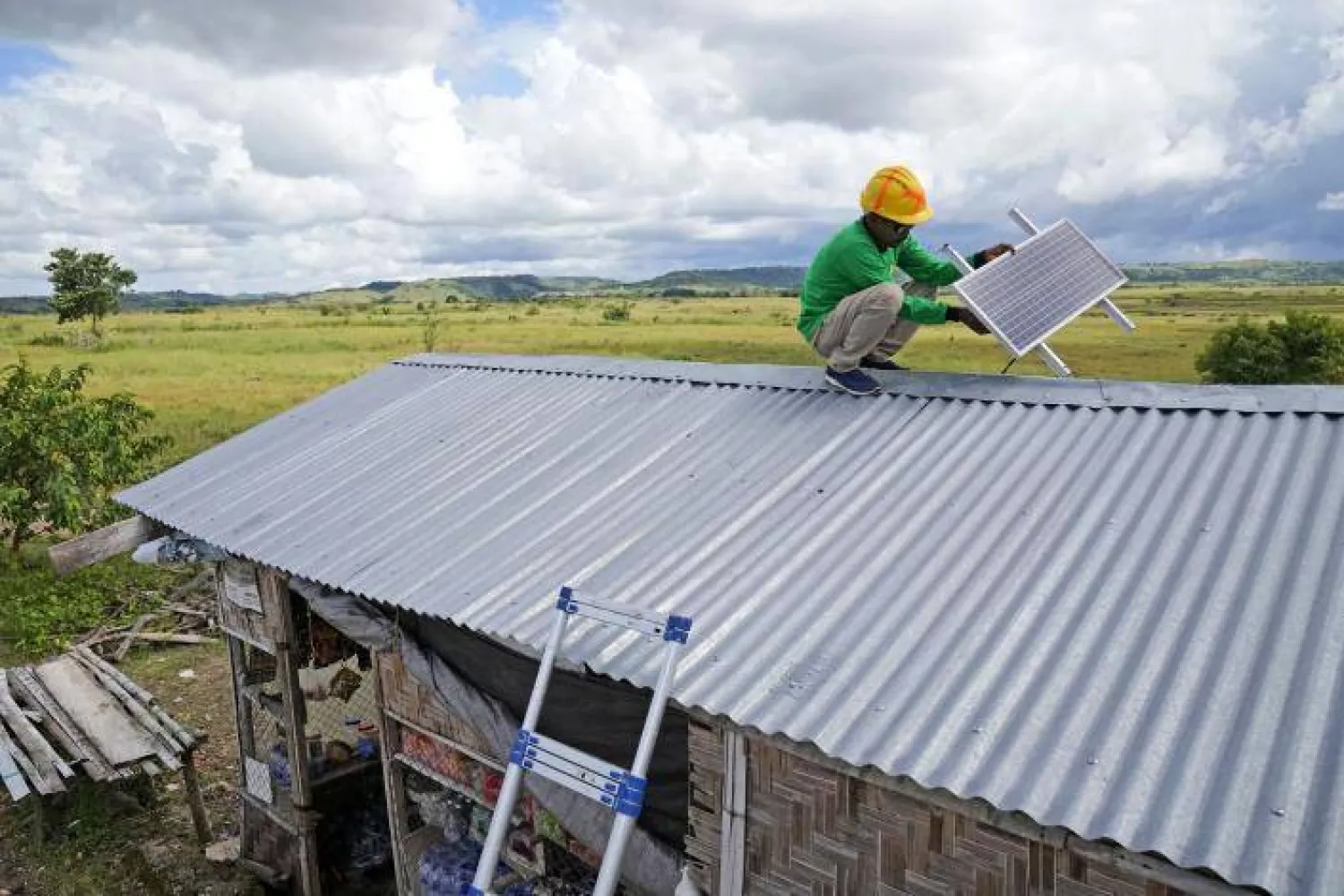
Antonius Makambombu, a worker of Sumba Sustainable Solutions performs maintenance work on a solar panel on the roof of a customer's shop in Laindeha village on Sumba Island, Indonesia, Wednesday, March 22, 2023. (AP Photo/Dita Alangkara)ASSOCIATED PRESSLess
TT

Off-grid Solar Brings Light, Time and Income to Remotest Villages

Antonius Makambombu, a worker of Sumba Sustainable Solutions performs maintenance work on a solar panel on the roof of a customer's shop in Laindeha village on Sumba Island, Indonesia, Wednesday, March 22, 2023. (AP Photo/Dita Alangkara)ASSOCIATED PRESSLess

As Tamar Ana Jawa wove a red sarong in the fading sunlight, her neighbor switched on a light bulb dangling from the sloping tin roof. It was just one bulb powered by a small solar panel, but in this remote village that means a lot. In some of the world's most remote places, off-grid solar systems are bringing villagers like Jawa more hours in the day, more money and more social gatherings.

Before electricity came to the village a bit less than two years ago, the day ended when the sun went down. Villagers in Laindeha, on the island of Sumba in eastern Indonesia, would set aside the mats they were weaving or coffee they were sorting to sell at the market as the light faded, The Associated Press said.

A few families who could afford them would start noisy generators that rumbled into the night, emitting plumes of smoke. Some people wired lightbulbs to old car batteries, which would quickly die or burn out appliances, as they had no regulator. Children sometimes studied by makeshift oil lamps, but these occasionally burned down homes when knocked over by the wind.

That's changed since grassroots social enterprise projects have brought small, individual solar panel systems to Laindeha and villages like it across the island.

For Jawa, it means much-needed extra income. When her husband died of a stroke in December 2022, Jawa wasn’t sure how she would pay for her children’s schooling. But when a neighbor got electric lighting shortly after, she realized she could continue weaving clothes for the market late into the evening.

“It used to be dark at night, now it’s bright until morning,” the 30-year-old mother of two said, carefully arranging and pushing red threads at the loom. “So tonight I work ... to pay for the children.”

Around the world, hundreds of millions of people live in communities without regular access to power, and off-grid solar systems like these are bringing limited access to electricity to places like these years before power grids reach them.

Some 775 million people globally lacked access to electricity in 2022, according to the International Energy Agency. Sub-Saharan Africa and South Asia are home to some of the largest populations without access to electricity. Not having electricity at home keeps people in poverty, the UN and World Bank wrote in a 2021 report. It’s hard for very poor people to get electricity, according to the report, and it’s hard for people who don’t have it to participate in the modern economy.

Indonesia has brought electricity to millions of people in recent years, going from 85% to nearly 97% coverage between 2005 and 2020, according to World Bank data. But there are still more than half a million people in Indonesia living in places the grid doesn’t reach.

While barriers still remain, experts say off-grid solar programs on the island could be replicated across the vast archipelago nation, bringing renewable energy to remote communities.

“Off-grid solar there plays an important role in that it will deliver clean electricity directly to those who are unelectrified,” said Daniel Kurniawan, a solar policy analyst at the Institute for Essential Services Reform.

Now, villagers frequently gather in the evening to continue the day’s work, gather to watch television shows on cell phones charged by the panels and help children do homework in light bright enough to read.

“I couldn’t really study at night before,” said Antonius Pekambani, a 17-year old student in Ndapaymi village, east Sumba. “But now I can.”

Solar power is still fairly rare in Indonesia. While the country has targeted more solar as part of its climate goals, there has been limited progress due to regulations that don't allow households to sell power back to the grid, ruling out a way of defraying the cost that has helped people afford solar in other parts of the world.

That's where grassroots organizations like Sumba Sustainable Solutions, based in eastern Sumba since 2019, saw potential to help.

Working with international donors to help subsidize the cost, it provides imported home solar systems, which can power light bulbs and charge cell phones, for monthly payments equivalent to $3.50 over three years.

The organization also offers solar-powered appliances such as wireless lamps and grinding machines. It said it has distributed over 3,020 solar light systems and 62 mills across the island, reaching more than 3,000 homes.

Imelda Pindi Mbitu, a 46-year-old mother of five living in Walatungga, said she used to spend whole days grinding corn kernels and coffee beans between two rocks to sell at the local market; now, she takes it to a solar-powered mill shared by the village.

“With manual milling, if I start in the morning I can only finish in the afternoon. I can’t do anything else," she said sitting in her wooden home. "If you use the machine, it’s faster. So now I can do other things.”

Similar schemes in other places, including Bangladesh and sub-Saharan Africa, have helped provide electricity for millions, according to the World Bank.

But some smaller off-grid solar systems like these don’t provide the same amount of power as grid access. While cell phones, light bulbs and mills remain charged, the systems don't generate enough power for a large sound system or a church.

Off-grid solar projects face hurdles too, said Jetty Arlenda, an engineer with Sumba Sustainable Solutions .

The organization's scheme is heavily reliant upon donors to subsidize the cost of solar equipment, which many rural residents would be unable to afford at their market cost. Villagers without off-grid solar panels are stuck on waitlists while Sumba Sustainable Solutions looks for more funding. They're hoping for support from Indonesia’s $20 billion Just Energy Transition Partnership deal, which is being negotiated by numerous developed nations and international financial institutions.

There's also been issues with recipients failing to make payments, especially as the island deals with locust outbreaks diminishing crops and livelihoods of villagers. And when solar systems break, they need imported parts that can be hard to come by.

But for now, villagers like Jawa said the solar systems are making a big difference.

“I'm grateful for this lamp," she said, sitting at the loom and nodding towards the hanging bulb. “It will be bright all night.”




A Herd Stop: Train Kills 3 Rare Bison in Poland

30 May 2016. BIALOWIEZA, POLAND. REUTERS/KACPER PEMPEL
TT

A Herd Stop: Train Kills 3 Rare Bison in Poland

30 May 2016. BIALOWIEZA, POLAND. REUTERS/KACPER PEMPEL

Three wild European bison died on Sunday morning after being hit by a train in Poland's vast UNESCO-listed Bialowieza Forest in the east, the local police told AFP.

According to a police spokesman, a herd of Europe's largest mammals, whose male specimens can reach 900 kilograms (nearly 2,000 pounds), crossed onto the train tracks as a locomotive carrying some 50 passengers between Bialystock and Warsaw aboard was steaming ahead.

"No passenger was injured but three animals perished in this accident, which happened at 7:00 am, near the village of Witowo," spokesman Konrad Karwacki told AFP.

The "Zubr" line train, which takes its name from the Polish word for bison, did not derail and was able to resume its journey around an hour and a half after the collision.

Some 1,200 bison, an emblematic animal in the eastern European country, currently inhabit the Polish part of the great Bialowieza Forest, considered the last primeval woodland in Europe.

The forest, which is divided by the Poland-Belarus border, is a treasure of biodiversity and a giant carbon sink.

Yet several bison fall victim to road accidents in the region every year.

"They are sometimes hit by trains, but these are usually isolated incidents," Professor Rafal Kowalczyk, from a local branch of the Polish Academy of Sciences, told AFP.

"I don't recall an accident where three bison were killed at the same time, run over by a train," the specialist in the giant mammals added.

Devastated by hunting, deforestation and the expansion of agriculture, the European bison nearly became extinct at the beginning of the 20th century.

After disappearing from Bialowieza, its last habitat in Europe, before the outbreak of World War II, the species was saved at the 11th hour thanks to the release of bison reared in zoos back into the wild.


Can Nations Save the Shorebird that Flies 30,000 km a Year?

The Hudsonian godwit (Limosa haemastica) is one of the world's most remarkable travelers, but its population has plunged 95 percent in four decades due to a complex mix of environmental changes across multiple countries. Luke Seitz / Cornell Lab of Ornithology/AFP
TT

Can Nations Save the Shorebird that Flies 30,000 km a Year?

The Hudsonian godwit (Limosa haemastica) is one of the world's most remarkable travelers, but its population has plunged 95 percent in four decades due to a complex mix of environmental changes across multiple countries. Luke Seitz / Cornell Lab of Ornithology/AFP

Chasing an endless summer, one shorebird species undertakes a grueling annual journey from the Arctic to the tip of South America and back -- a feat increasingly fraught with peril.

The Hudsonian godwit (Limosa haemastica) is one of the world's most remarkable travelers, but its population has plunged 95 percent in four decades due to a complex mix of environmental changes across multiple countries, said AFP.

It is one of 42 species proposed for international protection at a meeting of parties to the UN Convention on the Conservation of Migratory Species (CMS) that starts in Brazil on Monday.

Iconic creatures like the snowy owl -- of Harry Potter fame -- striped hyena and hammerhead shark are also on the list deemed in danger of extinction and needing conservation by the countries they pass through.

Migratory birds are facing "rapid and dramatic declines," said Nathan Senner, an ecologist and ornithology professor at the University of Massachusetts Amherst who has studied the Hudsonian godwit for 20 years.

Scientists are still unraveling the mysteries of the shorebird -- which can fly up to 11,000 kilometers (6,800 miles) in one stretch without stopping to eat, drink, or sleep.

And it is only part of the 30,000 kilometers (18,600 miles) that the godwit travels every year from their breeding grounds in the Arctic to Patagonia where they spend the southern summer.

- Disrupted migrations -

In order to do this "epic flight," they need "really predictable, abundant food resources" at every step of the journey, Senner told AFP.

That predictability is crumbling.

In the Arctic, shifting spring timing attributed to climate change has created a mismatch between when chicks hatch and the peak availability of insects they feed on.

One of the puzzles Senner is currently working on is why Hudsonian godwits have begun migrating later by six days than they did a decade ago.

Something "has either disrupted the cues that they use to time their migrations or their ability to successfully and rapidly prepare for the migration," he said.

In southern Chile, a boom in salmon and oyster farming has led to a build-up of infrastructure and the presence of people in the intertidal zones where they feed.

And in the United States, changes in farming practices are making the shallow water wetlands that the godwits rely on rarer and less predictable -- meaning they spend more time looking for a place to stop and feed.

"I think that is emblematic of lots of species, that most species can respond to one kind of change, but not a whole bunch of them all at the same time," said Senner.

- Essential to ecosystems -

"Climate change is taking a heavy toll on species that rely on a 'geological clock' for their survival; many are disappearing," Rodrigo Agostinho, president of Brazil's environmental agency (Ibama), told AFP.

These are some of the issues CMS parties will tackle at their meeting in Brazil's biodiversity-rich Pantanal, one of the world's most important global meetings for wildlife conservation.

These countries are legally obliged to protect species listed as at risk of extinction, conserve and restore their habitats, prevent obstacles to migration and cooperate with other range states.

Nevertheless, among the species listed under CMS, a report released earlier this month showed that 49 percent now have populations that are declining, up from 44 percent two years ago.

Amy Fraenkel, CMS executive secretary, told AFP that most of the species doing worse were birds, such as the Hudsonian godwit.

She said the situation was also "particularly alarming" for fish species, with 97 percent of those listed under the treaty threatened with extinction.

Migratory species "are essential to healthy ecosystems and a healthy planet," playing a key role in pollination, pest control and transporting nutrients, she said.

In a piece of good news, the meeting will propose removing Central Asia's Bactrian deer from its list of animals needing high protection, due to an increase in its population.


Dog Finds Canadian Message in a Bottle on Aberdeenshire Beach

A message in a bottle (Shutterstock) 
TT

Dog Finds Canadian Message in a Bottle on Aberdeenshire Beach

A message in a bottle (Shutterstock) 

A message in a bottle dropped from a boat off Canada has been found washed up in the north-east of Scotland, according to BBC.

The short letter, written in French and dated in 2024, was found inside the bottle at St Cyrus in Aberdeenshire.

Having travelled across the Atlantic, it was found by one of Mike Scott's dogs during a beach walk.

The 60-year-old said he was “amazed” by the bottle's journey of about 2,700 miles (4,300km).

The professional photographer from Johnshaven takes his dogs to St Cyrus most days for a walk.

He described the weather as “wild” at the time they discovered the bottle.

“As I was walking, Maggie my dog was sniffing a bottle that was just washing up. It was a really dark glass bottle with a lid and something in it,” he said.

He explained: “I had found a message in a bottle before, but it was just from Dundee, so I was not expecting much. There was a zip bag in it, and a letter in French. I put it in my rucksack and put it on translate when I got home.”

The note - which appeared to be signed 'Annie Chiasson' - said the bottle had been put to sea from a ferry travelling between Prince Edward Island and Iles-de-la-Madeleine in August 2024.

Scott said, “So the small glass bottle has survived two winters at sea, travelling from the east coast of Canada, across the north Atlantic, over the top of Scotland and down into the North Sea for us to find at St Cyrus.”

“The sender was asking to let them know if found,” he said. “We found the woman on Facebook, my wife sent a message, but we have heard nothing back.”

BBC Scotland News has also tried to contact the sender.

Scott said, “It was such a weird thing to find, it's not just our own rubbish that washes up. It's amazing it was not smashed. I do not imagine she thought it would end up in Scotland across the Atlantic.”