
With Record Heat and Drought-stricken Woods, Spain’s Catalonia Faces Perfect Wildfire Conditions

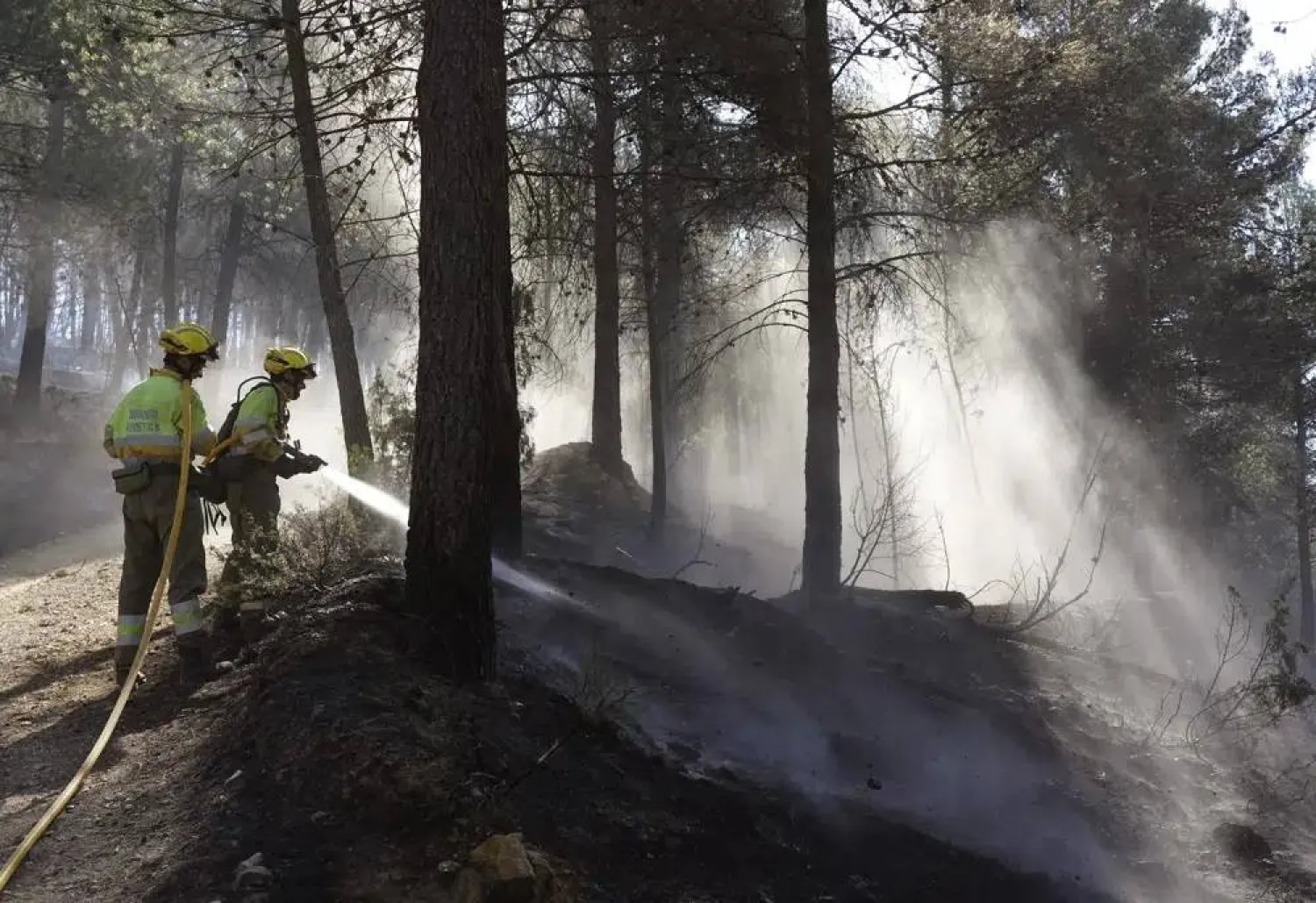
FILE - Firefighters try to extinguish a forest fire in Fuente la Reina, Castellon de la Plana, Spain, March 29, 2023. (AP Photo/Alberto Saiz, File)
TT

With Record Heat and Drought-stricken Woods, Spain’s Catalonia Faces Perfect Wildfire Conditions

FILE - Firefighters try to extinguish a forest fire in Fuente la Reina, Castellon de la Plana, Spain, March 29, 2023. (AP Photo/Alberto Saiz, File)

Surveying the hills covered with near bone-dry pines stretching to the Pyrenees in the distance, Asier Larrañaga has reason to be on guard.

This part of northeast Spain is, like large swaths of the Mediterranean country, braced for wildfires due to the lethal combination of a prolonged drought, record-high temperatures, and increasingly dense woods unable to adapt to a fast-changing climate, The Associated Press said.

Larrañaga is one of the top fire analysts for the firefighters of Catalonia charged with safeguarding the region's homes and landscapes. While grateful that some desperately needed rain has finally fallen in recent weeks, he is ready for the worst — unless July and August buck Spain’s historic trend of being the hottest and driest months of the year.

“If we have a normal summer ... and conditions of low humidity combined with high temperatures, then we will see fires that quickly expand beyond our extinction capacity. And for areas where it has not rained in May and this month, we could see these types of fires as early as next week,” Larrañaga told The Associated Press in the rural town of Solsona, some two hours north of Barcelona.

Spain suffered the biggest losses from wildfires of any European Union country last year amid a record-hot 2022. Four people, including one firefighter, died in blazes that consumed 306,000 hectares. And with Spain sweltering under a record-hot spring, it is again leading the continent in 2023 with 66,000 hectares turned to ashes. Now firefighters like Larrañaga across Spain are preparing for a potential scorcher of a summer.

The fires coincide with Catalonia and a large part of Spain’s south bearing the brunt of a drought that started last year and has only recently been somewhat alleviated by rain. The central reservoirs for Catalonia, which provide water for some six million people including Barcelona, are still only at 29% of capacity and water restrictions remain in place.

Climate change is playing a direct role in propagating these fires, experts agree. The increasing temperatures have made the plants that are used to more mild weather vulnerable to both plagues and fire. Spain, like the rest of the Mediterranean, is forecast to heat up faster than the global average. Spain saw fires that showed the virulence of a summer outbreak break out as early as March. Northern Europe is also battling blazes spurred by drought.

The 52-year-old Larrañaga is a member of Catalonia’s GRAF, its elite wildfire-fighting unit. Members of the Catalan firefighters are currently helping in Canada as part of a Spanish contingent sent to combat the massive fires that have sent smoke over the United States and as far as Europe.

Larrañaga was in Solsona to oversee a training session by the local fire brigade. Practice included simulating a last-resort protection maneuver used in cases when firefighters are trapped by the flames. They clear an area of vegetation and take refuge in their truck, which is equipped with sprinklers. The firefighters said that they hope it is a maneuver they will never have to use.

The Solsonès county, home to Solsona and its 9,000 residents, does not normally have large fires thanks to storms generated by the Pyrenees. But the downside is that its forests build up vegetation, or “fuel” for potential fires, that become vulnerable to a lightning strike, a spark from farm machinery, or arson. In 1998 a fire consumed 27,000 hectares in the country. Now Larrañaga is concerned that the landscape is primed to ignite again.

“The fires in these conditions can be very intense like the enormous ones we are seeing in Canada," he said. Larrañaga added that his worst-case scenario is "a situation where you have people, in a panic, trying to flee, who put themselves in danger because the access roads cross wooded areas,” stirring up memories of a tragedy in neighboring Portugal when over 60 people perished in a fire disaster in 2017.

Catalonia’s firefighters were tested last year by fires that erupted just when the official fire season started in mid-July.

That close call, fire chief David Borrell said, motivated their decision to increase the fire campaign to four months from three and start it a month earlier. That means more manpower and more aircraft for a longer period.

Borrell said that this new generation of more powerful fires has led to two changes in how they are fought. First, it is no longer possible to just “attack” a fire, firefighters have to wait for it, and if need be, sacrifice unfavorable terrain – whether due to its position related to the wind, access, or vegetation – if it means keeping the firefighters from wearing themselves out or even risking their lives.

“The second change is how to deal with simultaneous fires without getting overwhelmed,” Borrell told the AP at the Catalan firefighters' high-tech headquarters near Barcelona. “If you go all out against a fire, then you won’t be able to handle a second one, and with a third fire, you collapse. So to avoid that, we consider everything in one process. That is a potent strategy change we began last year. And for me, it is a game changer.”

The challenge, however, is still daunting with summer now here.

In addition to turning the terrain into a tinderbox, drought is complicating the firefighters' ability to work: some of Catalonia’s reservoirs have been ruled unusable for water-dumping aircraft due to the lack of their low levels of water.

“If we hadn’t had the rain we saw in May, we would now already be in a campaign of large fires,” Jordi Pagès, a wildfire expert for the Pau Costa Foundation, a Barcelona-based nonprofit organization for fire awareness.

"But we still had a spring with below average rainfall, so we can expect an intense summer.”


Rocket Re-entry Pollution Measured in Atmosphere for 1st Time

A SpaceX Falcon 9 rocket with the company's Dragon spacecraft on top launches from Space Launch Complex 40 for the Crew-12 mission at Cape Canaveral Space Force Station in Florida on February 13, 2026. (Photo by Jim WATSON / AFP)
TT

Rocket Re-entry Pollution Measured in Atmosphere for 1st Time

A SpaceX Falcon 9 rocket with the company's Dragon spacecraft on top launches from Space Launch Complex 40 for the Crew-12 mission at Cape Canaveral Space Force Station in Florida on February 13, 2026. (Photo by Jim WATSON / AFP)

When part of a SpaceX rocket re-entered Earth's atmosphere exactly a year ago, it created a spectacular fireball that streaked across Europe's skies, delighting stargazers and sending a team of scientists rushing towards their instruments.

The German team managed to measure the pollution the rocket's upper stage emitted in our planet's difficult-to-study upper atmosphere -- the first time this has been achieved, according to a study published on Thursday.

It is vital to learn more about this little-understood form of pollution because of the huge number of satellites that are planned to be launched in the coming years, the scientists emphasized.

In the early hours of February 19, 2025, the upper stage of a Falcon 9 rocket was tumbling back to Earth when it exploded into a fireball that made headlines from the UK to Poland.

"We were excited to try and test our equipment and hopefully measure the debris trail," the team led by Robin Wing and Gerd Baumgarten of the Leibniz Institute of Atmospheric Physics in Germany told AFP via email.

In particular, the scientists wanted to measure how the rocket polluted what they call the "ignorosphere" -- because it is so difficult to study.

This region between 50 to 100 kilometers (31 to 62 miles) above Earth includes the mesosphere and part of the lower thermosphere.

- 'Harbinger' -

The team used technology called LIDAR, which measures pollution in the atmosphere by shooting out lots of laser pulses and seeing which bounce back off something.

They detected a sudden spike in the metal lithium in an area nearly 100 kilometers above Earth. This plume had 10 times more lithium than is normal in this part of the atmosphere.

The team then traced the plume back to where the rocket re-entered the atmosphere, west of Ireland.

For the first time, this proves it is possible to study pollution from re-entering rockets at such heights before it disperses, the scientists said.

But the impact from this rocket pollution remains unknown.

"What we do know is that one ton of emissions at 75 kilometers (altitude) is equivalent to 100,000 tons at the surface," they said.

The study warned the case was a "harbinger" of the pollution to come, given how many rockets will be needed to launch all the satellites that Earth is planning to blast into space.

Currently, there are around 14,000 active satellites orbiting our planet.
In the middle of last month, China applied for permission to launch around 200,000 satellites into orbit.

Then at the end of January, billionaire Elon Musk's SpaceX applied for permission to launch one million more.

Eloise Marais, a professor of atmospheric chemistry at University College London not involved in the new study, told AFP the research was "really important".

"There is currently no suitable regulation targeting pollution input into the upper layers of the atmosphere," she explained.

"Even though these portions of the atmosphere are far from us, they have potentially consequential impacts to life on Earth if the pollutants produced are able to affect Earth's climate and deplete ozone in the layer protecting us from harmful UV radiation."

The study was published in the journal Communications Earth & Environment.


Deep-sea Fish Break the Mold with Novel Visual System

A close-up showing the shiny silver-green photophores (light organs) on the lower head of the deep-sea fish Maurolicus muelleri from the Red Sea, seen in this photograph released on February 11, 2026. Dr. Wen-Sung Chung/Handout via REUTERS
TT

Deep-sea Fish Break the Mold with Novel Visual System

A close-up showing the shiny silver-green photophores (light organs) on the lower head of the deep-sea fish Maurolicus muelleri from the Red Sea, seen in this photograph released on February 11, 2026. Dr. Wen-Sung Chung/Handout via REUTERS

For more than a century, biology textbooks have stated that vision among vertebrates - people included - is built from two clearly defined cell types: rods for processing dim light and cones for bright light and color. New research involving deep-sea fish shows this tidy division is, in reality, not so tidy.

Scientists have identified a new type of visual cell in deep-sea fish that blends the shape and form of rods with the molecular machinery and genes of cones. This hybrid type of cell, adapted for sight in gloomy light conditions, was found in larvae of three deep-sea fish species in the Red Sea, Reuters reported.

The species studied were: a hatchetfish, with the scientific name Maurolicus mucronatus; a lightfish, named Vinciguerria mabahiss; and a lanternfish, named Benthosema pterotum. The hatchetfish retained the hybrid cells throughout its life. The other two shifted to the usual rod-cone dichotomy in adulthood.

All three are small, with adults measuring roughly 1-3 inches (3-7 cm) long and the larvae much littler. They inhabit a marine realm of twilight conditions, with sunlight struggling to penetrate into the watery depths.

The vertebrate retina, a sensory membrane at the back of the eye that detects light and converts it into signals to the brain, possesses two main types of light-sensitive visual cells, called photoreceptors. They are named for their shape: rods and cones.

"The rods and cones slowly change position inside the retina when moving between dim and bright conditions, which is why our eyes take time to adjust when we flick on the light switch on our way to the restroom at night," said Lily Fogg, a postdoctoral researcher in marine biology at the University of Helsinki in Finland and lead author of the research published in the journal Science Advances.

"We found that, as larvae, these deep-sea fish mostly use a mix-and-match type of hybrid photoreceptor. These cells look like rods - long, cylindrical and optimized to catch as many light particles - photons - as possible. But they use the molecular machinery of cones, switching on genes usually found only in cones," Fogg said.

The researchers examined the retinas of fish larvae caught at depths from 65 to 650 feet (20 to 200 meters). In the type of dim environment they inhabit, rod and cone cells both are usually engaged in the vertebrate retina, but neither works very well. These fish display an evolutionary remedy.

"Our results challenge the longstanding idea that rods and cones are two fixed, clearly separated cell types. Instead, we show that photoreceptors can blend structural and molecular features in unexpected ways. This suggests that vertebrate visual systems are more flexible and evolutionarily adaptable than previously thought," Fogg said.

"It is a very cool finding that shows that biology does not fit neatly into boxes," said study senior author Fabio Cortesi, a marine biologist and neuroscientist at the University of Queensland in Australia. "I wouldn't be surprised if we find these cells are much more common across all vertebrates, including terrestrial species."

All three species emit bioluminescence using small light-emitting organs on their bodies, mostly located on the belly. They produce blue-green light that blends with the faint background light from the sun above. This strategy, called counterillumination, is a common form of camouflage in the deep sea to avoid predators.

"Small fish like these fuel the open ocean. They are plentiful and serve as food for many larger predatory fishes, including tuna and marlin, marine mammals such as dolphins and whales, and marine birds," Cortesi said.

These kinds of fish also engage in one of the biggest daily migrations in the animal kingdom. They swim near the surface at night to feed in plankton-rich waters, then return to the depths - 650 to 3,280 feet (200 to 1,000 meters) - during daytime to avoid predation.

"The deep sea remains a frontier for human exploration, a mystery box with the potential for significant discoveries," Cortesi said. "We should look after this habitat with the utmost care to make sure future generations can continue to marvel at its wonders."


Japan City Gets $3.6 Mn Donation in Gold to Fix Water System

FILE PHOTO: Factories line the port of Osaka, western Japan October 23, 2017. REUTERS/Thomas White/File Photo
TT

Japan City Gets $3.6 Mn Donation in Gold to Fix Water System

FILE PHOTO: Factories line the port of Osaka, western Japan October 23, 2017. REUTERS/Thomas White/File Photo

Osaka has received an unusual donation -- 21 kilograms of gold -- to pay for the maintenance of its ageing water system, the Japanese commercial hub announced Thursday.

The donation worth $3.6 million was made in November by a person who a month earlier had already given $3,300 in cash for the municipal waterworks, Osaka Mayor Hideyuki Yokoyama told a press conference.

"It's an absolutely staggering amount," said Yokoyama, adding that he was lost for words to express his gratitude.

"I was shocked."

The donor wished to remain anonymous, AFP quoted the mayor as saying.

Work to replace water pipes in Osaka, a city of 2.8 million residents, has hit a snag as the actual cost exceeded the planned budget, according to local media.