


The Next Big Advance in Cancer Treatment Could Be a Vaccine

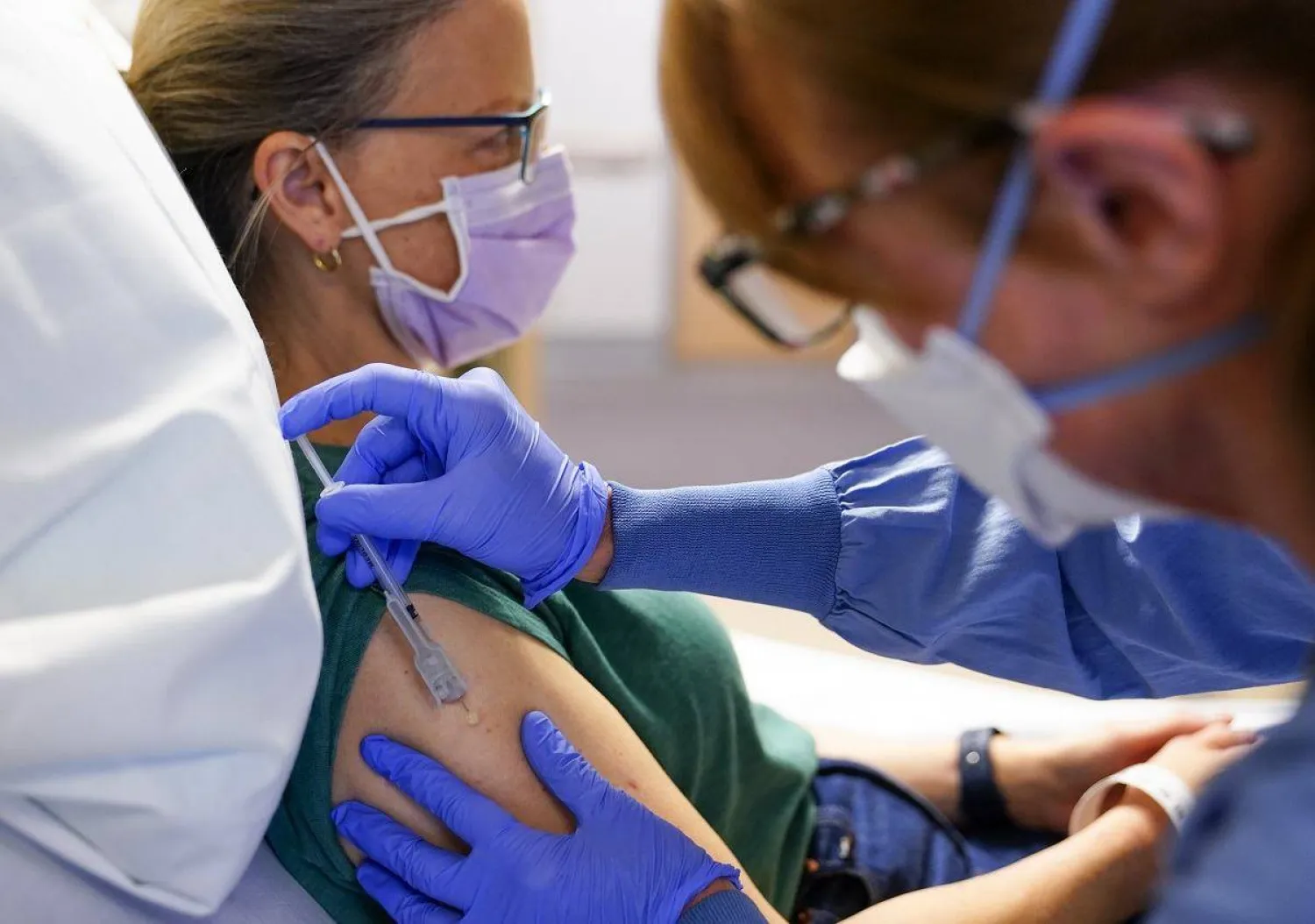
AP Photo/Lindsey Wasson- Registered nurse Erika Obrietan administers the third dose of an experimental breast cancer vaccine to patient Kathleen Jade at University of Washington Medical Center – Montlake, Tuesday, May 30, 2023, in Seattle.
TT

The Next Big Advance in Cancer Treatment Could Be a Vaccine

AP Photo/Lindsey Wasson- Registered nurse Erika Obrietan administers the third dose of an experimental breast cancer vaccine to patient Kathleen Jade at University of Washington Medical Center – Montlake, Tuesday, May 30, 2023, in Seattle.

After decades of limited success, scientists say research has reached a turning point, with many predicting more vaccines will be out in five years.

These aren’t traditional vaccines that prevent disease, but shots to shrink tumors and stop cancer from coming back. Targets for these experimental treatments include breast and lung cancer, with gains reported this year for deadly skin cancer melanoma and pancreatic cancer, AFP said.

“We’re getting something to work. Now we need to get it to work better,” said Dr. James Gulley, who helps lead a center at the National Cancer Institute that develops immune therapies, including cancer treatment vaccines.

More than ever, scientists understand how cancer hides from the body’s immune system. Cancer vaccines, like other immunotherapies, boost the immune system to find and kill cancer cells. And some new ones use mRNA, which was developed for cancer but first used for COVID-19 vaccines.

For a vaccine to work, it needs to teach the immune system’s T cells to recognize cancer as dangerous, said Dr. Nora Disis of UW Medicine’s Cancer Vaccine Institute in Seattle. Once trained, T cells can travel anywhere in the body to hunt down danger.

“If you saw an activated T cell, it almost has feet,” she said. “You can see it crawling through the blood vessel to get out into the tissues.”

Patient volunteers are crucial to the research.

Kathleen Jade, 50, learned she had breast cancer in late February, just weeks before she and her husband were to depart Seattle for an around-the-world adventure. Instead of sailing their 46-foot boat, Shadowfax, through the Great Lakes toward the St. Lawrence Seaway, she was sitting on a hospital bed awaiting her third dose of an experimental vaccine. She’s getting the vaccine to see if it will shrink her tumor before surgery.

“Even if that chance is a little bit, I felt like it’s worth it,” said Jade, who is also getting standard treatment.

Progress on treatment vaccines has been challenging. The first, Provenge, was approved in the US in 2010 to treat prostate cancer that had spread. It requires processing a patient’s own immune cells in a lab and giving them back through IV. There are also treatment vaccines for early bladder cancer and advanced melanoma.

Early cancer vaccine research faltered as cancer outwitted and outlasted patients’ weak immune systems, said Olja Finn, a vaccine researcher at the University of Pittsburgh School of Medicine.

“All of these trials that failed allowed us to learn so much,” Finn said.

As a result, she’s now focused on patients with earlier disease since the experimental vaccines didn’t help with more advanced patients. Her group is planning a vaccine study in women with a low-risk, noninvasive breast cancer called ductal carcinoma in situ.

More vaccines that prevent cancer may be ahead too. Decades-old hepatitis B vaccines prevent liver cancer and HPV vaccines, introduced in 2006, prevent cervical cancer.

In Philadelphia, Dr. Susan Domchek, director of the Basser Center at Penn Medicine, is recruiting 28 healthy people with BRCA mutations for a vaccine test. Those mutations increase the risk of breast and ovarian cancer. The idea is to kill very early abnormal cells, before they cause problems. She likens it to periodically weeding a garden or erasing a whiteboard.

Others are developing vaccines to prevent cancer in people with precancerous lung nodules and other inherited conditions that raise cancer risk.

“Vaccines are probably the next big thing” in the quest to reduce cancer deaths, said Dr. Steve Lipkin, a medical geneticist at New York’s Weill Cornell Medicine, who is leading one effort funded by the National Cancer Institute. “We’re dedicating our lives to that.”

People with the inherited condition Lynch syndrome have a 60% to 80% lifetime risk of developing cancer. Recruiting them for cancer vaccine trials has been remarkably easy, said Dr. Eduardo Vilar-Sanchez of MD Anderson Cancer Center in Houston, who is leading two government-funded studies on vaccines for Lynch-related cancers.

“Patients are jumping on this in a surprising and positive way,” he said.

Drugmakers Moderna and Merck are jointly developing a personalized mRNA vaccine for patients with melanoma, with a large study to begin this year. The vaccines are customized to each patient, based on the numerous mutations in their cancer tissue. A vaccine personalized in this way can train the immune system to hunt for the cancer’s mutation fingerprint and kill those cells.

But such vaccines will be expensive.

“You basically have to make every vaccine from scratch. If this wasn’t personalized, the vaccine could probably be made for pennies, just like the COVID vaccine,” said Dr. Patrick Ott of Dana-Farber Cancer Institute in Boston.

The vaccines under development at UW Medicine are designed to work for many patients, not just a single patient. Tests are underway in early and advanced breast cancer, lung cancer and ovarian cancer. Some results may come as soon as next year.

Todd Pieper, 56, from suburban Seattle, is participating in testing for a vaccine intended to shrink lung cancer tumors. His cancer has spread to his brain, but he’s hoping to live long enough to see his daughter graduate from nursing school next year.

“I have nothing to lose and everything to gain, either for me or for other people down the road,” Pieper said of his decision to volunteer.

One of the first to receive the ovarian cancer vaccine in a safety study 11 years ago was Jamie Crase of nearby Mercer Island. Diagnosed with advanced ovarian cancer when she was 34, Crase thought she would die young and had made a will that bequeathed a favorite necklace to her best friend. Now 50, she has no sign of cancer and she still wears the necklace.

She doesn’t know for sure if the vaccine helped, “But I’m still here.”


Heavy Rains Drench Southern California, Spawn Flash Flooding, Mud Flows

 A car sits buried in mud after flooding Wednesday, Dec. 24, 2025, in Wrightwood, Calif. (AP)
A car sits buried in mud after flooding Wednesday, Dec. 24, 2025, in Wrightwood, Calif. (AP)
TT

Heavy Rains Drench Southern California, Spawn Flash Flooding, Mud Flows

 A car sits buried in mud after flooding Wednesday, Dec. 24, 2025, in Wrightwood, Calif. (AP)
A car sits buried in mud after flooding Wednesday, Dec. 24, 2025, in Wrightwood, Calif. (AP)

Torrential rains unleashed widespread flash flooding and mud flows across Southern California on Wednesday, as authorities warned motorists to stay off roads while urging residents in flood zones to evacuate or shelter in place.

In the rain-soaked mountain resort of Wrightwood, east of Los Angeles, emergency crews spent much of the day answering dozens of rescue calls and pulling drivers to safety from submerged vehicles, San Bernardino County Fire Department spokesperson Christopher Prater said.

No casualties were reported as ‌of Wednesday night, according ‌to Prater.

Aerial video footage posted online by the fire department ‌showed ⁠rivers of ‌mud coursing through inundated cabin neighborhoods.

Downpours measuring an inch (2.54 cm) or more of rain an hour in some areas were spawned by the region's latest atmospheric storm, a vast airborne current of dense moisture siphoned from the Pacific and swept inland over the greater Los Angeles area.

The Christmas Eve storm was expected to persist into Friday, posing unsafe driving conditions during what would normally be a busy holiday travel period, according to the US National Weather Service.

"Life-threatening" storm conditions ⁠were expected to persist through Christmas Day over Southern California, "where widespread flash flooding is underway," the weather service said.

A flash-flood ‌warning was posted across much of Los Angeles County until ‍6 p.m. PST, urging motorists: "Do not ‍attempt to travel unless you are fleeing an area, subject to flooding or under ‍an evacuation order."

Los Angeles city officials urged residents to heed evacuation orders issued for about 130 homes considered especially vulnerable to mudslides and debris flows in areas where last year's wildfires ravaged the community of Pacific Palisades.

The San Bernardino County Sheriff's Department issued an evacuation warning for Wrightwood earlier in the day, but elevated the advisory to a shelter-in-place order as flood conditions worsened. The Angeles Crest Highway, a major traffic route through the San ⁠Gabriel Mountains, was closed in two stretches due to flooding

Wednesday's heavy rainfall was accompanied by strong, gusty winds that officials said were downing trees and power lines. In upper elevations of the Sierra mountains, the storm was expected to dump heavy snow.

NWS meteorologist Ariel Cohen said 4 to 8 inches of rain had fallen in some foothill areas by 9 a.m. PST, and the Los Angeles City News Service reported numerous rockslides in the mountains. Forecasts called for more than a foot (30.48 cm) of rain falling over some lower-terrain mountain areas by week's end.

Forecasters even issued a rare tornado warning for a small portion of east-central Los Angeles County due to heavy thunderstorm activity over the community of Alhambra.

As of Wednesday night, ‌rainfall over the region had subsided, but a second wave of the storm system was due to hit on Thursday, forecasters said.


China's LandSpace Hopes to Complete Rocket Recovery in Mid-2026

Zhuque-3 rocket by China’s private rocket firm LandSpace, takes off from the Jiuquan Satellite Launch Center, China, December 3, 2025, in this screengrab taken from handout drone footage provided by LandSpace. LandSpace/Handout via REUTERS
TT

China's LandSpace Hopes to Complete Rocket Recovery in Mid-2026

Zhuque-3 rocket by China’s private rocket firm LandSpace, takes off from the Jiuquan Satellite Launch Center, China, December 3, 2025, in this screengrab taken from handout drone footage provided by LandSpace. LandSpace/Handout via REUTERS

Chinese rocket developer LandSpace plans to successfully recover a reusable booster in mid-2026, a company executive said in an interview, underscoring the Beijing-based firm's ambition to become China's answer to SpaceX.

The ability to return, recover, and reuse a rocket's engine-packed first stage, or booster, after launch is crucial to reducing costs and making it easier for countries to send satellites into orbit, and to turn space exploration into a commercially viable business similar to civil aviation, Reuters reported.

Earlier this month, privately-owned LandSpace ‌became the first ‌Chinese entity to conduct a full reusable rocket ‌test, when ⁠Zhuque-3 ​blasted off ‌from a remote area in northwest China for its maiden flight, drawing comparisons to US aerospace giant SpaceX.

SECOND ATTEMPT PLANNED

While LandSpace failed to complete the crucial final step of landing and recovering the rocket's engine-packed booster, it hopes to clear this challenge in mid-2026 with a second test flight, Zhuque-3 deputy chief designer Dong Kai told Chinese podcast Tech Early Know in an interview published on Tuesday.

"If the second flight's recovery (stage) succeeds, we ⁠plan that on the fourth flight we will use a reused first stage to launch," Dong said.

So far, ‌the only company that has mastered reusable rocket technology is ‍SpaceX, founded by the world's richest ‍person Elon Musk. SpaceX's Falcon 9 launches around 150 times a year, or roughly ‍three times per week, with its booster reused dozens of times if necessary.

Musk said in October that LandSpace's Zhuque-3 design could allow it to beat the Falcon 9, but went on to state that the Chinese challenger's launch cadence would take more than five years to ​reach that of SpaceX's workhorse model, at which point the US firm would have transitioned to its heavier, new-generation model Starship and "doing over ⁠100 times the annual payload to orbit of Falcon".

INITIAL PUBLIC OFFERING

LandSpace's Dong said that, while the company was already building an engine for a future Starship-like model, he was not optimistic that in five years Falcon 9's work rate could be surpassed, noting that all rocket models in China combined this year totalled only around 100 launches.

"It's very difficult for a single company to reach that kind of frequency. It requires the support of an entire ecosystem," Dong said, adding that LandSpace had 10 launches planned next year for all its models.

Other executives have previously said that the financial cost of a high-frequency testing and launch regimen was crucial to SpaceX's success, and that LandSpace's only ‌hope of amassing enough funds to sustain a similar programme would be by tapping China's capital markets, pointing to plans for an initial public offering next year.


Russia Plans a Nuclear Power Plant on the Moon within a Decade

November's full moon, also known as Beaver Moon, rises over Fort-de-France in the French overseas island of Martinique, on November 5, 2025. (AFP)
TT

Russia Plans a Nuclear Power Plant on the Moon within a Decade

November's full moon, also known as Beaver Moon, rises over Fort-de-France in the French overseas island of Martinique, on November 5, 2025. (AFP)

Russia plans to put ​a nuclear power plant on the moon in the next decade to supply its lunar space program and a joint Russian-Chinese research station as major powers rush to explore the earth's only natural satellite.

Ever since Soviet cosmonaut Yuri Gagarin became the first human to go into space in 1961, Russia has prided itself as ‌a leading power in ‌space exploration, but in recent ‌decades ⁠it ​has fallen ‌behind the United States and increasingly China.

Russia's ambitions suffered a massive blow in August 2023 when its unmanned Luna-25 mission smashed into the surface of the moon while attempting to land, and Elon Musk has revolutionized the launch of space vehicles - once a Russian specialty.

Russia's state space corporation, Roscosmos, ⁠said in a statement that it planned to build a lunar power ‌plant by 2036 and signed a contract ‍with the Lavochkin Association ‍aerospace company to do it.

Roscosmos said the purpose of ‍the plant was to power Russia's lunar program, including rovers, an observatory and the infrastructure of the joint Russian-Chinese International Lunar Research Station.

"The project is an important step towards the creation of ​a permanently functioning scientific lunar station and the transition from one-time missions to a long-term lunar exploration program," ⁠Roscosmos said.

Roscosmos did not say explicitly that the plant would be nuclear but it said the participants included Russian state nuclear corporation Rosatom and the Kurchatov Institute, Russia's leading nuclear research institute.

The head of Roscosmos, Dmitry Bakanov, said in June that one of the corporation's aims was to put a nuclear power plant on the moon and to explore Venus, known as earth's "sister" planet.

The moon, which is 384,400 km (238,855 miles) from our planet, moderates the earth's wobble ‌on its axis, which ensures a more stable climate. It also causes tides in the world's oceans.
