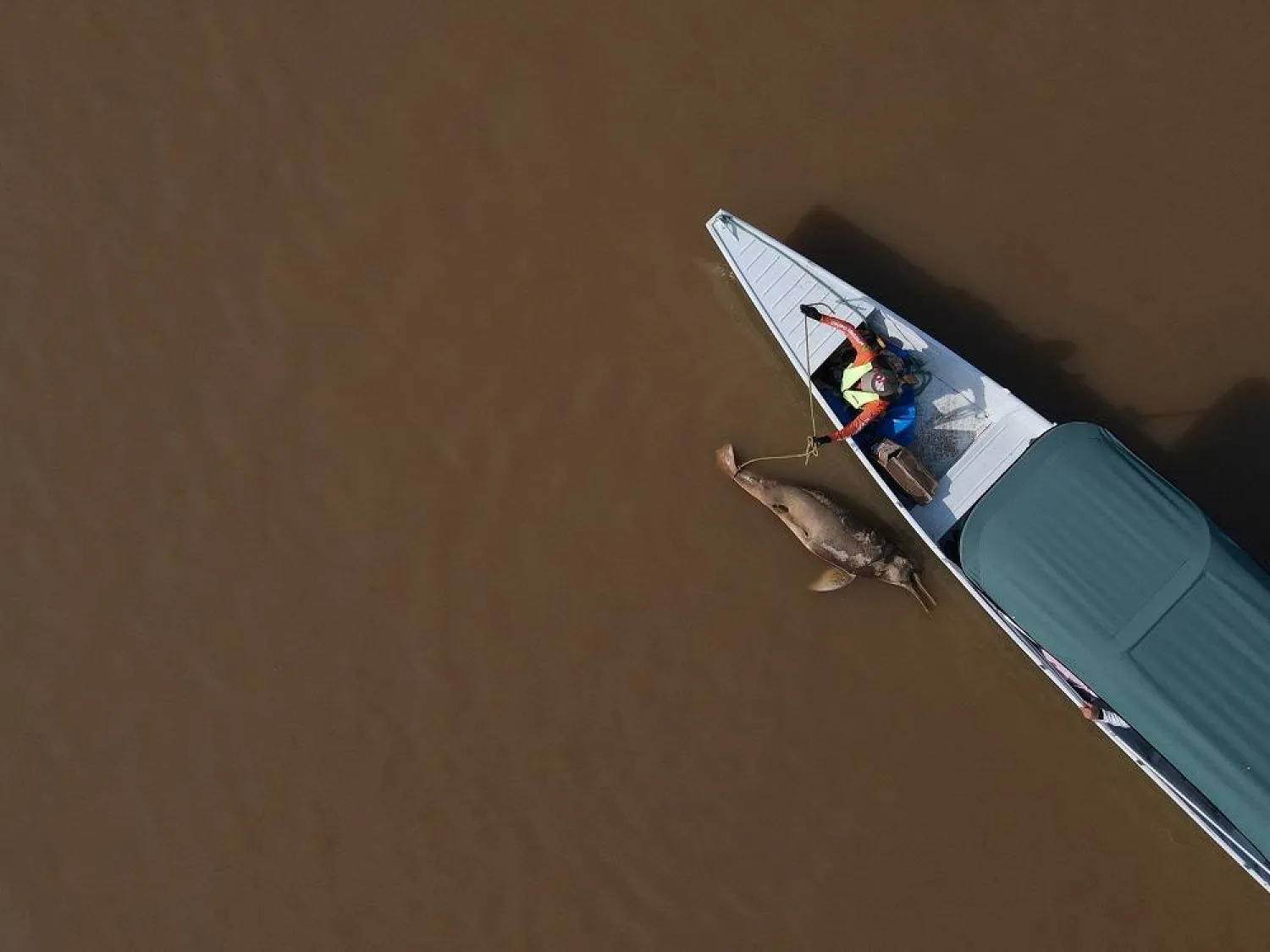
More than 100 Dolphins Found Dead in Brazilian Amazon as Water Temperatures Soar 

A dead dolphin is seen at the Tefe lake, affluent of the Solimoes river that has been affected by the high temperatures and drought in Tefe, Amazonas state, Brazil, October 1, 2023. (Reuters)
TT

More than 100 Dolphins Found Dead in Brazilian Amazon as Water Temperatures Soar 

A dead dolphin is seen at the Tefe lake, affluent of the Solimoes river that has been affected by the high temperatures and drought in Tefe, Amazonas state, Brazil, October 1, 2023. (Reuters)

More than 100 dolphins have died in the Brazilian Amazon rainforest in the past week as the region grapples with a severe drought, and many more could die soon if water temperatures remain high, experts say.

The Mamiraua Institute, a research group of Brazil’s Ministry of Science, Technology and Innovation, said two more dead dolphins were found Monday in the region around Tefe Lake, which is key for mammals and fish in the area. Video provided by the institute showed vultures picking at the dolphin carcasses beached on the lakeside. Thousands of fish have also died, local media reported.

Experts believe high water temperatures are the most likely cause of the deaths in the lakes in the region. Temperatures since last week have exceeded 39 degrees Celsius (102 degrees Fahrenheit) in the Tefe Lake region.

The Brazilian government’s Chico Mendes Institute for Biodiversity Conservation, which manages conservation areas, said last week it had sent teams of veterinarians and aquatic mammal experts to investigate the deaths.

There had been some 1,400 river dolphins in Tefe Lake, said Miriam Marmontel, a researcher from the Mamiraua Institute.

“In one week we have already lost around 120 animals between the two of them, which could represent 5% to 10% of the population,” said Marmontel.

Workers have recovered carcasses of dolphins since last week in a region where dry rivers have impacted impoverished riverside communities and stuck their boats in the sand. Amazonas Gov. Wilson Lima on Friday declared a state of emergency due to the drought.

Nicson Marreira, mayor of Tefe, a city of 60,000 residents. said his government was unable to deliver food directly to some isolated communities because the rivers are dry.

Ayan Fleischmann, the Geospatial coordinator at the Mamirauá Institute, said the drought has had a major impact on the riverside communities in the Amazon region.

“Many communities are becoming isolated, without access to good quality water, without access to the river, which is their main means of transportation,” he said.

Fleischmann said water temperatures rose from 32 C (89 F) on Friday to almost 38 C (100 F) on Sunday.

He said they are still determining the cause of the dolphin deaths but that the high temperature remains the main candidate.


Drones, AI and White Paint: Europe Races to Protect Infrastructure from Heat

A vehicle from Oslo Airport’s fire rescue services sprays water onto the runway at the airport, to combat heat, in Oslo, Norway, July 15, 2026. REUTERS/Tom Little
TT

Drones, AI and White Paint: Europe Races to Protect Infrastructure from Heat

A vehicle from Oslo Airport’s fire rescue services sprays water onto the runway at the airport, to combat heat, in Oslo, Norway, July 15, 2026. REUTERS/Tom Little

As Europe's railways buckle under record heat, roads melt and power grids strain, countries are turning to an array of fixes for ageing infrastructure, from drones inspecting tracks and AI-powered sensors to a surprisingly simple tool: white paint.

At Norway's Oslo airport on Wednesday, with temperatures set to hit 30 degrees Celsius (86 degrees Fahrenheit), 10 C above normal for the time of year, workers doused the tarmac with water to keep it cool.

It's a marked shift in a country more used to coping with the cold that reflects how Europe is having to adapt to rising temperatures that are stoking wildfires, causing thousands of excess deaths and putting infrastructure under growing pressure.

"In Norway, the asphalt must withstand both extreme cold and fairly warm temperatures," said Jørn Arvid Remark, operating engineer at Norwegian state-owned airport operator Avinor, adding the airport was testing a new heat-resistant asphalt.

The fire brigade sprays around 9,000 liters of water on key parts of the runway, which can get damaged at high temperatures as it softens under the weight of aircraft, Reuters reported.

Europe's roads and railways, many built decades ago, are increasingly struggling to cope.

Temperatures across Western Europe on Wednesday were 5.5 C above the average for July ⁠15, according to the ⁠Reuters Climate Monitor.

"Our infrastructure is in no way prepared for the extreme weather events that we're going to see," said Chris Dodwell, co-head of sustainability center at Impax Asset Management, adding heatwaves, once rare, were becoming regular events.

A 2025 report by leading central banks estimated that severe weather events, including heatwaves, droughts and floods, could cut euro zone GDP by as much as 4.7% by 2030.

Europe's railways have felt the impact acutely.

An EU report in April found that more than 70% of rail managers were seeing growing disruption from extreme weather. Between 2015 and 2024 weather-related interruptions amounted to the equivalent of one to three years of railway service across the region.

Heat can cause tracks to expand, and points, ⁠signals and power to fail. However, extreme weather triggered by high temperatures can be even more disruptive.

"The most critical issue for rail networks is not the heat itself, but the thunderstorms, strong winds and landslides that often follow heatwaves," said Oliviero Baccelli, a professor at Milan's Bocconi University.

"Italy has already experienced significant disruptions to its railway network, particularly on Alpine routes, as a result of climate-related events."

Northern European countries such as Britain face particular challenges because much of their rail infrastructure was designed for a narrower temperature range than networks in southern Europe.

John Lawrence, chair of the IET Railway Technical Network, said many rail components and systems were "in essence frozen in time".

He added it would be a huge cost to heat-proof entire networks, though operators were exploring more stable sleeper designs and technologies such as AI and drones to "speed up the amount of track that can be inspected and monitored".

Britain's Network Rail has pledged to invest  £2.6 billion ($3.5 billion)  between 2024 and 2029 to help its network withstand increasingly extreme weather.

Not all solutions are hugely expensive, however, with some operators using traditional methods to reflect heat. Stockholm's transport authority spent about 100,000 Swedish crowns ($10,300) painting ⁠sections of metro track white in ⁠May and June to reduce the risk of track buckling.

Martin Wilson, engineering director at French rail equipment manufacturer Alstom, said Europe could learn lessons from transport systems such as the Riyadh Metro and Dubai tram, designed to operate in temperatures above 50C (122F).

"Today's heatwaves are often more intense, more frequent and longer-lasting," he said.

"Rising temperatures are increasingly challenging rail systems across Europe."

Roads face similar pressures.

Engineers say northern European highways were built primarily to withstand damage from freeze-thaw cycles, while southern countries such as Spain use asphalt blends better suited to prolonged summer heat.

Finding the right balance is becoming harder as countries contend with both colder winters and hotter summers.

"They may have to adjust their approach," said José Pablo Sáez Villar of the Spanish Civil Engineers Association, referring to planners and road builders in northern Europe.

Paris transport operator RATP has created a heatwave contingency unit and is preparing a climate adaptation plan by the end of the year.

In Norway, officials say warmer, wetter weather is changing how new infrastructure is designed.

"Roads are going to be made more robust," said Grethe Vikane, head of social development and climate at the Norwegian Public Roads Administration.

"So they can withstand both the challenges already being experienced and the consequences of expected climate change."


Russian Haaland Lookalike Says Viral Video Felt ‘Like a Dream’

Anastasia Kostromitina, model of MOTION agency, who has gone viral with striking likeness to Norway's Erling Haaland, poses in Moscow, Russia July 10, 2026. (Reuters)
TT

Russian Haaland Lookalike Says Viral Video Felt ‘Like a Dream’

Anastasia Kostromitina, model of MOTION agency, who has gone viral with striking likeness to Norway's Erling Haaland, poses in Moscow, Russia July 10, 2026. (Reuters)

Friends and family have for a few years told Russian model Anastasia Kostromitina that she looked like Norwegian striker Erling Haaland, but it was not until he became the World Cup's superstar that she decided to take that online.

Earlier this month, she posted a video on Instagram highlighting the resemblance to Haaland -- both in looks and mimicking some of his now-trademark mannerisms and distinctive facial expressions.

It soon spiraled and gathered 6.4 million likes.

"At first, I did not even know what was happening, it felt like a dream," Kostromitina told AFP in Moscow, saying she "never expected" the video to go so viral.

"But I'm happy about it anyway," the 24-year-old added.

Haaland, 25, has been the social media sensation of the World Cup, with the Manchester City player now counting 68.8 million followers on social media.

Haaland sparkled at the tournament scoring seven times -- including a double against Brazil in their last 16 match -- as Norway reached the quarter-finals only to lose 2-1 to England.

Kostromitina had mixed feelings when she was first told she looked like the towering male footballer -- but has now embraced it.

"At first, to be honest, I didn't even understand how I could possibly resemble a male football player. But then I started to take it with a sense of humor and now I'm completely fine with it."

Naturally, she was supporting Norway in the World Cup and was sad when they lost.

"I was really rooting for them and was on the edge of my seat," she said of their last game in the competition.

Russia has been mostly banned from international sport since its 2022 Ukraine offensive and did not take part in the World Cup.

Kostromitina -- who is represented by Moscow-based Motion Model Management -- hoped that Haaland will "see my video, maybe even laugh."


Texas Is Drenched by Heavy Rains as Forecasters Warn That More Storms Could Bring Dangerous Floods

 In this handout photo provided by the Texas Parks and Wildlife Department, game wardens walk through high waters from heavy rains in Uvalde County, Texas, on Tuesday, July 14, 2026. (Texas Parks and Wildlife Department via AP)
In this handout photo provided by the Texas Parks and Wildlife Department, game wardens walk through high waters from heavy rains in Uvalde County, Texas, on Tuesday, July 14, 2026. (Texas Parks and Wildlife Department via AP)
TT

Texas Is Drenched by Heavy Rains as Forecasters Warn That More Storms Could Bring Dangerous Floods

 In this handout photo provided by the Texas Parks and Wildlife Department, game wardens walk through high waters from heavy rains in Uvalde County, Texas, on Tuesday, July 14, 2026. (Texas Parks and Wildlife Department via AP)
In this handout photo provided by the Texas Parks and Wildlife Department, game wardens walk through high waters from heavy rains in Uvalde County, Texas, on Tuesday, July 14, 2026. (Texas Parks and Wildlife Department via AP)

Heavy downpours in South Texas washed out highways and stranded motorists Tuesday as forecasters warned that a threat of more severe weather could bring dangerous flooding to already drenched counties near the border with Mexico.

Storms dumped up to a foot of rain in some rural areas of Texas, leading to dozens of high-water rescues across the region and officials shutting down portions of a busy highway for hours near Uvalde, about 80 miles (129 kilometers) west of San Antonio.

A flood watch also included Kerr County, where catastrophic flooding last year along the Guadalupe River killed more than 100 people.

No deaths or injuries Tuesday were immediately reported.

The National Weather Service warned that storms overnight could dump more than a foot of additional rain to some places into Wednesday, creating potentially catastrophic impacts from flash flooding in areas west of San Antonio.

Texas Gov. Greg Abbott issued a disaster declaration for dozens of counties.

“Intense rain rates and compounding effects from multiple rounds of storms will result in a dangerous flash flooding threat through Thursday,” the National Weather Service said.

Authorities on Tuesday posted videos of a rescue crew in a boat down flooded streets and one vehicle being swept away by fast-moving waters. Five people were rescued by members of the Texas Game Warden Search and Rescue Team and four were rescued by a local game warden, said Maggie Berger, a spokesperson for the Texas Parks and Wildlife Department.

In Uvalde, officials said there had been at least two dozen water rescues. They opened a local event center for anyone displaced by flooding. In Sabinal, officials were also making plans for a shelter.