

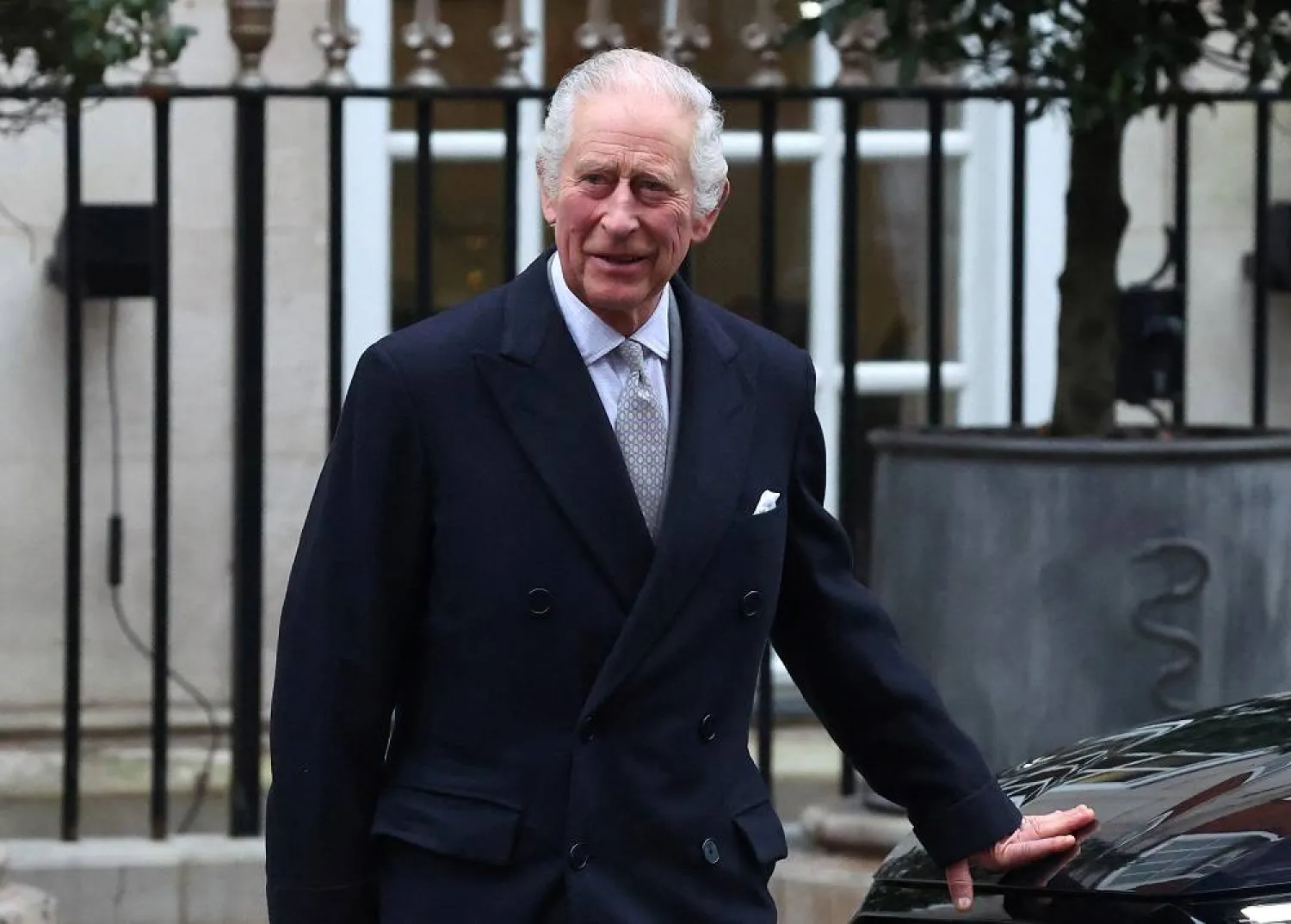

King Charles III Is Being Treated for Cancer, Will Temporarily Halt Public Duties 

Britain's King Charles leaves the London Clinic after receiving treatment for an enlarged prostate, in London, Britain January 29, 2024. (Reuters)
TT

King Charles III Is Being Treated for Cancer, Will Temporarily Halt Public Duties 

Britain's King Charles leaves the London Clinic after receiving treatment for an enlarged prostate, in London, Britain January 29, 2024. (Reuters)

Britain's King Charles III has been diagnosed with cancer and has begun treatment, Buckingham Palace said Monday. Less than 18 months into his reign, the 75-year-old monarch will suspend public engagements but will continue with state business, and won't be handing over his constitutional roles as head of state.

The palace didn't disclose what form of cancer the king has, but said it's not related to his recent treatment for a benign prostate condition.

The palace said "a separate issue of concern was noted" during Charles' treatment for an enlarged prostate last month, when he spent three nights in a London hospital.

"Diagnostic tests have identified a form of cancer," it said in a statement.

"His Majesty has today commenced a schedule of regular treatments, during which time he has been advised by doctors to postpone public-facing duties," the palace said. "Throughout this period, His Majesty will continue to undertake State business and official paperwork as usual."

The king is being treated as an outpatient, the palace said.

It said Charles, who has generally enjoyed good health, "remains wholly positive about his treatment and looks forward to returning to full public duty as soon as possible."

The palace added that the king "has chosen to share his diagnosis to prevent speculation and in the hope it may assist public understanding for all those around the world who are affected by cancer."

Charles became king in September 2022 when his mother, Queen Elizabeth II, died at the age of 96 after 70 years on the throne.

News of the king's diagnosis comes as his daughter-in-law Kate, Princess of Wales, recovers from abdominal surgery that saw her hospitalized for about two weeks.

Kate is still taking a break from royal duties as she recovers. Her husband, Prince William, who is heir to the throne, also took time off to help look after the couple's three children, but is due to preside over an investiture ceremony at Windsor Castle and a charity dinner on Wednesday.

Charles took the throne intending to preside over a slimmer monarchy with fewer senior royals carrying out ceremonial public duties. But with Charles and Kate both temporarily sidelined, Prince Harry self-exiled to California and Prince Andrew largely banished from view because of his friendship with sex offender Jeffrey Epstein, the royal "Firm" risks becoming severely overstretched.

The king personally called both William and Harry — as well as his siblings Princess Anne, Prince Andrew and Prince Edward — to share news of his health.

Harry, who quit royal duties in 2020, has spoken to his father about the diagnosis and "will be traveling to UK to see His Majesty in the coming days," said the office of Harry and his wife, Meghan.

UK political leaders sent messages of support. Prime Minister Rishi Sunak tweeted: "Wishing His Majesty a full and speedy recovery. I have no doubt he’ll be back to full strength in no time and I know the whole country will be wishing him well."

US President Joe Biden, traveling in Las Vegas on Monday, said he had just learned about Charles’s diagnosis and said he hopes to speak with him, "God willing."

"I’m concerned about him," Biden told reporters.

The president later posted on X, formerly known as Twitter: "Navigating a cancer diagnosis, treatment, and survivorship takes hope and absolute courage. Jill and I join the people of the United Kingdom in praying that His Majesty experiences a swift and full recovery."

Charles departed from royal tradition with his openness about his prostate condition. For centuries Britain's royal family remained tight-lipped about health matters.

When UK monarchs had real power, news of illness was withheld for fear it might weaken their authority. The habit of secrecy lingered after royals became constitutional figureheads.

The British public wasn’t told that Charles’ grandfather, King George VI, had lung cancer before his death in February 1952 at the age of 56, and some historians have claimed that the king himself wasn’t told he was terminally ill.

In the final years of Elizabeth's life, the public was told only that the queen was suffering from "mobility issues." The cause of her death was listed on the death certificate simply as "old age."

Pat Price, founder of the Catch Up With Cancer campaign, said millions shared the "collective concern" for the king's health.

"The king’s openness about his battle with cancer is a powerful reminder that one in two of us may face cancer at some point in our lives," Price said.



Volcano Guides at Mount Etna are Protesting over New Safety Rules

A group of people observes glowing lava emerging from a fissure during ongoing volcanic activity on Mount Etna in Catania, Sicily, Italy, January 3, 2026. REUTERS/Antonio Denti
TT

Volcano Guides at Mount Etna are Protesting over New Safety Rules

A group of people observes glowing lava emerging from a fissure during ongoing volcanic activity on Mount Etna in Catania, Sicily, Italy, January 3, 2026. REUTERS/Antonio Denti

Guides who take tourists to enjoy the striking views of Sicily’s Mount Etna are up in arms over tougher restrictions imposed by local authorities after a round of eruptions at the giant volcano in recent weeks.

Authorities in the city of Catania have suspended or restricted excursions to see the volcano's lava flows, prompting guides to go on strike for the first time in decades and leaving disgruntled tourists with fewer options to see the spectacle up close, The Associated Press reported.

Dozens of the guides demonstrated Wednesday in front of Mount Etna’s lava flow gate, calling the new restrictions excessive and saying the lava flows are slow-moving enough to be viewed safely as has been done in the past.

“These measures effectively nullify the role of guides, stripping them of their skills, function, and professional responsibility,” a statement by the guides’ regional board said.

The lava flows are especially spectacular after sunset, but under the new rules, excursions are allowed only until dusk and can go no closer than 200 meters (660 feet) to the lava flow. Also, a previously existing limit of 10 people per group is being vigorously enforced, including with drones.

Mount Etna is Europe’s most active volcano and the continent’s largest. It attracts hikers and backpackers to its slopes, while less adventurous tourists can take it in from a distance, most stunningly from the Ionian Sea.

At 3,350 meters (almost 10,990 feet) tall and 35 kilometers (21.7 miles) wide, the Sicilian giant frequently offers a front-row seat to nature’s power. Last June, a massive eruption forced tourists to flee the volcano after a plume of high-temperature gases, ash and rock several kilometers high billowed into the air above them.

The latest restrictions were adopted after Mount Etna started a round of eruptions on Christmas Eve.

The most advanced lava front reached 1,360 meters (4,460 feet) above sea level, before stopping and entering a cooling phase after a journey of approximately 3.4 kilometers (about 2 miles), local authorities said. The lava flow poses no danger to nearby residential areas, volcanologists say.

Italy's National Institute of Geophysics and Volcanology confirmed this week that Mount Etna’s eruption is ongoing, but said the lava fronts are cooling and not advancing further.

“This is a lava flow that is descending very slowly on an area that is now also flat or semi-flat,” said Dario Teri, 43, a member of Sicily’s association of alpine and volcano guides who participated in Wednesday’s protest.

The guides, who are expected to continue their strike in the coming days, hope to come to a compromise with authorities that can protect their profession while also ensuring the safety of visitors.

Claudia Mancini, a 32-year-old tourist, said she came from Palermo for an excursion with a guide at Mount Etna.

“Unfortunately, we got the bad news of the cancelling of all activity,” Mancini said, adding that she sympathized with the guides over a situation that “is not making anyone happy.”


Lego Unveils Tech-Filled Smart Bricks

Lego unveils Smart Bricks (AFP)
TT

Lego Unveils Tech-Filled Smart Bricks

Lego unveils Smart Bricks (AFP)

Lego has unveiled Smart Bricks - tech-filled versions of its small building blocks - which it says will bring sets to life with sound, light and reaction to movement, according to the BBC.

However, the new product range has got a mixed reaction from play experts, who said it risks undermining what makes Lego distinct for children in an increasingly digital world.

Announced at the Consumer Electronics Show (CES) 2026 in Las Vegas, the Danish toymaker's Smart Play system introduces new electronic components to the classic plastic blocks.

Lego said its new tech-enabled products, launching in March with a new Star Wars set, are its “most revolutionary innovation” in nearly 50 years.

But Josh Golin, executive director of children's wellbeing group Fairplay, believes Smart Bricks could “undermine what was once great about Legos” - harnessing children's own imagination during play.

He said the toy did not require extra features to generate sounds or other effects.

“As anyone who has ever watched a child play with old-school Legos knows, children's Lego creations already do move and make noises through the power of children's imaginations,” he told the BBC.

Andrew Manches, professor of children and technology at the University of Edinburgh, agreed the beauty of Lego lay in “the freedom to create, re-create, and adapt simple blocks into endless stories powered by children's imagination.”

But he also welcomed Lego's efforts to integrate physical and digital play with tools that react to the way children interact with its Smart Play products.

Julia Goldin, the company's chief product and marketing officer, previously told the BBC it viewed digital technology as an opportunity to “expand physical play and physical building.”

“We don't look at the digital world as a threat,” she said - adding its smart range weaves interactivity “seamlessly” with its physical products.

What are Lego Smart Bricks?

Lego says its Smart Bricks can sense motion, position and distance, allowing the models to respond in various ways during play.

Measuring 2x4, the brick itself contains sensors, lights, a small sound synthesizer, an accelerometer and a custom-made silicon chip enabling it to detect movement and react to it.

But it is designed to be used with Smart Minifigures and Smart Tags tiles - two additional products making up Lego's Smart Play System.

Similarly adapted from existing Lego components, these possess digital identifiers triggering different sounds or reactions when they detect and interact with each other.

For instance, when tried out by the BBC at CES, a Lego birthday cake recognized when its “candles” were blown out - sounding a cheer and a happy birthday song.

Meanwhile, a Lego helicopter made whooshing sounds when moved or rotated, with its Smart Brick lighting up red upon crashing.

Tom Donaldson, head of Lego's Creative Play Lab, said the tech intended to respond to children's actions and complement the way they naturally play.

He said the Smart Brick's reactions to responses would “hopefully inspire and surprise the user to keep them continuing to play.”

“We are building a platform that we want to last for many years,” he said.
Manches told the BBC reduced cost and size of components has “enabled more toymakers to integrate digital technology seamlessly into a range of toys.”

But he added despite exciting innovation, concerns remain about the security and privacy of new and emerging smart toys for children - particularly those which integrate AI.

“The key is to us all to remain critically reflective of the design of these toys, and to pay much attention to how they influence children's everyday lives,” he said.

It is not the first time Lego has dabbled in digital experimentation or sought to appeal to increasingly online audiences.

Since 2017 it has released augmented reality apps and experiences letting people play with computer-generated models layered over their surroundings.

Through collaborations with video game publishers such as Nintendo and Fortnite-maker Epic Games it has also looked to appeal to fans of trending games or new launches - releasing a Super Mario Minifigure in 2020 with a tiny display screen.

Lego chief executive Niels B. Christiansen said in the firm’s 2024 annual report it had accelerated spending on digital technology as a “strategic area” for the company.


Did Leonardo da Vinci Leave his DNA on Artwork?

Beige seamless vector background with Leonardo da Vinci sketch drawings (Shutterstock)
TT

Did Leonardo da Vinci Leave his DNA on Artwork?

Beige seamless vector background with Leonardo da Vinci sketch drawings (Shutterstock)

Scientists have recovered tiny DNA traces left on Renaissance artifacts, at least some of which they suspect belong to visionary Italian polymath Leonardo da Vinci.

They have recovered trace DNA from a red chalk drawing on paper called “Holy Child”, possibly made by da Vinci, and letters written by his ancestor, Frosino di Ser Giovanni da Vinci, held at a historical archive in Italy, according to The Independent.

Some Y-chromosome DNA sequences from the “Holy Child” artwork and from a letter penned by one of Leonardo’s cousins appear to belong to a genetic grouping of people with a shared ancestry in Tuscany, where the painter was born, according to the study.

When scientists compared the Y-chromosome DNA sequences from the artifacts with large Y-chromosome reference databases, they found the closest match within the broad lineage.

This Y-chromosome lineage is found today at notable frequencies in southern Europe, including Italy, North Africa and parts of the Near East.

Some of the DNA may be from da Vinci himself.

However, this is not conclusive proof, as establishing that any DNA trace from the artifacts indeed belongs to da Vinci is extremely complex, researchers said.

This is because scientists can’t verify genetic sequences from the artifacts against DNA known to have come from da Vinci himself. The iconic inventor has no known descendants and his burial site was disturbed in the early 19th century.

Historical artifacts can accumulate DNA from their environments and can potentially offer useful information about the people who created and handled them, the materials used to make them as well as the environments they passed through.

But studying such precious objects without damaging or contaminating them has long been a challenge.

Now, though, scientists have developed a “minimally invasive” method to recover “biological signatures of history” from Renaissance artwork and correspondence associated with da Vinci’s ancestors.

Most of the DNA traces belong to bacteria, fungi, plants, and viruses, shedding light on the nature of the materials of these artifacts, their storage environment, conservation treatments, and handling over the years.

Some of the genetic material, however, comes from humans.

Since the artifacts assessed in the new study were associated with male historical figures, scientists looked at markers of Y-chromosome DNA found in the biological samples.

“To enable stronger claims, especially relating to provenance, geolocation, or historical characteristics, future work is needed to help distinguish artifact-associated signal from modern handling,” researchers said.