


UN Says E-waste from Trashed Electric Devices Is Piling up and Recycling Isn’t Keeping Pace

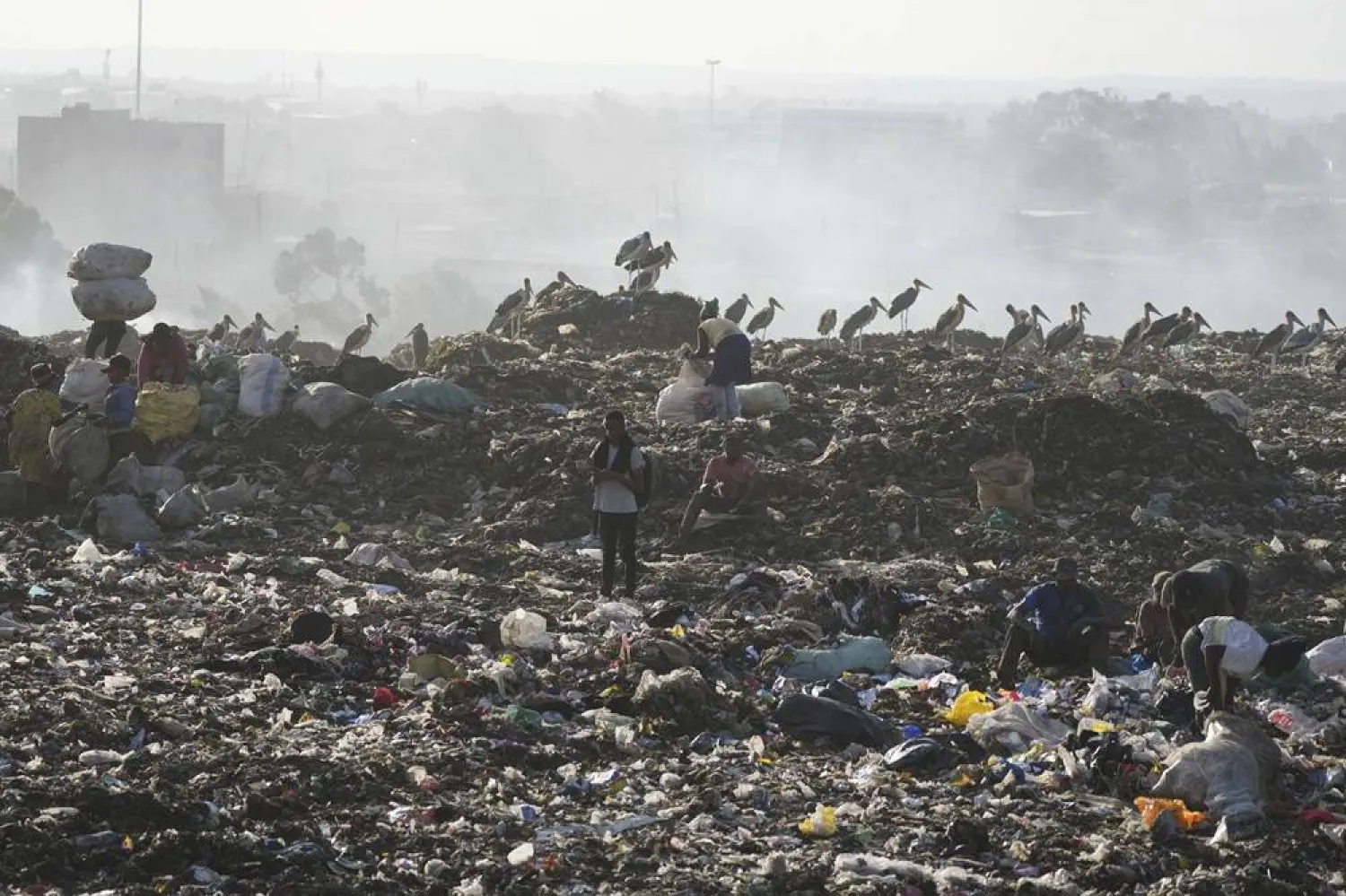
People scavenge recyclable materials for a living, past Marabou storks feeding on a mountain of garage at Dandora, the largest garbage dump in the capital Nairobi, Kenya Wednesday, March 20, 2024. (AP)
TT

UN Says E-waste from Trashed Electric Devices Is Piling up and Recycling Isn’t Keeping Pace

People scavenge recyclable materials for a living, past Marabou storks feeding on a mountain of garage at Dandora, the largest garbage dump in the capital Nairobi, Kenya Wednesday, March 20, 2024. (AP)

UN agencies have warned that waste from electronics is piling up worldwide while recycling rates remain low and are likely to fall even further.

The agencies were referring to "e-waste," which is defined as discarded devices with a plug or battery, including cellphones, electronic toys, TVs, microwave ovens, e-cigarettes, laptop computers and solar panels. It does not include waste from electronic vehicles, which fall into a separate category.

In a report released Wednesday, the UN’s International Telecommunications Union and research arm UNITAR said some 62 million tons of "e-waste" was generated in 2022, enough to fill tractor-trailers that could be lined up bumper to bumper around the globe. It’s on track to reach 82 million tons by 2030.

Metals — including copper, gold and iron — made up half of the 62 million tons, worth a total of some $91 billion, the report said. Plastics accounted for 17 million tons and the remaining 14 million tons include substances like composite materials and glass.

The UN says 22% of the e-waste mass was properly collected and recycled in 2022. It is expected to fall to 20% by the end of the decade because of "staggering growth" of such waste due to higher consumption, limited repair options, shorter product life cycles, growing "electronification" of society, and inadequate e-waste management infrastructure, the agencies said.

They said some of the discarded electronic devices contained hazardous elements like mercury, as well as rare Earth metals coveted by tech industry manufacturers. Currently, only 1% of the demand for the 17 minerals that make up the rare metals is met through recycling.

About half of all e-waste is generated in Asia, where few countries have laws on e-waste or collection targets, according to the report. Recycling and collection rates top 40% in Europe, where per-capita waste generation is highest: nearly 18 kilograms (39 pounds).

In Africa, which generates the least of any of the five big global regions, recycling and collection rates hover at about 1%, it said.

"The latest research shows that the global challenge posed by e-waste is only going to grow," said Cosmas Luckyson Zavazava, head of the ITU telecommunication development bureau. "With less than half of the world implementing and enforcing approaches to manage the problem, this raises the alarm for sound regulations to boost collection and recycling."

For some, e-waste represents a way to earn cash by rummaging through trash in the developing world to find coveted commodities, despite the health risks.

At the Dandora dumpsite where garbage collected from the Kenyan capital of Nairobi ends up — even though a court declared it full over a generation ago — scavengers try to earn a living by picking through rubbish for e-waste that can be sold to businesses as recycled material.

Steve Okoth hopes the flow continues so he can eke out an income, but he knows the risks.

"When the e-waste comes here, it contains some powder which affects my health," he said, adding that when electronic devices heat up, they release gases and he "can’t come to work because of chest problems."

However, Okoth said they don't have any other options: "We are now used to the smoke because if you don’t go to work you will not eat."

Recycling plants, like Nairobi’s WEEE center, have collection points across Kenya, where people can safely get rid of old electric equipment.

"We take inventory of the items," said Catherine Wasolia, WEEE's chief operating officer, to check for data on submitted devices and wipe them clean. Then they test each to assess if "it can be reused or repurposed."

E-waste expert George Masila worries about the impact of electronic waste on soil.

"When you have all this e-waste — either in the dumpsites or mercilessly deposited anywhere else — it could have major effects on the soil," Masila said. "Every year it rains and water flows and attracts all these elements that are deposited into the environment. You have water getting contaminated."

He said greater recycling and re-use of such materials, "are some of the things we should be considering."

Report authors acknowledged that many people in the developing world pay their bills through harvesting such e-waste, and called for them to be trained and equipped to make such work safer.

"We must try to support these people trying to find their niche," said Ruediger Kuehr, senior manager of the sustainable cycles program at UNITAR.



Swiss Author Erich von Daeniken Dies at 90

Erich von Daeniken, co-founder and co-owner of Mystery Park, poses in front of the Panorama Tower at Mystery Park in Interlaken, Wednesday, April 23, 2003. (Gaetan Ball)/Keystone via AP, File)
TT

Swiss Author Erich von Daeniken Dies at 90

Erich von Daeniken, co-founder and co-owner of Mystery Park, poses in front of the Panorama Tower at Mystery Park in Interlaken, Wednesday, April 23, 2003. (Gaetan Ball)/Keystone via AP, File)

Swiss author Erich von Daeniken, who helped popularize the idea that astronauts from outer space visited Earth ​to help lay the foundations for human civilization, has died aged 90.

Swiss media including national broadcaster SRF reported his death, and a note on his website said it occurred on Saturday, The AP news reported.

Von Daeniken rose to ‌prominence with ‌his 1968 book "Chariots of ‌the ⁠Gods?" ​which posited ‌that structures such as the pyramids of Ancient Egypt, Britain's Stonehenge and Peru's Nazca lines were too advanced for their time, and needed outside help.

"In my opinion, ancient structures were made ⁠by humans, not by the extraterrestrials, but it was ‌the extraterrestrials who guided them, ‍who them, ‍who gave them the knowledge how to ‍do it," von Daeniken says in a video on his YouTube channel.

His theories were controversial with historians, scientists and fellow ​writers. But they were popular, and his books, which included "The Gods were ⁠Astronauts", sold nearly 70 million copies worldwide, appearing in more than 30 languages, SRF said.

Von Daeniken argued that ancient religions, myths and art contained evidence that millennia ago, the ancestors of modern humans had made contact with advanced extraterrestrial beings who appeared godlike to them and enabled them to progress.

One ‌day, von Daeniken said, those beings would return.


Massive Iconic Iceberg 'on Verge of Complete Disintegration'

Iceberg A23a has turned blue and is “on the verge of complete disintegration,” NASA said. This photo was taken on December 26, 2025 (NASA)
TT

Massive Iconic Iceberg 'on Verge of Complete Disintegration'

Iceberg A23a has turned blue and is “on the verge of complete disintegration,” NASA said. This photo was taken on December 26, 2025 (NASA)

One of the largest and oldest icebergs ever tracked by scientists has turned blue and is “on the verge of complete disintegration,” NASA said on Thursday.

A23a, a massive wall of ice that was once twice the size of Rhode Island, is drenched in blue meltwater as it drifts in the South Atlantic off the eastern tip of South America, NASA said in a new release, according to CBS News.

A NASA satellite captured an image of the fading berg the day after Christmas, showing pools of blue meltwater on its surface. A day later, an astronaut aboard the International Space Station captured a photograph showing a closer view of the iceberg, with an even larger melt pool.

The satellite image suggests that the A23a has also “sprung a leak,” NASA said, as the weight of the water pooling at the top of the berg punched through the ice.

Scientists say all signs indicate the so-called “megaberg” could be just days or weeks from totally disintegrating as it rides currents that are pushing it toward even warmer waters.

Warmer air temperatures during this season could also speed up A23a's demise in an area that ice experts have dubbed a “graveyard” for icebergs.

“I certainly don't expect A-23A to last through the austral summer,” retired University of Maryland, Baltimore County scientist Chris Shuman said in a statement.

Blue and white linear patterns visible on A23a are likely related to striations, which are ridges that were scoured hundreds of years ago when the iceberg was part of the Antarctic bedrock, NASA said.

“The striations formed parallel to the direction of flow, which ultimately created subtle ridges and valleys on the top of the iceberg that now direct the flow of meltwater,” said Walt Meier, a senior research scientist at the National Snow & Ice Data Center.

The berg detached from Antarctica in 1986. It remained stuck for over 30 years before finally breaking free in 2020.

According to current estimates from the US National Ice Center, in early January 2026, the berg's area is 1,182 square kilometers -- still larger than New York City but a fraction of its initial size.


Scores of Homes Razed, One Dead in Australian Bushfires

Smoke rises from a burning forest on a hillside behind a home near Longwood as bushfires continue to burn under severe fire weather conditions in Longwood, Victoria, Australia, January 9, 2026. AAP/Michael Currie via REUTERS
TT

Scores of Homes Razed, One Dead in Australian Bushfires

Smoke rises from a burning forest on a hillside behind a home near Longwood as bushfires continue to burn under severe fire weather conditions in Longwood, Victoria, Australia, January 9, 2026. AAP/Michael Currie via REUTERS

Bushfires have razed hundreds of buildings across southeast Australia, authorities said Sunday, as they confirmed the first death from the disaster.

Temperatures soared past 40C as a heatwave blanketed the state of Victoria, sparking dozens of blazes that ripped through more than 300,000 hectares (740,000 acres) combined.

Fire crews tallied the damage as conditions eased on Sunday. A day earlier, authorities had declared a state of disaster.

Emergency Management Commissioner Tim Wiebusch said over 300 buildings had burned to the ground, a figure that includes sheds and other structures on rural properties, AFP reported.

More than 70 houses had been destroyed, he said, alongside huge swathes of farming land and native forest.

"We're starting to see some of our conditions ease," he told reporters.

"And that means firefighters are able to start getting on top of some of the fires that we still have in our landscape."

Police said one person had died in a bushfire near the town of Longwood, about two hours' drive north of state capital Melbourne.

"This really takes all the wind out of our sails," said Chris Hardman from Forest Fire Management Victoria.

"We really feel for the local community there and the family, friends and loved ones of the person that is deceased," he told national broadcaster ABC.

Photos taken this week showed the night sky glowing orange as the fire near Longwood tore through bushland.

"There were embers falling everywhere. It was terrifying," cattle farmer Scott Purcell told ABC.

Another bushfire near the small town of Walwa crackled with lightning as it radiated enough heat to form a localized thunderstorm.

Hundreds of firefighters from across Australia have been called in to help.

Australian Prime Minister Anthony Albanese said he was talking with Canada and the United States for possible extra assistance.

Millions have this week sweltered through a heatwave blanketing much of Australia.

High temperatures and dry winds combined to form some of the most dangerous bushfire conditions since the "Black Summer" blazes.

The Black Summer bushfires raged across Australia's eastern seaboard from late 2019 to early 2020, razing millions of hectares, destroying thousands of homes and blanketing cities in noxious smoke.

Australia's climate has warmed by an average of 1.51C since 1910, researchers have found, fueling increasingly frequent extreme weather patterns over both land and sea.

Australia remains one of the world's largest producers and exporters of gas and coal, two key fossil fuels blamed for global heating.