

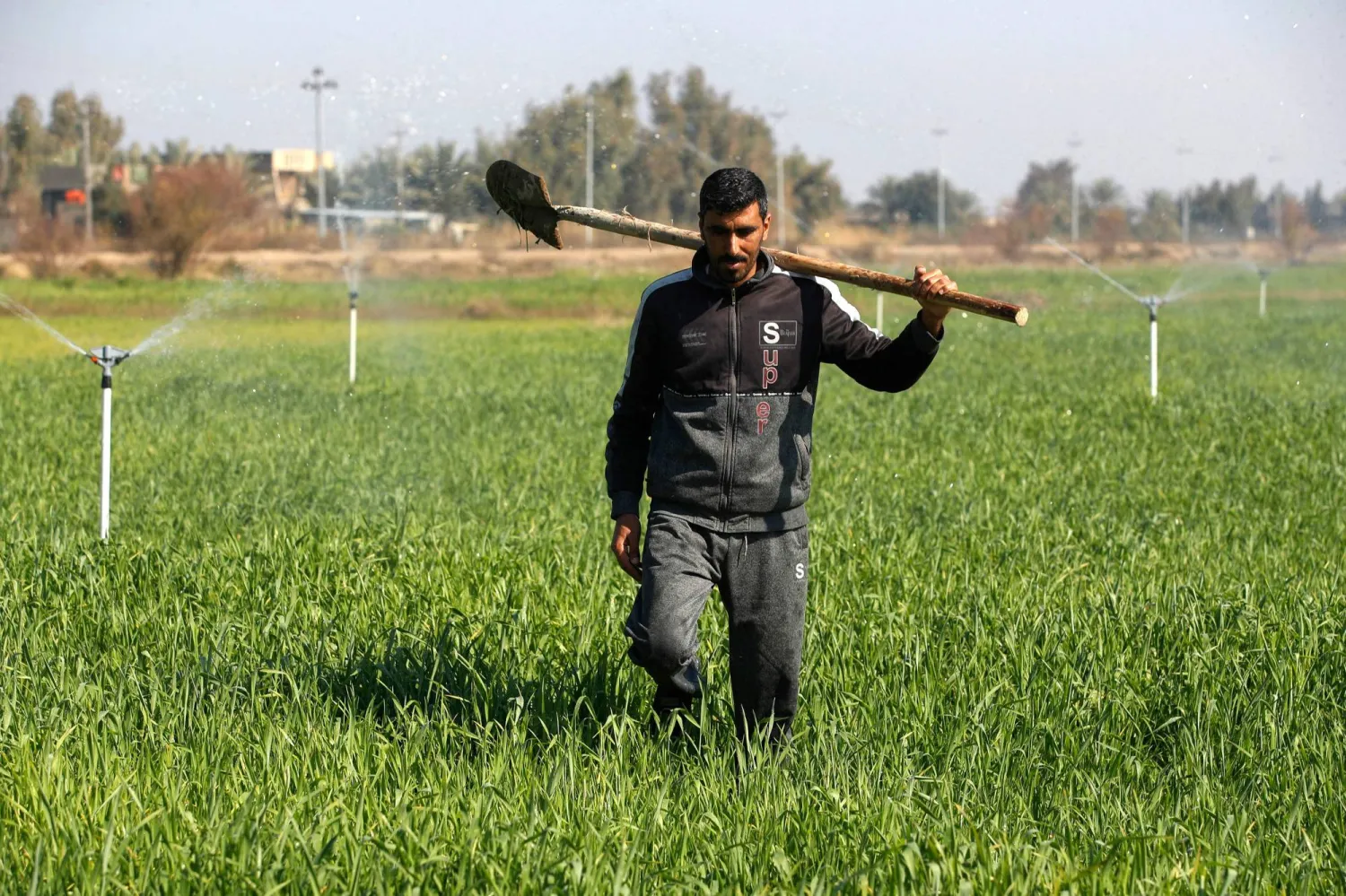

Sprinklers and Drip Irrigation Help Iraqis Beat Drought

A farmer walks next to sprinklers, part of a new water management systems brought by the UN World Food Programme, on his farm in the village of al-Azrakiya, in Iraq's central province of Anbar, on February 22, 2024. (Photo by AHMAD AL-RUBAYE / AFP)
TT

Sprinklers and Drip Irrigation Help Iraqis Beat Drought

A farmer walks next to sprinklers, part of a new water management systems brought by the UN World Food Programme, on his farm in the village of al-Azrakiya, in Iraq's central province of Anbar, on February 22, 2024. (Photo by AHMAD AL-RUBAYE / AFP)

After four years of drought, Iraqi farmer Mohammed Sami was about to abandon his father's parched land, but then a water-saving irrigation system revived his crops and his hopes.

He is among hundreds of farmers in the country battered by heatwaves, scarce rain and depleted rivers to benefit from new water management systems brought by the UN World Food Program, Agence France Presse reported.

The systems use automated sprinklers and drip irrigation to ensure scarce water is used in the most efficient way and is not lost as run-off or evaporated under the blazing sun.

"Since 2019, due to the water scarcity, we have been unable to farm the land," said 38-year-old Sami in his village of Al-Azrakiya in the central province of Anbar.

Crushed by the drought that was turning his 10 donums, or about one hectare, of land into desert, Sami started working in a nearby city as a day laborer several years ago.

"I thought about giving up farming for good," he said.

But then, two years ago, Sami's prospects changed, and his land has flourished again.

The WFP helped with a new automated irrigation system that waters his field for just two hours per day, two to three days a week.

"I now irrigate 10 donums with the same amount of water that I used for one donum before," he said, adding that his wheat harvest had shot up from seven to 12 tons per year.

Last year the WFP project helped more than 1,100 farmers "in areas most affected by climate change and drought," said Khansae Ghazi from the UN agency's Baghdad office.

The new irrigation systems "use 70 percent less water than traditional methods such as flooding" -- the vastly more wasteful method used for millennia.

The modern techniques allow farmers to grow diverse crops year-round, also including barley, cucumber, watermelon and eggplant, and reduce "the reliance on unpredictable rainfall", the WFP said.

- Land of Two Rivers -

Iraq, still recovering from years of war and chaos, is one of the five countries most impacted by some effects of climate change, according to the United Nations.

The site of ancient Mesopotamia, where civilizations flourished on the banks of the mighty Tigris and Euphrates rivers, Iraq now endures extreme water scarcity, worsened by upstream river dams in Iran and Turkey.

"Iraq is the Land of Two Rivers, its more than 7,000-year-old civilization has always relied on farming," said agriculture ministry spokesman Mohammed al-Khazai.

"For decades, the country was afflicted by floods, not drought."

But as rainfall has become more irregular and water more scarce, leaving aquifers depleted, many farmers have abandoned their plots in the new dust-bowl regions.

During the 2021-22 season, the farm sector's productivity plunged by 36 percent from the previous year, said the WFP.

State authorities have restricted water use for agriculture to ensure sufficient drinking water for Iraq's 43 million people.

To fight the problem, the ministry has also started offering sprinkler systems that farmers can pay off over a decade, with the state covering 30 percent of the cost.

"At first, it was difficult for the farmer to switch to modern irrigation," said Khazai.

But now the ministry hopes to boost harvests to more than six million tons of wheat in 2024, from five million last year.

This would exceed Iraq's domestic needs and present a big jump from around two million tons in 2022.

The UN agency warns there are limits to the gains brought by new techniques.

"While modern irrigation systems can significantly improve water efficiency and agricultural practices in Iraq, it may not be sufficient to tackle the complex issue of drought," it said.

But for now, farmers are happy with the gains they are seeing, among them Souad Mehdi in the village of Al-Azrakiya near the Euphrates, who said she has doubled her harvest.

The 40-year-old grows wheat and barley in the winter and corn, tomatoes and eggplant in the summer on her one-hectare plot.

"It used to take us two days to water our crops," she said. Now, she fills a basin with river water then turns on the sprinklers, a task that "doesn't take more than two hours.”



Power Restored to Thousands of Berlin Households After Attack on Lines Causes Several-Day Outage

A person with a candle stands at the window during a power outage in southwest Berlin, Germany, 05 January 2026. (EPA)
TT

Power Restored to Thousands of Berlin Households After Attack on Lines Causes Several-Day Outage

A person with a candle stands at the window during a power outage in southwest Berlin, Germany, 05 January 2026. (EPA)

Power was being restored on Wednesday to thousands of households in Berlin that had been without electricity in freezing temperatures for four days following a suspected far-left attack on high-voltage lines, authorities said.

About 45,000 households and 2,200 businesses lost their supply on Saturday morning after a fire on a bridge that carries high-voltage cables over the Teltow Canal, in the southwest of the German capital, affecting an estimated 100,000 people.

Authorities were able gradually to reconnect many to the network, but several days of work were required to repair the damage. Some 25,500 households and 1,200 businesses were still without power on Tuesday, largely in the prosperous Zehlendorf district.

It was the longest blackout in the city since the end of World War II.

Berlin's power network operator said service was gradually being restored Wednesday to all remaining households, German news agency dpa reported.

Investigators have focused on a written claim of responsibility by a far-left group, headlined “Turning off the juice to the rulers,” which said a gas-fired power plant in Berlin's Lichterfelde district had been “successfully sabotaged.” It claimed that the aim of the action was to strike the fossil-fuel energy industry, not to cause power outages.

Germany's domestic intelligence agency said self-styled “Volcano Groups” have been carrying out attacks on infrastructure in Berlin and the surrounding state of Brandenburg since 2011. A 2024 attack on a pylon that supplies a Tesla factory near Berlin temporarily halted production.


Nostalgia and New Fans as Tamagotchi Turns 30

More than 100 million of the pocket-sized plastic eggs have been sold worldwide since their debut three decades ago. (AFP)
TT

Nostalgia and New Fans as Tamagotchi Turns 30

More than 100 million of the pocket-sized plastic eggs have been sold worldwide since their debut three decades ago. (AFP)

Japan's Tamagotchi toys were a 1990s playground craze and the virtual pets that demand food and attention are still a hit among retro-loving Gen Z and nostalgic parents.

More than 100 million of the pocket-sized plastic eggs have been sold worldwide since their debut, manufacturer Bandai Namco says.

The company is showing off the Tamagotchi's evolution from bouncing black-and-white pixelated characters to color screens and wifi connectivity at a special 30th anniversary exhibition that opens in Tokyo on Wednesday.

Swinging from keychains, the Tamagotchi -- whose name is a portmanteau of the Japanese words for "egg" and "watch" -- has become a popular fashion accessory among young people in recent years, according to Bandai.

Sales of Tamagotchi merchandise, not including video games, rose around sevenfold in five years from 2019, it says.

Rafaela Miranda Freire, a 15-year-old Brazilian tourist visiting Tokyo's Harajuku shopping district with her mother, told AFP she didn't own a Tamagotchi but liked the idea.

"It's really nostalgic and cute. Like some 2000s cute aesthetic," she said, admitting that some people her age "just don't like it or think it's childish".

But old-school toys can be a healthy alternative to social media, Freire said.

"It's good. You just get off the phone and appreciate the small things in life."

- Top toy -

Last year British retailer Hamleys ranked the Tamagotchi in its list of the top 100 toys of all time, alongside the likes of Lego and the Rubik's Cube.

The digital pets, which need attending to when they are hungry, sick or have defecated on the virtual floor, grow up as users care for them -- but can die if they are neglected.

Entering the exhibition through a giant white egg, visitors can view various photo-friendly displays and a history room where they can play with some of the dozens of different models released over the years.

Nearly half of all Tamagotchi unit sales were in Japan, with 33 percent in the Americas but just two percent in other Asia-Pacific countries, Bandai Namco says.

Harajuku shopper Yumeho Akita, 25, told AFP she had good memories of raising her Tamagotchi for several months during her childhood.

"I really wanted one, and I finally got one, so I cherished it and raised the character very carefully," she recalled.

And some parents say they want their children to experience the same.

US screenwriter Justin Piasecki, on holiday in Japan, told AFP he had recently bought Tamagotchis for Christmas for his two daughters, aged four and six.

"They basically have a computer science degree in Tamagotchi at this point," the 41-year-old told AFP. "I thought I would need to show them how to do it, but now they're showing me."


'Magical' Blue Flower Changing Farmers' Fortunes in India

The butterfly pea grows wild across India. (Shutterstock)  
TT

'Magical' Blue Flower Changing Farmers' Fortunes in India

The butterfly pea grows wild across India. (Shutterstock)  

“Until a few years ago, the butterfly pea flower was just another climbing plant in my village,” said Nilam Brahma who lives in Anthaigwlao, a village in the northeastern Indian state of Assam.

Butterfly pea, also known as aparajita in India, grows as a vine and has a striking blue flower.

Around two years ago, Brahma heard that local women were making money selling the flowers, which can be made into tea, or a blue dye, according to BBC.

She decided to join them.

“The results surprised even me. The first time I earned $50 from selling dried flowers, I felt a shock. It made me believe I could control my own future,” she said.

The experiment led to a small business.

“I applied for a small loan and invested in solar dryers. The machines helped me dry flowers faster, preserve their color, and meet the quality standards demanded by buyers,” Brahma added.

Thailand and Indonesia have been the leading growers and consumers of butterfly pea flowers. But there's growing global demand for the flower, which is attracting entrepreneurs in India.

“The global demand for natural colorants is exploding,” explained Varshika Reddy, the founder of THS Impex, which exports natural dyes and additives.

Behind that demand is consumer appetite for natural ingredients and tighter controls in the US and Europe on synthetic food dyes.

In 2021, the US Food and Drug Administration (FDA) approved butterfly pea flower as a food additive.

However, in 2022 the European Food Safety Authority (EFSA) raised safety concerns about using the flower.

Both the EU and the UK classify butterfly pea flower as a "novel" food, meaning it still needs approval for widespread use.

Nevertheless, Indian entrepreneurs still see potential and want to develop India's market.

“The crop is still seen as a backyard ornamental or medicinal plant rather than a commercial commodity,” said Reddy. “There is no structured market awareness, no government classification, and no standard pricing mechanism, making farmers uncertain about returns.”

She is working with farmers to raise production standards.

“We work with a dedicated cluster of farmers and their families in Uttar Pradesh, including a significant number of women farmers. We have established formal contracts... we provide comprehensive agronomy support, including guidance on best farming practices, irrigation management, and crop-specific techniques,” Reddy said.

Others in India have spotted the commercial opportunity.

“When you infuse the flower in hot water, it turns blue, and when you squeeze lemon into it, it turns purple. That felt magical,” said Nitesh Singh, who is based just outside Delhi.

Like Reddy, he thought that the flower had much more potential in India.

“It was here for thousands of years, but nobody knew it could become clean, healthy food,” Singh added.