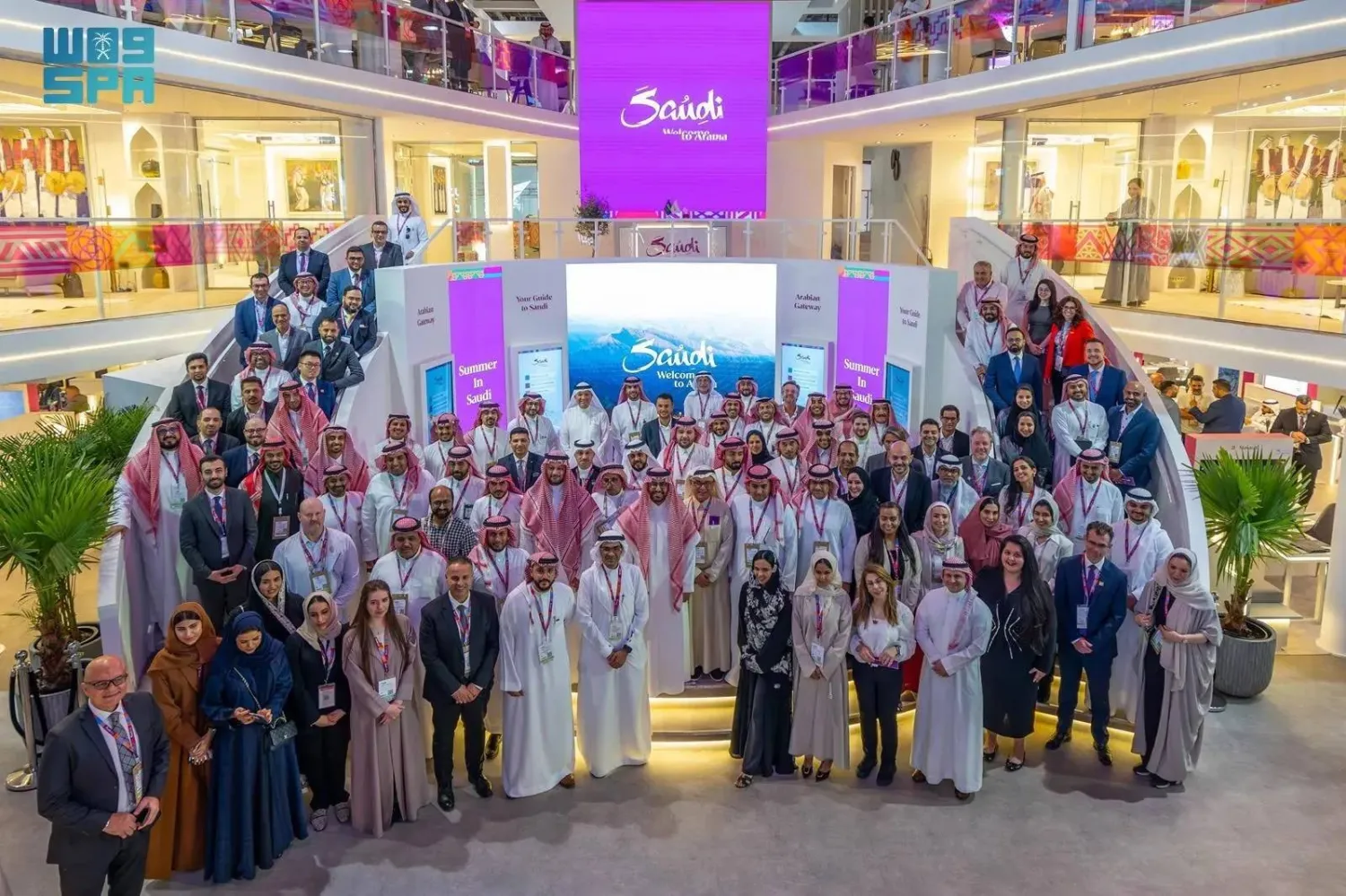
Saudi Showcases Spectacular Summer Escape at Arabia Travel Market 2024

The Saudi Tourism Authority (STA) marked the start of this year’s Arabian Travel Market (ATM) by showcasing the Kingdom’s spectacular summer destinations. (SPA)
TT

Saudi Showcases Spectacular Summer Escape at Arabia Travel Market 2024

The Saudi Tourism Authority (STA) marked the start of this year’s Arabian Travel Market (ATM) by showcasing the Kingdom’s spectacular summer destinations. (SPA)

The Saudi Tourism Authority (STA) marked the start of this year’s Arabian Travel Market (ATM) by showcasing the Kingdom’s spectacular summer destinations to trade partners as the country’s tourism sector continues to go from strength to strength, said the Saudi Press Agency on Tuesday.
Representatives from Saudi Arabia’s booming tourism ecosystem kicked-off the Middle East’s biggest travel and tourism trade show aiming to build awareness of the kingdom’s unique and diverse summer destination offerings, strengthen and establish new trade partnerships, and celebrate the remarkable year-on-year growth of the Saudi tourism sector.
STA chief executive and board member Fahd Hamidaddin is leading the Saudi delegation of 72 partners from across the tourism sector -- including top destination management companies, hoteliers, and airlines -- to the show that was held in Dubai.
The delegation is aiming to showcase the Kingdom’s distinctive summer destinations to trade partners and consumers in the Gulf Cooperation Council (GCC) region and underline its status as a world-leading year-round tourism destination, with a strategic focus on priority markets like India and China.
Over the summer season, Saudi Arabia offers a unique and diverse range of activities and destinations for visitors, including young families, ranging from the pristine beaches of the Red Sea, the rich culture of Jeddah, and an events program like no other, including the Esports World Cup starting in Riyadh this July.
Saudi’s mountainous regions including the tranquil and picturesque destinations of Aseer, Taif, and Al Baha also provide a refreshing escape during the summer season with temperatures in the low 20s Celsius. These serene retreats are ideal for adventure travelers who seek natural beauty, wildlife, hiking trails, and cool breezes.
"We’re delighted to be back at ATM this year to showcase Saudi as a unique summer destination, offering an action-packed events calendar, cool mountain regions for adventure seekers, and pristine beaches for families and those looking to relax,” STA’s Hamidaddin said.
“The MEA and APAC markets are hugely important in our overarching tourism strategy with a combined 23 million visits last year, and we will be focusing on growing those numbers,” Hamidaddin said.
“Having welcomed over 100m million tourists in 2023, Saudi is the land of now -- offering growth and opportunities like no other to trade partners across the globe. And over the coming days, we look forward to building new long-lasting partnerships, sharing knowledge, and showcasing the wealth of opportunities Saudi has to offer,” Hamidaddin said.
Building on the success of last year’s presence at ATM, where over 50,000 visitors were welcomed at the Saudi stand, this year’s exhibit is set across three floors with partners showcasing hundreds of affordable and luxury bookable products for destinations such as Jeddah, AlUla, Aseer, Riyadh, and the Red Sea.
At ATM, visitors can race a bike through the mountains of Aseer on a virtual simulator, download specially curated Saudi Summer playlists in partnership with Anghami, see an array of football memorabilia at the Saudi Pro League Museum, enjoy live performances of traditional Saudi dancers, and view digital art displays from local artists. The diversity of the Kingdom will also be showcased with an interactive Saudi map and activities calendar.
The stand also showcases the new “Saudi Rewards” scheme, a first-of-its-kind program, offering free nationwide rewards for citizens and visitors to unlock points on tourism, shopping, dining, entertainment, and more. Saudi Rewards currently has a network of 17 partners and will have a dedicated booth at ATM with interactive activations for visitors to enjoy.
On the first day of the event, Hamidaddin participated in a flagship panel event alongside other tourism leaders from the GCC to discuss collaboration and Saudi Arabia’s role in the region’s growing tourism sector.
Popular UAE radio station Dubai Eye also broadcast their afternoon show live from the Saudi booth where they discussed the Kingdom’s summer offering, while trailblazing Indian influencer Masoom Minawala Mehta and world-famous travel influencer brothers, Wael and Nael Abualteen, were on the stand creating content for their social channels.
STA and its partners are aiming to build on the successes of last year’s ATM, where more than 1,600 deals and more than 50 MoUs and strategic agreements were signed – resulting in 35,000 extra visits.
The Kingdom presents trade partners with an unparalleled opportunity for sustained growth. Notably, the country achieved a significant milestone by welcoming 100 million tourists in 2023. Together with partners, STA is building knowledge of Saudi’s destination offerings to consumers to address barriers to destination knowledge and welcome more visitors than ever to the Kingdom.
This boom is continuing in 2024, with the first quarter of the year witnessing a double-digit growth increase in tourists compared to the same period last year -- bolstering Saudi Arabia’s position as a leading global tourism destination and driving progress towards its revised target of 150 million visits by 2030.



'Secret Highway' to Mars Could Cut Journey Time to 153 Days

Chance may lead us to the shortest paths in space as well. (Shutterstock)
TT

'Secret Highway' to Mars Could Cut Journey Time to 153 Days

Chance may lead us to the shortest paths in space as well. (Shutterstock)

Astronomers have identified a new space corridor that could cut hundreds of days from the journey to Mars by taking advantage of a natural route followed by some asteroids as they travel between planets.

The distance between Earth and Mars constantly changes depending on their positions and orbital speeds around the Sun. It reaches its shortest point when Earth lies directly between the Sun and the Red Planet, a phenomenon known as “Mars opposition,” which occurs roughly every 26 months.

Even so, reaching Mars currently takes between seven and 10 months, even using the fastest spacecraft available. But the newly identified space corridor, which opens during periods when the two planets are relatively close, could reduce the total mission time to just 153 days.

Space agencies typically plan planetary missions by analyzing planetary orbital data to determine optimal flight paths and fuel requirements. However, this newly identified corridor was discovered through the study of asteroid orbital data instead.

Astronomers explored whether asteroid trajectories could reveal hidden shortcuts through space, focusing on asteroid 2001 CA21, which is believed to cross the orbital paths of both Earth and Mars.

Researchers analyzed the asteroid’s close approaches to Mars, a trajectory that could allow spacecraft to follow a more direct route to the Red Planet. They also examined Mars opposition windows in 2027, 2029, and 2031 to determine which offered the best conditions for a shorter journey.

The study found that 2031 is the only year in which the geometry of Earth and Mars aligns favorably with the asteroid’s orbital plane, making the rapid route possible.

The researchers said in the study, published in Acta Astronautica and cited by The Independent: “The 2031 Mars opposition supports two complete round-trip missions in less than one year while aligning with the orbital plane associated with asteroid CA21, demonstrating how small-body orbital data can help identify rapid interplanetary transfer opportunities at an early stage.”

They added: “This study presents an innovative engineering methodology for designing rapid interplanetary missions.”

The research team hopes future studies into the orbital dynamics of near-Earth asteroids will contribute to developing faster and more efficient designs for interplanetary space travel.


Study Shows How Potato-based Diet Changed Genetics of Andean People

FILE PHOTO: A woman sells potatoes at La Parada market in La Victoria district of Lima, Peru, June 14, 2017. REUTERS/Mariana Bazo/File Photo
TT

Study Shows How Potato-based Diet Changed Genetics of Andean People

FILE PHOTO: A woman sells potatoes at La Parada market in La Victoria district of Lima, Peru, June 14, 2017. REUTERS/Mariana Bazo/File Photo

Indigenous people in the Andes domesticated the potato - a great source of starch, vitamins, minerals and fiber - 6,000 to 10,000 years ago, making this tuber a central part of their diet.

These people then experienced genetic adaptations beneficial for such a diet that are still seen in their descendants living in Peru.

New genomic research documents how these descendants - speakers of the Quechua language of the once-great Inca Empire - underwent fortification involving a gene called AMY1 that is involved in starch digestion, a function useful for people with a potato-centric diet.

The study found that these people possess an average of 10 copies of AMY1 - two to four more than most people. No other known population globally exceeds that number. According to Reuters, the study also showed that the onset of these genetic changes in this population coincided with the advent of potato domestication.

"It is a wonderful case of culture shaping biology," said evolutionary and anthropological geneticist Omer Gokcumen of the University at Buffalo, one of the senior ⁠authors of the ⁠research published this week in the journal Nature Communications.

"This highlights the importance of dietary adaptation in human evolutionary history, with implications for metabolism, health and the impact of domestication events on human biology," said UCLA anthropological geneticist Abigail Bigham, also one of the study's senior authors.

At the molecular level, AMY1 governs an enzyme called amylase that is present in saliva and is responsible for breaking down starch in the mouth when a person eats starchy foods. A person with more copies of the gene may produce more of the enzyme.

This greater dosage, the researchers said, may facilitate better metabolism of ⁠high-starch diets. Amylase may also be involved in regulating the microbiome - the body's natural collection of microbes - which can shift with dietary change.

Lactose tolerance is another example of diet-driven evolutionary adaptation, involving a gene related to an enzyme that breaks down lactose in milk.

In the new study, the researchers analyzed genomic data spanning more than 3,700 people across 85 populations in the Americas, Europe, Africa and Asia, including 81 native Quechua speakers of Andean ancestry in Peru.

The researchers said it appears that over time evolutionary forces favored extra copies of AMY1 in the ancient Andeans.

In order to become widespread, a genetic variant may provide some advantage.

"Therefore, one hypothesis is that people with more copies of AMY1 may have been better able to process starch-rich foods, including potatoes," University at Buffalo doctoral student and study co-lead author Luane Landau said.

"Individuals who were born with the higher copies of AMY1 may have had an ⁠advantage as compared to ⁠individuals who did not have it, and left more descendants over generations.

Over time, this could explain why the genetic version linked to high AMY1 copy number became more common in Andean populations today," Landau said.

Potatoes represented a reliable food source - a crop that thrived at the high altitudes these people inhabited.

"They were one of the main sources for calories in the ancient Andean diet," University at Buffalo doctoral student and study co-lead author Kendra Scheer said.

Potatoes were at the heart of the Inca food supply. They were brought to Europe and the rest of the world following the Spanish conquest of the Inca Empire in the 16th century.

"Their global culinary spread is a testament to their broad likeability," Bigham said.

At markets in the Andean highlands and elsewhere in Peru, Quechua speakers sell a wide variety of potatoes, with flesh of various colors including purple, blue, red, gold, white and even black.

"In Peru, there are about 3,000 to 4,000 different kinds of potato, but the majority of the world has access to only a select few strains. Therefore, there is a whole world of different types of French fries that are possible," Scheer said.


Court Rules in ‘Sunbed War,’ Towels Lose

A pool with sunbeds at a luxury resort (Shutterstock)
TT

Court Rules in ‘Sunbed War,’ Towels Lose

A pool with sunbeds at a luxury resort (Shutterstock)

A German tourist has won a payout of more than €900 (£850) after he was unable to secure a sun lounger due to other guests reserving them with towels, according to BBC.

The man, who has not been identified, was on holiday in Greece with his family in 2024, and said he spent 20 minutes a day trying to find a sun lounger, despite waking up at 06:00.

He then sued his tour operator for allowing the reservation system, arguing the sunbeds were reserved so often, they were unusable.

Judges at a district court in Hanover ruled in his favor, and said the family of four were entitled to a larger refund on their package holiday as it had been “defective.”

The man had initially paid €7,186 (£6,211) to take his wife and their two children on the package holiday to Kos, an island in Greece.

In his arguments to court, he said that his tour operator had failed to enforce the resort's ban on towel reserving, and did not confront guests who were engaging in the practice.

He added that even when his family rose at 06:00, loungers were unavailable, and his children were forced to lie on the floor.

Though the tour operator had initially paid out a refund of €350 (£302), judges in Hanover ruled the family was entitled to a refund of €986.70 (£852.89).

They said that although the travel company did not run the hotel and could not ensure every customer could access a sunbed at any given time, the operator did have an obligation to make sure there was an organizational structure that would guarantee a “reasonable” ratio of sunbeds to guests.

Many tourists will have encountered “sunbed wars” or “dawn dash” on holiday, which is the practice of reserving loungers with towels.