


'Danger Behind the Beauty': More Solar Storms Could Be Heading our Way

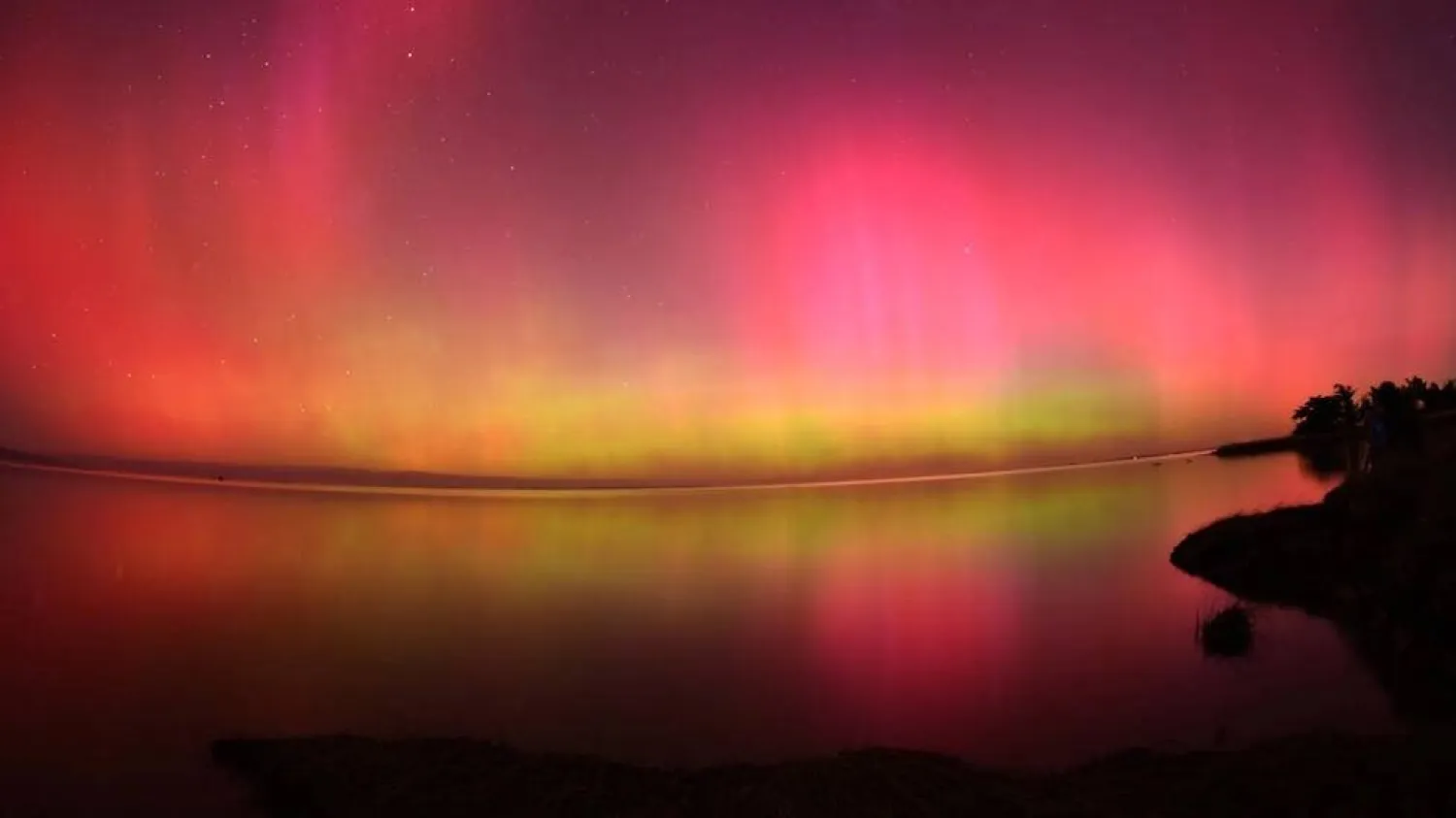
Auroras may be pretty, but the solar storms that cause them can cause serious havoc on Earth, scientists have warned. Sanka Vidanagama / AFP/File
TT

'Danger Behind the Beauty': More Solar Storms Could Be Heading our Way

Auroras may be pretty, but the solar storms that cause them can cause serious havoc on Earth, scientists have warned. Sanka Vidanagama / AFP/File

Tourists normally have to pay big money and brave cold climates for a chance to see an aurora, but last weekend many people around the world simply had to look up to see these colorful displays dance across the sky.
Usually banished to the poles of Earth, the auroras strayed as far as Mexico, southern Europe and South Africa on the evening of May 10, delighting skygazers and filling social media with images of exuberant pinks, greens and purples.
But for those charged with protecting Earth from powerful solar storms such as the one that caused the auroras, a threat lurks beneath the stunning colors.
"We need to understand that behind this beauty, there is danger," Quentin Verspieren, the European Space Agency's space safety program coordinator, told AFP.
Mike Bettwy of the US Space Weather Prediction Center said that "we're focused on the more sinister potential impacts" of solar storms, such as taking out power grids and satellites, or exposing astronauts to dangerous levels of radiation.
The latest auroras were caused by the most powerful geomagnetic storm since the "Halloween Storms" of October 2003, which sparked blackouts in Sweden and damaged power infrastructure in South Africa.

There appears to have been less damage from the latest solar storms, though it often takes weeks for satellite companies to reveal problems, Bettwy said.
There were reports that some self-driving farm tractors in the United States stopped in their tracks when their GPS guidance systems went out due to the storm, he told AFP.
'Definitely not over'
These strange effects are caused by massive explosions on the surface of the Sun that shoot out plasma, radiation and even magnetic fields at incredibly fast speeds born on the solar wind.
The recent activity has come from a sunspot cluster 17 times the size of Earth which has continued raging over the week. On Tuesday it blasted out the strongest solar flare seen in years.
The sunspot has been turning towards the edge of the Sun's disc, so activity is expected to die down in the short term as its outbursts aim away from our planet.
But in roughly two weeks the sunspot will swing back around, again turning its gaze towards Earth.
In the meantime, another sunspot is "coming into view right now" which could trigger "major activity in the coming days", ESA space weather service coordinator Alexi Glover told AFP.
So the solar activity is "definitely not over", she added.
It is difficult to predict how violent these sunspots could be -- or whether they could spark further auroras.
But solar activity is only just approaching the peak of its roughly 11-year cycle, so the odds of another major storm are highest "between now and the end of next year", Bettwy said.
What threat do solar storms pose?
Geomagnetic storms such as the recent one create a magnetic charge of voltage and current, "essentially overloading" things like satellites and power grids, according to Bettwy.
The most famous example came in 1859 during the worst solar storm in recorded history, called the Carrington Event.
As well as stunning auroras, the storm caused sparks to fly off of telegraph stations. The charge that originated from the Sun was so strong that some telegraphs worked without being plugged into a power source.
So what would happen if such a powerful geomagnetic storm struck Earth again?
Bettwy said most countries have improved their power grids, which should prevent prolonged outages like those that hit Sweden in 2003 or Canada in 1989.
Still, he suggested people have an emergency kit in case electricity is knocked out for a day or two. Fresh water might also help in case filtration plants go offline.
Astronauts are particularly at risk from radiation during extreme solar activity. Those on the International Space Station usually take the best shelter they can when a bad storm is expected.
Bettwy said a massive solar storm could expose astronauts to an "unhealthy dose" of radiation, but he did not think it would be lethal.
Emphasizing that he did not want to "instill fear", Bettwy added that radiation can also potentially "get through the fuselage" of planes flying near the north pole.
Airlines sometimes change routes during extreme solar storms to avoid this happening, he added.
Several upcoming missions are expected to improve forecasting of the Sun's intense and unpredictable weather, aiming to give Earth more time to prepare.



Coffee Regions Hit by Extra Days of Extreme Heat, Say Scientists 

17 April 2012, North Rhine-Westphalia, Vluyn: A general view of Arabica Coffee beans. (dpa)
TT

Coffee Regions Hit by Extra Days of Extreme Heat, Say Scientists 

17 April 2012, North Rhine-Westphalia, Vluyn: A general view of Arabica Coffee beans. (dpa)

The world's main coffee-growing regions are roasting under additional days of climate change-driven heat every year, threatening harvests and contributing to higher prices, researchers said Wednesday.

An analysis found that there were 47 extra days of harmful heat per year on average in 25 countries representing nearly all global coffee production between 2021 and 2025, according to independent research group Climate Central.

Brazil, Vietnam, Colombia, Ethiopia and Indonesia -- which supply 75 percent of the world's coffee -- experienced on average 57 additional days of temperatures exceeding the threshold of 30C.

"Climate change is coming for our coffee. Nearly every major coffee-producing country is now experiencing more days of extreme heat that can harm coffee plants, reduce yields, and affect quality," said Kristina Dahl, Climate Central's vice president for science.

"In time, these impacts may ripple outward from farms to consumers, right into the quality and cost of your daily brew," Dahl said in a statement.

US tariffs on imports from Brazil, which supplies a third of coffee consumed in the United States, contributed to higher prices this past year, Climate Central said.

But extreme weather in the world's coffee-growing regions is "at least partly to blame" for the recent surge in prices, it added.

Coffee cultivation needs optimal temperatures and rainfall to thrive.

Temperatures above 30C are "extremely harmful" to arabica coffee plants and "suboptimal" for the robusta variety, Climate Central said. Those two plant species produce the majority of the global coffee supply.

For its analysis, Climate Central estimated how many days each year would have stayed below 30C in a world without carbon pollution but instead exceeded that level in reality -- revealing the number of hot days added by climate change.

The last three years have been the hottest on record, according to climate monitors.


Dog Gives Olympics Organizers Paws for Thought

A dog wanders on the ski trail during the women's team cross country free sprint qualification event of the Milano Cortina 2026 Winter Olympic Games at Tesero Cross-Country Skiing Stadium in Lago di Tesero (Val di Fiemme), on February 18, 2026. (Photo by Anne-Christine POUJOULAT / AFP)
TT

Dog Gives Olympics Organizers Paws for Thought

A dog wanders on the ski trail during the women's team cross country free sprint qualification event of the Milano Cortina 2026 Winter Olympic Games at Tesero Cross-Country Skiing Stadium in Lago di Tesero (Val di Fiemme), on February 18, 2026. (Photo by Anne-Christine POUJOULAT / AFP)

A dog decided he would bid for an unlikely Olympic medal on Wednesday as he joined the women's cross country team free sprint in the Milan-Cortina Games.

The dog ran onto the piste in Tesero in northern Italy and gamely, even without skis, ran behind two of the competitors, Greece's Konstantina Charalampidou and Tena Hadzic of Croatia.

He crossed the finishing line, his moment of glory curtailed as he was collared by the organizers and led away -- his owner no doubt will have a bone to pick with him when they are reunited.


Olives, Opera and a Climate-Neutral Goal: How a Mural in Greece Won ‘Best in the World’ 

A building with the mural entitled “Kalamata” depicting opera legend Maria Callas by artist Kleomenis Kostopoulos is seen in Kalamata town, about 240 kilometers (150 miles) southwest of Athens, Monday, Feb. 9, 2026. (AP) 
TT

Olives, Opera and a Climate-Neutral Goal: How a Mural in Greece Won ‘Best in the World’ 

A building with the mural entitled “Kalamata” depicting opera legend Maria Callas by artist Kleomenis Kostopoulos is seen in Kalamata town, about 240 kilometers (150 miles) southwest of Athens, Monday, Feb. 9, 2026. (AP) 

Long known for its olives and seaside charm, the southern Greek city of Kalamata has found itself in the spotlight thanks to a towering mural that reimagines legendary soprano Maria Callas as an allegory for the city itself.

The massive artwork on the side of a prominent building in the city center has been named 2025’s “Best Mural of the World” by Street Art Cities, a global platform celebrating street art.

Residents of Kalamata, approximately 240 kilometers (150 miles) southwest of Athens, cultivate the world-renowned olives, figs and grapes that feature prominently on the mural.

That was precisely the point.

Vassilis Papaefstathiou, deputy mayor of strategic planning and climate neutrality, explained Kalamata is one of the few Greek cities with the ambitious goal of becoming climate-neutral by 2030. He and other city leaders wanted a way to make abstract concepts, including sustainable development, agri-food initiatives, and local economic growth, more tangible for the city’s nearly 73,000 residents.

That’s how the idea of a massive mural in a public space was born.

“We wanted it to reflect a very clear and distinct message of what sustainable development means for a regional city such as Kalamata,” Papaefstathiou said. “We wanted to create an image that combines the humble products of the land, such as olives and olive oil — which, let’s be honest, are famous all over the world and have put Kalamata on the map — with the high-level art.”

“By bringing together what is very elevated with ... the humbleness of the land, our aim was to empower the people and, in doing so, strengthen their identity. We want them to be proud to be Kalamatians.”

Southern Greece has faced heatwaves, droughts and wildfires in recent years, all of which affect the olive groves on which the region’s economy is hugely dependent.

The image chosen to represent the city was Maria Callas, widely hailed as one of the greatest opera singers of the 20th century and revered in Greece as a national cultural symbol. She may have been born in New York to Greek immigrant parents, but her father came from a village south of Kalamata. For locals, she is one of their own.

This connection is also reflected in practice: the alumni association at Kalamata’s music school is named for Callas, and the cultural center houses an exhibition dedicated to her, which includes letters from her personal archive.

Artist Kleomenis Kostopoulos, 52, said the mural “is not actually called ‘Maria Callas,’ but ‘Kalamata’ and my attempt was to paint Kalamata (the city) allegorically.”

Rather than portraying a stylized image of the diva, Kostopoulos said he aimed for a more grounded and human depiction. He incorporated elements that connect the people to their land: tree branches — which he considers the above-ground extension of roots — birds native to the area, and the well-known agricultural products.

“The dress I create on Maria Callas in ‘Kalamata’ is essentially all of this, all of this bloom, all of this fruition,” he said. “The blessed land that Kalamata itself has ... is where all of these elements of nature come from.”

Creating the mural was no small feat. Kostopoulos said it took around two weeks of actual work spread over a month due to bad weather. He primarily used brushes but also incorporated spray paint and a cherry-picker to reach all edges of the massive wall.

Papaefstathiou, the deputy mayor, said the mural has become a focal point.

“We believe this mural has helped us significantly in many ways, including in strengthening the city’s promotion as a tourist destination,” he said.

Beyond tourism, the mural has sparked conversations about art in public spaces. More building owners in Kalamata have already expressed interest in hosting murals.

“All of us — residents, and I personally — feel immense pride,” said tourism educator Dimitra Kourmouli.

Kostopoulos said he hopes the award will have a wider impact on the art community and make public art more visible in Greece.

“We see that such modern interventions in public space bring tremendous cultural, social, educational and economic benefits to a place,” he said. “These are good springboards to start nice conversations that I hope someday will happen in our country, as well.”