


Panama Prepares to Evacuate First Island in Face of Rising Sea Level

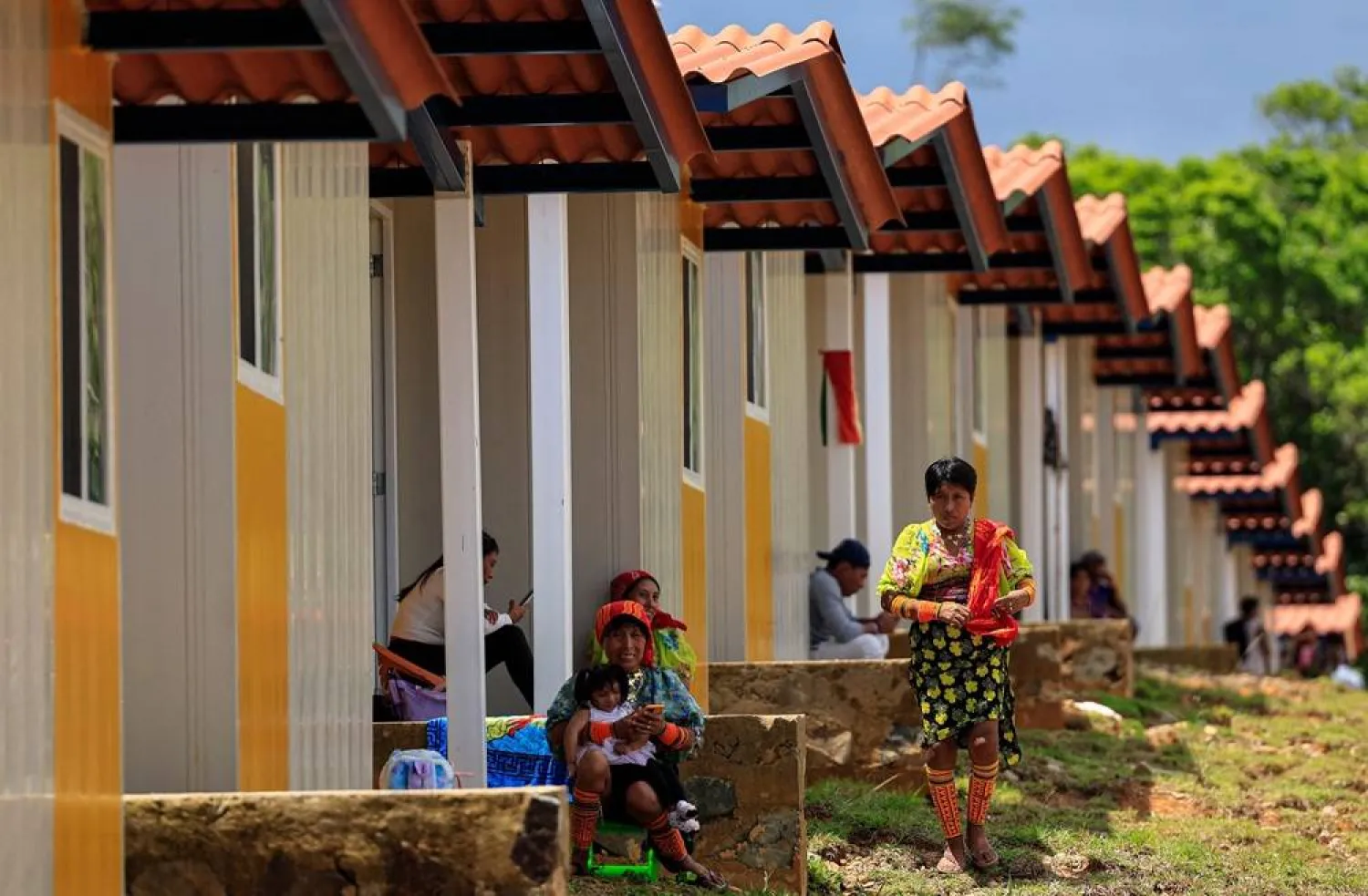
Indigenous Gunas sit outside their new homes in Nuevo Carti, Guna Yala Comarca, on the Caribbean coast in mainland Panama, on May 29, 2024. (AFP)
TT

Panama Prepares to Evacuate First Island in Face of Rising Sea Level

Indigenous Gunas sit outside their new homes in Nuevo Carti, Guna Yala Comarca, on the Caribbean coast in mainland Panama, on May 29, 2024. (AFP)

On a tiny island off Panama’s Caribbean coast, about 300 families are packing their belongings in preparation for a dramatic change. Generations of Gunas who have grown up on Gardi Sugdub in a life dedicated to the sea and tourism will trade that next week for the mainland’s solid ground.

They go voluntarily — sort of.

The Gunas of Gardi Sugdub are the first of 63 communities along Panama’s Caribbean and Pacific coasts that government officials and scientists expect to be forced to relocate by rising sea levels in the coming decades.

On a recent day, the island’s Indigenous residents rowed or sputtered off with outboard motors to fish. Children, some in uniforms and others in the colorful local textiles called "molas," chattered as they hustled through the warren of narrow dirt streets on their way to school.

"We’re a little sad, because we’re going to leave behind the homes we’ve known all our lives, the relationship with the sea, where we fish, where we bathe and where the tourists come, but the sea is sinking the island little by little," said Nadín Morales, 24, who prepared to move with her mother, uncle and boyfriend.

Gardi Sugdub is one of about 50 populated islands in the archipelago of the Guna Yala territory. It is only about 400 yards (366 meters) long and 150 yards (137 meters) wide. From above, it’s roughly a prickly oval surrounded by dozens of short docks where residents tie up their boats.

Every year, especially when the strong winds whip up the sea in November and December, water fills the streets and enters the homes. Climate change isn't only leading to a rise in sea levels, but it's also warming oceans and thereby powering stronger storms.

The Gunas have tried to reinforce the island’s edge with rocks, pilings and coral, but seawater keeps coming.

"Lately, I’ve seen that climate change has had a major impact," Morales said. "Now the tide comes to a level it didn’t before, and the heat is unbearable."

The Guna’s autonomous government decided two decades ago that they needed to think about leaving the island, but at that time it was because the island was getting too crowded. The effects of climate change accelerated that thinking, said Evelio López, a 61-year-old teacher on the island.

He plans to move with relatives to the new site on the mainland that the government developed at a cost of $12 million. The concrete houses sit on a grid of paved streets carved out of the lush tropical jungle just over a mile (2 kilometers) from the port, where an eight-minute boat ride carries them to Gardi Sugdub.

Leaving the island is "a great challenge, because more than 200 years of our culture is from the sea, so leaving this island means a lot of things," López said. "Leaving the sea, the economic activities that we have there on the island, and now we’re going to be on solid ground, in the forest. We’re going to see what the result is in the long run."

Steven Paton, director of the Smithsonian Institution’s physical monitoring program in Panama, said that the upcoming move "is a direct consequence of climate change through the increase in sea level."

"The islands on average are only a half-meter above sea level, and as that level rises, sooner or later the Gunas are going to have to abandon all of the islands almost surely by the end of the century or earlier."

"All of the world's coasts are being affected by this at different speeds," Paton said.

Residents of a small coastal community in Mexico moved inland last year after storms continued to take away their homes. Governments are being forced to take action, from the Italian lagoon city of Venice to the coastal communities of New Zealand.

A recent study by Panama’s Environmental Ministry’s Climate Change directorate, with support from universities in Panama and Spain, estimated that by 2050, Panama would lose about 2.01% of its coastal territory to increases in sea levels.

Panama estimates that it will cost about $1.2 billion to relocate the 38,000 or so inhabitants who will face rising sea levels in the short- and medium-term, said Ligia Castro, climate change director for the Environmental Ministry.

On Gardi Sugdub, women who make the elaborately embroidered molas worn by Guna women hang them outside their homes when finished, trying to catch the eye of visiting tourists.

The island and others along the coast have benefitted for years from year-round tourism.

Braucilio de la Ossa, the deputy secretary of Carti, the port facing Gardi Sugdub, said that he planned to move with his wife, daughter, sister-in-law and mother-in-law. Some of his wife’s relatives will stay on the island.

He said the biggest challenge for those moving would be the lifestyle change of moving from the sea inland even though the distance is relatively small.

"Now that they will be in the forest their way of living will be different," he said.



Scientists and Data Explain Why Kenya’s Lakes Are Rising as Thousands Face an Uncertain Future 

A man stands on a rooftop overlooking submerged homes after rising waters from Lake Naivasha flooded Kihoto Village, displacing hundreds, in Naivasha, Kenya's Rift Valley region, on Tuesday, Nov. 11, 2025. (AP Photo/Andrew Kasuku)
TT

Scientists and Data Explain Why Kenya’s Lakes Are Rising as Thousands Face an Uncertain Future 

A man stands on a rooftop overlooking submerged homes after rising waters from Lake Naivasha flooded Kihoto Village, displacing hundreds, in Naivasha, Kenya's Rift Valley region, on Tuesday, Nov. 11, 2025. (AP Photo/Andrew Kasuku)

When Dickson Ngome first leased his farm at Lake Naivasha in Kenya’s Rift Valley in 2008, it was over 2 kilometers (1.2 miles) from shore. The farm was on 1.5 acres (0.6 hectares) of fertile land where he grew vegetables to sell at local markets.

At the time, the lake was receding and people were worried that it might dry up altogether. But since 2011, the shore has crept ever closer. The rains started early this year, in September, and didn't let up for months.

One morning in late October, Ngome and his family woke up to find their home and farm inside the lake. The lake levels had risen overnight and about a foot of water covered everything.

“It seemed as if the lake was far from our homes,” Ngome’s wife, Rose Wafula, told The Associated Press. “And then one night we were shocked to find our houses flooded. The water came from nowhere.”

The couple and their four children have had to leave home and are camping out on the first floor of an abandoned school nearby.

Some 5,000 people were displaced by the rise in Lake Naivasha’s levels this year. Some scientists attribute the higher levels to increased rains caused by climate change, although there may be other factors causing the lake’s steady rise over the past decade.

The lake is a tourism hot spot and surrounded by farms, mostly growing flowers, which have gradually been disappearing into the water as the lake levels rise.

Rising levels have not been isolated to Naivasha: Kenya’s Lake Baringo, Lake Nakuru and Lake Turkana — all in the Rift Valley — have been steadily rising for 15 years.

“The lakes have risen almost beyond the highest level they have ever reached,” said Simon Onywere, who teaches environmental planning at Kenyatta University in Kenya’s capital Nairobi.

Rising lake levels displaced tens of thousands

A study in the Journal of Hydrology last year found that lake areas in East Africa increased by 71,822 square kilometers (27,730 square miles) between 2011 and 2023. That affects a lot of people: By 2021, more than 75,000 households had been displaced across the Rift Valley, according to a study commissioned that year by the Kenyan Environment Ministry and the United Nations Development Program.

In Baringo, the submerged buildings that made headlines in 2020 and 2021 are still underwater.

“In Lake Baringo, the water rose almost 14 meters,” Onywere said. “Everything went under, completely under. Buildings will never be seen again, like the Block Hotels of Lake Baringo.”

Flower farms taking a beating Lake Naivasha has risen steadily too, “engulfing three quarters of some flower farms,” Onywere said.

Horticulture is a major economic sector in Kenya, generating just over a billion US dollars in revenue in 2024 and providing 40% of the volume of roses sold in the European Union, according to Kenya’s Ministry of Foreign Affairs.

Significant research has gone into the reasons behind the rising lakes phenomenon: A 2021 study on the rise of Kenya’s Rift Valley lakes was coauthored by Kenyan meteorologist Richard Muita, who is now acting assistant director of the Kenya Meteorological Department.

“There are researchers who come up with drivers that are geological, others with reasons like planetary factors,” Muita said. “The Kenya Meteorological Department found that the water level rises are associated with rainfall patterns and temperature changes. When the rains are plentiful, it aligns with the increase in the levels of the Rift Valley lake waters.”

Sedimentation is also a factor. “From the research I have read, there’s a lot of sediment, especially from agricultural related activities, that flows into these lakes,” says Muita.

‘A mess’ made by the government years ago

Naivasha’s official high water mark was demarcated at 1,892.8 meters (6,210 feet) above sea level by the Riparian Association in 1906, and is still used by surveyors today. That means this year’s flooding was still almost a meter (3 feet) below the high mark.

It also means that the community of Kihoto on Lake Naivasha where the Ngomes lived lies on riparian land — land that falls below the high water mark, and can only be owned by the government.

“It’s a mess established by the government ... towards the late 1960s,” said Silas Wanjala, general manager of the Lake Naivasha Riparian Association, which was founded some 120 years ago and has been keeping meticulous records of the lake’s water levels since.

Back then, a farmer was given a “temporary agricultural lease” on Kihoto, said Wanjala. When it later flooded and the farmer packed up and left, the farmworkers stayed on the land and later applied for subdivisions, which were approved. In the 60-odd years since, a whole settlement has grown on land that is officially not for lease or sale.

This also isn’t the first time it’s been flooded, said Wanjala. It's just very rare that the water comes up this high. That’s little consolation for the people who have been displaced by this year’s floods and now cannot go home without risking confrontations with hippopotamuses.

To support those people, the county is focusing its efforts on where the need is greatest.

“We are tackling this as an emergency," says Joyce Ncece, chief officer for disaster management in Nakuru County, which oversees Lake Naivasha. “The county government has provided trucks to help families relocate. We have been helping to pay rent for those who lack the finances.”

Scientists like Onywere and Muita are hoping for longer-term solutions. “Could we have predicted this so that we could have done better infrastructure in less risk-prone areas?” Onywere said.

Muita wants to see a more concerted global effort to combat climate change, as well as local, nature-based solutions centered on Indigenous knowledge, such as “conservation agriculture, where there is very limited disturbance of the land,” to reduce sedimentation of the lakes.

But all of this is of little help to Ngome and Wafula, who are still living at the school with their children. As the rest of the world looks forward to the holidays and new year, their future is uncertain. Lake Naivasha’s continuous rise over the past 15 years does not bode well: They have no idea when, or if, their farm will ever be back on dry land.


Japan Footballer 'King Kazu' to Play on at the Age of 58

Japanese footballer Kazuyoshi Miura is set to join a new team at the age of 58. STR / AFP
TT

Japan Footballer 'King Kazu' to Play on at the Age of 58

Japanese footballer Kazuyoshi Miura is set to join a new team at the age of 58. STR / AFP

Evergreen 58-year-old striker Kazuyoshi Miura is set to join a Japanese third-division team to begin his 41th season as a professional footballer, local media reported Sunday.

Miura, known as "King Kazu", will join Fukushima United on a year-long loan after spending last season with fourth-tier Atletico Suzuka, said AFP.

The signing is not yet official but Miura's recent moves have typically been announced at 11:11am on January 11, in a nod to his shirt number.

The former Japan international will turn 59 in February.

He made seven appearances last season for Suzuka, who were relegated to Japan's regional leagues after finishing second-bottom of the table and losing a playoff.

Miura made his professional debut in 1986 for Brazilian team Santos and he has also played for teams in Italy, Croatia, Australia and Portugal.

He helped put football in Japan on the map when the professional J. League was launched in 1993.

He made his Japan debut in 1990 but was famously left out of the squad for their first World Cup finals appearance in 1998, despite scoring 55 goals in 89 games for the national side.


Elysee Palace Silver Steward Arrested for Stealing Thousands of Euros’ Worth of Silverware

General view of the Elysee Palace, the French President's official residence, in Paris, France, February 21, 2024. (Reuters)
TT

Elysee Palace Silver Steward Arrested for Stealing Thousands of Euros’ Worth of Silverware

General view of the Elysee Palace, the French President's official residence, in Paris, France, February 21, 2024. (Reuters)

Three men will stand trial next year after a silver steward employed at the official residence of the French president was arrested this week for the theft of items of silverware and table service worth thousands of euros, the Paris prosecutor's office said.

The Elysee Palace’s head steward reported the disappearance, with the estimated loss ranging between 15,000 and 40,000 euros ($17,500-$47,000).

The Sevres Manufactory, which supplied most of the furnishings, identified several of the missing items on online auction websites. Questioning of Elysee staff led investigators to suspect one of the silver stewards, whose inventory records gave the impression he was planning future thefts.

Investigators established that the man was in a relationship with the manager of a company specializing in the online sale of objects, notably tableware. Investigators discovered on his Vinted account a plate stamped “French Air Force” and “Sevres Manufactory” ashtrays that are not available to the general public.

Around 100 objects were found in the silver steward’s personal locker, his vehicle and their home. Among the items recovered were copper saucepans, Sevres porcelain, a Rene Lalique statuette and Baccarat coupes.

The two were arrested Tuesday. Investigators also identified a single receiver of the stolen goods. The recovered items were returned to the Elysee Palace.

The three suspects appeared in court Thursday on charges of jointly stealing movable property listed as part of the national heritage — an offense punishable by up to 10 years in prison and a 150,000-euro fine, as well as aggravated handling of stolen goods.

The trial was postponed to Feb. 26. The defendants were placed under judicial supervision, banned from contacting one another, prohibited from appearing at auction venues and barred from their professional activities.
