


Perfectly Preserved Centuries-Old Cherries Unearthed at George Washington’s Mount Vernon

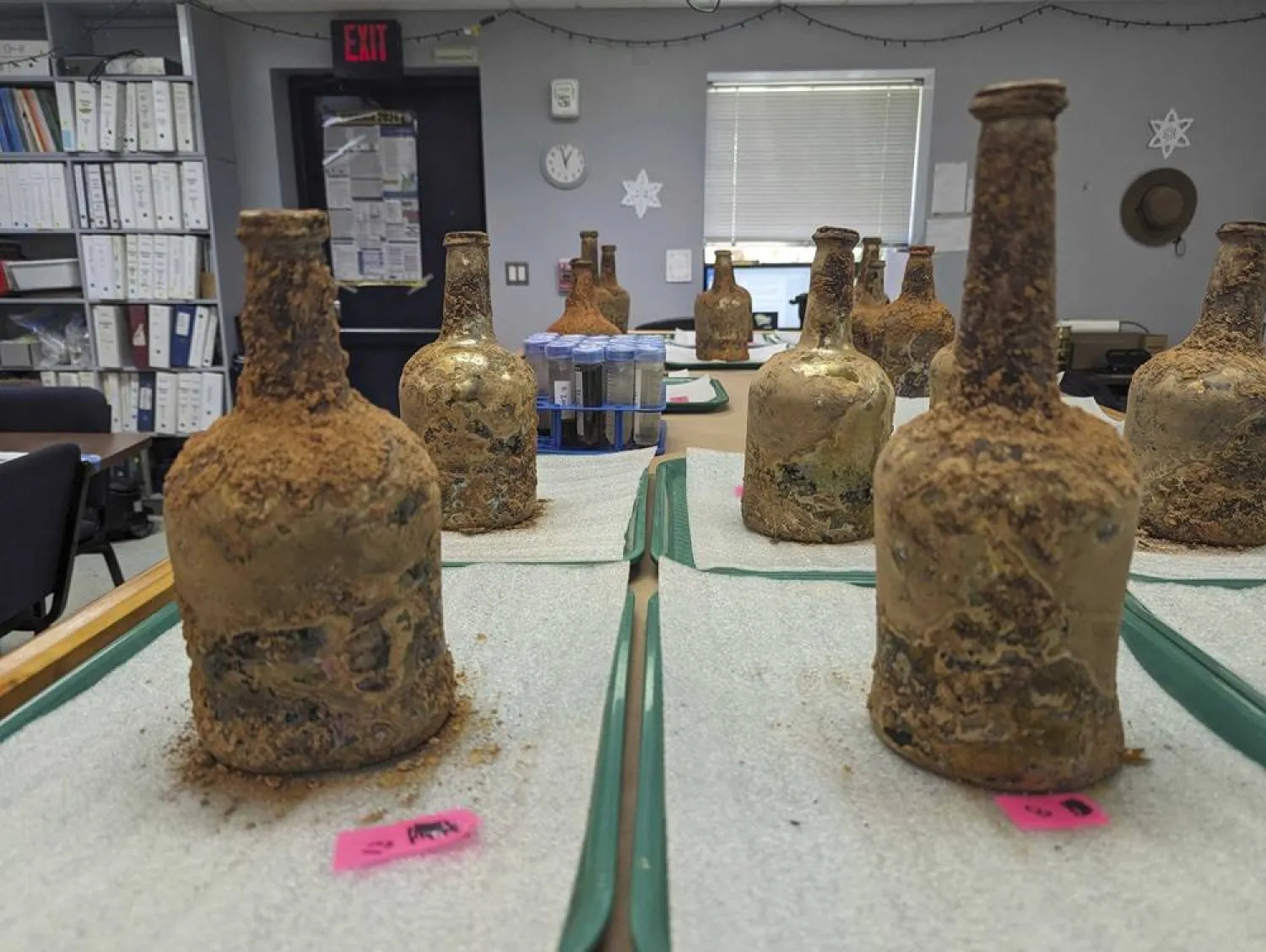
18th century artifacts found underneath George Washington's residence in Mount Vernon, Va., Monday, June 17, 2024. (AP Photo/Nathan Ellgren)
TT

Perfectly Preserved Centuries-Old Cherries Unearthed at George Washington’s Mount Vernon

18th century artifacts found underneath George Washington's residence in Mount Vernon, Va., Monday, June 17, 2024. (AP Photo/Nathan Ellgren)

George Washington never did cut down the cherry tree, despite the famous story to the contrary, but he did pack away quite a few bottles of the fruit at his Mount Vernon home.

Dozens of bottles of cherries and berries — impossibly preserved in storage pits uncovered from the cellar of his mansion on the banks of the Potomac River — were discovered during an archaeological dig connected to a restoration project.

Jason Boroughs, Mount Vernon's principal archaeologist, said the discovery of so much perfectly preserved food from more than 250 years ago is essentially unprecedented.

"Finding what is essentially fresh fruit, 250 years later, is pretty spectacular," Boroughs said in an interview. "All the stars sort of have to align in the right manner for that to happen."

Whole pieces of fruit, recognizable as cherries, were found in some of the bottles. Other bottles held what appear to be gooseberries or currants, though testing is underway to confirm that.

Mount Vernon is partnering with the US Department of Agriculture, which is conducting DNA testing on the fruit. They are also examining more than 50 cherry pits recovered from the bottles to see if any of them can be planted.

"It's kind of a longshot," said Benjamin Gutierrez, a USDA plant geneticist, of the chances of using a cherry pit to grow a tree. Seeds preserve best when they are dry, and most of the samples found at Mount Vernon were waterlogged. A couple of pits tested initially were not viable as seeds.

Still, he said the bottles are a remarkable find. In addition to DNA testing, he said chemical testing may be able to show if particular spices were used to preserve the fruits.

Records at Mount Vernon show that George and Martha Washington were fond of cherries, at least when mixed with brandy. Martha Washington's recipe for a "cherry bounce" cocktail survives, and Washington wrote that he took a canteen of cherry bounce with him on a trip across the Alleghenies in 1784.

These cherries, though, were most likely bottled to be eaten simply as cherries, Boroughs said.

The quality of the preservation reflect a high caliber of work. Slaves ran the plantation's kitchen. The kitchen was overseen by an enslaved woman named Doll, who came to Mount Vernon in 1758 with Martha Washington, according to the estate.

"The enslaved folks who were taking care of the trees, picking the fruit, working in the kitchen, those would have been the folks that probably would have overseen and done this process," Boroughs said. "It’s a highly skilled process. Otherwise they just wouldn’t have survived this way."

The bottles were found only because Mount Vernon is doing a $40 million revitalization project of the mansion that they expect to be completed by the nation's 250th birthday in 2026.

"When we do archaeology, it’s destructive," Boroughs said. "So unless we have a reason to disturb those resources, we tend not to."

"In this case, because of these needed structural repairs to the mansion, the ground was going to be disturbed. So we looked there first," he continued. "We didn’t expect to find all this."

They know the bottles predate 1775 because that's when an expansion of the mansion led to the area being covered over with a brick floor.

Mount Vernon announced back in April, at the start of its archaeological work, that it had found two bottles. As the dig continued, the number increased to 35 in six distinct storage pits. Six of the bottles were broken, with the other 29 intact. Twelve held cherries, 16 held the other berries believed to be currants and gooseberries, and one larger bottle held both cherries and other berries.

Boroughs believes they have now uncovered all the cherries and berries that survived.

"There is a lot of information that we’re excited to get from these bottles," he said.


‘Like Skiing’: First Urban Cable Car Unveiled Outside Paris

This photograph shows the first urban cable car "C1" in Ile-de-France region during its official launch, in between Creteil Pointe du Lac and Villeneuve-Saint-Georges, on the outskirts of Paris on December 13, 2025. (AFP)
TT

‘Like Skiing’: First Urban Cable Car Unveiled Outside Paris

This photograph shows the first urban cable car "C1" in Ile-de-France region during its official launch, in between Creteil Pointe du Lac and Villeneuve-Saint-Georges, on the outskirts of Paris on December 13, 2025. (AFP)

Gondolas floated above a cityscape in the southeastern suburbs of Paris on Saturday as officials unveiled the first urban cable car in the French capital's region.

Authorities inaugurated the C1 line in the suburb of Limeil-Brevannes in the presence of Valerie Pecresse, the head of the Ile-de-France region, and the mayors of the towns served by the cable car.

The 4.5-kilometer route connects Creteil to Villeneuve-Saint-Georges and passes through Limeil-Brevannes and Valenton.

Historically used to cross rugged mountain terrain, such systems are increasingly being used to link up isolated neighborhoods.

"It's like skiing!" joked Ibrahim Bamba, a 20-year-old student who lives in Limeil-Brevannes which is not served by the Paris metro or any rail network.

"It's the Alps on the Marne!" said Pecresse, referring to the department of Val-de-Marne located in the Grand Paris metropolis.

The cable car will carry some 11,000 passengers per day in its 105 gondolas, each able to accommodate ten passengers.

The total journey will take 18 minutes, including stops along the way, compared to around 40 minutes by bus or car, connecting the isolated neighborhoods to the Paris metro line 8. A ride requires a bus ticket or travel pass used for the Paris metro.

"This is a great step forward in terms of transportation. The roads are often congested in the morning," said Salimatou Bah, 52, who has lived in Limeil-Brevannes for thirteen years.

"We wondered if people would be hesitant, but I think it just takes a little time to adapt."

- 'Urban divides' -

Pecresse said the project was the result of "a 10-year obstacle course."

"We had to find the funding, convince local residents," she said. "For the inhabitants of Val-de-Marne, it's a sign of consideration."

The 138-million-euro project was cheaper to build than a subway, officials said.

"An underground metro would never have seen the light of day because the budget of more than billion euros could never have been financed," said Gregoire de Lasteyrie, vice-president of the Ile-de-France regional council in charge of transport.

Each cabin can accommodate ten seated passengers as well as wheelchairs, bicycles, and strollers. Inside, video surveillance and emergency call buttons have been installed to ensure passenger safety in addition to staff at each station.

The cable car is a response to "urban divides" in neighborhoods that were "lacking in terms of public transport," said Metin Yavuz, mayor of Valenton, a town of 16,000 inhabitants.

It is France's seventh urban cable car, with aerial tramways already operating in cities including Brest, Saint-Denis de La Reunion and Toulouse.

France's first urban cable car was built in Grenoble, nestled at the foot of the Alps, in 1934. The iconic "bubbles" have become one of the symbols of the southeastern city.

Cable cars are considered one of the safest means of transport in the world.

In France, the last fatal accident occurred in 1999 in the Hautes-Alpes, when 20 people lost their lives.


Before Megalodon, Researchers Say a Monstrous Shark Ruled Ancient Australian Seas

 A illustration made in Sept. 3, 2025, of a gigantic 8 meter (26 foot) long mega-predatory lamniform shark swimming beside a long-necked plesiosaur in the seas off Australia 115 million years ago. (Pollyanna von Knorring/Swedish Museum of Natural History via AP)
A illustration made in Sept. 3, 2025, of a gigantic 8 meter (26 foot) long mega-predatory lamniform shark swimming beside a long-necked plesiosaur in the seas off Australia 115 million years ago. (Pollyanna von Knorring/Swedish Museum of Natural History via AP)
TT

Before Megalodon, Researchers Say a Monstrous Shark Ruled Ancient Australian Seas

 A illustration made in Sept. 3, 2025, of a gigantic 8 meter (26 foot) long mega-predatory lamniform shark swimming beside a long-necked plesiosaur in the seas off Australia 115 million years ago. (Pollyanna von Knorring/Swedish Museum of Natural History via AP)
A illustration made in Sept. 3, 2025, of a gigantic 8 meter (26 foot) long mega-predatory lamniform shark swimming beside a long-necked plesiosaur in the seas off Australia 115 million years ago. (Pollyanna von Knorring/Swedish Museum of Natural History via AP)

In the age of dinosaurs — before whales, great whites or the bus-sized megalodon — a monstrous shark prowled the waters off what's now northern Australia, among the sea monsters of the Cretaceous period.

Researchers studying huge vertebrae discovered on a beach near the city of Darwin say the creature is now the earliest known mega-predator of the modern shark lineage, living 15 million years earlier than enormous sharks found before.

And it was huge. The ancestor of today’s 6-meter (20-foot) great white shark was thought to be about 8 meters (26 feet) long, the authors of a paper published in the journal Communications Biology said.

“Cardabiodontids were ancient, mega-predatory sharks that are very, very common from the later part of the Cretaceous, after 100 million years ago,” said Benjamin Kear, the senior curator in paleobiology at the Swedish Museum of Natural History and one of the study’s authors. “But this has pushed the time envelope back of when we’re going to find absolutely enormous cardabiodontids.”

Sharks have a 400-million-year history but lamniforms, the ancestors of today’s great white sharks, appear in the fossil record from 135 million years ago. At that time they were small — probably only a meter in length — which made the discovery that lamniforms had already become gigantic by 115 million years ago an unexpected one for researchers.

The vertebrae were found on coastline near Darwin in Australia’s far north, once mud from the floor of an ancient ocean that stretched from Gondwana — now Australia — to Laurasia, which is now Europe. It’s a region rich in fossil evidence of prehistoric marine life, with long-necked plesiosaurs and ichthyosaurs among the creatures discovered so far.

The five vertebrae that launched the quest to estimate the size of their mega-shark owners were not a recent discovery, but an older one that had been somewhat overlooked, Kear said. Unearthed in the late 1980s and 1990s, the fossils measured 12 centimeters (4.7 inches) across and had been stored in a museum for years.

When studying ancient sharks, vertebrae are prizes for paleontologists. Shark skeletons are made of cartilage, not bone, and their fossil record is mostly made up of teeth, which sharks shed throughout their lives.

“The importance of vertebrae is they give us hints about size,” Kear said. “If you’re trying to scale it from teeth, it’s difficult. Are the teeth big and the bodies small? Are they big teeth with big bodies?”

Scientists have used mathematical formulas to estimate the size of extinct sharks like megalodon, a massive predator that came later and may have reached 17 meters (56 feet) in length, Kear said. But the rarity of vertebrae mean questions of ancient shark size are difficult to answer, he added.

The international research team spent years testing different ways to estimate the size of the Darwin cardabiodontids, using fisheries data, CT scans and mathematical models, Kear said. Eventually, they arrived at a likely portrait of the predator’s size and shape.

“It would’ve looked for all the world like a modern, gigantic shark, because this is the beauty of it,” Kear said. “This is a body model that has worked for 115 million years, like an evolutionary success story.”

The study of the Darwin sharks suggested that modern sharks rose early in their adaptive evolution to the top of prehistoric food chains, the researchers said. Now, scientists could scour similar environments worldwide for others, Kear said.

“They must have been around before,” he said. “This thing had ancestors.”

Studying ancient ecosystems like this one could help researchers understand how today’s species might respond to environmental change, Kear added.

“This is where our modern world begins,” he said. “By looking at what happened during past shifts in climate and biodiversity, we can get a better sense of what might come next.”


Move over Larry: Maximus the PM's Cat Grabs Belgium Spotlight

Larry the Downing Street cat is a global celebrity in his own right, with more than 900,000 followers on X. JUSTIN TALLIS / AFP/File
TT

Move over Larry: Maximus the PM's Cat Grabs Belgium Spotlight

Larry the Downing Street cat is a global celebrity in his own right, with more than 900,000 followers on X. JUSTIN TALLIS / AFP/File

It is no secret that a tabby named Larry wields considerable power in Downing Street. Now in Belgium, a rescue cat named Maximus has shot to social media stardom as bewhiskered sidekick and PR weapon of Prime Minister Bart De Wever.

Taken in from a shelter by the Flemish conservative leader over the summer, the grey fluffball has become a fixture on Instagram -- snapped batting at string or lolling around in the boss's office.

But while Larry has risen above politics as Chief Mouser to six British prime ministers, the adventures of De Wever's four-legged friend come with a dose of salty commentary on Belgium's turbulent public life, said AFP.

Cartoon bubbles have captured Maximus musing sardonically -- in Flemish -- on everything from the country's long-running budget showdown to strikes over his boss's austerity measures, or a new voluntary military service for young Belgians.

'Maximus, can you catch a drone?'

Less than six months after his account went live in July, Maximus has caught up with his master when it comes to Instagram followers.

The account name -- @maximustp16 -- stands for "Maximus Textoris Pulcher", a cryptic reference to that of his boss, which means "The Weaver" in Dutch.

Those in the know say the fel-influencer's posts are put up by the prime minister's personal assistant.

But the Belgian leader -- known for his deadpan sense of humor -- is also pretty prolific online, and regularly cross-posts with the cat's account when he wants to strike a lighter note.

Since taking office in February, De Wever has posted a whole series of vignettes of himself with Maximus, pushing him in a stroller or taking a nap by his side.

His first response in October to the news of a foiled plot to attack him using drone-mounted explosives?

A post showing the prime minister and reclining cat with the cartoon caption "Maximus, can you catch a drone?"

"No -- but I'm catching dreams like no one else!" the mog replies.

'Noise and hot air'

All good fun, but what is the strategy at work?

For political analyst Dave Sinardet the spoof account is chiefly a way for the 54-year-old De Wever to freshen up his public image -- and show he does not take himself too seriously.

"It's a smart way to do political PR," said Sinardet, a university professor in Brussels. "It makes politicians seem friendlier, gentler -- considering that most people see them as rational, even arrogant figures."

The Flemish nationalist faces an uphill challenge -- under fire from left-wing parties who accuse him of unpicking social protections with rolling strikes and protests targeting his government all year.

Deploying pets as political PR assets is nothing new: every US president in history, with the exception of Donald Trump, has posed with animals at the White House.

Larry the Downing Street cat is a global celebrity in his own right, with his @Number10cat account on X boasting almost 900,000 followers.

But De Wever's posts with Maximus are not to everyone's liking at home.

A video of the prime minister pretending to play "Amazing Grace" on the bagpipes -- the pipe being Maximus's tail -- during tense budget talks had the opposition hissing.

"Quite the summary of their politics: noise and hot air," snapped the socialist lawmaker Patrick Prevot.
