It's Not as World-Famous as Ramen or Sushi. But The Humble Onigiri Is Soul Food in Japan

A variety of onigiri, rice balls, are seen on a plate at a Taro Tokyo Onigiri shop in Tokyo, on June 5, 2024. (AP Photo/Shuji Kajiyama)
TT

It's Not as World-Famous as Ramen or Sushi. But The Humble Onigiri Is Soul Food in Japan

A variety of onigiri, rice balls, are seen on a plate at a Taro Tokyo Onigiri shop in Tokyo, on June 5, 2024. (AP Photo/Shuji Kajiyama)

The word “onigiri” became part of the Oxford English Dictionary this year, proof that the humble sticky-rice ball and mainstay of Japanese food has entered the global lexicon.
The rice balls are stuffed with a variety of fillings and typically wrapped in seaweed. It's an everyday dish that epitomizes “washoku” — the traditional Japanese cuisine that was designated a UNESCO Intangible Cultural Heritage a decade ago, The Associated Press said.
Onigiri is “fast food, slow food and soul food,” says Yusuke Nakamura, who heads the Onigiri Society, a trade group in Tokyo.
Fast because you can find it even at convenience stores. Slow because it uses ingredients from the sea and mountains, he said. And soul food because it's often made and consumed among family and friends. No tools are needed, just gently cupped hands.
“It’s also mobile, food on the move,” he said.
Onigiri in its earliest form is believed to go back at least as far as the early 11th Century; it's mentioned in Murasaki Shikibu’s “The Tale of Genji.” It appears in Akira Kurosawa’s classic 1954 film “Seven Samurai” as the ultimate gift of gratitude from the farmers.
What exactly goes into onigiri? The sticky characteristic of Japanese rice is key.
What's placed inside is called “gu,” or filling. A perennial favorite is umeboshi, or salted plum. Or perhaps mentaiko, which is hot, spicy roe. But in principle, anything can be placed inside onigiri, even sausages or cheese.
Then the ball is wrapped with seaweed. Even one nice big onigiri would make a meal, although many people would eat more.
Some stand by the classic onigiri Yosuke Miura runs Onigiri Asakusa Yadoroku, a restaurant founded in 1954 by his grandmother. Yadoroku, which roughly translates to “good-for-nothing,” is named for her husband, Miura's grandfather. It claims to be the oldest onigiri restaurant in Tokyo.
There are just two tables. The counter has eight chairs. Takeout is an option, but you still have to stand in line.
“Nobody dislikes onigiri,” said Miura, smiling behind a wooden counter. In a display case before him are bowls of gu, including salmon, shrimp and miso-flavored ginger. “It’s nothing special basically. Every Japanese has 100% eaten it."
Also a classical flautist, Miura sees onigiri as a score handed down from his grandmother, one which he will reproduce faithfully.
“In classical music, you play what’s written on the music sheet. Onigiri is the same,” he says. “You don’t try to do something new.”
Yadoruku is tucked away in the quaint old part of Tokyo called Asakusa. It opens at 11:30 a.m. and closes when it runs out of rice, usually within the hour. Then it opens again for dinner. The most expensive onigiri costs 770 yen ($4.90), with salmon roe, while the cheapest is 319 yen ($2). That includes miso soup. No reservations are taken.
Although onigiri can be round or square, animal or star-shaped, Miura’s standard is the triangular ones. He makes them to order, right before your eyes, taking just 30 seconds for each.
He places the hot rice in triangular molds that look like cookie cutters, rubs salt on his hands and then cups the rice — three times to gently firm the sides. The crisp nori, or seaweed, is wrapped like a kerchief around the rice, with one end up so it stays crunchy.
The first bite is just nori and rice. The gu comes with your second bite.
“The Yadoroku onigiri will not change until the end of Earth,” Miura said with a grin.
Others want to experiment Miyuki Kawarada runs Taro Tokyo Onigiri, which has four outlets in Japan. She is eyeing Los Angeles, too, and then Paris. Her vision: to make onigiri “the world’s fast food.”
The name Taro was chosen because it’s common, the Japanese equivalent of John or Michael. Onigiri, she says, has mass appeal because it's simple to make, is gluten-free and is versatile.
And other Japanese foods like ramen and sushi have found worldwide popularity, she notes.
At her cheerful, modern shop, workers wearing khaki-colored company T-shirts busily prepare the gu and rice balls in a kitchen visible behind the cash register. The shop only serves takeout.
Kawarada’s onigiri has lots of gu on top, for colorful toppings, instead of inside. Each one comes with a separately wrapped piece of nori to be placed around it right before you eat.
Her gu gets adventurous. Cream cheese is mixed with a pungent Japanese pickle called "iburigakko,” for instance, and each onigiri costs 250 yen ($1.60). Spam and egg onigiri costs 300 yen ($1.90); the one adorned with several types of “kombu,” or edible kelp, called “Dashi Punch X3,” costs 280 yen ($1.80).
“Onigiri is the infinite universe. We don’t get tied down in tradition,” said Kawarada.
The customers Asami Hirano, who stopped in while walking her dog, took a long time choosing her meal at Taro Tokyo Onigiri on a recent day.
“I’ve always loved onigiri since I was a kid. My mother made them,” she said.
Nicolas Foo Cheung, a Frenchman who works nearby as an intern, had been to Taro Tokyo Onigiri a few times before and thinks it’s a good deal. “It’s simple food,” he said.
Miki Yamada, a food promoter, intentionally calls onigiri “omusubi,” the other common word for rice balls, because the latter more clearly refers to the idea of connections. She says her life's mission is to bring people together, especially since the triple earthquake, tsunami and nuclear disasters hit her family's rice farm in Fukushima, northeastern Japan, in 2011.
“By facing up to omusubi, I have encountered a spirituality, a basic Japanese-ness of sorts,” she said.
There is nothing better, she said, than plain Aizu rice omusubi with a pinch of salt and utterly nothing inside.
“It energizes you. It’s that ultimate comfort food,” she said.



Crews Recover Bodies of 9 Backcountry Skiers Days after California Avalanche

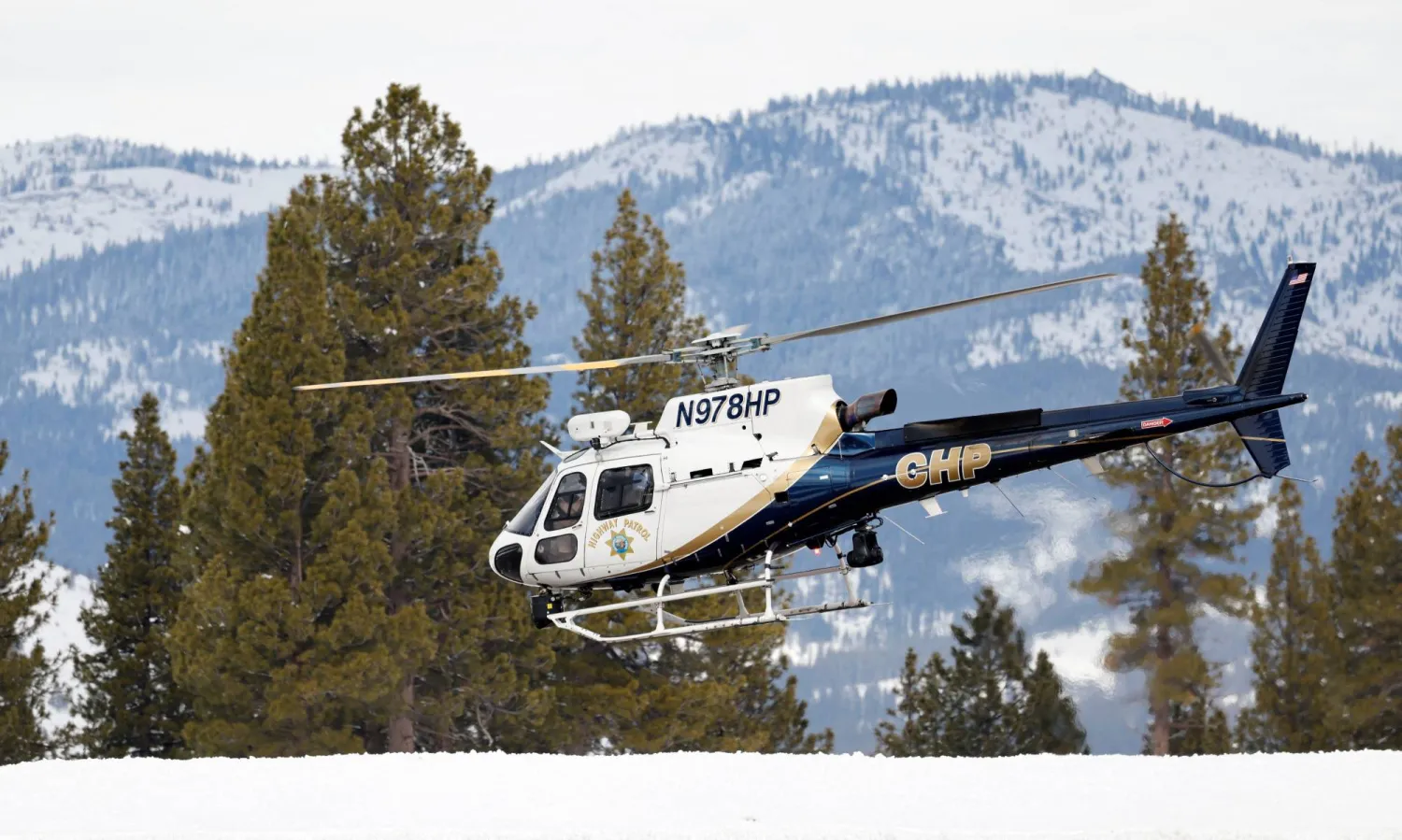
A California Highway Patrol helicopter lifts off from Truckee Tahoe Airport while taking part in recovery efforts for the skiers that died in an avalanche in the Sierra Nevada mountains, in Truckee, California, US February 21, 2026.  REUTERS/Fred Greaves
A California Highway Patrol helicopter lifts off from Truckee Tahoe Airport while taking part in recovery efforts for the skiers that died in an avalanche in the Sierra Nevada mountains, in Truckee, California, US February 21, 2026. REUTERS/Fred Greaves
TT

Crews Recover Bodies of 9 Backcountry Skiers Days after California Avalanche

A California Highway Patrol helicopter lifts off from Truckee Tahoe Airport while taking part in recovery efforts for the skiers that died in an avalanche in the Sierra Nevada mountains, in Truckee, California, US February 21, 2026.  REUTERS/Fred Greaves
A California Highway Patrol helicopter lifts off from Truckee Tahoe Airport while taking part in recovery efforts for the skiers that died in an avalanche in the Sierra Nevada mountains, in Truckee, California, US February 21, 2026. REUTERS/Fred Greaves

Crews recovered the bodies of nine backcountry skiers who were killed by an avalanche in California's Sierra Nevada, authorities said Saturday, concluding a harrowing operation that was hindered by intense snowfall.

A search team reached the bodies of eight victims and found one other who had been missing and presumed dead since Tuesday’s avalanche on Castle Peak near Lake Tahoe. The ninth person who was missing was found “relatively close” to the other victims, according to Nevada County Sheriff’s Lt. Dennis Hack, but was impossible to see due to whiteout conditions at that time.

At a news conference, Sheriff Shannon Moon praised the collective efforts of the numerous agencies that helped recover the bodies — from the California Highway Patrol to the National Guard to the Pacific Gas & Electric utility company — and 42 volunteers who helped on the last day of the operation.

“We are fortunate in this mountain community that we are very tight-knit, and our community shows up in times of tragedy,” The Associated Press quoted Moon as saying.

The sheriff named for the first time the three guides from Blackbird Mountain Company who died: Andrew Alissandratos, 34, Nicole Choo, 42, and Michael Henry, 30.

According to biographies on the company's website, Alissandratos was originally from Tampa, Florida, and moved to Tahoe roughly a decade ago. He enjoyed a wide array of adventure activities, from backcountry exploration to rock climbing.

Henry moved to Colorado in 2016 and then to Truckee three years later. He was described as “laid back” and devoted to sharing his knowledge and love of the mountains with others.

There was no bio for Choo on the website.

“This was an enormous tragedy, and the saddest event our team has ever experienced,” Blackbird Mountain founder Zeb Blais said Wednesday in a statement.

“We are doing what we can to support the families who lost so much,” he said, “and the members of our team who lost treasured friends and colleagues.”

The six other fatal victims were women who were part of a close-knit group of friends who were experienced backcountry skiers and knew how to navigate the Sierra Nevada wilderness, their families said this week.

They were identified as Carrie Atkin, Liz Clabaugh, Danielle Keatley, Kate Morse, Caroline Sekar and Kate Vitt, all in their 40s. They lived in the San Francisco Bay Area, Idaho and the Lake Tahoe area.

“We are devastated beyond words,” the families said in a statement. “Our focus right now is supporting our children through this incredible tragedy and honoring the lives of these extraordinary women. They were all mothers, wives and friends, all of whom connected through the love of the outdoors.”

The families asked for privacy while they grieve and added that they “have many unanswered questions.”

Two of the friends got out alive and were rescued along with four others, including one guide, after Tuesday’s avalanche. Their names have not been released.

The avalanche struck on the last day of the 15 skiers’ three-day tour, when the group decided to end the trip early to avoid the impending snowstorm.

Officials have said the path they took is a “normally traveled route” but declined to specify what that meant.

At around 11:30 a.m. Tuesday, the six survivors called for help, describing a sudden and terrifying slide that was approximately the length of a football field. In the aftermath they discovered the bodies of three fellow skiers, according to Hack.

Rescuers were not able to reach them until roughly six hours after the initial call for help, Hack said, and took two separate paths to arrive. They found five other bodies, leaving only one person unaccounted for.

But it was immediately clear to rescuers that it was too dangerous to extract the bodies at that time due to the heavy snowfall and threat of more avalanches.

Those conditions persisted on Wednesday and Thursday.

A breakthrough on Friday Authorities used two California Highway Patrol helicopters, with the help of Pacific Gas & Electric Company, to break up the snow and intentionally release unstable snowpack to reduce the avalanche risk.

Crews were then able to recover five victims that evening before it got too dark to access the last three.

Rescuers used helicopters and ropes to hoist the last four bodies from the mountain the following morning, fighting through severe winds that forced them to make multiple trips. The bodies were then taken to snowcats — trucks that are outfitted to drive on snow — for further transport.

“We cannot say enough how tremendously sorry we are for the families that have been affected by this avalanche,” Moon said.

Initial reports indicated that at least two of the surviving skiers were not swept away by the avalanche, Hack said. The others were standing separately and relatively close together and were hit.

Hack declined to offer information about what might have set off the avalanche.

Authorities close the area The terrain will be off-limits to visitors until mid-March, said Chris Feutrier, forest supervisor for the Tahoe National Forest. Officials intended to restore public access once the investigation is complete.

“This is the public’s land, and they love to recreate on it,” Feutrier said. “The Forest Service doesn’t close public land for every hazard or every obstacle. We trust the American people to use their best judgment when recreating.”


Riyadh Municipality Decorates Capital with Over 5,000 Lights for Founding Day

The capital's streets have transformed into vibrant displays of national pride, embodying 299 years of continuous development and progress - SPA
TT

Riyadh Municipality Decorates Capital with Over 5,000 Lights for Founding Day

The capital's streets have transformed into vibrant displays of national pride, embodying 299 years of continuous development and progress - SPA

The Riyadh Municipality has illuminated the capital's main streets, vital thoroughfares, and public squares with over 5,000 decorative lights in celebration of Saudi Founding Day.

The project involved installing 5,481 decorative lights across various locations to enhance the festive atmosphere throughout Riyadh's neighborhoods, giving the city a harmonious visual character that reflects profound pride in the nation's rich history, SPA reported.

As light and identity intertwine, the capital's streets have transformed into vibrant displays of national pride, embodying 299 years of continuous development and progress.

The transformation reflects the deep significance of Founding Day in the hearts of citizens and translates their loyalty to the leadership's blessed journey.


Residents in Australia’s Victoria State Urged to Evacuate as Bushfire Rages

This undated handout image received on December 26, 2024 from the State Control Center of the Victoria Emergency Services shows officials on a road near a bushfire in the Grampians National Park in Australia's Victoria state. (Handout / State Control Center of the Victoria Emergency Services / AFP)
TT

Residents in Australia’s Victoria State Urged to Evacuate as Bushfire Rages

This undated handout image received on December 26, 2024 from the State Control Center of the Victoria Emergency Services shows officials on a road near a bushfire in the Grampians National Park in Australia's Victoria state. (Handout / State Control Center of the Victoria Emergency Services / AFP)

An ‌out-of-control bushfire in Australia's Victoria state prompted an evacuation alert for residents near a remote mining settlement, authorities said on Saturday.

The alert, at the highest emergency rating, was for the area surrounding the A1 Mine Settlement in the Gaffney's Creek region, about 50 km (31 miles) ‌northeast of ‌state capital Melbourne.

"Leaving immediately is ‌the ⁠safest option, before ⁠conditions become too dangerous," Victoria Emergency said on its website, adding that the fire was not yet controlled.

Mountainous terrain was making it difficult for firefighters to battle ⁠the blaze from the ‌ground, the ‌Australian Broadcasting Corp. reported.

Since the 1860s gold ‌has been mined in the sparsely-populated ‌area, which is also popular with campers and tourists.

Three other bushfires were burning on Saturday at watch and act ‌level, the second highest danger rating, Victoria Emergency said.

In January, ⁠thousands ⁠of firefighters battled bushfires in Australia's southeast that razed homes, cut power to thousands of homes and burned swathes of bushland. They were the worst fires to hit the southeast since the Black Summer blazes of 2019-2020 that destroyed an area the size of Türkiye and killed 33 people.