

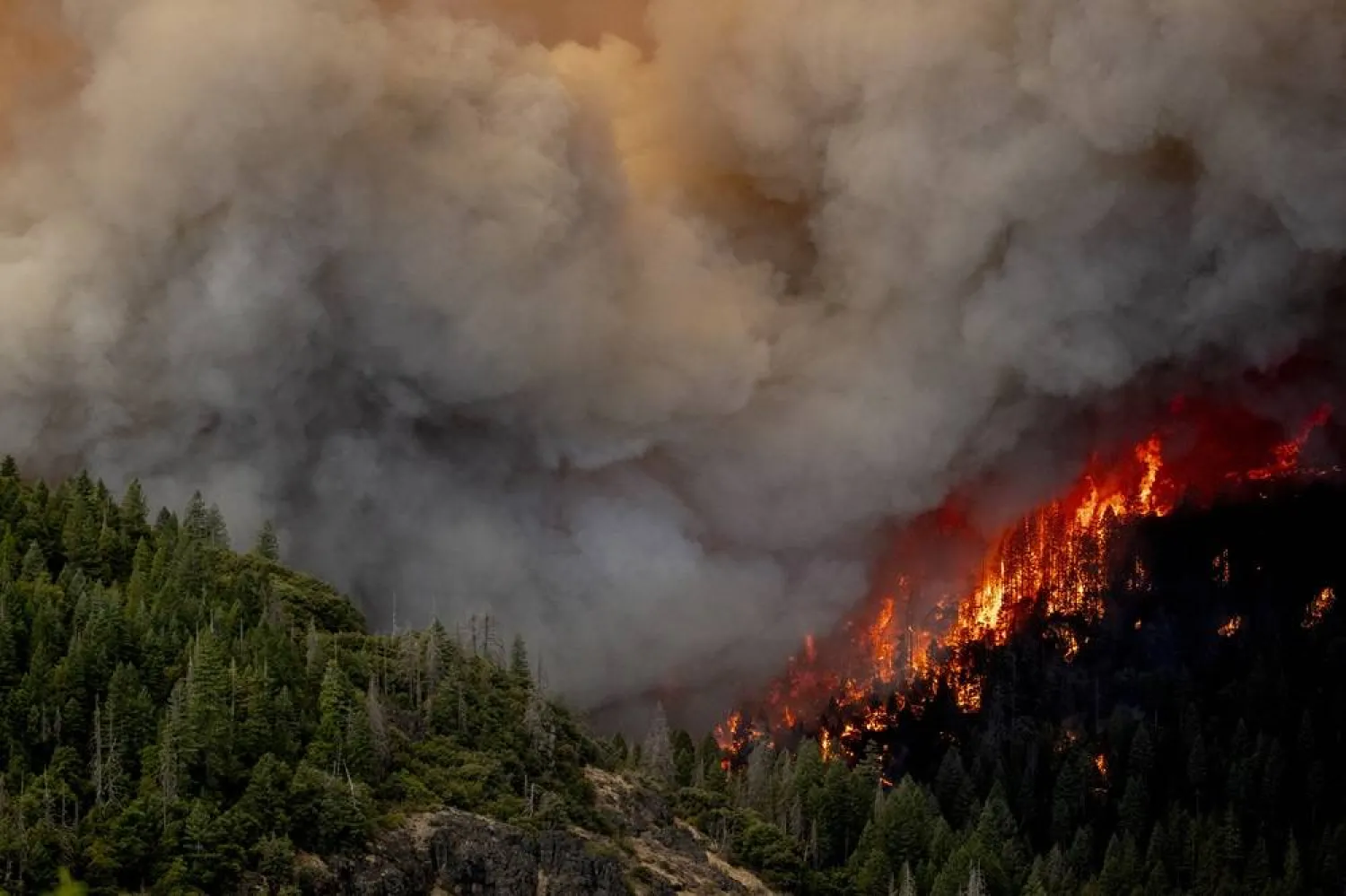

California’s Largest Wildfire Explodes in Size as Fires Rage across US West

 A column of flame burns on a hillside during the Park Fire near Lomo, Calif., Friday, July 26, 2024. (Stephen Lam/San Francisco Chronicle via AP)
A column of flame burns on a hillside during the Park Fire near Lomo, Calif., Friday, July 26, 2024. (Stephen Lam/San Francisco Chronicle via AP)
TT

California’s Largest Wildfire Explodes in Size as Fires Rage across US West

 A column of flame burns on a hillside during the Park Fire near Lomo, Calif., Friday, July 26, 2024. (Stephen Lam/San Francisco Chronicle via AP)
A column of flame burns on a hillside during the Park Fire near Lomo, Calif., Friday, July 26, 2024. (Stephen Lam/San Francisco Chronicle via AP)

California's largest active fire exploded in size on Friday evening, growing rapidly amid bone-dry fuel and threatening thousands of homes as firefighters scrambled to meet the danger.

The Park Fire's intensity and dramatic spread led fire officials to make unwelcome comparisons to the monstrous Camp Fire, which burned out of control in nearby Paradise in 2018, killing 85 people and torching 11,000 homes.

More than 130 structures have been destroyed by this fire so far, and thousands more are threatened as evacuations were ordered in four counties — Butte, Plumas, Tehama and Shasta. It stood at 374 square miles (967 square kilometers) on Friday night and was moving quickly north and east after igniting Wednesday when authorities said a man pushed a burning car into a gully in Chico and then calmly blended in with others fleeing the scene.

"There’s a tremendous amount of fuel out there and it’s going to continue with this rapid pace," Cal Fire incident commander Billy See said at a briefing. He said the fire was advancing up to 8 square miles (21 square kilometers) an hour on Friday afternoon.

Officials at Lassen Volcanic National Park evacuated staff from Mineral, a community of about 120 people where the park headquarters are located, as the fire moved north toward Highway 36 and east toward the park.

Communities elsewhere in the US West and Canada were under siege Friday, from a fast-moving blaze sparked by lightning sent people fleeing on fire-ringed roads in rural Idaho to a new blaze that was causing evacuations in eastern Washington.

In eastern Oregon, a pilot was found dead in a small air tanker plane that crashed while fighting one of the many wildfires spreading across several Western states.

More than 110 active fires covering 2,800 square miles (7,250 square kilometers) were burning in the US on Friday, according to the National Interagency Fire Center. Some were caused by the weather, with climate change increasing the frequency of lightning strikes as the region endures record heat and bone-dry conditions.

The fire in eastern Washington was threatening homes, the railroad, Interstate 90 and the community of Tyler, which was evacuated Friday. The Columbia Basin fire in Spokane County closed part of Highway 904 between the interstate and Cheney. Multiple planes, helicopters and fire personnel were working hard to contain the fire, according to the Washington State Patrol.

In Chico, California, Carli Parker is one of hundreds who fled their homes as the Park Fire pushed close. Parker decided to leave her Forest Ranch residence with her family when the fire began burning across the street. She has previously been forced out of two homes by fire, and she said she had little hope that her residence would remain unscathed.

"I think I felt like I was in danger because the police had come to our house because we had signed up for early evacuation warnings, and they were running to their vehicle after telling us that we need to self-evacuate and they wouldn’t come back," said Parker, a mother of five.

Ronnie Dean Stout, 42, of Chico, was arrested early Thursday in connection with the blaze and held without bail pending a Monday arraignment, officials said. There was no reply to an email to the district attorney asking whether the suspect had legal representation or someone who could comment on his behalf.

Fire crews were making progress on another complex of fires burning in the Plumas National Forest near the California-Nevada line, said Forest Service spokesperson Adrienne Freeman. Most of the 1,000 residents evacuated by the lightning-sparked Gold Complex fires were returning home Friday. Some crews were peeling off to help battle the Park Fire.

"As evidenced by the (Park) fire to the West, some of these fires are just absolutely exploding and burning at rates of spread that it is just hard to even imagine," Tim Hike, Forest Service incident commander of the Gold Complex fire about 50 miles (80 km) northwest of Reno, said Friday. "The fire does not look that bad right up until it does. And then that just might be too late."

Forest Ranch evacuee Sherry Alpers, fled with her 12 small dogs and made the decision to stay in her car outside a Red Cross shelter in Chico after learning that animals would not be allowed inside. She ruled out traveling to another shelter after learning the dogs would be kept in cages, since her dogs have always roamed free at her home.

Alpers said she doesn’t know whether the fire spared her home or not, but she said that as long as her dogs are safe, she doesn't care about the material things.

"I’m kind of worried, but not that much," she said. "If it’s gone, it’s gone."

Brian Bowles was also staying in his car outside the shelter with his dog Diamon. He said he doesn't know if his mobile home is still standing.

Bowles said he only has a $100 gift card he received from United Way, which handed them out to evacuees.

"Now the question is, do I get a motel room and comfortable for one night? Or do I put gas in the car and sleep in here?" he said. "Tough choice."

In Oregon, a Grant County Search and Rescue team on Friday morning located a small single-engine air tanker that had disappeared while fighting the 219-square-mile (567 square kilometers) Falls Fire burning near the town of Seneca and the Malheur National Forest. The pilot died, said Bureau of Land Management information officer Lisa Clark. No one else was aboard the bureau-contracted aircraft when it went down in steep, forested terrain.

The most damage so far has been to the Canadian Rockies’ Jasper National Park, where a fast-moving wildfire forced 25,000 people to flee and devastated the park’s namesake town, a World Heritage site.

In Idaho, lightning strikes sparked fast-moving wildfires and the evacuation of multiple communities. The fires were burning on about 31 square miles (80 square kilometers) Friday afternoon.

Videos posted to social media include a man who said he heard explosions as he fled Juliaetta, about 27 miles (43 kilometers) southeast of the University of Idaho’s campus in Moscow. The town of just over 600 residents was evacuated Thursday just ahead of roaring fires, as were several other communities near the Clearwater River and the Nez Perce Tribal Hatchery Complex, which breeds salmon.

There’s no estimate yet on the number of buildings burned in Idaho, nor is there information about damage to urban communities, officials said Friday morning.

Oregon still has the biggest active blaze in the United States, the Durkee Fire, which combined with the Cow Fire to burn nearly 630 square miles (1,630 square kilometers). It remains unpredictable and was only 20% contained Friday, according to the government website InciWeb.

The National Interagency Fire Center said more than 27,000 fires have burned more than 5,800 square miles (15,000 square kilometers) in the US this year, and in Canada, more than 8,000 square miles (22,800 square kilometers) have burned in more than 3,700 fires so far, according to its National Wildland Fire Situation Report issued Wednesday.



Nine Skiers Missing, Six Rescued after California Avalanche

FILE PHOTO: The snow-covered Sierra Nevada Mountains are seen from the air during a Pacific Gas and Electric snowpack survey near Nevada City, California, US April 3, 2017.  REUTERS/Bob Strong/File Photo
FILE PHOTO: The snow-covered Sierra Nevada Mountains are seen from the air during a Pacific Gas and Electric snowpack survey near Nevada City, California, US April 3, 2017. REUTERS/Bob Strong/File Photo
TT

Nine Skiers Missing, Six Rescued after California Avalanche

FILE PHOTO: The snow-covered Sierra Nevada Mountains are seen from the air during a Pacific Gas and Electric snowpack survey near Nevada City, California, US April 3, 2017.  REUTERS/Bob Strong/File Photo
FILE PHOTO: The snow-covered Sierra Nevada Mountains are seen from the air during a Pacific Gas and Electric snowpack survey near Nevada City, California, US April 3, 2017. REUTERS/Bob Strong/File Photo

Nine skiers were missing after an avalanche in California's Sierra Nevada mountains on Tuesday, but six others, who had been stranded, have since been rescued, authorities said.

The avalanche swept the Castle Peak area of Truckee, California, about 10 miles north of Lake Tahoe, at about 11:30 a.m. Pacific time, engulfing a group of skiers, according to a Facebook statement posted by the Nevada County Sheriff's Office.

Those rescued have varying injuries and two were ‌sent to a hospital ‌for treatment.

The sheriff's office revised the number of ‌people ⁠in the group to ⁠15 from an earlier estimate of 16, adding that no further updates were expected on Tuesday evening.

If all nine of the missing skiers should perish, the incident would rank among the deadliest single avalanches on record in the United States. The Colorado Avalanche Information Center has tallied six US avalanche fatalities so far this season.

Avalanches have claimed an average of 27 lives ⁠each winter in the United States over the past ‌decade, the center reported.

A winter storm warning ‌was in effect for much of northern California on Tuesday, with heavy snow ‌forecast in the upper elevations of the Sierra Nevada.

The Sierra Avalanche Center ‌had posted an alert before dawn on Tuesday, warning of a "high avalanche danger" in the ski region, the sheriff's statement said.

"I don't think it was a wise choice," Greene said of the decision of a ski tour company to take paying ‌customers out into the backcountry under such conditions, adding, "but we don't know all the details yet." He declined to ⁠name the company involved.

Rescue ⁠ski teams were dispatched to the avalanche zone from the Boreal Mountain Ski Resort and Tahoe Donner's Alder Creek Adventure Center.

The survivors had taken refuge in a makeshift shelter, constructed partly from tarpaulin sheets and communicated with rescuers via radio beacon and text messaging.

Greene declined to say how many of the ski guides and how many of their customers were among the missing.

Weather conditions remained hazardous in the Sierra backcountry slopes, with additional avalanche activity expected through Tuesday night and into Wednesday, according to the sheriff's statement.

California Governor Gavin Newsom was briefed on the avalanche, and state authorities were "coordinating an all-hands search-and-rescue effort" in conjunction with local emergency teams, his office said in a posting on X.


Surprise Shark Caught on Camera for 1st Time in Antarctica’s Near-freezing Deep

In this image made from video and released by the University of Western Australia, a sleeper shark swims into the spotlight of a video camera in Antarctica in January 2025. (Minderoo-UWA Deep-Sea Research Centre, Inkfish, Kelpie Geoscience via AP)
TT

Surprise Shark Caught on Camera for 1st Time in Antarctica’s Near-freezing Deep

In this image made from video and released by the University of Western Australia, a sleeper shark swims into the spotlight of a video camera in Antarctica in January 2025. (Minderoo-UWA Deep-Sea Research Centre, Inkfish, Kelpie Geoscience via AP)

An ungainly barrel of a shark cruising languidly over a barren seabed far too deep for the sun’s rays to illuminate was an unexpected sight.

Many experts had thought sharks didn’t exist in the frigid waters of Antarctica before this sleeper shark lumbered warily and briefly into the spotlight of a video camera, researcher Alan Jamieson said this week. The shark, filmed in January 2025, was a substantial specimen with an estimated length of between 3 and 4 meters (10 and 13 feet).

“We went down there not expecting to see sharks because there’s a general rule of thumb that you don’t get sharks in Antarctica,” Jamieson said.

“And it’s not even a little one either. It’s a hunk of a shark. These things are tanks,” he added.

The camera operated by the Minderoo-UWA Deep-Sea Research Centre, which investigates life in the deepest parts of the world’s oceans, was positioned off the South Shetland Islands near the Antarctic Peninsula. That is well inside the boundaries of the Antarctic Ocean, also known as the Southern Ocean, which is defined as below the 60-degree south latitude line.

The center on Wednesday gave The Associated Press permission to publish the images.
The shark was 490 meters (1,608 feet) deep where the water temperature was a near-freezing 1.27 degrees Celsius (34.29 degrees Fahrenheit).

A skate appears in frame motionless on the seabed and seemingly unperturbed by the passing shark. The skate, a shark relative that looks like a stingray, was no surprise since scientists already knew their range extended that far south.

Jamieson, who is the founding director of the University of Western Australia-based research center, said he could find no record of another shark found in the Antarctic Ocean.

Peter Kyne, a Charles Darwin University conservation biologist independent of the research center, agreed that a shark had never before been recorded so far south.

Climate change and warming oceans could potentially be driving sharks to the Southern Hemisphere’s colder waters, but there was limited data on range changes near Antarctica because of the region’s remoteness, Kyne said.

The slow-moving sleeper sharks could have long been in Antarctica without anyone noticing, he said.

“This is great. The shark was in the right place, the camera was in the right place and they got this great footage,” Kyne said. “It’s quite significant.”

The sleeper shark population in the Antarctic Ocean was likely sparse and difficult for humans to detect, Jamieson said.

The photographed shark was maintaining a depth of around 500 meters (1,640 feet) along a seabed that sloped into much deeper water. The shark maintained that depth because that was the warmest layer of several water layers stacked upon each other to the surface, Jamieson said.

The Antarctic Ocean is heavily layered, or stratified, to a depth of around 1,000 meters (3,280 feet) because of conflicting properties including colder, denser water from below not readily mixing with fresh water running off melting ice from above.

Jamieson expects other Antarctic sharks live at the same depth, feeding on the carcasses of whales, giant squids and other marine creatures that die and sink to the bottom.

There are few research cameras positioned at that specific depth in Antarctic waters.

Those that are can only operate during the Southern Hemisphere summer months, from December through February.

“The other 75% of the year, no one’s looking at all. And so this is why, I think, we occasionally come across these surprises,” Jamieson said.


17th Century Wreck Reappears from Stockholm Deep

The remains of a 17th century shipwreck is pictured after resurfacing in Stockholm, Sweden, on February 17, 2026. (Photo by Jonathan NACKSTRAND / AFP)
TT

17th Century Wreck Reappears from Stockholm Deep

The remains of a 17th century shipwreck is pictured after resurfacing in Stockholm, Sweden, on February 17, 2026. (Photo by Jonathan NACKSTRAND / AFP)

A 17th century Swedish Navy shipwreck buried underwater in central Stockholm for 400 years has suddenly become visible due to unusually low Baltic Sea levels.

The wooden planks of the ship's well-preserved hull have since early February been peeking out above the surface of the water off the island of Kastellholmen, providing a clear picture of its skeleton.

"We have a shipwreck here, which was sunk on purpose by the Swedish Navy," Jim Hansson, a marine archeologist at Stockholm's Vrak - Museum of Wrecks, told AFP.

Hansson said experts believe that after serving in the navy, the ship was sunk around 1640 to use as a foundation for a new bridge to the island of Kastellholmen.

Archeologists have yet to identify the exact ship, as it is one of five similar wrecks lined up in the same area to form the bridge, all dating from the late 16th and early 17th centuries.

"This is a solution, instead of using new wood you can use the hull itself, which is oak" to build the bridge, Hansson said.

"We don't have shipworm here in the Baltic that eats the wood, so it lasts, as you see, for 400 years," he said, standing in front of the wreck.

Parts of the ship had already broken the surface in 2013, but never before has it been as visible as it is now, as the waters of the Baltic Sea reach their lowest level in about 100 years, according to the archaeologist.

"There has been a really long period of high pressure here around our area in the Nordics. So the water from the Baltic has been pushed out to the North Sea and the Atlantic," Hansson explained.

A research program dubbed "the Lost Navy" is underway to identify and precisely date the large number of Swedish naval shipwrecks lying on the bottom of the Baltic.