


California’s Largest Wildfire Explodes in Size as Fires Rage across US West

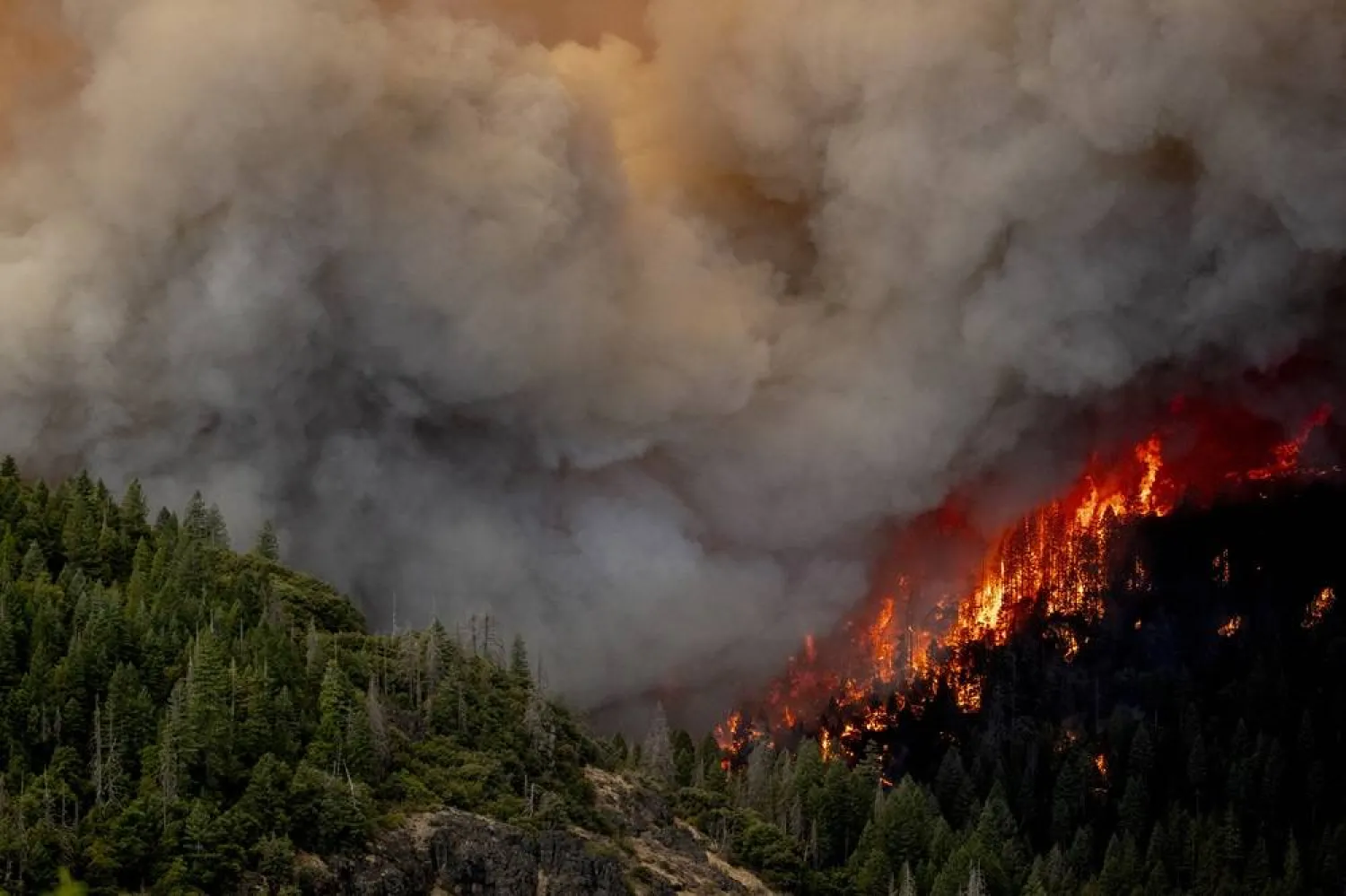
 A column of flame burns on a hillside during the Park Fire near Lomo, Calif., Friday, July 26, 2024. (Stephen Lam/San Francisco Chronicle via AP)
A column of flame burns on a hillside during the Park Fire near Lomo, Calif., Friday, July 26, 2024. (Stephen Lam/San Francisco Chronicle via AP)
TT

California’s Largest Wildfire Explodes in Size as Fires Rage across US West

 A column of flame burns on a hillside during the Park Fire near Lomo, Calif., Friday, July 26, 2024. (Stephen Lam/San Francisco Chronicle via AP)
A column of flame burns on a hillside during the Park Fire near Lomo, Calif., Friday, July 26, 2024. (Stephen Lam/San Francisco Chronicle via AP)

California's largest active fire exploded in size on Friday evening, growing rapidly amid bone-dry fuel and threatening thousands of homes as firefighters scrambled to meet the danger.

The Park Fire's intensity and dramatic spread led fire officials to make unwelcome comparisons to the monstrous Camp Fire, which burned out of control in nearby Paradise in 2018, killing 85 people and torching 11,000 homes.

More than 130 structures have been destroyed by this fire so far, and thousands more are threatened as evacuations were ordered in four counties — Butte, Plumas, Tehama and Shasta. It stood at 374 square miles (967 square kilometers) on Friday night and was moving quickly north and east after igniting Wednesday when authorities said a man pushed a burning car into a gully in Chico and then calmly blended in with others fleeing the scene.

"There’s a tremendous amount of fuel out there and it’s going to continue with this rapid pace," Cal Fire incident commander Billy See said at a briefing. He said the fire was advancing up to 8 square miles (21 square kilometers) an hour on Friday afternoon.

Officials at Lassen Volcanic National Park evacuated staff from Mineral, a community of about 120 people where the park headquarters are located, as the fire moved north toward Highway 36 and east toward the park.

Communities elsewhere in the US West and Canada were under siege Friday, from a fast-moving blaze sparked by lightning sent people fleeing on fire-ringed roads in rural Idaho to a new blaze that was causing evacuations in eastern Washington.

In eastern Oregon, a pilot was found dead in a small air tanker plane that crashed while fighting one of the many wildfires spreading across several Western states.

More than 110 active fires covering 2,800 square miles (7,250 square kilometers) were burning in the US on Friday, according to the National Interagency Fire Center. Some were caused by the weather, with climate change increasing the frequency of lightning strikes as the region endures record heat and bone-dry conditions.

The fire in eastern Washington was threatening homes, the railroad, Interstate 90 and the community of Tyler, which was evacuated Friday. The Columbia Basin fire in Spokane County closed part of Highway 904 between the interstate and Cheney. Multiple planes, helicopters and fire personnel were working hard to contain the fire, according to the Washington State Patrol.

In Chico, California, Carli Parker is one of hundreds who fled their homes as the Park Fire pushed close. Parker decided to leave her Forest Ranch residence with her family when the fire began burning across the street. She has previously been forced out of two homes by fire, and she said she had little hope that her residence would remain unscathed.

"I think I felt like I was in danger because the police had come to our house because we had signed up for early evacuation warnings, and they were running to their vehicle after telling us that we need to self-evacuate and they wouldn’t come back," said Parker, a mother of five.

Ronnie Dean Stout, 42, of Chico, was arrested early Thursday in connection with the blaze and held without bail pending a Monday arraignment, officials said. There was no reply to an email to the district attorney asking whether the suspect had legal representation or someone who could comment on his behalf.

Fire crews were making progress on another complex of fires burning in the Plumas National Forest near the California-Nevada line, said Forest Service spokesperson Adrienne Freeman. Most of the 1,000 residents evacuated by the lightning-sparked Gold Complex fires were returning home Friday. Some crews were peeling off to help battle the Park Fire.

"As evidenced by the (Park) fire to the West, some of these fires are just absolutely exploding and burning at rates of spread that it is just hard to even imagine," Tim Hike, Forest Service incident commander of the Gold Complex fire about 50 miles (80 km) northwest of Reno, said Friday. "The fire does not look that bad right up until it does. And then that just might be too late."

Forest Ranch evacuee Sherry Alpers, fled with her 12 small dogs and made the decision to stay in her car outside a Red Cross shelter in Chico after learning that animals would not be allowed inside. She ruled out traveling to another shelter after learning the dogs would be kept in cages, since her dogs have always roamed free at her home.

Alpers said she doesn’t know whether the fire spared her home or not, but she said that as long as her dogs are safe, she doesn't care about the material things.

"I’m kind of worried, but not that much," she said. "If it’s gone, it’s gone."

Brian Bowles was also staying in his car outside the shelter with his dog Diamon. He said he doesn't know if his mobile home is still standing.

Bowles said he only has a $100 gift card he received from United Way, which handed them out to evacuees.

"Now the question is, do I get a motel room and comfortable for one night? Or do I put gas in the car and sleep in here?" he said. "Tough choice."

In Oregon, a Grant County Search and Rescue team on Friday morning located a small single-engine air tanker that had disappeared while fighting the 219-square-mile (567 square kilometers) Falls Fire burning near the town of Seneca and the Malheur National Forest. The pilot died, said Bureau of Land Management information officer Lisa Clark. No one else was aboard the bureau-contracted aircraft when it went down in steep, forested terrain.

The most damage so far has been to the Canadian Rockies’ Jasper National Park, where a fast-moving wildfire forced 25,000 people to flee and devastated the park’s namesake town, a World Heritage site.

In Idaho, lightning strikes sparked fast-moving wildfires and the evacuation of multiple communities. The fires were burning on about 31 square miles (80 square kilometers) Friday afternoon.

Videos posted to social media include a man who said he heard explosions as he fled Juliaetta, about 27 miles (43 kilometers) southeast of the University of Idaho’s campus in Moscow. The town of just over 600 residents was evacuated Thursday just ahead of roaring fires, as were several other communities near the Clearwater River and the Nez Perce Tribal Hatchery Complex, which breeds salmon.

There’s no estimate yet on the number of buildings burned in Idaho, nor is there information about damage to urban communities, officials said Friday morning.

Oregon still has the biggest active blaze in the United States, the Durkee Fire, which combined with the Cow Fire to burn nearly 630 square miles (1,630 square kilometers). It remains unpredictable and was only 20% contained Friday, according to the government website InciWeb.

The National Interagency Fire Center said more than 27,000 fires have burned more than 5,800 square miles (15,000 square kilometers) in the US this year, and in Canada, more than 8,000 square miles (22,800 square kilometers) have burned in more than 3,700 fires so far, according to its National Wildland Fire Situation Report issued Wednesday.



Coffee Regions Hit by Extra Days of Extreme Heat, Say Scientists 

17 April 2012, North Rhine-Westphalia, Vluyn: A general view of Arabica Coffee beans. (dpa)
TT

Coffee Regions Hit by Extra Days of Extreme Heat, Say Scientists 

17 April 2012, North Rhine-Westphalia, Vluyn: A general view of Arabica Coffee beans. (dpa)

The world's main coffee-growing regions are roasting under additional days of climate change-driven heat every year, threatening harvests and contributing to higher prices, researchers said Wednesday.

An analysis found that there were 47 extra days of harmful heat per year on average in 25 countries representing nearly all global coffee production between 2021 and 2025, according to independent research group Climate Central.

Brazil, Vietnam, Colombia, Ethiopia and Indonesia -- which supply 75 percent of the world's coffee -- experienced on average 57 additional days of temperatures exceeding the threshold of 30C.

"Climate change is coming for our coffee. Nearly every major coffee-producing country is now experiencing more days of extreme heat that can harm coffee plants, reduce yields, and affect quality," said Kristina Dahl, Climate Central's vice president for science.

"In time, these impacts may ripple outward from farms to consumers, right into the quality and cost of your daily brew," Dahl said in a statement.

US tariffs on imports from Brazil, which supplies a third of coffee consumed in the United States, contributed to higher prices this past year, Climate Central said.

But extreme weather in the world's coffee-growing regions is "at least partly to blame" for the recent surge in prices, it added.

Coffee cultivation needs optimal temperatures and rainfall to thrive.

Temperatures above 30C are "extremely harmful" to arabica coffee plants and "suboptimal" for the robusta variety, Climate Central said. Those two plant species produce the majority of the global coffee supply.

For its analysis, Climate Central estimated how many days each year would have stayed below 30C in a world without carbon pollution but instead exceeded that level in reality -- revealing the number of hot days added by climate change.

The last three years have been the hottest on record, according to climate monitors.


Dog Gives Olympics Organizers Paws for Thought

A dog wanders on the ski trail during the women's team cross country free sprint qualification event of the Milano Cortina 2026 Winter Olympic Games at Tesero Cross-Country Skiing Stadium in Lago di Tesero (Val di Fiemme), on February 18, 2026. (Photo by Anne-Christine POUJOULAT / AFP)
TT

Dog Gives Olympics Organizers Paws for Thought

A dog wanders on the ski trail during the women's team cross country free sprint qualification event of the Milano Cortina 2026 Winter Olympic Games at Tesero Cross-Country Skiing Stadium in Lago di Tesero (Val di Fiemme), on February 18, 2026. (Photo by Anne-Christine POUJOULAT / AFP)

A dog decided he would bid for an unlikely Olympic medal on Wednesday as he joined the women's cross country team free sprint in the Milan-Cortina Games.

The dog ran onto the piste in Tesero in northern Italy and gamely, even without skis, ran behind two of the competitors, Greece's Konstantina Charalampidou and Tena Hadzic of Croatia.

He crossed the finishing line, his moment of glory curtailed as he was collared by the organizers and led away -- his owner no doubt will have a bone to pick with him when they are reunited.


Olives, Opera and a Climate-Neutral Goal: How a Mural in Greece Won ‘Best in the World’ 

A building with the mural entitled “Kalamata” depicting opera legend Maria Callas by artist Kleomenis Kostopoulos is seen in Kalamata town, about 240 kilometers (150 miles) southwest of Athens, Monday, Feb. 9, 2026. (AP) 
TT

Olives, Opera and a Climate-Neutral Goal: How a Mural in Greece Won ‘Best in the World’ 

A building with the mural entitled “Kalamata” depicting opera legend Maria Callas by artist Kleomenis Kostopoulos is seen in Kalamata town, about 240 kilometers (150 miles) southwest of Athens, Monday, Feb. 9, 2026. (AP) 

Long known for its olives and seaside charm, the southern Greek city of Kalamata has found itself in the spotlight thanks to a towering mural that reimagines legendary soprano Maria Callas as an allegory for the city itself.

The massive artwork on the side of a prominent building in the city center has been named 2025’s “Best Mural of the World” by Street Art Cities, a global platform celebrating street art.

Residents of Kalamata, approximately 240 kilometers (150 miles) southwest of Athens, cultivate the world-renowned olives, figs and grapes that feature prominently on the mural.

That was precisely the point.

Vassilis Papaefstathiou, deputy mayor of strategic planning and climate neutrality, explained Kalamata is one of the few Greek cities with the ambitious goal of becoming climate-neutral by 2030. He and other city leaders wanted a way to make abstract concepts, including sustainable development, agri-food initiatives, and local economic growth, more tangible for the city’s nearly 73,000 residents.

That’s how the idea of a massive mural in a public space was born.

“We wanted it to reflect a very clear and distinct message of what sustainable development means for a regional city such as Kalamata,” Papaefstathiou said. “We wanted to create an image that combines the humble products of the land, such as olives and olive oil — which, let’s be honest, are famous all over the world and have put Kalamata on the map — with the high-level art.”

“By bringing together what is very elevated with ... the humbleness of the land, our aim was to empower the people and, in doing so, strengthen their identity. We want them to be proud to be Kalamatians.”

Southern Greece has faced heatwaves, droughts and wildfires in recent years, all of which affect the olive groves on which the region’s economy is hugely dependent.

The image chosen to represent the city was Maria Callas, widely hailed as one of the greatest opera singers of the 20th century and revered in Greece as a national cultural symbol. She may have been born in New York to Greek immigrant parents, but her father came from a village south of Kalamata. For locals, she is one of their own.

This connection is also reflected in practice: the alumni association at Kalamata’s music school is named for Callas, and the cultural center houses an exhibition dedicated to her, which includes letters from her personal archive.

Artist Kleomenis Kostopoulos, 52, said the mural “is not actually called ‘Maria Callas,’ but ‘Kalamata’ and my attempt was to paint Kalamata (the city) allegorically.”

Rather than portraying a stylized image of the diva, Kostopoulos said he aimed for a more grounded and human depiction. He incorporated elements that connect the people to their land: tree branches — which he considers the above-ground extension of roots — birds native to the area, and the well-known agricultural products.

“The dress I create on Maria Callas in ‘Kalamata’ is essentially all of this, all of this bloom, all of this fruition,” he said. “The blessed land that Kalamata itself has ... is where all of these elements of nature come from.”

Creating the mural was no small feat. Kostopoulos said it took around two weeks of actual work spread over a month due to bad weather. He primarily used brushes but also incorporated spray paint and a cherry-picker to reach all edges of the massive wall.

Papaefstathiou, the deputy mayor, said the mural has become a focal point.

“We believe this mural has helped us significantly in many ways, including in strengthening the city’s promotion as a tourist destination,” he said.

Beyond tourism, the mural has sparked conversations about art in public spaces. More building owners in Kalamata have already expressed interest in hosting murals.

“All of us — residents, and I personally — feel immense pride,” said tourism educator Dimitra Kourmouli.

Kostopoulos said he hopes the award will have a wider impact on the art community and make public art more visible in Greece.

“We see that such modern interventions in public space bring tremendous cultural, social, educational and economic benefits to a place,” he said. “These are good springboards to start nice conversations that I hope someday will happen in our country, as well.”