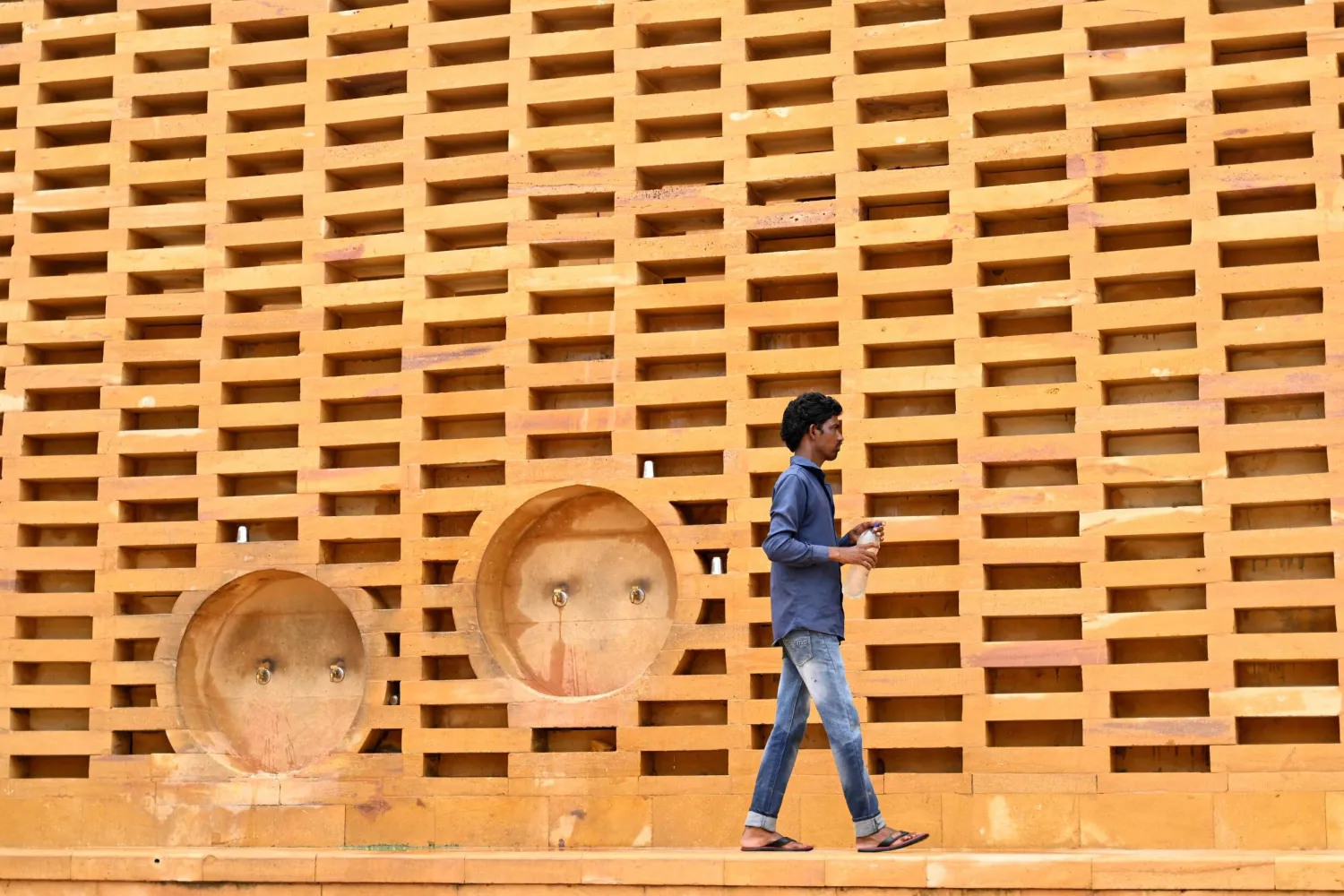
Indian Desert School's Unique Design Offers Respite from Heat

Temperatures inside the school can be as much as 20 percent lower than those outside. Idrees MOHAMMED / AFP
TT

Indian Desert School's Unique Design Offers Respite from Heat

Temperatures inside the school can be as much as 20 percent lower than those outside. Idrees MOHAMMED / AFP

In the sweltering heat of India's Thar desert, where summer highs soar above 50 degrees Celsius, an architecturally striking school is an oasis of cool thanks to a combination of age-old techniques and modern design.
The Rajkumari Ratnavati girls' school uses the same yellow sandstone as the 12th-century fort in nearby Jaisalmer, in India's western state of Rajasthan, dubbed the "golden city" due to the color of the rock, AFP said.
Like the fort, the school has thick rubble walls that help bounce back the heat, while the interior is plastered with lime, a porous material that regulates humidity and aids natural cooling.
Unlike the ancient fort, its roof is lined with solar panels, which provide all the school's power in an area with frequent electricity cuts.
Temperatures inside the school, designed by US-based architect Diana Kellogg and built by local artisans -- many of them parents of pupils -- can be as much as 20 percent lower than those outside.
"I love going to the school," said eight-year-old Khushboo Kumari, one of the 170 students.
"The air feels as if it is coming from an AC."
The school's classrooms are arranged around an open elliptical courtyard resembling a Roman coliseum, and walls with grids of vents create shade while allowing for cooling airflow.
Elevated windows allow hot air to escape as it rises. Rainwater is harvested from the flat roof.
In some places, the walls are dotted with perforations -- a technique known as "jali" that was traditionally used for modesty, shielding women from view in the conservative society.
At the school, it is used to promote ventilation, creating a breeze channeled by the building's oval shape.
"There is cross-ventilation," said school supervisor Rajinder Singh Bhati, aged 29. "The white tiles on the terrace reflect the sunlight."
"It is totally eco-friendly."
'Airy and cool'
India this year baked in its longest-ever heatwave, according to government weather experts.
Temperatures surged above 50 degrees Celsius (122 degrees Fahrenheit), with warnings people will face increasingly oppressive heat in the future.
Manohar Lal, 32, the father of pupil Khushboo, said students looked forward to class thanks to the relative cool.
"There are frequent power cuts in Rajasthan, and children have to suffer as temperatures touch almost 50 degrees Celsius in summer," Lal said outside his modest home of mud and brick, which does not have a ceiling fan.
"But there are no such worries in the school because it is powered by solar energy," he added.
"It is airy and cool, and that is why the children enjoy going to school".
'Feels like heaven'
The school is supported by the US-based CITTA Education Foundation, meaning pupils attend for free in a state where the literacy rate for women is about 52 percent.
Uniforms, school materials and lunch for pupils are also provided.
"It's a big thing that they are getting quality education free of cost, considering they can't even afford proper meals or clothing," said Hindi teacher Priyanka Chhangani, 40.
Kellogg, the architect, said combining tradition with modern design and sustainable techniques was key.
"Because the craftsmen were so familiar with the stone, we were able to integrate traditional architectural details along with indigenous heritage details, so that the structure felt authentic to the region", she said.
Her oval design was inspired by "feminine symbols of strength", she added.
But while her design focused on tackling baking heat, it also faces an unexpected, climate change-driven problem -- floods.
Intense rainfall during the annual monsoon is common from June to September, but experts say climate change is increasing its frequency and severity.
That increased rainfall has begun to impact the school, which was designed for a drier climate.
This year, a long-dormant river was overflowing, washing away soil at one side of the school.
Rajan Rawal, a professor at India's Centre for Environmental Planning and Technology University, said the increasing intensity of rain was impacting buildings designed for other weather.
"Disasters like heat waves and floods impact the structural stability," Rawal said.
They also affect the thermal performance of the building, he added.
But teacher Chhangani said the school was still changing the lives of the pupils.
"These children don't even have fans at home," she said. "When they come to school, it feels like heaven to them."



Coffee Regions Hit by Extra Days of Extreme Heat, Say Scientists 

17 April 2012, North Rhine-Westphalia, Vluyn: A general view of Arabica Coffee beans. (dpa)
TT

Coffee Regions Hit by Extra Days of Extreme Heat, Say Scientists 

17 April 2012, North Rhine-Westphalia, Vluyn: A general view of Arabica Coffee beans. (dpa)

The world's main coffee-growing regions are roasting under additional days of climate change-driven heat every year, threatening harvests and contributing to higher prices, researchers said Wednesday.

An analysis found that there were 47 extra days of harmful heat per year on average in 25 countries representing nearly all global coffee production between 2021 and 2025, according to independent research group Climate Central.

Brazil, Vietnam, Colombia, Ethiopia and Indonesia -- which supply 75 percent of the world's coffee -- experienced on average 57 additional days of temperatures exceeding the threshold of 30C.

"Climate change is coming for our coffee. Nearly every major coffee-producing country is now experiencing more days of extreme heat that can harm coffee plants, reduce yields, and affect quality," said Kristina Dahl, Climate Central's vice president for science.

"In time, these impacts may ripple outward from farms to consumers, right into the quality and cost of your daily brew," Dahl said in a statement.

US tariffs on imports from Brazil, which supplies a third of coffee consumed in the United States, contributed to higher prices this past year, Climate Central said.

But extreme weather in the world's coffee-growing regions is "at least partly to blame" for the recent surge in prices, it added.

Coffee cultivation needs optimal temperatures and rainfall to thrive.

Temperatures above 30C are "extremely harmful" to arabica coffee plants and "suboptimal" for the robusta variety, Climate Central said. Those two plant species produce the majority of the global coffee supply.

For its analysis, Climate Central estimated how many days each year would have stayed below 30C in a world without carbon pollution but instead exceeded that level in reality -- revealing the number of hot days added by climate change.

The last three years have been the hottest on record, according to climate monitors.


Dog Gives Olympics Organizers Paws for Thought

A dog wanders on the ski trail during the women's team cross country free sprint qualification event of the Milano Cortina 2026 Winter Olympic Games at Tesero Cross-Country Skiing Stadium in Lago di Tesero (Val di Fiemme), on February 18, 2026. (Photo by Anne-Christine POUJOULAT / AFP)
TT

Dog Gives Olympics Organizers Paws for Thought

A dog wanders on the ski trail during the women's team cross country free sprint qualification event of the Milano Cortina 2026 Winter Olympic Games at Tesero Cross-Country Skiing Stadium in Lago di Tesero (Val di Fiemme), on February 18, 2026. (Photo by Anne-Christine POUJOULAT / AFP)

A dog decided he would bid for an unlikely Olympic medal on Wednesday as he joined the women's cross country team free sprint in the Milan-Cortina Games.

The dog ran onto the piste in Tesero in northern Italy and gamely, even without skis, ran behind two of the competitors, Greece's Konstantina Charalampidou and Tena Hadzic of Croatia.

He crossed the finishing line, his moment of glory curtailed as he was collared by the organizers and led away -- his owner no doubt will have a bone to pick with him when they are reunited.


Olives, Opera and a Climate-Neutral Goal: How a Mural in Greece Won ‘Best in the World’ 

A building with the mural entitled “Kalamata” depicting opera legend Maria Callas by artist Kleomenis Kostopoulos is seen in Kalamata town, about 240 kilometers (150 miles) southwest of Athens, Monday, Feb. 9, 2026. (AP) 
TT

Olives, Opera and a Climate-Neutral Goal: How a Mural in Greece Won ‘Best in the World’ 

A building with the mural entitled “Kalamata” depicting opera legend Maria Callas by artist Kleomenis Kostopoulos is seen in Kalamata town, about 240 kilometers (150 miles) southwest of Athens, Monday, Feb. 9, 2026. (AP) 

Long known for its olives and seaside charm, the southern Greek city of Kalamata has found itself in the spotlight thanks to a towering mural that reimagines legendary soprano Maria Callas as an allegory for the city itself.

The massive artwork on the side of a prominent building in the city center has been named 2025’s “Best Mural of the World” by Street Art Cities, a global platform celebrating street art.

Residents of Kalamata, approximately 240 kilometers (150 miles) southwest of Athens, cultivate the world-renowned olives, figs and grapes that feature prominently on the mural.

That was precisely the point.

Vassilis Papaefstathiou, deputy mayor of strategic planning and climate neutrality, explained Kalamata is one of the few Greek cities with the ambitious goal of becoming climate-neutral by 2030. He and other city leaders wanted a way to make abstract concepts, including sustainable development, agri-food initiatives, and local economic growth, more tangible for the city’s nearly 73,000 residents.

That’s how the idea of a massive mural in a public space was born.

“We wanted it to reflect a very clear and distinct message of what sustainable development means for a regional city such as Kalamata,” Papaefstathiou said. “We wanted to create an image that combines the humble products of the land, such as olives and olive oil — which, let’s be honest, are famous all over the world and have put Kalamata on the map — with the high-level art.”

“By bringing together what is very elevated with ... the humbleness of the land, our aim was to empower the people and, in doing so, strengthen their identity. We want them to be proud to be Kalamatians.”

Southern Greece has faced heatwaves, droughts and wildfires in recent years, all of which affect the olive groves on which the region’s economy is hugely dependent.

The image chosen to represent the city was Maria Callas, widely hailed as one of the greatest opera singers of the 20th century and revered in Greece as a national cultural symbol. She may have been born in New York to Greek immigrant parents, but her father came from a village south of Kalamata. For locals, she is one of their own.

This connection is also reflected in practice: the alumni association at Kalamata’s music school is named for Callas, and the cultural center houses an exhibition dedicated to her, which includes letters from her personal archive.

Artist Kleomenis Kostopoulos, 52, said the mural “is not actually called ‘Maria Callas,’ but ‘Kalamata’ and my attempt was to paint Kalamata (the city) allegorically.”

Rather than portraying a stylized image of the diva, Kostopoulos said he aimed for a more grounded and human depiction. He incorporated elements that connect the people to their land: tree branches — which he considers the above-ground extension of roots — birds native to the area, and the well-known agricultural products.

“The dress I create on Maria Callas in ‘Kalamata’ is essentially all of this, all of this bloom, all of this fruition,” he said. “The blessed land that Kalamata itself has ... is where all of these elements of nature come from.”

Creating the mural was no small feat. Kostopoulos said it took around two weeks of actual work spread over a month due to bad weather. He primarily used brushes but also incorporated spray paint and a cherry-picker to reach all edges of the massive wall.

Papaefstathiou, the deputy mayor, said the mural has become a focal point.

“We believe this mural has helped us significantly in many ways, including in strengthening the city’s promotion as a tourist destination,” he said.

Beyond tourism, the mural has sparked conversations about art in public spaces. More building owners in Kalamata have already expressed interest in hosting murals.

“All of us — residents, and I personally — feel immense pride,” said tourism educator Dimitra Kourmouli.

Kostopoulos said he hopes the award will have a wider impact on the art community and make public art more visible in Greece.

“We see that such modern interventions in public space bring tremendous cultural, social, educational and economic benefits to a place,” he said. “These are good springboards to start nice conversations that I hope someday will happen in our country, as well.”