


Hurricane Hone Sweeps Past Hawaii, Dumping Enough Rain to Ease Wildfire Fears

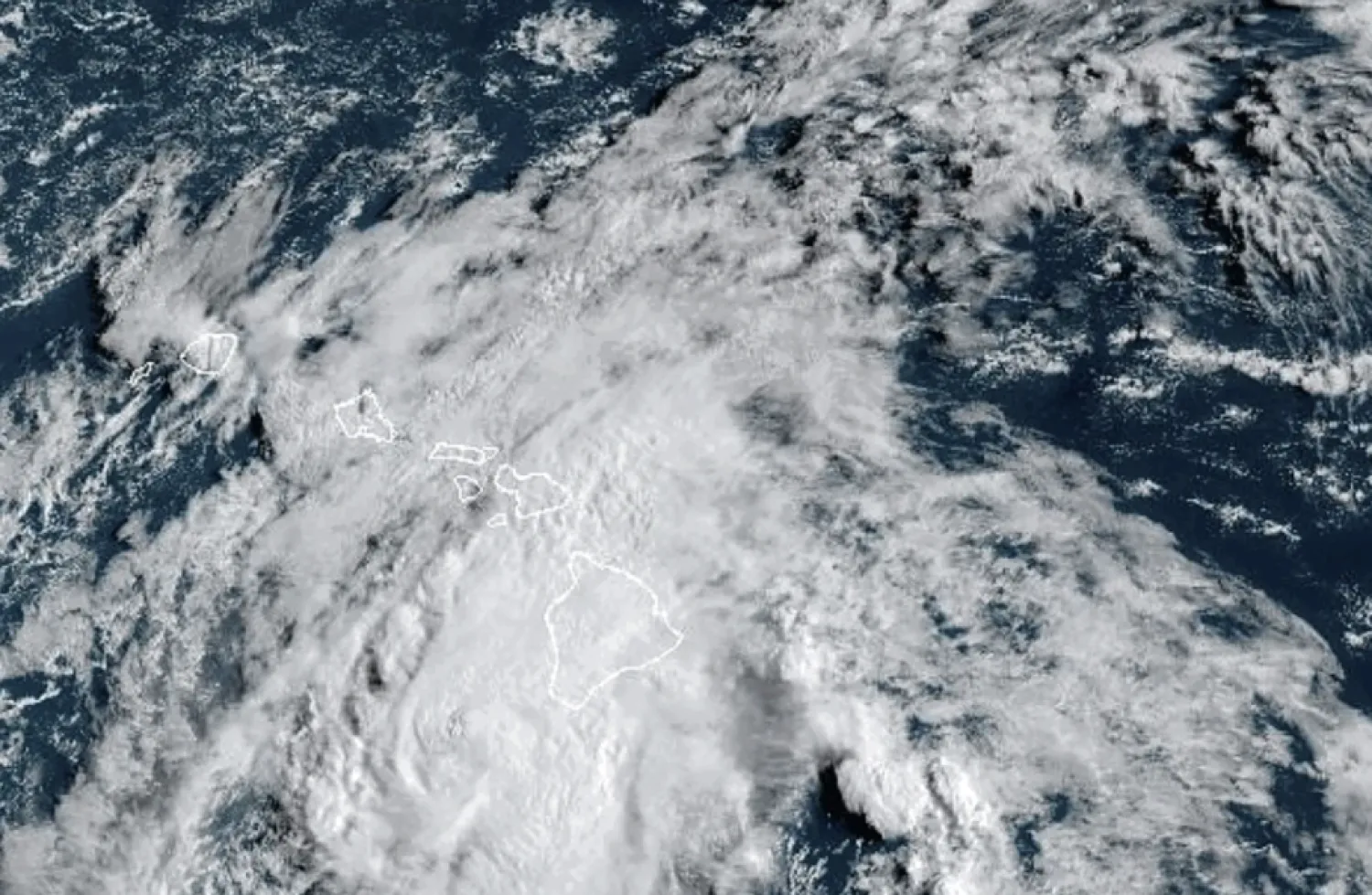
This Aug. 25, 2024 satellite image provided by the National Oceanic and Atmospheric Administration shows Hurricane Hone passing south of Hawaii. (NOAA via AP)
TT

Hurricane Hone Sweeps Past Hawaii, Dumping Enough Rain to Ease Wildfire Fears

This Aug. 25, 2024 satellite image provided by the National Oceanic and Atmospheric Administration shows Hurricane Hone passing south of Hawaii. (NOAA via AP)

Hurricane Hone passed just south of Hawaii on Sunday, dumping so much rain that the National Weather Service called off its red flag warnings that strong winds could lead to wildfires on the drier sides of the islands.

Meanwhile, the eastern Pacific saw a new threat emerge as Tropical Storm Hector formed, packing top sustained winds of 45 mph (75 kph). There were no coastal watches or warnings in effect as Hector churned far out at sea, the National Hurricane Center said, The AP reported.

Hone (pronounced hoe-NEH) had top winds of 85 mph (140 kph) Sunday morning as it swirled slowly past the Big Island, centered about 45 miles (72 kilometers) off its southernmost point, according to Jon Jelsema, a senior forecaster at the Central Pacific Hurricane Center. He said tropical storm force winds were blowing across the island’s southeast-facing slopes, carrying up to a foot (30 centimeters) or more of rain.

Floods closed Highway 11 between Kona and Hilo, and a higher-altitude alternative, the Cane Road, was closed by flooding as well, isolating properties like the Aikane Plantation Coffee Co. outside Pahala, where owner Phil Becker said his 10-inch (25-centimeter) rain gauge overflowed in the deluge.

“We’ve got quite a lot of flood damage, the gulches are running full speed ahead and they’re overflowing the bridges, so we’re trapped down here, we can’t get in or out,” Becker said Sunday.

Becker said his plantation is off the grid, powered with batteries charged by solar electricity, and his family is safe, so they have no reason to evacuate. The weather may even prove beneficial: “We’ve been in a drought situation so the coffee is probably loving all this rain,” he said.

Hurricane Gilma, meanwhile, weakened to a still-major Category 3 hurricane Saturday night, but it was far east of Hawaii and forecast to weaken into a depression before it reaches the islands.

Shelters were opened as Hurricane Hone blew in and beach parks on the eastern side of the Big Island were closed due to dangerously high surf, Hawaii County Mayor Mitch Roth said.

Jelsema offered a vivid metaphor for the rainfall: “As the rain gets pushed up the mountain terrain it wrings it out, kind of like wringing out a wet towel,” he said.

“It’s been really soaking those areas, there’s been flooding of roads. Roads have been cut off by high flood waters there in the windward sections of the big island, and really that’s the only portion of the state that’s had much flooding concern at this point,” he said.

Hone, whose name is Hawaiian for “sweet and soft,” poked at memories still fresh of last year's deadly blazes on Maui, which were fueled by hurricane-force winds. Red flag alerts are issued when warm temperatures, very low humidity and stronger winds combine to raise fire dangers. Most of the archipelago is already abnormally dry or in drought, according to the US Drought Monitor.

The Aug. 8, 2023, blaze that torched the historic town of Lahaina was the deadliest US wildfire in more than a century, with 102 dead. Dry, overgrown grasses and drought helped spread the fire.

Calvin Endo, a Waianae Coast neighborhood board member who lives in Makaha, a leeward Oahu neighborhood prone to wildfires, has worried for years about dry brush on private property behind his home. He's taken matters into his own hands by clearing the brush himself, but he's concerned about nearby homes abutting overgrown vegetation.

“All you need is fire and wind and we’ll have another Lahaina,” Endo said as the storm approached. “I notice the wind started to kick up already."

The cause of the Lahaina blaze is still under investigation, but it’s possible it was ignited by bare electrical wire and leaning power poles toppled by the strong winds. The state’s two power companies, Hawaiian Electric and the Kauai Island Utility Cooperative, were prepared to shut off power if necessary to reduce the chance that live, damaged power lines could start fires, but they later said the safety measures would not be necessary as Hone blew past the islands.

Roth said a small blaze that started Friday night in Waikoloa, on the dry side of the Big Island, was brought under control without injuries or damage.



Coffee Regions Hit by Extra Days of Extreme Heat, Say Scientists 

17 April 2012, North Rhine-Westphalia, Vluyn: A general view of Arabica Coffee beans. (dpa)
TT

Coffee Regions Hit by Extra Days of Extreme Heat, Say Scientists 

17 April 2012, North Rhine-Westphalia, Vluyn: A general view of Arabica Coffee beans. (dpa)

The world's main coffee-growing regions are roasting under additional days of climate change-driven heat every year, threatening harvests and contributing to higher prices, researchers said Wednesday.

An analysis found that there were 47 extra days of harmful heat per year on average in 25 countries representing nearly all global coffee production between 2021 and 2025, according to independent research group Climate Central.

Brazil, Vietnam, Colombia, Ethiopia and Indonesia -- which supply 75 percent of the world's coffee -- experienced on average 57 additional days of temperatures exceeding the threshold of 30C.

"Climate change is coming for our coffee. Nearly every major coffee-producing country is now experiencing more days of extreme heat that can harm coffee plants, reduce yields, and affect quality," said Kristina Dahl, Climate Central's vice president for science.

"In time, these impacts may ripple outward from farms to consumers, right into the quality and cost of your daily brew," Dahl said in a statement.

US tariffs on imports from Brazil, which supplies a third of coffee consumed in the United States, contributed to higher prices this past year, Climate Central said.

But extreme weather in the world's coffee-growing regions is "at least partly to blame" for the recent surge in prices, it added.

Coffee cultivation needs optimal temperatures and rainfall to thrive.

Temperatures above 30C are "extremely harmful" to arabica coffee plants and "suboptimal" for the robusta variety, Climate Central said. Those two plant species produce the majority of the global coffee supply.

For its analysis, Climate Central estimated how many days each year would have stayed below 30C in a world without carbon pollution but instead exceeded that level in reality -- revealing the number of hot days added by climate change.

The last three years have been the hottest on record, according to climate monitors.


Dog Gives Olympics Organizers Paws for Thought

A dog wanders on the ski trail during the women's team cross country free sprint qualification event of the Milano Cortina 2026 Winter Olympic Games at Tesero Cross-Country Skiing Stadium in Lago di Tesero (Val di Fiemme), on February 18, 2026. (Photo by Anne-Christine POUJOULAT / AFP)
TT

Dog Gives Olympics Organizers Paws for Thought

A dog wanders on the ski trail during the women's team cross country free sprint qualification event of the Milano Cortina 2026 Winter Olympic Games at Tesero Cross-Country Skiing Stadium in Lago di Tesero (Val di Fiemme), on February 18, 2026. (Photo by Anne-Christine POUJOULAT / AFP)

A dog decided he would bid for an unlikely Olympic medal on Wednesday as he joined the women's cross country team free sprint in the Milan-Cortina Games.

The dog ran onto the piste in Tesero in northern Italy and gamely, even without skis, ran behind two of the competitors, Greece's Konstantina Charalampidou and Tena Hadzic of Croatia.

He crossed the finishing line, his moment of glory curtailed as he was collared by the organizers and led away -- his owner no doubt will have a bone to pick with him when they are reunited.


Olives, Opera and a Climate-Neutral Goal: How a Mural in Greece Won ‘Best in the World’ 

A building with the mural entitled “Kalamata” depicting opera legend Maria Callas by artist Kleomenis Kostopoulos is seen in Kalamata town, about 240 kilometers (150 miles) southwest of Athens, Monday, Feb. 9, 2026. (AP) 
TT

Olives, Opera and a Climate-Neutral Goal: How a Mural in Greece Won ‘Best in the World’ 

A building with the mural entitled “Kalamata” depicting opera legend Maria Callas by artist Kleomenis Kostopoulos is seen in Kalamata town, about 240 kilometers (150 miles) southwest of Athens, Monday, Feb. 9, 2026. (AP) 

Long known for its olives and seaside charm, the southern Greek city of Kalamata has found itself in the spotlight thanks to a towering mural that reimagines legendary soprano Maria Callas as an allegory for the city itself.

The massive artwork on the side of a prominent building in the city center has been named 2025’s “Best Mural of the World” by Street Art Cities, a global platform celebrating street art.

Residents of Kalamata, approximately 240 kilometers (150 miles) southwest of Athens, cultivate the world-renowned olives, figs and grapes that feature prominently on the mural.

That was precisely the point.

Vassilis Papaefstathiou, deputy mayor of strategic planning and climate neutrality, explained Kalamata is one of the few Greek cities with the ambitious goal of becoming climate-neutral by 2030. He and other city leaders wanted a way to make abstract concepts, including sustainable development, agri-food initiatives, and local economic growth, more tangible for the city’s nearly 73,000 residents.

That’s how the idea of a massive mural in a public space was born.

“We wanted it to reflect a very clear and distinct message of what sustainable development means for a regional city such as Kalamata,” Papaefstathiou said. “We wanted to create an image that combines the humble products of the land, such as olives and olive oil — which, let’s be honest, are famous all over the world and have put Kalamata on the map — with the high-level art.”

“By bringing together what is very elevated with ... the humbleness of the land, our aim was to empower the people and, in doing so, strengthen their identity. We want them to be proud to be Kalamatians.”

Southern Greece has faced heatwaves, droughts and wildfires in recent years, all of which affect the olive groves on which the region’s economy is hugely dependent.

The image chosen to represent the city was Maria Callas, widely hailed as one of the greatest opera singers of the 20th century and revered in Greece as a national cultural symbol. She may have been born in New York to Greek immigrant parents, but her father came from a village south of Kalamata. For locals, she is one of their own.

This connection is also reflected in practice: the alumni association at Kalamata’s music school is named for Callas, and the cultural center houses an exhibition dedicated to her, which includes letters from her personal archive.

Artist Kleomenis Kostopoulos, 52, said the mural “is not actually called ‘Maria Callas,’ but ‘Kalamata’ and my attempt was to paint Kalamata (the city) allegorically.”

Rather than portraying a stylized image of the diva, Kostopoulos said he aimed for a more grounded and human depiction. He incorporated elements that connect the people to their land: tree branches — which he considers the above-ground extension of roots — birds native to the area, and the well-known agricultural products.

“The dress I create on Maria Callas in ‘Kalamata’ is essentially all of this, all of this bloom, all of this fruition,” he said. “The blessed land that Kalamata itself has ... is where all of these elements of nature come from.”

Creating the mural was no small feat. Kostopoulos said it took around two weeks of actual work spread over a month due to bad weather. He primarily used brushes but also incorporated spray paint and a cherry-picker to reach all edges of the massive wall.

Papaefstathiou, the deputy mayor, said the mural has become a focal point.

“We believe this mural has helped us significantly in many ways, including in strengthening the city’s promotion as a tourist destination,” he said.

Beyond tourism, the mural has sparked conversations about art in public spaces. More building owners in Kalamata have already expressed interest in hosting murals.

“All of us — residents, and I personally — feel immense pride,” said tourism educator Dimitra Kourmouli.

Kostopoulos said he hopes the award will have a wider impact on the art community and make public art more visible in Greece.

“We see that such modern interventions in public space bring tremendous cultural, social, educational and economic benefits to a place,” he said. “These are good springboards to start nice conversations that I hope someday will happen in our country, as well.”