300 Artists Sign Open Letter Opposing Israel Participation in Venice Film Festival

Of Dogs and Men (AE Content)
TT

300 Artists Sign Open Letter Opposing Israel Participation in Venice Film Festival

Of Dogs and Men (AE Content)

Around 300 filmmakers have signed an open letter opposing two Israeli films set to screen at the Venice Film Festival, held from 28 August to 7 September 2024.
Among the signatories are Italian filmmaker Enrico Parenti, actors Niccolò Senni, Simona Cavallari and Chiara Baschetti, in addition to a number of Arab filmmakers and actors — including two-time Oscar-nominated filmmaker Hany Abu-Assad and actor Saleh Bakri.
It seemed awkward to show two Israeli films at the Venice Film Festival while the war in the Gaza Strip was still in full swing, particularly that the festival administration had earlier opposed Russian participation because of the war in Ukraine.
The letter by filmmakers and artists is aimed at Dani Rosenberg’s Hebrew-language film Al Klavim Veanashim (Of Dogs and Men). The director is known for films that address the issue of the relationship between Palestinians and Israelis. His new film is set against the backdrop of the ongoing war in Gaza.
The second is Amos Gitai’s Why War. The latter stars French actors Irene Jacob, Mathieu Amalric and Micha Lescot. It is a fictional movie filmed against the backdrop of current events in Gaza. However, reports said that it does not address it directly.
According to the Hollywood Reporter, the open letter is entitled No Artwashing at 81 Mostra Del Cinema di Venezia.
“We, the undersigned artists, filmmakers and cultural workers, reject complicity with the Israeli regime of apartheid and oppose the artwashing of its Gaza genocide against Palestinians at the 81st Film Festival in Venice,” the letter said.
It added, “Two films screening at the Festival—Of Dogs and Men and Why War—were created by Israeli production companies that are complicit in whitewashing Israel’s oppression against Palestinians.”
In another paragraph, the letter said the Venice Film Festival has remained silent about Israel’s atrocities against the Palestinian people.
“This silence outrages us deeply. As art and film workers around the world, we call for effective and ethical measures to hold apartheid Israel to account for its crimes and system of colonial oppression against Palestinians,” it wrote.
The festival has not issued any reaction or comment. But any response will likely include denying the festival’s support for what is happening in Gaza and its adhering to the separation between art and politics.
In recent years, the Venice festival had faced similar but less important protests when it decided to screen films by directors Roman Polanski, Luc Besson and Woody Allen, who have been accused of sexual harassment on multiple occasions.
At the time, Venice Film Festival boss Alberto Barbera defended his decision, stating that he is “a festival director, not a judge.”
But the protest by filmmakers opposing the screening of two Israeli films constitutes an uncommon development. Therefore, the festival must find justifications beyond those mentioned earlier.
Danny Rosenberg's Of Dogs and Men is about a young girl searching for her missing dog in the midst of the ongoing war.
Amos Gitai's Why War, a movie considered by some Arab critics to be a left-wing anti-government film, is said to be more of a backstory than a report on the present events although it builds on them.


Indonesia to Loan Endangered Komodo Dragons to Japan for Breeding Program

A Komodo Dragon is seen in Komodo National Park, Indonesia April 6, 2018. REUTERS/Henning Gloystein/File Photo
TT

Indonesia to Loan Endangered Komodo Dragons to Japan for Breeding Program

A Komodo Dragon is seen in Komodo National Park, Indonesia April 6, 2018. REUTERS/Henning Gloystein/File Photo

Indonesia will loan two Komodo dragons to Japan's Shizuoka prefecture, where it is hoped the endangered reptiles will be able to breed, and will receive some red pandas and giraffes in return, an official said on Monday.

The Forestry Ministry said the animal swaps would increase "contributions from both parties toward wildlife protection and conservation, as well as raising public awareness of biodiversity," adding that the program ⁠was intended to breed ⁠the Komodo dragons, which the IUCN Red List classifies as endangered.

Ahmad Munawir, a conservation official at the ministry, told Reuters a male and a female will be sent to a zoo in ⁠Shizuoka. In return, the prefecture will send several animals to Indonesia, including red pandas and giraffes, Ahmad said.

The agreement was signed last week, ahead of a visit to Japan by President Prabowo Subianto, who will meet with Japanese Prime Minister Sanae Takaichi later this week.

Indonesia is home to over 3,000 Komodo dragons, according to government data. ⁠The ⁠reptiles are the largest lizards in the world, growing up to around 3 meters (10 feet) long. They have a yellow forked tongue and a venomous bite.

Japan's TV Shizuoka has reported the two dragons would arrive as early as June for the breeding program. Ahmad said the dragons would be sent after a business-to-business agreement was signed by the zoos in Indonesia and Japan.


Chesney the Kangaroo Scales Tall Fence and Flees Petting Zoo for 3 Days on the Lam

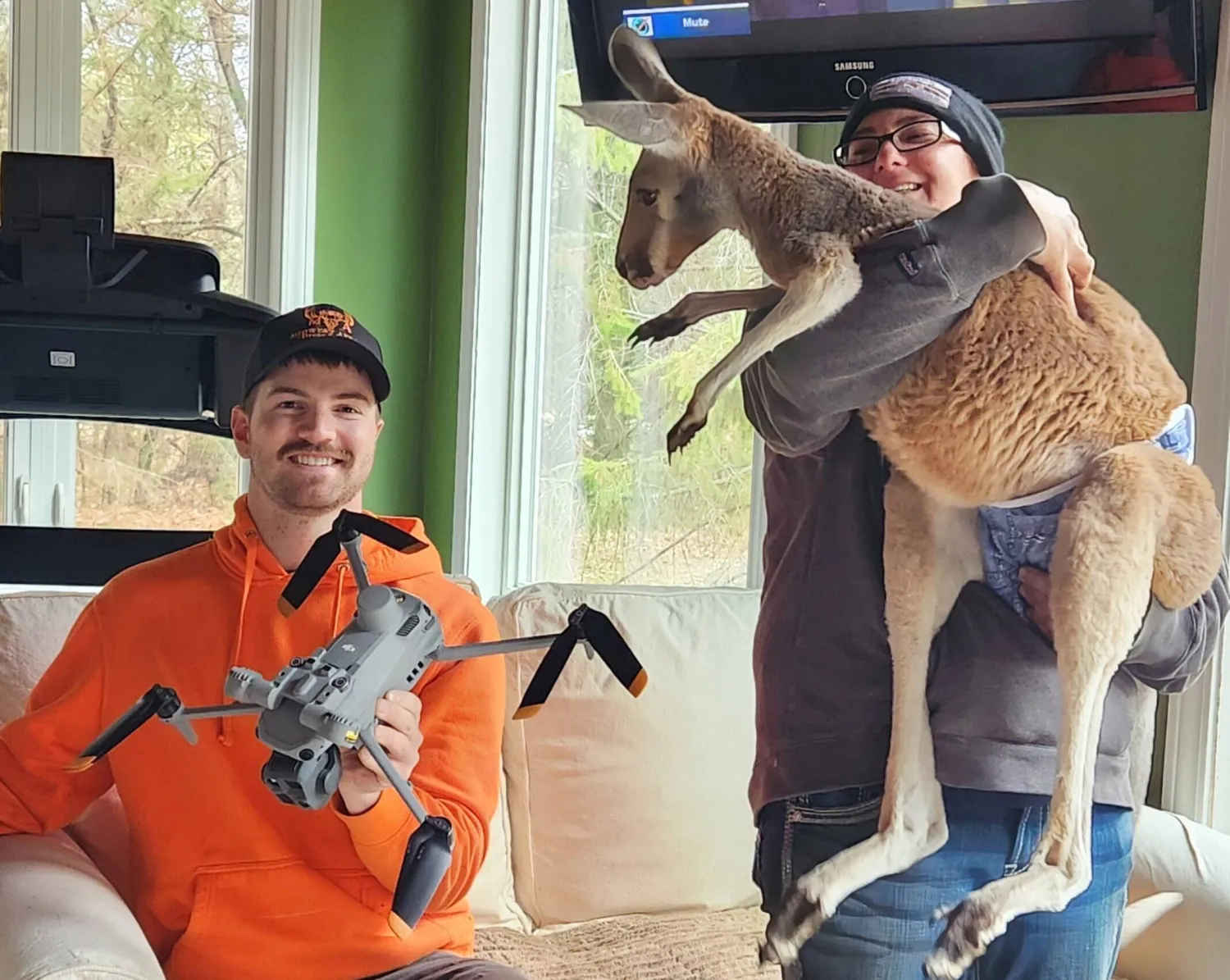
This photo provided by Cara Johnson shows her husband and drone operator, Colton Johnson, left, sitting next to Stacy Brereton as she holds a kangaroo named Chesney at Sunshine Farm, in Necedah, Wis., Saturday, March 28, 2026. (Cara Johnson via AP)
TT

Chesney the Kangaroo Scales Tall Fence and Flees Petting Zoo for 3 Days on the Lam

This photo provided by Cara Johnson shows her husband and drone operator, Colton Johnson, left, sitting next to Stacy Brereton as she holds a kangaroo named Chesney at Sunshine Farm, in Necedah, Wis., Saturday, March 28, 2026. (Cara Johnson via AP)

How does a kangaroo escape a petting zoo?

It's not the opening line to a dad joke. If you're Chesney the kangaroo, you scale an eight-foot (2 1/2 meter) fence and go on the lam for three days, giving your keeper sleepless nights and sending residents of a small Wisconsin town on a search that would end happily on Saturday.

The unprecedented leap at Sunshine Farm in Necedah, Wisconsin, last week was precipitated by some stray dogs that rushed the enclosure and spooked the 16-month-old Chesney, said his keeper, Debbie Marland. She and friends then trekked hither and yon in this town about 160 miles (255 kilometers) northwest of Milwaukee.

They chased reports of sightings and even rented heat-seeking drones, which proved effective in narrowing down the wanderings of the high-jumping adventurer.

“I was putting on about 37,000 steps per day looking for him,” Marland said Sunday. "I haven't done so much exercise in a very long time."

Chesney and his roommate Kenny are named for country-music starKenny Chesney. They're among 25 animals at Sunshine Farm, with horses, sheep, alpacas, Kunekune pigs, Highland cows and a Bactrian camel. The farm is generally open Fridays through Sundays from mid-May through mid-November and tours are offered to visitors who can interact with the animals.

Chesney escaped about 11:15 a.m. last Wednesday. Though he stayed within a three-mile (5-kilometer) radius of the farm, he kept his pursuers guessing.

Colton Johnson, owner of Midwest Aerial Drone Services, has used heat-sensing drones to help hunters recover deer and reunite missing dogs with their owners. Add a kangaroo to the list.

Johnson spent three days trailing Chesney alongside Marland and a team of volunteers. His strategy was similar to the ones he uses to find lost pets, but Johnson said the appearance of Chesney's heat signature on the drone footage was unique.

“It almost looked like a dinosaur running through the woods,” Johnson said. “It's got a long tail, and the way it was moving and hopping, that's the only way that I can describe it.”

The team caught up with Chesney on Wednesday and again Thursday night, but Johnson said the frightened kangaroo slipped away — once by jumping into a cold river — and Johnson lost track on the drone.

According to Marland's friend, Stacy Brereton, who helps out at the farm routinely, Friday was a tough day. No one had spotted Chesney all day and searchers feared he had wandered farther afield into even more unfamiliar territory, Brereton said.

Then, Friday night, Chesney was discovered nestled under a tree in a wooded area. A group of searchers surrounded him, but ever fleet of foot — 20 mph (32 kph) is no stretch for him — Chesney eluded them.

Marland returned to the area Saturday morning with Chesney's favorite treats and pieces of material that had his and Kenny's scent. Other searchers later joined her. But with no sign of the kangaroo, they started packing up. Just then, they spotted the long-eared kangaroo with outsize back legs approaching.

Brereton stepped up with a delicate touch.

“He had a very calm attitude when he walked up, obviously you could tell he wasn’t in fight-or-flight mode, so I just went with that,” Brereton said. “I just stayed calm with him and I just kind of went and sat and let him come to me.”

Chesney heard the voices and wanted attention, said Brereton, who eventually scooped up the 40-pound (18-kilogram) animal.

“I do believe he heard our comforting voices, he smelled the familiar smells of home and it just made him feel safe," said Brereton, adding, “I'm just glad he loves me as much as I love him.”

Marland said the “the community really did come together" for the kangaroo, who is now something of a celebrity. A Sunshine Farm fan has written a children's book about Chesney's adventures, which Marland hopes to publish and sell to recoup some of the search costs.

Kenny, who with his marsupial mate has the run of Marland's house, was happy to be reunited with Chesney. Though hungry and tired, Chesney was otherwise healthy but will get a checkup with the veterinarian shortly.

To be safe, Marland added, a new mesh top will be placed over the kangaroo enclosure to prevent any more high-jumping hijinks.


UN Body: Forty New Migratory Species Win International Protection

Migrating White Storks (Ciconia ciconia) in a field at a key stopover site for migratory birds near the West Bank city of Jenin, 26 March 2026. EPA/ALAA BADARNEH
TT

UN Body: Forty New Migratory Species Win International Protection

Migrating White Storks (Ciconia ciconia) in a field at a key stopover site for migratory birds near the West Bank city of Jenin, 26 March 2026. EPA/ALAA BADARNEH

The UN Convention on the Conservation of Migratory Species of Wild Animals (CMS) on Sunday approved the listing of 40 new species for international protection, including the snowy owl featured in the Harry Potter saga.

The decision came at the conclusion of the COP15 summit on migratory species in Campo Verde, Brazil, which brought together representatives from 132 countries and the European Union.

It is one of the world's most important global meetings for wildlife conservation.

Also on the new list for protection along with the snowy owl (Bubo scandiacus) are the Hudsonian godwit (Limosa haemastica) -- a long-beaked shorebird threatened with extinction -- and the great hammerhead shark (Sphyrna mokarran).

The new list featured land mammals like the striped hyena (Hyaena hyaena) and other aquatic wildlife such as the giant otter (Pteronura brasiliensis).

The countries that are party to the CMS are legally obliged to protect species listed as at risk of extinction, conserve and restore their habitats, prevent obstacles to migration and cooperate with other range states.

Campo Verde is in Brazil's biodiversity-rich Pantanal wetlands, in the southern Amazon.

According to a report released ahead of the summit, nearly half (49 percent) of all species catalogued by the CMS are showing signs of declining numbers, and nearly one in four are threatened with extinction on a worldwide scale.

Another major UN assessment, published on Tuesday as the summit opened, warned that migratory freshwater fish populations crucial to river health and sustaining the livelihoods of millions of people are in freefall and risk collapse.

Habitat destruction, overfishing and water pollution from the Amazon to the Danube threaten the very survival of hundreds of species whose epic voyages along the world's great rivers go largely unnoticed.

Last November, Brazil hosted the COP30 climate summit in the Amazonian city of Belem.