New England Town Celebrates Being Birthplace of Teenage Mutant Ninja Turtles

Bronze statues of the Teenage Mutant Ninja Turtles characters are displayed as part of the permanent collection at the Woodman Museum, Thursday, Sept. 5, 2024, in Dover, N.H.  (AP Photo/Charles Krupa)
Bronze statues of the Teenage Mutant Ninja Turtles characters are displayed as part of the permanent collection at the Woodman Museum, Thursday, Sept. 5, 2024, in Dover, N.H. (AP Photo/Charles Krupa)
TT

New England Town Celebrates Being Birthplace of Teenage Mutant Ninja Turtles

Bronze statues of the Teenage Mutant Ninja Turtles characters are displayed as part of the permanent collection at the Woodman Museum, Thursday, Sept. 5, 2024, in Dover, N.H.  (AP Photo/Charles Krupa)
Bronze statues of the Teenage Mutant Ninja Turtles characters are displayed as part of the permanent collection at the Woodman Museum, Thursday, Sept. 5, 2024, in Dover, N.H. (AP Photo/Charles Krupa)

As the Teenage Mutant Ninja Turtles grew to become a pop culture sensation, the place where they were conceived rarely got mentioned.
It wasn't the New York City sewers, where the Turtles mutated from regular reptiles into a crime-fighting quartet who battled foes with nunchucks, snark and pizza. Rather, it was a small city near the New Hampshire coast.
According to The Associated Press, a new exhibit hopes to put that community, Dover, New Hampshire, at the center of the Turtles' story and, in turn, attract Turtle-obsessed fans or anyone else who grew up reading the comics and watching Ninja Turtles movies and TV shows. At one point in the 1980s, the frenzy around the Turtles was called Turtlemania.
“It's the birthplace,” said Kevin Eastman, who, along with Peter Laird, created the Teenage Mutant Ninja Turtles 41 years ago when the two shared a house in Dover. The first issue went on sale a year later. “That’s where the Turtles were created. ... It is very historic and very important to us.”
The Turtles' exhibit opened last month at the Woodman Museum, which houses an eclectic collection that includes a stuffed polar bear and a Victorian funeral exhibit replete with a horse-drawn hearse.
With its explosion of colors and cabinets full of action figures, the exhibit aims to be the place to go for all things Turtles.
It starts with franchise's humble beginnings in Dover, where the duo formed Mirage Studios, a play on the fact they were creating the first comic in their living room rather than an actual studio. Inspired by Eastman's fascination with turtles and martial arts, they came up with the crime-fighting Turtles and self-published their first comic in black and white.
“We hoped that one day we would sell enough copies of our 3,000 printed, $1.50 comic books that we could pay my uncle back,” Eastman said, adding that they had no intention of writing a second issue until fans asked for more.
“We loved our characters. We loved what we did. We told the best story we could. We hoped for the best,” he continued. “But I also could never have imagined that one comic book would lead to any of this.”
Ralph DiBernardo, whose store in nearby Rochester sells comics and games, was among the first to champion the Turtles. He knew Eastman and Laird from selling them comics and was the first person to sell their Turtles comic commercially after purchasing 500 copies. But he said at the time, it seemed more like a favor to friends than a business decision, with him thinking, “those guys are never going to make their money back.”
“To watch them go from two struggling guys just barely getting by to becoming multi-millionaires, it’s that American dream story that just never happens,” said DiBernardo, who remains friends with the two artists.
The exhibit details the emergence of the Turtles as a global phenomenon, featuring pizza-obsessed characters with catchphrases such as “cowabunga” and “booyakasha.”
Among the exhibit's highlights are a video game console where visitors can play Turtles arcade games, vinyl records of soundtracks from Turtles movies and signed, first-run Turtles comics, including some valued in the tens of thousands of dollars. The marketing power of the Turtles is also on display, with everything from Turtles-inspired Christmas ornaments, throw rugs and backpacks to a talking toothbrush.
In the middle of it all is a set of massive bronze statues depicting the four turtles — Leonardo, Michelangelo, Donatello and Raphael — along with the mutant rat and resident sage, Master Splinter. The display was one of 12 made as part of a fundraiser by Eastman to benefit a museum in Northampton, Massachusetts.



Scottish Antiques Auction Selling Neck Shackles Accused of ‘Profiting from Slavery’

“I think it’s important not to upset and offend, but shock people into learning the whole truth,” the auctioneer, Marcus Salter, said. (Cheeky Auctions Tain)
TT

Scottish Antiques Auction Selling Neck Shackles Accused of ‘Profiting from Slavery’

“I think it’s important not to upset and offend, but shock people into learning the whole truth,” the auctioneer, Marcus Salter, said. (Cheeky Auctions Tain)

An antiques auction selling chains linked to the enslavement of African people in Zanzibar has been accused of “profiting from slavery,” according to The Guardian.

The shackles, dated to 1780 and valued at about £1,000, are among objects listed in the auction, called “Challenging History.”

The auctioneer Marcus Salter, of Cheeky Auctions in Tain, Ross, said he wanted to ensure history was confronted with the sale of the “sensitive artifact” and did not wish to offend.

“I think it’s important not to upset and offend, but shock people into learning the whole truth,” Salter said. “There are certain things we’re not allowed to sell at auction. We had to check with the platform we’re selling with that we could do this. They consider the slave chains to be a historical artefact, therefore we can.

But Labour MP Bell Ribeiro-Addy, who chairs the all-party parliamentary group for Afrikan reparations, said trading in such items meant people were “continuing to profit from the slave trade.”

She said, “If they were to be put in a museum I would understand, but buying and selling them like oddities is the same thing that people do when it comes to human remains– treating them as collector’s items, something to be fetishized rather than items that should be looked at in horror.”

Salter said he was selling the chains for a dealer whose father had owned them for 50 years, adding: “No matter what happens there’s going to be money made out of it from somewhere.”

He claimed if the item was donated to a museum, it could be “put into storage and never seen again”, and that slavery-linked mahogany was sold and used without controversy.

In 2024, the Antiques Roadshow expert Ronnie Archer-Morgan refused to value an ivory bangle linked to enslavement.

Caecilia Dance, an associate at London law firm Wedlake Bell, has advised on the restitution of Nazi-looted art. Dance said she could not comment on the auction, but that there was “no specific law against” trading objects linked to slavery.

She added that “public interest stewardship” – donation, sale, or long-term loan to a museum with relationships with affected communities – would be the “ideal management pathway” for an item linked to slavery.


Crews Recover Bodies of 9 Backcountry Skiers Days after California Avalanche

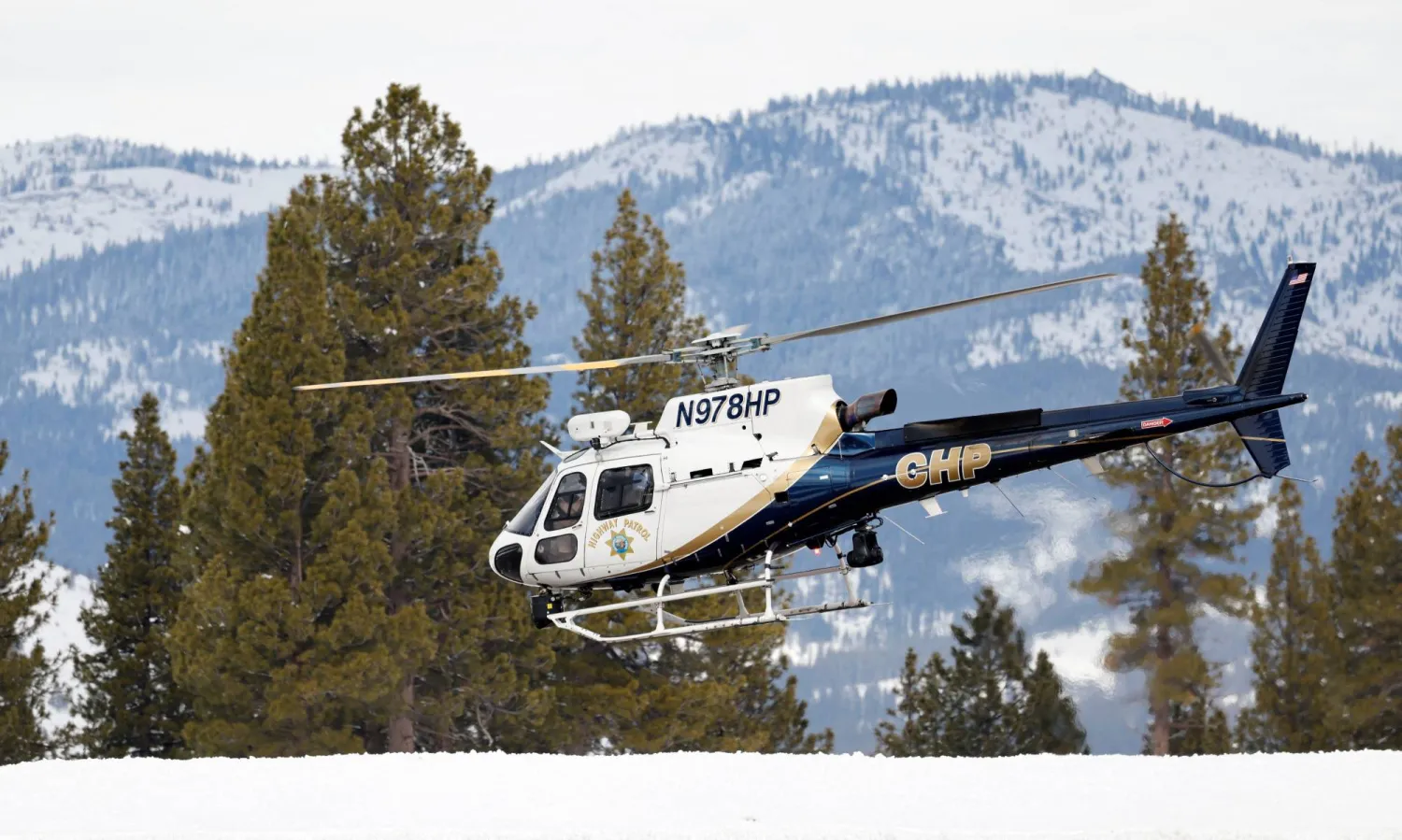
A California Highway Patrol helicopter lifts off from Truckee Tahoe Airport while taking part in recovery efforts for the skiers that died in an avalanche in the Sierra Nevada mountains, in Truckee, California, US February 21, 2026.  REUTERS/Fred Greaves
A California Highway Patrol helicopter lifts off from Truckee Tahoe Airport while taking part in recovery efforts for the skiers that died in an avalanche in the Sierra Nevada mountains, in Truckee, California, US February 21, 2026. REUTERS/Fred Greaves
TT

Crews Recover Bodies of 9 Backcountry Skiers Days after California Avalanche

A California Highway Patrol helicopter lifts off from Truckee Tahoe Airport while taking part in recovery efforts for the skiers that died in an avalanche in the Sierra Nevada mountains, in Truckee, California, US February 21, 2026.  REUTERS/Fred Greaves
A California Highway Patrol helicopter lifts off from Truckee Tahoe Airport while taking part in recovery efforts for the skiers that died in an avalanche in the Sierra Nevada mountains, in Truckee, California, US February 21, 2026. REUTERS/Fred Greaves

Crews recovered the bodies of nine backcountry skiers who were killed by an avalanche in California's Sierra Nevada, authorities said Saturday, concluding a harrowing operation that was hindered by intense snowfall.

A search team reached the bodies of eight victims and found one other who had been missing and presumed dead since Tuesday’s avalanche on Castle Peak near Lake Tahoe. The ninth person who was missing was found “relatively close” to the other victims, according to Nevada County Sheriff’s Lt. Dennis Hack, but was impossible to see due to whiteout conditions at that time.

At a news conference, Sheriff Shannon Moon praised the collective efforts of the numerous agencies that helped recover the bodies — from the California Highway Patrol to the National Guard to the Pacific Gas & Electric utility company — and 42 volunteers who helped on the last day of the operation.

“We are fortunate in this mountain community that we are very tight-knit, and our community shows up in times of tragedy,” The Associated Press quoted Moon as saying.

The sheriff named for the first time the three guides from Blackbird Mountain Company who died: Andrew Alissandratos, 34, Nicole Choo, 42, and Michael Henry, 30.

According to biographies on the company's website, Alissandratos was originally from Tampa, Florida, and moved to Tahoe roughly a decade ago. He enjoyed a wide array of adventure activities, from backcountry exploration to rock climbing.

Henry moved to Colorado in 2016 and then to Truckee three years later. He was described as “laid back” and devoted to sharing his knowledge and love of the mountains with others.

There was no bio for Choo on the website.

“This was an enormous tragedy, and the saddest event our team has ever experienced,” Blackbird Mountain founder Zeb Blais said Wednesday in a statement.

“We are doing what we can to support the families who lost so much,” he said, “and the members of our team who lost treasured friends and colleagues.”

The six other fatal victims were women who were part of a close-knit group of friends who were experienced backcountry skiers and knew how to navigate the Sierra Nevada wilderness, their families said this week.

They were identified as Carrie Atkin, Liz Clabaugh, Danielle Keatley, Kate Morse, Caroline Sekar and Kate Vitt, all in their 40s. They lived in the San Francisco Bay Area, Idaho and the Lake Tahoe area.

“We are devastated beyond words,” the families said in a statement. “Our focus right now is supporting our children through this incredible tragedy and honoring the lives of these extraordinary women. They were all mothers, wives and friends, all of whom connected through the love of the outdoors.”

The families asked for privacy while they grieve and added that they “have many unanswered questions.”

Two of the friends got out alive and were rescued along with four others, including one guide, after Tuesday’s avalanche. Their names have not been released.

The avalanche struck on the last day of the 15 skiers’ three-day tour, when the group decided to end the trip early to avoid the impending snowstorm.

Officials have said the path they took is a “normally traveled route” but declined to specify what that meant.

At around 11:30 a.m. Tuesday, the six survivors called for help, describing a sudden and terrifying slide that was approximately the length of a football field. In the aftermath they discovered the bodies of three fellow skiers, according to Hack.

Rescuers were not able to reach them until roughly six hours after the initial call for help, Hack said, and took two separate paths to arrive. They found five other bodies, leaving only one person unaccounted for.

But it was immediately clear to rescuers that it was too dangerous to extract the bodies at that time due to the heavy snowfall and threat of more avalanches.

Those conditions persisted on Wednesday and Thursday.

A breakthrough on Friday Authorities used two California Highway Patrol helicopters, with the help of Pacific Gas & Electric Company, to break up the snow and intentionally release unstable snowpack to reduce the avalanche risk.

Crews were then able to recover five victims that evening before it got too dark to access the last three.

Rescuers used helicopters and ropes to hoist the last four bodies from the mountain the following morning, fighting through severe winds that forced them to make multiple trips. The bodies were then taken to snowcats — trucks that are outfitted to drive on snow — for further transport.

“We cannot say enough how tremendously sorry we are for the families that have been affected by this avalanche,” Moon said.

Initial reports indicated that at least two of the surviving skiers were not swept away by the avalanche, Hack said. The others were standing separately and relatively close together and were hit.

Hack declined to offer information about what might have set off the avalanche.

Authorities close the area The terrain will be off-limits to visitors until mid-March, said Chris Feutrier, forest supervisor for the Tahoe National Forest. Officials intended to restore public access once the investigation is complete.

“This is the public’s land, and they love to recreate on it,” Feutrier said. “The Forest Service doesn’t close public land for every hazard or every obstacle. We trust the American people to use their best judgment when recreating.”


Riyadh Municipality Decorates Capital with Over 5,000 Lights for Founding Day

The capital's streets have transformed into vibrant displays of national pride, embodying 299 years of continuous development and progress - SPA
TT

Riyadh Municipality Decorates Capital with Over 5,000 Lights for Founding Day

The capital's streets have transformed into vibrant displays of national pride, embodying 299 years of continuous development and progress - SPA

The Riyadh Municipality has illuminated the capital's main streets, vital thoroughfares, and public squares with over 5,000 decorative lights in celebration of Saudi Founding Day.

The project involved installing 5,481 decorative lights across various locations to enhance the festive atmosphere throughout Riyadh's neighborhoods, giving the city a harmonious visual character that reflects profound pride in the nation's rich history, SPA reported.

As light and identity intertwine, the capital's streets have transformed into vibrant displays of national pride, embodying 299 years of continuous development and progress.

The transformation reflects the deep significance of Founding Day in the hearts of citizens and translates their loyalty to the leadership's blessed journey.