
Türkiye Wants to Regulate Germany’s Beloved Döner Kebab Street Food 

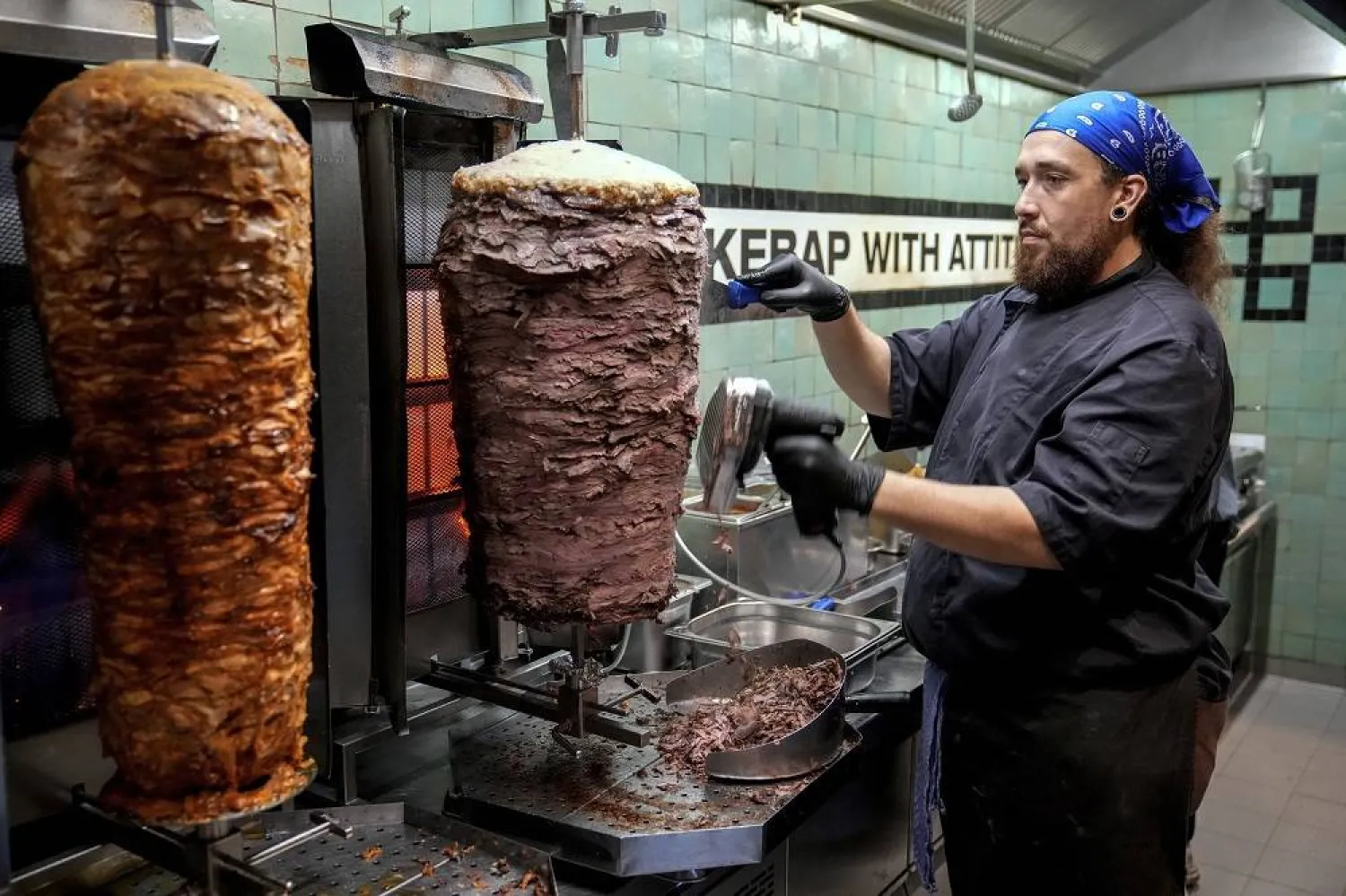
Döner chef Hvesley Silva cuts döner kebab in a döner kebab restaurant in Berlin, Germany, Monday, Sept. 16, 2024. (AP)
TT

Türkiye Wants to Regulate Germany’s Beloved Döner Kebab Street Food 

Döner chef Hvesley Silva cuts döner kebab in a döner kebab restaurant in Berlin, Germany, Monday, Sept. 16, 2024. (AP)

Beef and chicken glisten as they rotate slowly on vertical spits before they are carved off in razor-thin strips. Two cooks slide from a sizzling griddle to a warm toaster in a practiced dance. Mounds of fresh tomatoes, cabbage and red onions shine in a colorful tableau.

The scene at Kebap With Attitude in Berlin’s trendy Mitte neighborhood is typical of any street-side stand or restaurant where cooks pile the ingredients into pita bread to create the city’s beloved döner kebab.

But the snack's status could be in jeopardy if the European Commission approves a bid by Türkiye to regulate what can legally take the döner kebab name.

In the balance is an industry that generates annual sales of roughly 2.3 billion euros (nearly $2.6 billion) in Germany alone, and 3.5 billion euros (nearly $3.9 billion) across Europe, according to the Berlin-based Association of Turkish Döner Producers in Europe.

“From the government to the streets, everyone is eating döner kebab,” Deniz Buchholz, the owner of Kebap With Attitude, said as waiters ferried steaming orders from the kitchen to hungry lunchtime customers on a rainy Monday afternoon.

The word “döner” is derived from the Turkish verb “dönmek,” which means “to turn.” The meat is grilled for hours on a spit and sliced off when the meat becomes crisp and brown. In Türkiye, the dish originally was made of lamb and sold only on a plate. But in the 1970s, Turkish immigrants in Berlin opted to serve it in a pita and tweak the recipe to make it special for Berliners.

“They realized that the Germans like everything in the bread,” said Buchholz, who was raised in Berlin and has Turkish roots. “And then they said, ‘OK, let’s put this dish into a bread’ and this is how it came to döner kebab Berlin-style.”

In April, Türkiye applied to have döner kebab protected under a status called “traditional specialty guaranteed.” It’s below the vaunted “protected designation of origin” that applies to geographic region-specific products, but could still impact kebab-shop owners, their individual recipes and their customers throughout Germany.

Under Türkiye’s proposal, beef would be required to come from cattle that is at least 16 months old. It would be marinated with specific amounts of animal fat, yogurt or milk, onion, salt, and thyme, as well as black, red and white peppers. The final product must be sliced off the vertical spit into pieces that are 3 to 5 millimeters (0.1 to 0.2 inches) thick. Chicken would be similarly regulated.

The European Commission must decide by Sept. 24 whether 11 objections to the application, including from Germany’s Federal Ministry of Food and Agriculture, have merit. If they do, Germany and Türkiye will have up to six months to hammer out a compromise. The European Commission has the final say.

“We have taken note of the application from Türkiye with some astonishment,” Germany’s Federal Ministry of Food and Agriculture said in a statement to The Associated Press.

“The kebab is part of Germany, and the diversity of its preparation methods reflects the diversity of our country — this must be preserved. In the interests of the many fans in Germany, we are committed to ensuring that the doner kebab can remain as it is prepared and eaten here," the ministry said.

It appears that vegetables, turkey and some veal kebabs — all of which are popular in Germany — would no longer be allowed under Türkiye’s application because it does not specifically mention them, causing confusion in the German food industry.

“The kebab belongs to Germany. Everyone should be allowed to decide for themselves how it is prepared and eaten here. There’s no need for guidelines from Ankara,” Cem Özdemir, Germany’s federal food and agriculture minister who also has Turkish roots, wrote on social platform X.

Buchholz of Kebap With Attitude said he isn’t worried about possible regulations.

Although he said it might be a way to keep the quality high for the traditional döner kebab — he believes it has lapsed in some places — he added that shop owners might have to harness Berlin’s legacy of creative solutions to keep their expanded menus.

“We will go the Berlin way and we’ll find a solution to name it different,” he said, like calling it a “veggie sandwich.”

Döner kebab impacts the political sphere, too. Anger over kebab costs that have risen into the double-digits led the Die Linke, the Left party, to ask German Chancellor Olaf Scholz for a “price break” that would have subsidized the street food and set a maximum price for customers. Scholz declined, but took to social media to explain that increasing food costs come in part from soaring energy costs — which are fueled by Russia’s war on Ukraine.

And German President Frank-Walter Steinmeier engaged in “döner diplomacy” when he brought a third-generation kebab-shop owner, as well as a full skewer of meat, to Türkiye in April. The trip was the first official visit there by a German president in a decade, even as Türkiye’s populist president, Recep Tayyip Erdogan, is seen as having increasingly authoritarian instincts. Erdogan's reputation has made some Turkish citizens who own kebab shops in Germany fearful of speaking out against the proposed regulations for fear of facing reprisals when they go home.

In its objection, the German Hotel and Restaurant Association wrote that Türkiye’s proposals differ from typical German preparations for döner, and that the regulations could lead to economic problems for kebab shops — as well as potential legal challenges.

The German döner kebab economy should not be held to Turkish rules, the association said in a statement.

“The diversity of the kebab must be preserved,” the association said.


Elusive Wild Cat Feared Extinct Rediscovered in Thailand

This handout picture taken with a camera trap and released on December 26, 2025, by Thailand's Department of National Parks, Wildlife and Plant Conservation (DNP) and Panthera Thailand shows a recently rediscovered flat-headed cat in southern Thailand's Princess Sirindhorn Wildlife Sanctuary. (AFP / Thailand's Department of National Parks, Wildlife and Plant Conservation (DNP) / Panthera Thailand)
TT

Elusive Wild Cat Feared Extinct Rediscovered in Thailand

This handout picture taken with a camera trap and released on December 26, 2025, by Thailand's Department of National Parks, Wildlife and Plant Conservation (DNP) and Panthera Thailand shows a recently rediscovered flat-headed cat in southern Thailand's Princess Sirindhorn Wildlife Sanctuary. (AFP / Thailand's Department of National Parks, Wildlife and Plant Conservation (DNP) / Panthera Thailand)

An elusive wild cat long feared extinct in Thailand has been rediscovered three decades after the last recorded sighting, conservation authorities and an NGO said Friday.

Flat-headed cats are among the world's rarest and most threatened wild felines. Their range is limited to Southeast Asia and they are endangered because of dwindling habitat.

The domestic cat-sized feline with its distinctive round and close-set eyes was last spotted in a documented sighting in Thailand in 1995.

But an ecological survey that began last year, using camera traps in southern Thailand's Princess Sirindhorn Wildlife Sanctuary, recorded 29 detections, according to the country's Department of National Parks, Wildlife and Plant Conservation and wild cat conservation organization Panthera.

"The rediscovery is exciting, yet concerning at the same time," veterinarian and researcher Kaset Sutasha of Kasetsart University told AFP, noting that habitat fragmentation has left the species increasingly "isolated".

It was not immediately clear how many individuals the detections represent, as the species lacks distinctive markings so counting is tricky.

But the findings suggest a relatively high concentration of the species, Panthera conservation program manager Rattapan Pattanarangsan told AFP.

The footage included a female flat-headed cat with her cub -- a rare and encouraging sign for a species that typically produces only one offspring at a time.

Nocturnal and elusive, the flat-headed cat typically lives in dense wetland ecosystems such as peat swamps and freshwater mangroves, environments that are extremely difficult for researchers to access, Rattapan said.

Globally, the International Union for Conservation of Nature estimates that around 2,500 adult flat-headed cats remain in the wild, classifying the species as endangered.

In Thailand, it has long been listed as "possibly extinct".

Thailand's peat swamp forests have been heavily fragmented, largely due to land conversion and agricultural expansion, said Kaset, who was not involved in the ecological survey but has researched wild cats for years.

The animals also face mounting threats from disease spread by domestic animals, and they struggle to reproduce across isolated areas.

While the rediscovery offers hope, it is only a "starting point" for future conservation efforts, he said.

"What comes after this is more important -- how to enable them to live alongside us sustainably, without being threatened."


Hooked on the Claw: How Crane Games Conquered Japan’s Arcades

This picture taken on June 6, 2024 shows a claw crane game shop in Akihabara district of Tokyo. (AFP)
TT

Hooked on the Claw: How Crane Games Conquered Japan’s Arcades

This picture taken on June 6, 2024 shows a claw crane game shop in Akihabara district of Tokyo. (AFP)

As school and work wrap up, crowds fill Tokyo's many bustling arcade halls -- not to battle it out in fighting games, but to snag plush toys from claw machines.

In one of these gaming hubs in the Japanese capital's Ikebukuro district, aisles of crane games stretch as far as the eye can see.

The crown jewels of the arcade industry, they occupy the building's first two floors, relegating video games to the basement and upper levels.

"Crane games are keeping the sector afloat," said Morihiro Shigihara, an industry expert and former arcade manager.

"Arcade operators, machine manufacturers, and even prize suppliers depend on this business," he told AFP.

Some 80 percent of the 22,000 arcades Japan had in 1989 have shut down, but revenues have held up thanks to claw machines, according to the Japan Amusement Industry Association.

Their share of revenue has climbed since 1993 from 20 percent to more than 60 percent, the association said.

Suzuna Nogi, a 20-year-old student, visits these arcades at least twice a week in search of "big plushies" on which she can spend up to 3,000 yen ($19) at 100 yen per try.

"What I like best is the sense of accomplishment," she said, even though there is no guarantee of success.

Nogi added that she enjoys "the thrill of not knowing whether you'll manage to grab something or not".

The sensitivity of the claw arms is adjusted by operators "based on the cost of the prizes and revenue targets", Shigihara said.

"You can also make the game easier to compete with a nearby arcade."

- From cigarettes to candy -

This year, the industry is officially celebrating the 60th anniversary of these construction crane-inspired machines in Japan.

But they have actually been around since before World War II, said Benoit Bottos, who wrote his doctoral dissertation on the subject at Japan's Chuo University.

Older models, installed in cafes or bowling alleys, sometimes offered lighters and cigarettes, but those prizes quickly gave way to children's candy.

In the late 1980s, the machines began to gain traction, notably with game company Sega's 1985 invention of the "UFO Catcher", which switched up the older version that forced players to lean in and look down.

"The old ones were a bit dark. So we opted for a brighter, showcase-like style where you can see the prizes right in front of you," said Takashi Sasaya, a Sega executive.

But the real stroke of genius "was putting plush toys in the claw games", said Bottos.

Manufacturing giants like Sega or Bandai, involved in both video games and toys, then began negotiating licenses for anime and manga characters, with Sega notably securing Disney rights.

"That largely explains the success of these machines," said Bottos, who describes them as "somewhere between a vending machine, a game of chance and a game of skill".

- 'Transformation' -

The success of claw games also feeds on Japan's booming fan culture of "oshikatsu", with many people devoting more and more time and money to supporting their favorite idol.

Part of asserting their fan identity involves collecting character merchandise.

"I love Pokemon, so I often come looking for plush toys and merch from the franchise," said professional Pokemon card player Akira Kurasaki, showing off nails decorated with his most beloved characters.

Arcade operators have taken this enthusiasm to heart, tailoring their prize selections to the demographics of their neighborhood and organizing events around certain characters.

"New prizes are introduced almost every day," said Sasaya, the Sega executive.

The hegemony of claw machines has also gone hand in hand with a gradual transformation of urban hangouts.

Arcades -- seen in the 1970s and 1980s as dark, male-dominated places linked to crime -- "tried to attract a new audience" of women and families, Bottos said.

"The crane game is emblematic of that transformation."


Hawaii’s Big Island Bans Feeding Feral Cats in an Effort to Help Endangered Native Species

Liz Swan sets up food and a trap for stray cats near the Kealakehe Transfer Station and Recycling Center, Tuesday, Dec. 2, 2025, in Kailua-Kona, Hawaii. (AP)
TT

Hawaii’s Big Island Bans Feeding Feral Cats in an Effort to Help Endangered Native Species

Liz Swan sets up food and a trap for stray cats near the Kealakehe Transfer Station and Recycling Center, Tuesday, Dec. 2, 2025, in Kailua-Kona, Hawaii. (AP)

Throngs of feral cats emerge from the shade of parked trucks and bushes as soon as the familiar Subaru Forester pulls into a dump on Hawaii's Big Island. They run after the vehicle to a certain meal — a gravy train that might not be around much longer.

A Hawaii County law set to take effect at the start of the new year bans feeding feral animals on county property. It's an effort to protect native species, such as an endangered goose called the nene, from a super predator introduced to the islands by Europeans in the 18th century.

But the measure doesn't sit well with many cat lovers, including the driver of the Subaru, Liz Swan, who has been feeding feral felines on the Big Island for 33 years.

“I don’t believe the cats should be exterminated at the expense of the nene,” Swan said. “They’re both living creatures.”

It's unclear how many feral cats — abandoned pets and their descendants — live on the Big Island. Estimates range well into the tens of thousands, with pockets of dense colonies supported by people. Opponents of the ban say it will hamper their efforts to contain the population by trapping and neutering the animals and that hungry cats will then have to hunt for food.

A variety of threats

About 200 cats live at the Kealakehe Transfer Station and Recycling Center, not far from the bustling tourist district of Kona.

Swan shows up every late afternoon with water and kibble, and says she's never seen a nene anywhere near the dump. Despite living amid trash, the cats there generally appear robust, most of them missing the tip of an ear, indicating they’ve been spayed or neutered.

The cats threaten the native species directly — by killing them — and indirectly, biologists say. Food left out for the cats can attract native animals, bringing them into closer contact with humans. Cat feces can also spread a parasite that causes toxoplasmosis, a disease that has killed endangered Hawaiian monk seals and native birds.

Last year, a male nene — pronounced “neh-neh” — was struck and killed by a car as it crossed a road in Hilo, on the eastern side of the island, to reach a cat feeding station. The goose's surviving mate, which also had a gosling die of toxoplasmosis in 2024, has recently taken on another partner and is nesting in a Hilo park, the state Department of Land and Natural Resources announced this month.

A nene stands near a sign reading "DO NOT FEED NENE" at Hapuna Beach, Tuesday, Dec. 2, 2025, in Kamuela, Hawaii. (AP)

The county's feeding ban will help protect them, the department said.

A Hawaiian biologist's view State wildlife biologist Raymond McGuire recently checked for nene nesting sites among the barren black-rock fields near a shopping center at the Waikoloa resort. It's not their traditional habitat, but he has seen the geese fly in to grab food — risking getting hit by cars — and last year some nested there.

As he approached, a pair of feline eyes peered out of a crack in the lava rock. Cats emerged from their nooks, perhaps mistaking him for someone who might offer food.

McGuire was relieved to see there were no nene nearby, but frustrated with evidence the cats are being fed: empty water bowls and aluminum pans.

He's a cat owner — "my favorite animal is a cat" — but as a Hawaiian whose love of nature inspired him to pursue conservation work, he believes there is no room for them where native species are struggling to survive.

“There's so many birds that my kids will never see, that I got to see,” he said, referring to native forest birds. “I think about my ancestors and I do wonder: Are we honoring them well in what we do? Because they did take steps to protect them.”

Feral cats are a problem in many places, but Hawaii's sensitive ecosystem is full of species that evolved without mammalian predators, making them especially vulnerable, McGuire said.

'I felt bad for the cats'

Hawaiian culture is closely tied to Hawaii’s animals; aumakua, or ancestral spirit guides, can take animal form, noted Big Island Mayor Kimo Alameda. His family's aumakua is the shark, he said.

After the county council passed the measure with a veto-proof 6-2 vote, Alameda decided to let it take effect without his signature. Opponents persuaded him it would harm the cats.

“I had a soft spot for that,” he said. “I felt bad for the cats.”

The debate was so contentious that some opponents sent him hate messages, Alameda said.

The mayor said he hopes police consider enforcement a low priority. Violations carry fines of up to $50 for a first offense and up to $500 for subsequent offenses.

Will the ban prompt feeders to work in secret? The answer is simple to Makaʻala Kaʻaumoana, a cultural practitioner — someone who works to preserve Hawaiian cultural traditions — on the island of Kauai.

Trapping, neutering and releasing cats makes no difference because they can still hunt, she said.

“The cats have to be removed," she said.

Debbie Cravatta, who feeds cats in her West Hawaii neighborhood, questioned why.

“It’s a native species — why does that reign over a domestic cat that somebody dumped out pregnant and that had six kittens out in the wild?" Cravatta said. "Why is that life more valuable than this life?”

Opponents also argue the ban might only push feeding efforts underground.

“I'm not going to let them starve,” Swan said.