


October’s ‘Ring of Fire’ Solar Eclipse Will Dazzle Parts of South America and the Pacific

 A supermoon rises behind a horse statue atop of Triumphal Arc during a partial lunar eclipse in Moscow, Russia, Wednesday, Sept. 18, 2024. (AP)
A supermoon rises behind a horse statue atop of Triumphal Arc during a partial lunar eclipse in Moscow, Russia, Wednesday, Sept. 18, 2024. (AP)
TT

October’s ‘Ring of Fire’ Solar Eclipse Will Dazzle Parts of South America and the Pacific

 A supermoon rises behind a horse statue atop of Triumphal Arc during a partial lunar eclipse in Moscow, Russia, Wednesday, Sept. 18, 2024. (AP)
A supermoon rises behind a horse statue atop of Triumphal Arc during a partial lunar eclipse in Moscow, Russia, Wednesday, Sept. 18, 2024. (AP)

A “ring of fire” eclipse of the sun is coming. But only a lucky few will be in the path.

The annular solar eclipse will be visible Wednesday over Easter Island and the tips of Argentina and Chile.

Here’s how to safely watch the final solar spectacle of the year.

What is an annular solar eclipse? Solar eclipses happen when the sun, moon and Earth line up just so. The moon casts a shadow that can partially or totally block the sun’s light.

During an annular eclipse, the moon obscures all but a ring-shaped sliver of the sun. That’s because the moon is at a point in its orbit that’s farther from Earth.

“The moon is just not quite big enough to cover the sun,” said Carolyn Sumners at the Houston Museum of Natural Science.

This eclipse will occur mostly over water in the Pacific. Rapa Nui, known as Easter Island, is in the path along with parts of Argentina and Chile.

A partial solar eclipse, when the sun appears as a crescent, can be seen from several locations including Brazil, Paraguay, Uruguay and Hawaii.

Solar eclipses happen about two to five times a year. April's total eclipse of the sun dazzled skywatchers in parts of Mexico, Canada and the US

How do I safely look at a solar eclipse? Looking directly at the sun can cause eye damage, even when most of it is covered.

The annular eclipse is safe to spot wearing solar eclipse glasses, which block out ultraviolet light from the sun and nearly all visible light. Sunglasses or binoculars won’t cut it.

Glasses should say they comply with ISO 12312-2 standards, though fake suppliers can also list this on their products.

If you don't have eclipse glasses, you can still enjoy the spectacle indirectly. Make a pinhole projector using household materials or hold up a colander and look down to see an image of the eclipse projected below.

Peering at the ground under a shady tree can also reveal crescent shadows as the sunlight filters through branches and leaves.

What’s coming next? Two partial solar eclipses will grace the skies next year in March and September.

The next total solar eclipse won’t arrive until 2026 and will pass over the northern fringes of Greenland, Iceland and Spain.
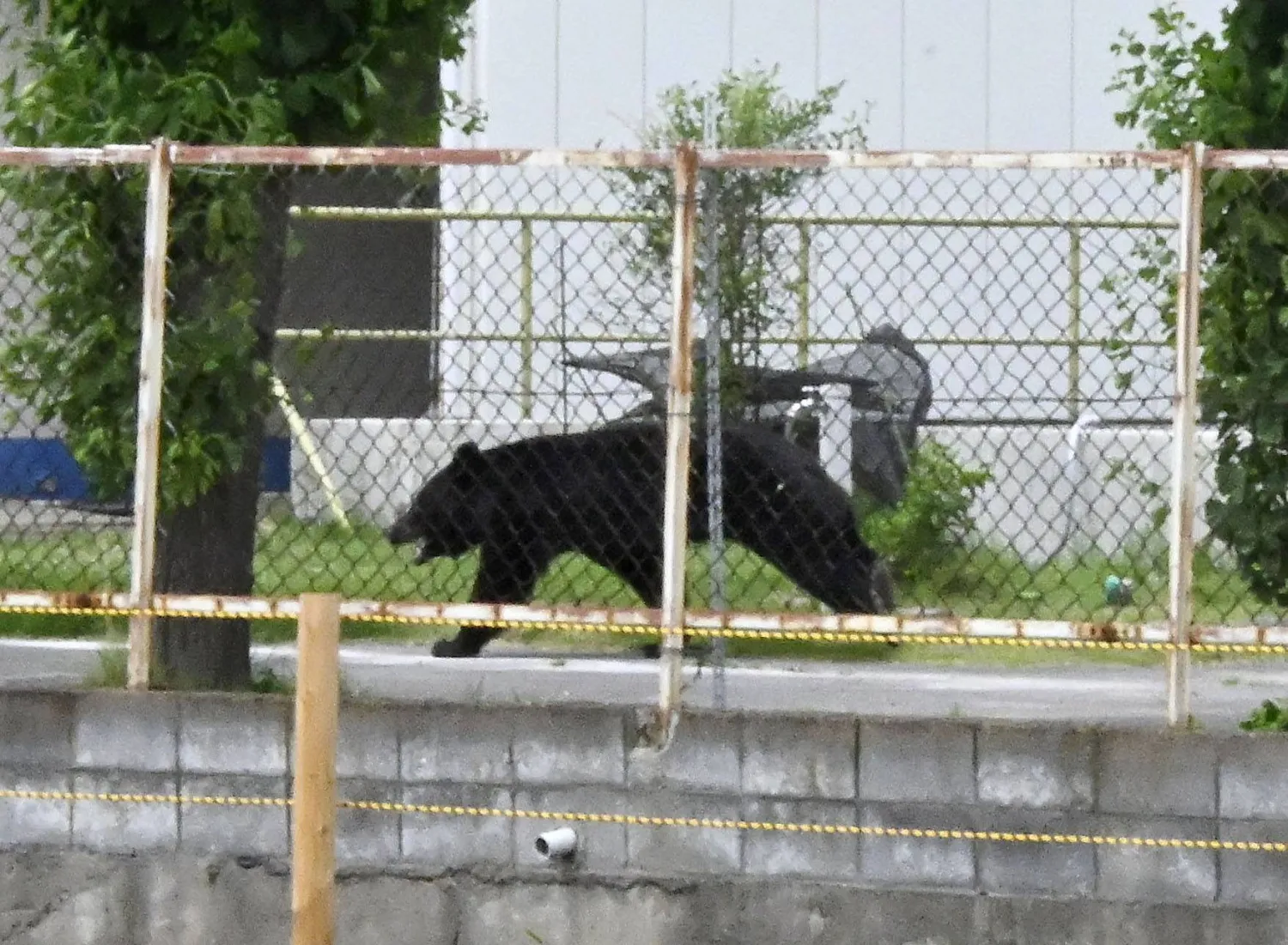



Bear Goes on Rampage in Japan, Injuring Four People

A bear walks on the premises of an office in Fukushima, Japan, Tuesday, June 2, 2026. (Kyodo News via AP)
TT

Bear Goes on Rampage in Japan, Injuring Four People

A bear walks on the premises of an office in Fukushima, Japan, Tuesday, June 2, 2026. (Kyodo News via AP)

A bear attack left four people injured in two factories and a residential area in northern Japan's Fukushima on Tuesday, police and media reports said.

A record 13 people were killed by bears in Japan last year, and there has been a jump in sightings as the animals emerge hungry from hibernation.

"A bear-related human injury incident... occurred in Fukushima City, injuring four people," the prefectural police said in a statement, said AFP.

The bear was first spotted in a car parts factory, prompting an emergency call explaining that "employees had been bitten", the Yomiuri Shimbun daily reported citing police and fire department officials.

As the bear continued its rampage, two other people were injured, one in a residential area and the other on the premises of an electronic equipment manufacturer nearby, the Yomiuri said, adding that the animal was thought to have remained inside the factory.

The report said one of those attacked was heavily injured, while the rest suffered only mild injuries.

In the last fiscal year to March, bear sightings nationwide topped 50,000, more than double the previous record set two years earlier, according to official data.

The animals were seen entering homes, roaming near schools and rampaging through supermarkets and hot spring resorts on an almost daily basis.

Record sightings have been reported again this year as the bears emerge from their winter slumber, according to local media.

In April, bear attacks killed one person and injured five others, according to the environment ministry.

There have also been more than a dozen bear sightings reported on the outskirts of Tokyo this year, with a Russian man in his 30s reportedly mauled as he hiked in the city last month.


Hawaii’s Kilauea Sets Record for Lava Fountaining Episodes in Any 1 Eruption for the Volcano

This image released by the United States Geological Survey shows lava fountains from Kīlauea volcano on Monday, June 1, 2026, in Hawaii. (L. Gallant/USGS via AP)
TT

Hawaii’s Kilauea Sets Record for Lava Fountaining Episodes in Any 1 Eruption for the Volcano

This image released by the United States Geological Survey shows lava fountains from Kīlauea volcano on Monday, June 1, 2026, in Hawaii. (L. Gallant/USGS via AP)

The on-and-off eruption of Hawaii’s Kilauea volcano broke a record Monday with the number of periods it has produced fountains of lava since it began erupting in December 2024, the Hawaiian Volcano Observatory said.

Monday marked 48 fountaining episodes, setting the record for any one eruption on Kilauea, said Katie Mulliken, a geologist and spokesperson with the observatory.

Episodes are separated by periods during which little to no lava erupts. Since lava is coming from the same vents in a crater at Kilauea's summit, it is the same overall eruption, she said in an email.

There are several notable aspects of the current eruption, she said, including how accessible it is for viewing by residents and tourists.

An eruption during the 1980s, in which 47 lava fountaining episodes occurred over about 3 1/2 years, occurred in a more remote area, she said.

The ongoing eruption is also reshaping the topography at the summit, she said.

But the lava fountains also can impact neighboring communities with volcanic fragments and ash, known as tephra.

Kilauea, located on Hawaii’s Big Island, is one of the world’s most active volcanoes.


Fears of Hunger Overwhelm Guatemalan Village as El Nino Approaches

As the drought spreads and forecasts for the El Nino phenomenon grow increasingly bleak, a fear of hunger grips the residents of the Indigenous village of Cunen in northern Guatemala. Johan ORDONEZ / AFP
TT

Fears of Hunger Overwhelm Guatemalan Village as El Nino Approaches

As the drought spreads and forecasts for the El Nino phenomenon grow increasingly bleak, a fear of hunger grips the residents of the Indigenous village of Cunen in northern Guatemala. Johan ORDONEZ / AFP

While drought expands through Cunen as the specter of El Nino climate instability approaches, one fear has seized this indigenous Guatemalan village: death by hunger.

The rains still haven't come here, where local farmers fear the lack of water could ruin the subsistence crops they need to survive.

"If there isn't rain, (the crops) won't come...If there isn't anything we're going to die of hunger," Cecilia Pasa Sarat, a 38-year-old woman who has planted a small amount of corn, told AFP in Xetzac, a village in Cunen.

Cunen is a hard-to-reach mountainous region where the majority of the approximately 47,000 residents are poor, and rely on water from wells that are now going dry.

This village in the Indigenous Maya department of Quiche lays in the heart of the Dry Corridor, an arid mountainous stretch running through Honduras, El Salvador and Nicaragua that's become vulnerable to extreme climatic events.

Quiche was one of Guatemala's most hard-hit regions during the El Nino related food crisis in 2023. Some worry the crisis could return due to a lack of government support.

The phenomenon now fueling local residents' hunger fears occurs every two to six years as part of a natural climatic cycle that affects the surface temperatures on the Pacific Ocean.

It's expected to start between June and August, creating monthslong planetary ripple effects.

- Prolonged damage -

Weeks of drought have desiccated the dusty streets of Xetzac, where the creeks that usually irrigate the town's patchwork of corn, potato, broccoli and bean fields are evaporating under the brutal sun.

Taking refuge in the tree shade where the resin-scent of pines drifts down the hillside, Elvira Pasa says the eventual loss of the village harvests will only end in "hunger."

"We farm, we don't sell it, we just eat it," the 27-year-old community leader and mother of a two and seven-year-old son told AFP.

"Whatever we plant is what we eat. What will happen if it doesn't rain?" 43-year-old Lucia Rojop asks herself.

Her fears are well-founded: around 2.5 million Guatemalans face potential food insecurity due to the drought and the high probability of a powerful El Nino weather cycle.

The Guatemalan government says it has 1.1 million rations ready to distribute in the face of an emergency.

According to experts, the chance that El Nino could spiral into a more dangerous event depends on numerous atmospheric factors.

Governments across the dry countries of Central America raised alert levels over the El Niño phenomenon.

But El Nino isn't the only reason the situation is worsening.

Just in Guatemala, the "dry corridor" expanded from 40 to 160 municipalities since 2004, meaning almost half of the country has been subjected to climate change-fueled drought, according to the government.

El Nino has reduced by half, according to Alex Guerra, the director of the Private Institute for Investigation on Climate Change (ICC).

Cecilia Pasa walks through a puny corn farm, a clear testimony of the drought. "The plants can't take it anymore, the ground is drier, it's not humid anymore like it used to be," she says categorically.

It means that only half of her neighbors planted corn this year. Everyone else, including Catarina Sica, didn't even bother.

"There isn't rain, and the time has passed for us to plant," Sica says while showing the black, white, and yellow seeds still on the cob of corn.

- Migratory impact -

The brutal challenges of working the fields in Cunen, for years, were eased with remittances migrants sent home from the United States. Yet Donald Trump's mass deportations have taken away that support.

Around 24,000 Guatemalans have been deported this year, many from Quiche.

The deportations have paralyzed the construction of homes - the great dream of many migrants - as well as the jobs that go with it.

Families now deal with the crisis by raising pigs, sheep, chickens and turkeys for sale.

Sica's husband returned two years ago after saving enough money to build a concrete house. Now he works occasionally in agriculture, though the $10 daily wage he earns means the family diet is limited to beans, herbs and potatoes, like most locals.

"We're seeing what to do, but it all depends on God," the woman says with resignation.