


Pakistan Limits Outdoor Activities, Market Hours to Curb Air Pollution-Related Illness

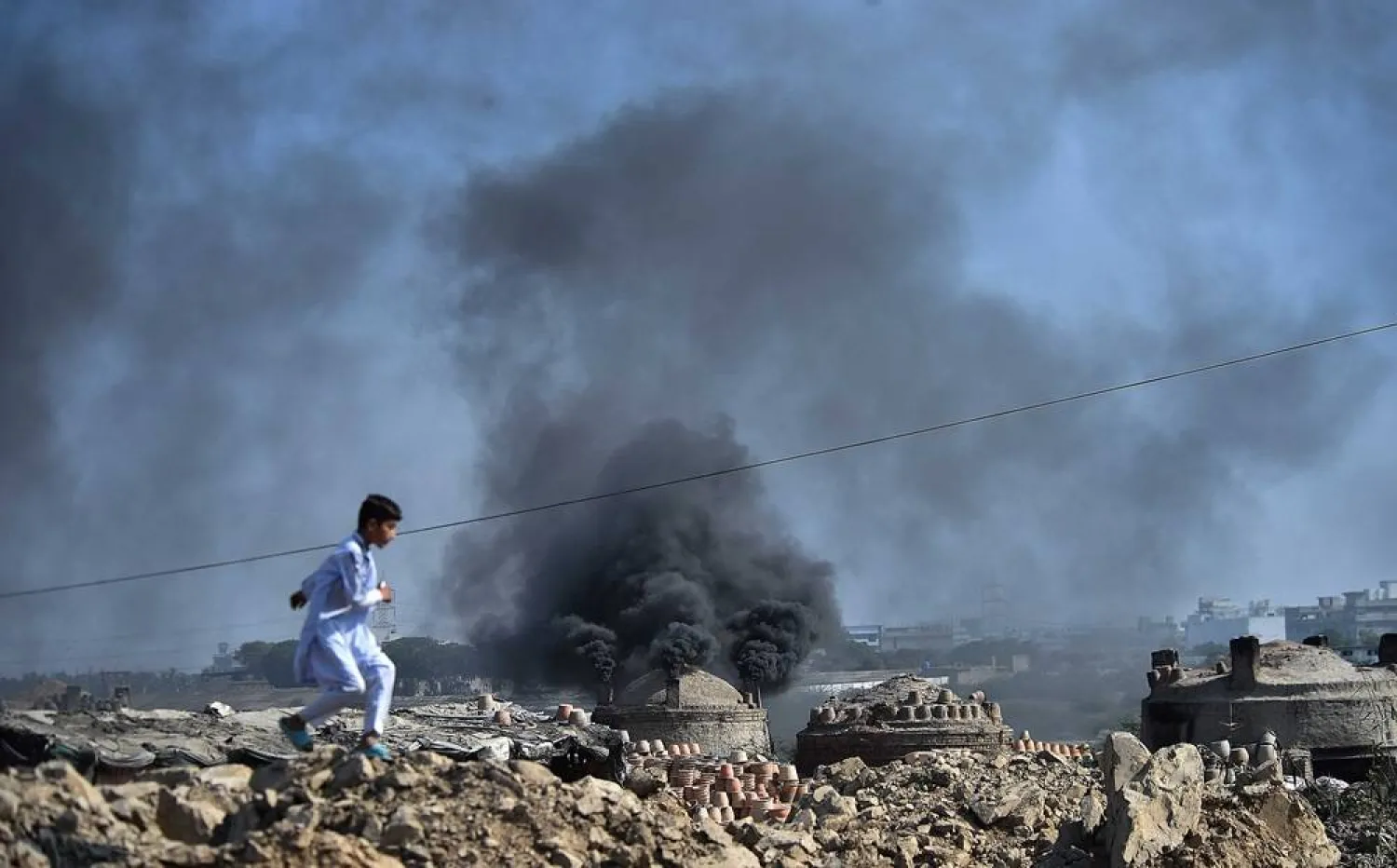
A boy runs as in the background smoke emits from a pottery factory in Karachi, Pakistan, 10 November 2024. (EPA)
TT

Pakistan Limits Outdoor Activities, Market Hours to Curb Air Pollution-Related Illness

A boy runs as in the background smoke emits from a pottery factory in Karachi, Pakistan, 10 November 2024. (EPA)

Pakistan's Punjab province banned most outdoor activities and ordered shops, markets and malls in some areas to close early from Monday to curb illnesses caused by intense air pollution.

The province has closed educational institutions and public spaces like parks and zoos until Nov. 17 in places including Lahore, the world's most polluted city in terms of air quality, according to Swiss group IQAir's live ratings.

The districts of Lahore, Multan, Faisalabad and Gujranwala have seen an unprecedented rise in patients with respiratory diseases, eye and throat irritation, and pink eye disease, the Punjab government said in an order issued late on Sunday.

The new restrictions will also remain in force until Nov. 17.

"The spread of conjunctivitis/ pink eye disease due to bacterial or viral infection, smoke, dust or chemical exposure is posing a serious and imminent threat to public health," the Punjab government said.

While outdoor activities including sports events, exhibitions and festivals, and dining at restaurants have been prohibited, "unavoidable religious rites" are exempt from this direction, the order said.

Outlets like pharmacies, oil depots, dairy shops and fruit and vegetable shops have similarly been exempted from the directions to close by 8 p.m. local time.

Lahore's air quality remained hazardous on Monday, with an index score of more than 600, according to IQAir, but this was significantly lower than the 1,900 that it touched in places earlier this month.

A score of 0-50 is considered good.

UNICEF on Monday also called for greater efforts to reduce pollution and protect children's health in Punjab, saying that more than 11 million children under five years of age are in danger as they breathe the toxic air.

"In addition, schools in smog-affected areas have been closed...the learning of almost 16 million children in Punjab has been disrupted," said Abdullah Fadil, UNICEF Representative in the country.

"Pakistan, already in the grips of an education emergency...cannot afford more learning losses," he said.

Several parts of South Asia are engulfed by a toxic haze each winter as cold air traps dust, emissions and smoke from farm fires.

Punjab has blamed its toxic air this year on pollution wafting in from India, where northern parts have also been battling hazardous air, and has said it will take the issue up with the neighboring country through its foreign ministry.

India's Supreme Court on Monday directed the Delhi government to decide by Nov. 25 on imposing a perpetual ban on firecrackers, legal news portal Bar and Bench reported.

Firecrackers set off by revelers on Diwali, the Hindu festival of lights celebrated on Oct. 31 this year despite a ban, have aggravated the region's pollution problem.



NASA Delivers Harsh Assessment of Botched Boeing Starliner Test Flight

NASA duo Butch Wilmore and Suni Williams were stuck on the ISS for nine months. Handout / NASA TV/AFP/File
TT

NASA Delivers Harsh Assessment of Botched Boeing Starliner Test Flight

NASA duo Butch Wilmore and Suni Williams were stuck on the ISS for nine months. Handout / NASA TV/AFP/File

NASA on Thursday blamed what it called engineering vulnerabilities in Boeing's Starliner spacecraft along with internal agency mistakes in a sharply critical report assessing a botched mission that left two astronauts stranded in space.

The US space agency labeled the 2024 test flight of the Starliner capsule a "Type A" mishap -- the same classification as the deadly Challenger and Columbia shuttle disasters -- a category that reflects the "potential for a significant mishap," it said.

The failures left a pair of NASA astronauts stranded aboard the International Space Station for nine months in a mission that captured global attention and became a political flashpoint.

"Starliner has design and engineering deficiencies that must be corrected, but the most troubling failure revealed by this investigation is not hardware. It's decision-making and leadership," said NASA administrator Jared Isaacman in a briefing.

"If left unchecked," he said, this mismanagement "could create a culture incompatible with human spaceflight."

The top space official said the investigation found that a concern for the reputation of Boeing's Starliner clouded an earlier internal probe into the incident.

"Programmatic advocacy exceeded reasonable bounds and place the mission, the crew and America's space program at risk in ways that were not fully understood at the time," Isaacman said.

He said Starliner currently "is less reliable for crew survival than other crewed vehicles" and that "NASA will not fly another crew on Starliner until technical causes are understood and corrected" and a problematic propulsion system is fixed.

But the administrator insisted that "NASA will continue to work with Boeing, as we do all of our partners that are undertaking test flights."

In a statement, Boeing said it has "made substantial progress on corrective actions for technical challenges we encountered and driven significant cultural changes across the team that directly align with the findings in the report."

- 'We failed them' -

Isaacman also had harsh words for internal conduct at NASA.

"We managed the contract. We accepted the vehicle, we launched the crew to space. We made decisions from docking through post-mission actions," he told journalists.

"A considerable portion of the responsibility and accountability rests here."

In June 2024 Butch Wilmore and Suni Williams embarked on what was meant to be an eight-to-14-day mission. But this turned into nine months after propulsion problems emerged in orbit and the Starliner spacecraft was deemed unfit to fly them back.

The ex-Navy pilots were reassigned to the NASA-SpaceX Crew-9 mission. A Dragon spacecraft flew to the ISS that September with a team of two, rather than the usual four, to make room for the stranded pair.

The duo, both now retired, were finally able to arrive home safely in March 2025.

"They have so much grace, and they're so competent, the two of them, and we failed them," NASA associate administrator Amit Kshatriya told Thursday's briefing.

"The agency failed them."

Kshatriya said the details of the report were "hard to hear" but that "transparency" was the only path forward.

"This is not about pointing fingers," he said. "It's about making sure that we are holding each other accountable."

Both Boeing and SpaceX were commissioned to handle missions to the ISS more than a decade ago.


Abandoned Baby Monkey Finds Comfort in Stuffed Orangutan

A baby Japanese macaque named Punch sits next to a stuffed orangutan at Ichikawa City Zoo, in Ichikawa, Chiba Prefecture, Japan, February 19, 2026. REUTERS/Kim Kyung-Hoon
TT

Abandoned Baby Monkey Finds Comfort in Stuffed Orangutan

A baby Japanese macaque named Punch sits next to a stuffed orangutan at Ichikawa City Zoo, in Ichikawa, Chiba Prefecture, Japan, February 19, 2026. REUTERS/Kim Kyung-Hoon

At a zoo outside Tokyo, the monkey enclosure has become a must-see attraction thanks to an inseparable pair: Punch, a baby Japanese macaque, and his stuffed orangutan companion.

Punch's mother abandoned the macaque when he was born seven months ago at the Ichikawa City Zoo and when an onlooker noticed and alerted zookeepers, they swung into action.

Japanese baby macaques typically cling to their mothers to build muscle strength and for a ‌sense of security, ‌so Punch needed a swift intervention, zookeeper ‌Kosuke ⁠Shikano said. The keepers ⁠experimented with substitutes including rolled-up towels and other stuffed animals before settling on the orange, bug-eyed orangutan, sold by Swedish furniture brand IKEA.

“This stuffed animal has relatively long hair and several easy places to hold," Shikano said. "We thought that its resemblance to a monkey might help ⁠Punch integrate back into the troop later ‌on, and that’s why ‌we chose it."

Punch has rarely been seen without it since, ‌dragging the cuddly toy everywhere even though it is ‌bigger than him, and delighting fans who have flocked to the zoo since videos of the two went viral, Reuters reported.

“Seeing Punch on social media, abandoned by his parents but still trying ‌so hard, really moved me," said 26-year-old nurse Miyu Igarashi. "So when I got the ⁠chance to ⁠meet up with a friend today, I suggested we go see Punch together.”

Shikano thinks Punch's mother abandoned him because of the extreme heat in July when she gave birth.

Punch has had some differences with the other monkeys as he has tried to communicate with them, but zookeepers say that is part of the learning process and he is steadily integrating with the troop.

"I think there will come a day when he no longer needs his stuffed toy," Shikano said.


Trump Says he’s Ordering Release of Data on UFOs, Aliens

US President Donald Trump speaks aboard Air Force One (AP)
TT

Trump Says he’s Ordering Release of Data on UFOs, Aliens

US President Donald Trump speaks aboard Air Force One (AP)

US President Donald Trump said on Thursday he is ordering federal agencies to begin “identifying and releasing” government files related to UFOs and aliens, a move sought for decades by some Americans.

“Based on the tremendous interest shown, I will be directing the Secretary of War, and other relevant Departments and Agencies, to begin the process of identifying and releasing Government files related to alien and extraterrestrial life, unidentified aerial phenomena (UAP), and unidentified flying objects (UFOs),” Trump posted on his Truth Social platform.

Trump claimed earlier Thursday that his predecessor, former President Barack Obama, made classified information public when he confirmed the existence of extraterrestrial life.

“He gave classified information. He's not supposed to be doing that,” he told reporters on Air Force One. “He made a big mistake.”

During an ⁠interview with podcast host Brian Tyler Cohen released ‌on Saturday, Obama was asked if aliens were real.

“They're real, but I haven't seen them, and they're not being kept in ... Area 51. There's no underground facility unless there's this enormous conspiracy and they hid it from the president of the United States,” Obama said.

Area ⁠51 is a classified Air Force facility in Nevada that fringe theorists have speculated holds alien bodies and a crashed spaceship. CIA archives released in 2013 said it was a test site for top-secret spy planes.

“I saw no evidence during my presidency that extraterrestrials have made contact with us. Really!” Obama said in an Instagram post on Sunday.

In the post, Obama explained his belief that aliens exist by saying the statistical odds of life beyond Earth were high because the universe is so ⁠vast. He added that the chances of extraterrestrial life visiting Earth were low given the distance.

Following his comments ⁠on Obama, Trump added that he had not seen evidence that aliens exist, saying, “I don't know ⁠if they're ⁠real or not.”