119-year-old Brazilian Woman Stakes Claim as World's Oldest Person

Deolira Gliceria Pedro da Silva, 119, sits in her house in Itaperuna, Rio de Janeiro state, Brazil, January 14, 2025. REUTERS/Ricardo Moraes
TT

119-year-old Brazilian Woman Stakes Claim as World's Oldest Person

Deolira Gliceria Pedro da Silva, 119, sits in her house in Itaperuna, Rio de Janeiro state, Brazil, January 14, 2025. REUTERS/Ricardo Moraes

Two months away from what she says is her 120th birthday, Deolira Gliceria Pedro da Silva, a great-grandmother from the state of Rio de Janeiro in Brazil is rushing to be recognized as the world’s oldest living person by the Guinness World Records.

The institution currently features another Brazilian, Inah Canabarro Lucas, a nun from the southern state of Rio Grande do Sul as the oldest living person at 116 years, but Deolira’s family and doctors are confident that she will soon take the religious woman’s title.

“She is still not in the book, but she is the oldest in the world according to the documents we have on her, as I recently discovered,” said Deolira’s granddaughter Doroteia Ferreira da Silva, who is half her age, Reuters reported.

The documents show that Pedro da Silva was born on March 10th 1905 in the rural area of Porciuncula, a small town in the state of Rio. She now lives in a colorfully painted house in Itaperuna, where her two granddaughters Doroteia, 60, and Leida Ferreira da Silva, 64, take care of her.

The grandmother is also supervised by doctors and researchers who are interested in how she outlived the average life expectancy in Brazil, which currently sits at 76.4 years, by more than four decades.

“Mrs. Deolira, in 2025, will be 120 years old. She is in a good general state of health for her condition, she is not taking any medication,” said geriatric doctor Juair de Abreu Pereira, who checks up on Pedro da Silva frequently and is assisting her family in the process with Guinness World Records.

In a statement, Guinness said it couldn't confirm receiving Pedro da Silva's application, because it receives many from people around the world who claim to be the oldest living person.

Major floods in the region almost twenty years ago destroyed most of Deolira’s original documents, her doctor said. That may pose a challenge for the official recognition of her age.

Even if her age is not precise, Pedro da Silva is certainly older than 100 years, according to Mateus Vidigal, a researcher at the University of Sao Paulo who has studied her case as part of a project to understand the super elderly population of Brazil.

“Mrs. Deolira has not been excluded from the study, but there is this fragility which is the lack of documentation that is approved by those organizations,” Vidigal said, referring to vetting institutions such as the Guinness World Records.

Pedro Silva’s healthy diet and sleeping habits are key to her longevity, according to Dr. Pereira. To this day, she has a good interaction with her family and likes eating bananas.

“I wish I could get to her age and be like that,” Ferreira da Silva, her granddaughter, said. “While we have high blood pressure and diabetes, she does not have any of that.”


There are no sudden countries.

Diriyah Biennale Foundation logo
TT

There are no sudden countries.

Diriyah Biennale Foundation logo

Donya Abdulhadi

Executive Director, Marketing, Communication and Strategic Partnerships

Diriyah Biennale Foundation

A slow-moving convoy is led through Wadi Hanifa towards the JAX District — a scene that merges heritage and natural landscape, pulsating with eager expression. Across the valley floor, vintage and new pickup trucks release their brakes and begin to slowly move after sunset, accompanied by camels and their handlers, clapping rhythmically, keeping movement paced and deliberate. The procession begins, as viewers watch in anticipation as it advances to where the Wadi ends and the district begins, culminating in its merging with hundreds of people in collective celebration, Saudi and non-Saudi communities alike, at the doors of the third edition of the Diriyah Contemporary Art Biennale.

This performative scene, led by Saudi artist 7amdan, in the heart of Diriyah, known as the birthplace of the Saudi state, is not only symbolic, but diagnostic. To understand Saudi Arabia today — its acceleration, its ambition and its demographic shifts — one must see it as continuation, rather than sudden rupture.

Yet, discourse about transformation in the Arab world often fixates on politics and economic output. Against this backdrop, what is frequently overlooked is the cultural practices that make nation-scale change sustainable. The seemingly “sudden” revival of old cities, the creation of new ones, the inward migration of talent, policy reforms and the announcements of investments have been the primary scenes driving international understandings of Saudi Arabia’s transformation. Yet, the opportunity to more accurately read this change as a part of a much larger, rhythmic “procession,” is laid bare.

The Diriyah Contemporary Art Biennale, conceived by the Diriyah Biennale Foundation, artistically directed by Nora Razian and Sabih Ahmed and titled In Interludes and Transitions, adopts procession as its opening metaphor. In Arab contexts, processions are often reduced to ritual display — pilgrims moving in unison, caravans crossing deserts, ceremonial marches through city streets. But procession has never been mere spectacle. It is infrastructure: the mechanism through which trade, belief, labor, and knowledge moved across terrain..

For centuries, the Arabian Peninsula has functioned as a corridor: between East Africa and South Asia, between the Mediterranean and the Indian Ocean, between desert interiors and maritime routes. Trade, pilgrimage, seasonal migration, and the circulation of stories formed moving networks long before oil supported economic growth. Procession was not only physical movement; it has been the layering of skills, dialects, value systems, commercial and cultural practices across generations.

That pattern continues today, if in intensified form.

Today, Saudi Arabia is growing into one of the most demographically dynamic countries in the region. Expatriates constitute a ‘minority’ of more than 13 million residents — over 30% of the population — according to the Saudi General Authority for Statistics. These are not marginal, cosmetic figures; they reflect not temporary labor influx but a structural condition in which cross-border movement is foundational to the Kingdom’s social and economic architecture.

But migration is at times framed as sudden, episodic, even opportunistic — as individuals arriving to capitalize on growth or regulatory reform — when a more accurate reading is coordinated movement at scale: capital, labor, and expertise advancing in waves.

Consider the economic transformation underway. Saudi Arabia’s Vision 2030 has committed hundreds of billions of dollars toward diversification — tourism, logistics, renewable energy, entertainment, advanced manufacturing. The non-oil sector now contributes more than 50% of Saudi GDP. Crossing this threshold marks not diversification in theory, but a measurable shift in the engine of national growth from extractive dependence to multi-sector productivity. These figures signal structural and collective reorientation rather than incremental reform.

Procession in this region has in fact always been collective. Trade caravans moved in formation; pilgrimages operated in waves; ports thrived because of overlapping routes. Contemporary economic development follows a similar logic of embeddedness: partnerships with local entities, alignment with national transformation agendas, and participation in sectors are not bureaucratic formalities, but the modern equivalent of traveling in convoy.

Procession carries memory and implies sequencing. The region’s openness to global capital is not cultural amnesia; it is consistent with centuries of exchange. Riyadh’s rapid urban transformation is layered atop older routes. Reforms are phased, sector-specific, and often geographically concentrated. Nation-scale projects like Diriyah operate as critical nodes in a larger movement of urban and economic reconfiguration, designed to continue to attract long-term talent and capital. The labor statistics reinforce this. The volume of movement reflects systemic reliance on cross-border mobility instead of temporary flux.

Procession also implies visibility. In a caravan, each participant is seen, and reputation travels quickly. Trust, responsibility and credible contribution to collective goals matter. The region’s economic model, while globally integrated, remains relational at its core.

Like all changes, transformation is not frictionless. Regulatory frameworks evolve. Processions can re-route. Those looking to understand its transformation must recognize that the route is dynamic. Short-term extraction strategies — arrive, profit, exit — misread the scale of transformation underway.

The Biennale’s invocation of interludes and transitions offers a useful corrective to simplistic growth narratives. Saudi Arabia is not simplistically in acceleration; it moves through phases: consolidation, experimentation, recalibration. Periods of pause, regulatory and fiscal review and project restructuring might appear as reversals, but are actually interludes that prepare for the next transition.

Transformation here is neither chaotic nor accidental, but sequenced. It advances in steps, sometimes rapid, sometimes measured, but rarely isolated. Those who understand the rhythm of that movement participate in its momentum.

Procession, then, is not poetic flourish. It is a practical framework of reading change. In Saudi Arabia today, transformation moves in procession. The question is not whether it is occurring, but how attentively one reads its cadence and moves within it.



Stranded Whale Frees Itself Again Off German Coast and Disappears

Seagulls fly above a humpback whale that managed to free itself overnight from a sandbank in shallow waters of Wismar Bay in the Baltic Sea, near Wismar, Germany March 31, 2026. REUTERS/Annegret Hilse
TT

Stranded Whale Frees Itself Again Off German Coast and Disappears

Seagulls fly above a humpback whale that managed to free itself overnight from a sandbank in shallow waters of Wismar Bay in the Baltic Sea, near Wismar, Germany March 31, 2026. REUTERS/Annegret Hilse

A humpback whale struggling in shallow waters off Germany's northern Baltic Sea coast has freed itself for a third time and has now disappeared, a police spokesman told AFP Tuesday.

"The whale seems to have left Wismar. However, there have been no sightings so far," the spokesman for the city's water police said.

The 13.5-meter (44-foot) long animal has been struggling in shallow waters in the area for more than a week, having first been spotted in the early hours of March 23 near the city of Luebeck.

It managed to free itself from a sandbank there but ran into further difficulty after swimming east.

It twice became stuck on sandbanks close to the city of Wismar and over the weekend experts warned that its breathing rate had reduced.

Nevertheless experts hope that the whale may be able to make it back to its natural habitat in the Atlantic Ocean.

Speaking on ZDF television on Monday, marine biologist and rescue coordinator Burkard Baschek said the lack of sightings was a good sign.

"We haven't received any further reports so far, which is good," he said, adding: "We can now only hope that it will eventually manage to make it under its own steam."

The whale is believed to be suffering from skin problems due to the lower level of salt content in the Baltic Sea compared to the open ocean.

It is possible the whale came into the Baltic following a shoal of fish or having been distracted by the noise of a submarine.


India to Begin World’s Biggest Population Count

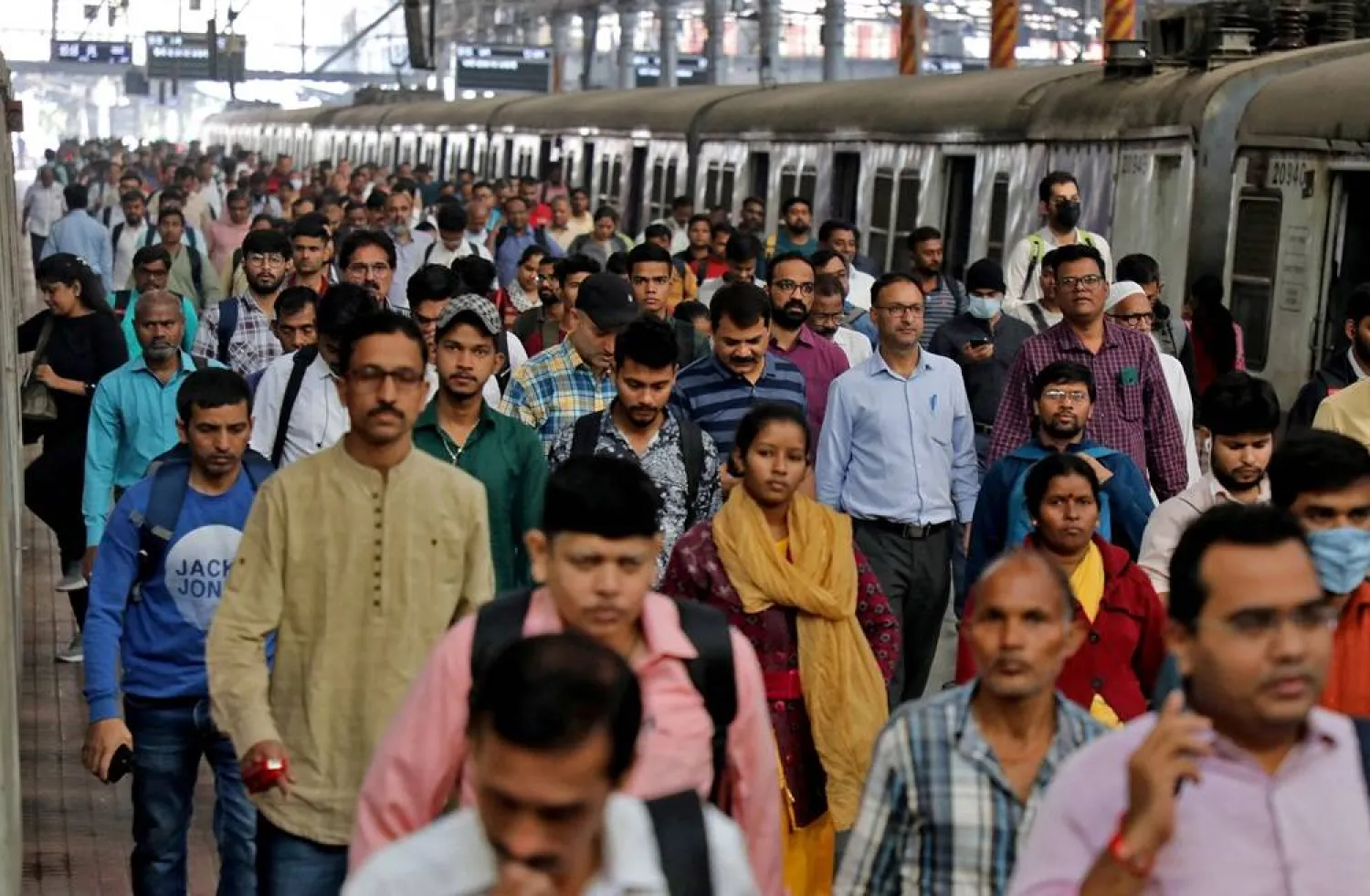
Commuters walk on a platform after disembarking from a suburban train at a railway station in Mumbai, India, January 21, 2023. (Reuters)
TT

India to Begin World’s Biggest Population Count

Commuters walk on a platform after disembarking from a suburban train at a railway station in Mumbai, India, January 21, 2023. (Reuters)

India will launch the world's largest census on Wednesday, with more than three million officials to take part in a vast counting exercise over the next year.

The South Asian nation, home to an estimated 1.4 billion people, faces mounting challenges in providing electricity, food and housing to its growing population.

Many of its sprawling megacities are already grappling with water shortages, air and water pollution, and overcrowded slums.

India's government calls the $1.24 billion count a "gigantic exercise of national importance" that could support "inclusive governance and evidence-based policy formulation".

The enumeration will also include the politically sensitive issue of caste, the millennia-old social hierarchy that divides Hindus by function and social standing.

The upcoming census presents a formidable logistical challenge. India's 2024 general election, the largest democratic exercise in history, was conducted in seven phases over six weeks.

The census will be carried out in two phases.

The first phase, beginning Wednesday and running until September, will involve a staggered, month-long enumeration to record details of housing and amenities.

The process will combine door-to-door visits with an option for online self-enumeration, linking to an app drawing on satellite imagery and available in 16 languages.

A second phase will focus on population data including demographic, social and economic details as well as the more contentious question of caste.

Caste remains a powerful determinant of social status in India, shaping access to resources, education and opportunity.

A caste survey conducted in 2011 was never published, with authorities citing inconsistencies in the data.

The last time comprehensive caste data was collected as part of a census was in 1931, under British colonial rule.

Governments since resisted updating the data, citing administrative complexity and concerns over potential social tensions.

For most of the country, population enumeration will take place in the weeks leading up to the reference date of March 1, 2027.

In high-altitude Himalayan regions -- including the disputed territory of Jammu and Kashmir -- it will take place ahead of October 1, 2026, before snowfall begins.

India has not conducted a census since 2011, after the 2021 round was delayed by the Covid-19 pandemic.

According to the last census, India's population was 1.21 billion.

In 2023, the United Nations estimated that India had surpassed China to become the world's most populous country, with more than 1.42 billion people.