
Syrians Chase Equestrian Glory in Sport Once Dominated by Assads

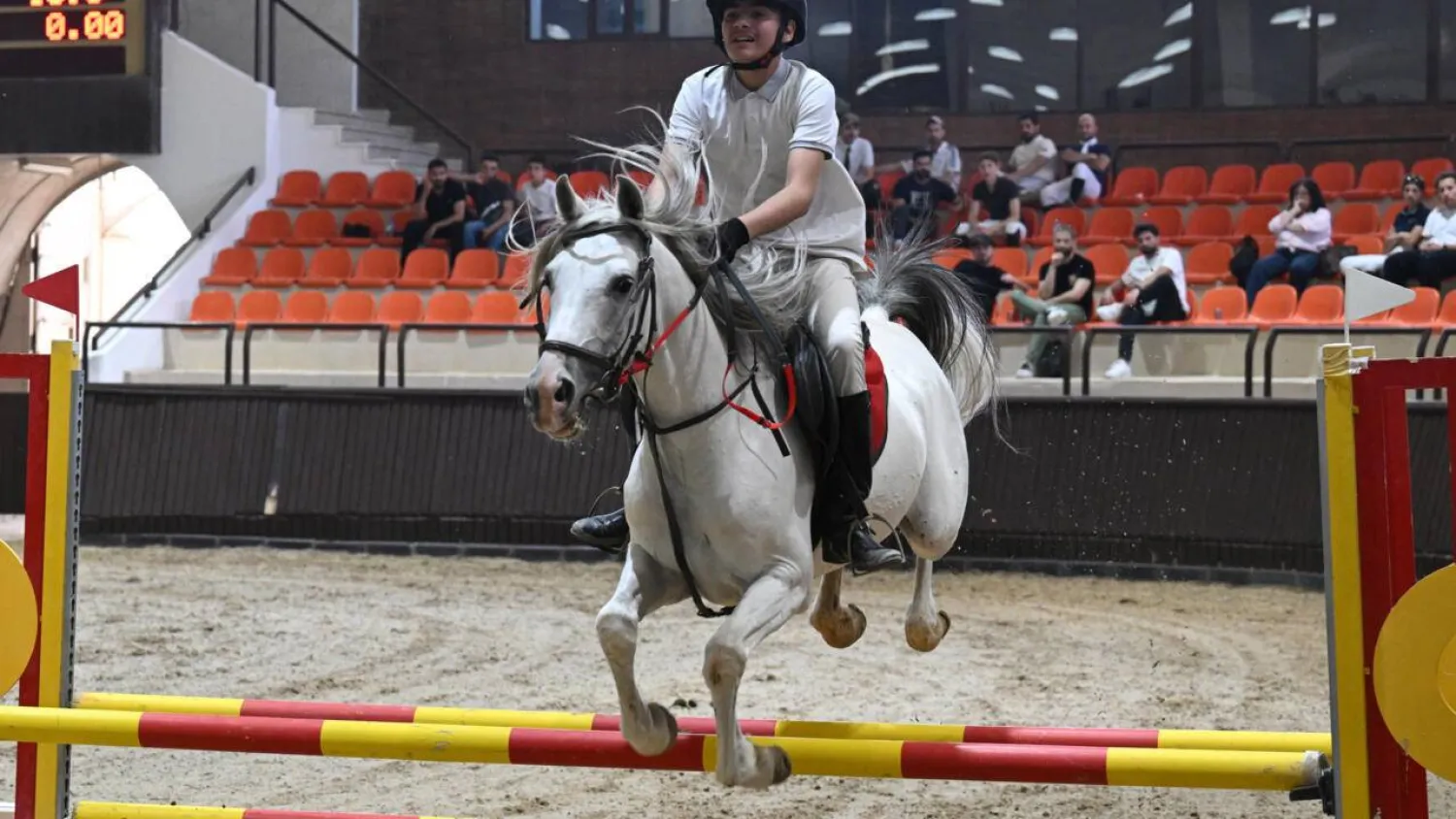
A rider competes at the Al-Nasr Equestrian Show Jumping Championship in Dimas, northwest of Damascus. LOUAI BESHARA / AFP
TT

Syrians Chase Equestrian Glory in Sport Once Dominated by Assads

A rider competes at the Al-Nasr Equestrian Show Jumping Championship in Dimas, northwest of Damascus. LOUAI BESHARA / AFP

For weeks, Ziad Abu al-Dahab has been training for gold at an equestrian tournament near Damascus -- in a sport once dominated by Syria's Assad family and their inner circle.

"Results used to be decided in advance, always favoring those close to the government," the 25-year-old rider said.

"My greatest ambition was to reach third place, but today, I can aim for first and do well with my new horse."

For decades, former president Bashar al-Assad, his relatives and allies enjoyed wide-ranging privileges before his overthrow in a lightning offensive in December.

Equestrian sports surged in the 1990s under Assad's late brother Bassel, who was being groomed to succeed their father Hafez before dying in a car crash in 1994. Bashar took over and became president in 2000.

Bassel used to take part in tournaments at home and abroad and styled himself as Syria's "first rider".

His profile helped shine a spotlight on the sport, which came to symbolize elite status under the Assads.

Abu al-Dahab said those close to the family had European horses, which far outperformed the local ones of other competitors.

"It was impossible to compete with the ruling family," he said while walking his horse on the sand.

Impossible competition

Outside the Dimas equestrian club near Damascus, a statue of Bassel still stands, his face now hidden by the new Syrian flag.

The family's grip on the sport passed to the next generation, including Sham, daughter of Bashar's brother Maher.

Sham used to compete in Syria and at international tournaments, often placing high.

The attention she received in the media stirred controversy, with critics seeing it as propaganda.

That grip on the sport kept some away. Munana Shaker, 26, said her father banned her from competing until the Assads were gone.

"My father forbade me from practicing due to fear (of the ruling family), and he always told me that competition with them was impossible," she said as she stroked her white mare, Mariana.

"He didn't want us associating with the Assad family at all. He told me the story of the equestrian who was jailed after beating Bassel al-Assad, and did not want to put me in danger."

She was referring to Adnan Qassar, a prominent rider who outperformed Bassel before being imprisoned without trial in 1993, accused of plotting to kill him.

Many believe his sporting success was the real reason for his arrest. Qassar was freed 21 years later under a presidential pardon.

"I have long stayed away from this sport, but it is now time to come back strong. I am from the Shaker family, not the Assad family," she said.

'Dream come true'

Shadi Abu al-Dahab, 48, oversees about 240 horses -- including some of the Assads' former European ones.

"Around 40 horses were set aside for the Assad family. No one else was allowed to get near them," he said.

But today, he's seeing new faces and growing interest in the sport.

"We have new skills that we discover daily, and enthusiastic children... We now have a large number of riders aspiring to compete and get titles," he said.

Fellow trainer Salah al-Ahmad, 52, was beaming as his son took the mare Topsy for a spin -- once ridden by Sham al-Assad.

"He used to dream of touching her or patting her head," Ahmad said. "Now in this new era, the mare is with him, and he has won two tournaments.

"It's a dream come true."


Jazan Festival 2026 Kicks Off Thursday with Grand Parade

his year’s festival offers an unprecedented experience that brings together the charm of the region’s unique geographic diversity - SPA
TT

Jazan Festival 2026 Kicks Off Thursday with Grand Parade

his year’s festival offers an unprecedented experience that brings together the charm of the region’s unique geographic diversity - SPA

The Jazan Festival 2026 will launch on Thursday in a carnival anticipated by thousands of visitors from within the region and beyond.

The festival will open with a grand celebratory parade starting at 3:45 p.m. along the Jazan city waterfront, signaling the start of an entertainment and cultural season that will extend for several months, according to SPA.

This year’s festival offers an unprecedented experience that brings together the charm of the region’s unique geographic diversity, from its towering green mountains and golden beaches to its picturesque islands, alongside the authenticity of its rich heritage, complemented by modern touches in entertainment programs designed to meet the aspirations of all age groups.

Performing arts inspired by local folklore will add an authentic dimension, while moving installations will flow in harmonious rhythm.

Completing the visual spectacle, integrated light and sound shows will create an enchanting atmosphere before the festivities conclude with a dazzling fireworks display lighting up the Jazan sky in vibrant colors.


Russia Plans a Nuclear Power Plant on the Moon within a Decade

November's full moon, also known as Beaver Moon, rises over Fort-de-France in the French overseas island of Martinique, on November 5, 2025. (AFP)
TT

Russia Plans a Nuclear Power Plant on the Moon within a Decade

November's full moon, also known as Beaver Moon, rises over Fort-de-France in the French overseas island of Martinique, on November 5, 2025. (AFP)

Russia plans to put ​a nuclear power plant on the moon in the next decade to supply its lunar space program and a joint Russian-Chinese research station as major powers rush to explore the earth's only natural satellite.

Ever since Soviet cosmonaut Yuri Gagarin became the first human to go into space in 1961, Russia has prided itself as ‌a leading power in ‌space exploration, but in recent ‌decades ⁠it ​has fallen ‌behind the United States and increasingly China.

Russia's ambitions suffered a massive blow in August 2023 when its unmanned Luna-25 mission smashed into the surface of the moon while attempting to land, and Elon Musk has revolutionized the launch of space vehicles - once a Russian specialty.

Russia's state space corporation, Roscosmos, ⁠said in a statement that it planned to build a lunar power ‌plant by 2036 and signed a contract ‍with the Lavochkin Association ‍aerospace company to do it.

Roscosmos said the purpose of ‍the plant was to power Russia's lunar program, including rovers, an observatory and the infrastructure of the joint Russian-Chinese International Lunar Research Station.

"The project is an important step towards the creation of ​a permanently functioning scientific lunar station and the transition from one-time missions to a long-term lunar exploration program," ⁠Roscosmos said.

Roscosmos did not say explicitly that the plant would be nuclear but it said the participants included Russian state nuclear corporation Rosatom and the Kurchatov Institute, Russia's leading nuclear research institute.

The head of Roscosmos, Dmitry Bakanov, said in June that one of the corporation's aims was to put a nuclear power plant on the moon and to explore Venus, known as earth's "sister" planet.

The moon, which is 384,400 km (238,855 miles) from our planet, moderates the earth's wobble ‌on its axis, which ensures a more stable climate. It also causes tides in the world's oceans.


Seasonal Rains Transform Saudi Arabia’s Rawdat Muhanna into Natural Lake

People visit Rawdat Muhanna after recent rainfall. (SPA)
TT

Seasonal Rains Transform Saudi Arabia’s Rawdat Muhanna into Natural Lake

People visit Rawdat Muhanna after recent rainfall. (SPA)

Rawdat Muhanna, or Muhanna's Garden, located near the town of Al-Nabqiyah in the eastern part of Saudi Arabia’s Qassim region, has witnessed a notable influx of visitors and picnickers in recent days following rainfall that filled the Rawdat with water, transforming it into a vast natural lake.

The rare and striking scene has drawn residents and visitors from within and outside the region, reported the Saudi Press Agency on Tuesday.

Stretching over more than 10 kilometers, Rawdat Muhanna has become a breathtaking natural landscape amid the sands of Al-Thuwairat. The contrast between the blue waters and the red desert sand has created a picturesque panorama, making the site a favored destination for nature enthusiasts and photographers.

Rawdat Muhanna is one of the region’s prominent seasonal parks, as several valleys flow into it, most notably Wadi Al-Mustawi. These valleys contribute to the accumulation of large volumes of water, which in some seasons can remain for nearly a year, boosting the site’s ecological value and making it one of the most beautiful natural areas in the Qassim desert.

Visitors said Rawdat Muhanna has become an ideal destination for outdoor recreation and relaxation.